
What should a brooklyn tech startup IP theft investigation establish before anyone changes access, devices, or files? A suspicious download or employee departure may raise a legitimate concern, but neither shows by itself what information was copied, who accessed it, or why. Acting before defining the inquiry can also change digital information that may help explain what happened.
For a startup with limited in-house investigative capacity, the first step is to turn the concern into specific questions. Identify the information involved, where it is stored, which systems or users may be relevant, and what period to examine. Then assess available activity in context, without assuming that an unusual event proves misconduct.
This guide explains how to scope an inquiry around a startup’s systems and operations, which information may be relevant, and how computer forensics and corporate investigation can contribute to fact-based findings. Those findings can help company leaders decide what to discuss with legal counsel and how to proceed without unnecessarily disrupting the business.
Key Takeaways
- Assess possible unauthorized access, copying, use, or disclosure without treating suspicion as proof of misconduct.
- A brooklyn tech startup IP theft investigation can define the information, systems, users, and time period relevant to the concern.
- Compare an internal review, computer forensic analysis, and a broader corporate investigation to match the scope to the business question.
- Document how the concern surfaced and which business records may help focus the inquiry.
- Use computer forensics and corporate investigation to develop findings for company leaders to discuss with legal counsel.
Why a Brooklyn Tech Startup May Need an IP Theft Investigation
A technology startup’s valuable business information may include software, product concepts, technical methods, or customer records. Suspected IP theft refers to possible unauthorized access to, copying, use of, or disclosure of confidential business information. The distinction matters: an unusual event can warrant examination, but it does not establish that information was taken or that anyone acted improperly.
Potential business effects include a loss of competitive advantage, uncertainty about who can access sensitive material, and disruption to product or client work. A focused inquiry helps a Brooklyn company examine a defined concern without treating routine system activity as proof or expanding an initial question into a review of the entire business. The broader category of Intellectual Property Infringement includes different forms of unauthorized use. An investigation should identify the specific information and conduct at issue.
Which startup information may warrant investigation?
Describe the material in practical terms: what it is, who owns or developed it, how the business uses it, and where it is stored. Examples include source code in a development repository, product designs in shared project files, internal technical documents, or client data in business systems. These are examples of information to consider, not evidence that a particular incident occurred.
Separate material the company treats as confidential from information that is public or routinely shared with customers, vendors, or partners. A document’s sensitivity depends on its contents and business use, not just its file name. Identifying relevant versions, repositories, folders, or records makes the concern more precise and helps keep unrelated routine work outside the inquiry.
When does a concern become an investigative question?
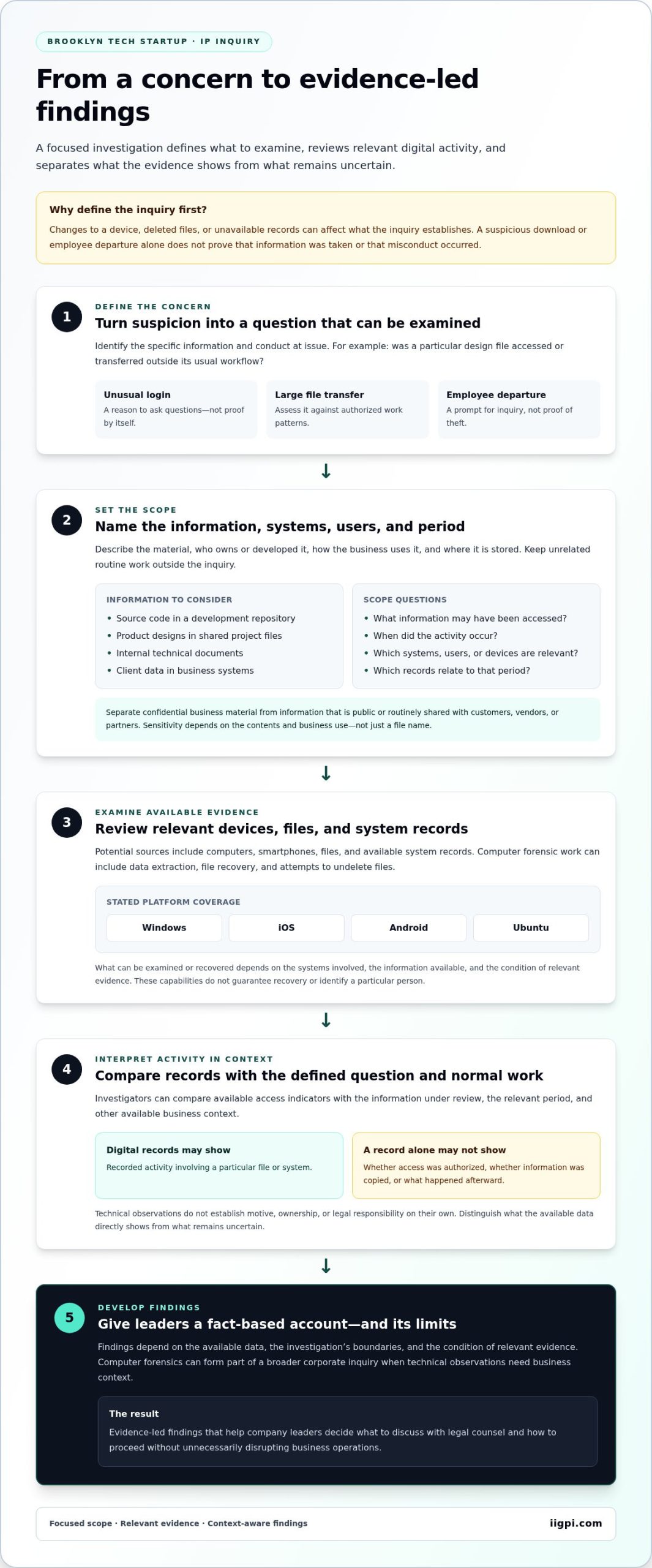
Turn the concern into questions that can be examined: What information may have been accessed? When did the activity occur? Which systems were involved, and what user activity is relevant to that period? For example, a company might ask whether a specific design file was accessed or transferred outside its usual workflow. Answering that question requires context, including authorized work patterns and how the system is used.
An unusual login, a large file transfer, or an employee’s departure may prompt questions, but none alone establishes theft, intent, or misconduct. A Brooklyn tech startup IP theft investigation is evidence-led fact-finding that assesses relevant information and activity without presuming the conclusion. A defined scope helps leaders address the concern while maintaining product development, customer service, and other business operations.
How a Brooklyn IP Theft Investigation Examines Digital Evidence
A brooklyn tech startup IP theft investigation starts with a defined scope, not an indiscriminate search across every company device or account. Investigators identify the information in question, where it may be stored, which users or devices may be relevant, and the period tied to the concern. This framework focuses the examination on material that can answer a specific business question and helps limit avoidable disruption.
Potential sources include computers, smartphones, files, and available system records. What can be examined depends on the systems involved, the information available, and its condition when the review begins. Changes to a device, deleted files, or unavailable records can affect what the inquiry establishes. The scope should therefore match the evidence that can be examined and the questions the company needs answered.
What can computer forensics examine?
Computer forensic services can include data extraction, file recovery, and attempts to undelete files. International Investigative Group’s stated platform coverage includes Windows, iOS, Android, and Ubuntu. These capabilities support the examination of relevant computers and smartphones, but do not guarantee that particular information can be recovered or that a specific person can be identified. The computer forensics guide provides further context on forensic analysis in corporate and legal investigations.
How investigators connect digital activity to the concern
Investigators compare available access indicators with the information under review and the relevant period. They may examine whether records show activity involving a particular file or system, then assess that activity against the defined scope and other available information. Technical observations can describe what a system records, but they do not establish motive, ownership, or legal responsibility on their own.
Digital evidence can document activity, but it must be interpreted in context. A record of access may not show whether the activity was authorized, whether information was copied, or what happened afterward. A careful assessment distinguishes what available data directly shows from what remains uncertain instead of treating one indicator as a complete account of events.
Findings depend on the data available, the investigation’s boundaries, and the condition of relevant evidence. Computer forensics can be one part of a broader corporate inquiry when technical observations need to be considered alongside business context. International Investigative Group provides computer forensic services as part of its investigative work for companies examining relevant digital information.
How to Evaluate an IP Theft Investigation for a Brooklyn Startup
The right investigative approach depends on the decision company leaders need to make. A question about activity on one device differs from a concern involving several people, business processes, or the use of confidential information outside the company. For a Brooklyn tech startup IP theft investigation, match the method and scope to the question rather than starting with the broadest possible review.
| Investigative question | Relevant evidence | Potential scope | Intended business decision |
|---|---|---|---|
| Was a particular file accessed or altered? | Relevant device, file, and available system records | Computer forensic examination focused on identified material and a defined period | Determine what the available records document and whether further review is warranted |
| Does the concern involve conduct beyond a single device or file? | Relevant business records, interviews, and digital information within scope | Corporate & Business Investigation, potentially informed by computer forensics | Assess the broader pattern and identify appropriate business next steps |
| Is the initial concern specific enough to investigate? | Existing company records and a documented account of the concern | Internal review to frame questions and identify relevant systems | Clarify whether a focused external investigation is appropriate |
Which investigative approach fits the question?
An internal review can help leaders organize known facts and define the business issue. It differs from a forensic examination, which focuses on digital information, and a broader corporate investigation, which can address conduct and business context. A question about a file or device may call for computer forensics; wider concerns may call for Corporate & Business Investigations. IIGPI can customize the scope to the services required.
What should a useful investigative scope clarify?
Before work begins, define the information and systems under review, the central questions, the relevant boundaries, and the reporting needs. These details help protect confidentiality, reduce avoidable interruption to product development and customer service, and give investigators a basis for keeping the inquiry focused as information emerges.
When a company has legal counsel, investigators can coordinate with counsel on investigative questions and reporting. They do not provide legal advice or represent the company. A useful report separates documented observations from interpretation and identifies unresolved questions, helping decision-makers understand both what the investigation found and what the evidence does not establish.
These criteria can help a startup choose between an internal review, a forensic examination, or a broader inquiry, and assess whether the proposed scope is proportionate to the concern. For more context on business investigations, review this corporate fraud investigation guidance.
What Brooklyn Startup Leaders Can Do Before an Investigation
Before commissioning a brooklyn tech startup IP theft investigation, leaders can clarify the concern without drawing conclusions about responsibility. The immediate goals are to record what is known, identify potentially relevant information, and avoid unnecessary actions that could complicate fact-finding. Coordinate preservation and employment or legal decisions with the company’s legal counsel.
- Identify the concern. Describe what prompted attention, such as a reported file transfer or an unexpected access change, without labeling it theft.
- Record known facts. Note when and how the concern came to light, who identified it, and which events or business records may be relevant.
- Define the information and systems. Identify the specific material believed to be affected and where it may be stored, such as a company device, repository, or business account.
- Coordinate next steps. Consult legal counsel about preservation and employment or legal decisions before taking steps that could affect relevant data or people.
Prepare a factual incident brief
A concise incident brief gives decision-makers and investigators a shared starting point. Record when the concern surfaced, the known events, the systems involved, and the questions that remain open. Identify the information believed to be affected and where the business stores it. Separate firsthand observations from assumptions or secondhand reports. For example, distinguish a system notification you reviewed from a colleague’s interpretation of that notification. Keep the account factual and neutral.
Include who first raised the concern, when it was reported if known, and which business records may help explain the event. Avoid editing or annotating original records in ways that could obscure their original contents, and ask counsel how relevant material should be handled. The brief is a working record, not a finding that misconduct occurred.
Protect investigative focus and business continuity
Limit discussion to people with a defined business or investigative role. Avoid speculative accusations and ad hoc actions that could complicate fact-finding. Before changing access, devices, or files that may be relevant, coordinate with counsel and the appropriate investigative professionals. This approach helps the company address operational needs while considering how to preserve information for review.
A clearly defined scope directs the evidence review to the systems and questions that matter, reducing unnecessary disruption to routine work. It also helps distinguish a focused investigation from broad searches that may collect unrelated business or personal information. Leaders can prepare by listing the concern, the information and systems involved, known facts, and the decisions the findings may need to inform.
If your company is organizing a suspected incident, International Investigative Group conducts scoped corporate investigations for business clients.
Engaging IIGPI for a Brooklyn Tech Startup IP Theft Investigation
For a Brooklyn company assessing possible misuse of proprietary information, the investigative approach should fit the business question and the information available. International Investigative Group, Ltd. (IIGPI) is a New York City private investigation firm serving corporate clients, including businesses in Brooklyn. IIGPI conducts Corporate & Business Investigations and Computer Forensic Services. These services can be combined in a defined inquiry, with forensic examination supporting the broader investigation where appropriate.
A brooklyn tech startup IP theft investigation may involve digital information, business activity, or both. Investigators work within a defined scope to examine the concern and develop findings that help company decision-makers consider next steps, without presuming what occurred. Findings can inform discussions with the company’s legal counsel, but IIGPI does not provide legal advice or legal representation.
What IIGPI brings to a corporate investigation
IIGPI’s team includes professionals with former law-enforcement experience. The firm’s computer forensic capabilities include computer and smartphone forensics, data extraction, recovery, and attempts to undelete files. These are investigative capabilities, not guarantees that particular information can be recovered or that an individual can be attributed to an event. Their relevance depends on the systems and data involved and the scope of the inquiry.
IIGPI is Licensed, Bonded, Insured and reports 10,000+ Cases Solved. These credentials and case figures provide context about the firm, but do not promise a specific result in an individual investigation. For a startup, the practical consideration is whether the inquiry is scoped to its operations and the questions its leaders need answered.
Investigative packages are customized, and clients are billed for the services they require. The work can be structured around the matter, such as a focused forensic examination, a broader corporate inquiry, or a combination of relevant services, rather than assuming every investigation needs the same scope.
How to begin a confidential discussion
Decision-makers can prepare by summarizing the concern, its known business impact, and the evidence or records already identified. A concise account of what prompted the inquiry, which information may be involved, and what remains uncertain can help define a practical investigative approach. Present unexamined conclusions as questions, not established facts.
Investigative findings support informed business decisions and coordination with legal counsel; they do not replace counsel’s advice. If your organization is considering an inquiry, contact IIGPI to discuss a customized investigative scope.
Turn Uncertainty Into a Clear Next Step
The next step in a brooklyn tech startup IP theft investigation is not to decide what the evidence means before it has been examined. First identify the unanswered business question and the type of inquiry that could address it. A clearly scoped process helps leaders move from concern toward informed decisions while keeping the focus on evidence rather than assumptions.
A structured inquiry also gives your team a basis for discussing the matter with legal counsel and considering how to maintain ordinary operations. IIGPI can tailor an investigative scope to the services required, drawing on corporate investigation and computer forensic capabilities where relevant. Its investigators conduct work locally and internationally on matters involving Brooklyn businesses.
To discuss an approach suited to your company’s concern, discuss a customized investigation with IIGPI.
Frequently Asked Questions
What does an IP theft investigation for a Brooklyn tech startup involve?
A Brooklyn tech startup IP theft investigation is a fact-finding inquiry into suspected unauthorized access, copying, use, or disclosure of business information. Its scope depends on what information may be involved and where it is stored, such as a source repository or shared project workspace. Computer forensics may examine relevant digital data, but an unusual event alone does not establish that theft occurred. The inquiry is shaped by the circumstances and the questions the company needs answered.
Can computer forensics determine who took a startup’s source code?
Computer forensic analysis may identify relevant digital activity and help assess whether source code was accessed, copied, or recovered from examined data. It cannot automatically prove who physically acted. Account or device records need to be interpreted alongside access arrangements and other available evidence. Findings describe technical observations, not a person’s intent or legal responsibility. The company’s counsel should guide legal decisions based on the full circumstances.
What evidence should a startup preserve when it suspects IP theft?
Document what was observed and identify potentially relevant information, devices, and systems, such as a named repository, company laptop, or shared account. Record who raised the concern and when, and distinguish direct observations from reports or assumptions. Avoid unnecessary changes to potentially relevant data while the scope is being considered. Coordinate preservation decisions with company counsel, since no single record guarantees a particular investigative finding.
Should a Brooklyn startup investigate suspected IP theft internally or use a private investigator?
An internal review can help clarify what prompted concern and identify records that may be relevant. When questions require a structured examination, International Investigative Group provides Corporate & Business Investigations and Computer Forensic Services. The appropriate approach depends on the business question, systems involved, and available in-house expertise. A private investigation can add focused fact-finding, but does not replace company counsel’s role in legal decisions.
Can an IP theft investigation examine smartphones and different operating systems?
Yes. IIGPI’s computer forensic services cover Windows, iOS, Android, and Ubuntu platforms, with capabilities such as data extraction and recovery. A company smartphone may be relevant if it was used to access business files or communications. Whether a particular device or dataset is examined depends on its connection to the inquiry and the defined scope. Not every device will yield recoverable information or establish what happened.
Does hiring an investigator guarantee that stolen intellectual property will be recovered?
No investigation guarantees the recovery of information or a particular outcome. Computer forensic examination and corporate investigation can help assess available evidence and document findings, but what can be established depends on the data, its condition, and the circumstances. IIGPI provides customized investigative services. Questions about legal remedies or decisions should be addressed with the company’s counsel. Findings can inform those discussions without determining their outcome.
How does IIGPI tailor an IP theft investigation for a startup?
IIGPI, a New York City-based private investigation firm, develops customized packages billed for the services required. Decision-makers can describe the concern, the business information involved, relevant systems, and the questions they need examined. IIGPI can then define an investigative scope using its corporate and computer forensic services as appropriate. The scope is tailored to the matter, without a promise of a specific price, timeline, or result.