
In the sophisticated ecosystem of Manhattan commerce, the reliance on automated background check applications is not merely a technical oversight; it’s a profound institutional vulnerability that necessitates the integration of elite background investigation services nyc. High-level decision-makers recognize that the New York City regulatory environment, characterized by the stringent Fair Chance Act and the 2026 statewide prohibition on credit history assessments, creates a labyrinthine path for even the most diligent human resources departments. The inherent complexity of local labor laws means that a single procedural error in the vetting process can result in substantial penalties and irreparable reputational damage.
This analysis serves as an authoritative intelligence report detailing the transition from superficial data scraping to a framework of deep-tier investigative rigor. You will gain a comprehensive understanding of the methodologies required to achieve absolute compliance while mitigating the risks associated with high-stakes executive appointments. We’ll examine the structural requirements of two-tiered screening, the necessity of individualized assessments under Article 23-A, and the elite investigative strategies that transform raw data into actionable institutional intelligence.
Key Takeaways
- Understand the transition from superficial database queries to a hierarchical intelligence model involving primary and tertiary source verification for absolute data integrity.
- Navigate the complex regulatory framework of the NYC Fair Chance Act and the Fair Credit Reporting Act to ensure institutional compliance and avoid significant financial penalties.
- Implement a strategic, tiered vetting protocol that aligns investigative depth with the specific risk profile and sensitivity of high-stakes corporate appointments.
- Leverage professional background investigation services nyc that utilize a global agent network and law enforcement-based expertise to protect organizational reputation and financial assets.
The Imperative for Rigorous Background Investigations in the New York Metropolitan Area
A background check, when conducted within the parameters of high-stakes commerce, represents a multifaceted intelligence protocol designed to verify the absolute integrity of individuals and entities. In the New York metropolitan area, the deployment of sophisticated background investigation services nyc has evolved from a peripheral administrative function into a critical pillar of institutional risk management. As a premier global financial epicenter, New York presents a unique risk environment where the financial and legal consequences of an inadequate executive hire can frequently reach tens of millions of dollars. While the New York City Department of Investigation (DOI) enforces rigorous standards for public sector appointments under Executive Order 16, private enterprises require a more nuanced and strategic framework that addresses the intricacies of private equity and international law. Institutional stability in the 2026 market depends on the capacity to identify latent risks before they manifest as costly litigation or catastrophic internal fraud.
The Escalation of Corporate Risk in a Globalized Economy
The prevalence of credentials fraud and sophisticated identity manipulation has reached unprecedented levels within high-level recruitment cycles. New York firms, positioned at the intersection of international trade and capital markets, remain primary targets for internal fraud and speculatively motivated litigation. Reputational due diligence has consequently emerged as a core component of modern investigative services, moving beyond basic criminal records to evaluate an individual’s historical alignment with institutional values. This proactive intelligence model, championed by International Investigative Group, ensures that organizations aren’t merely filling a vacancy but are actively securing their operational future against systemic vulnerabilities.
Distinguishing Professional Intelligence from Automated Screening
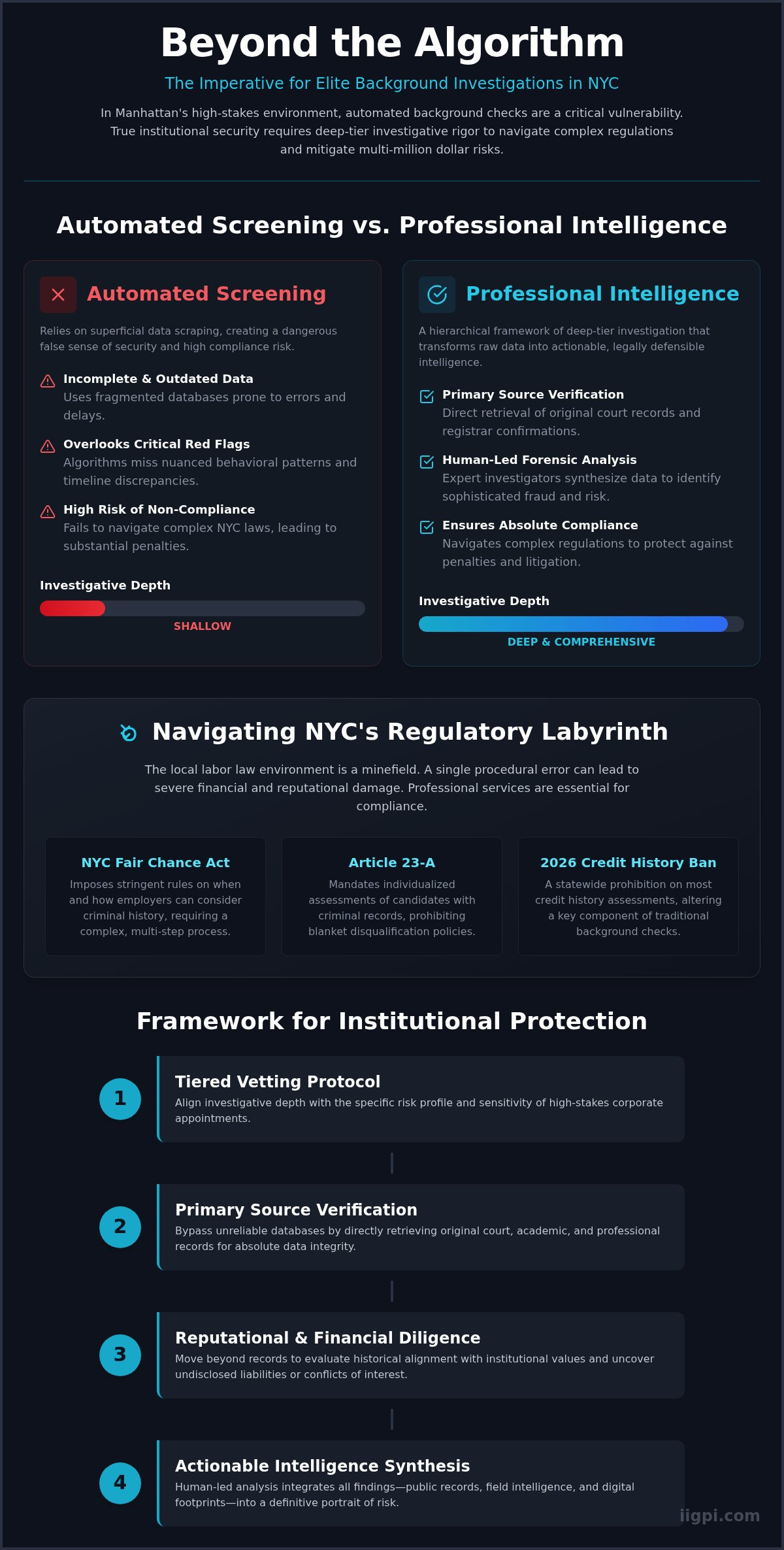
The proliferation of “instant” background check platforms has introduced a dangerous sense of complacency into the corporate vetting process. These automated systems typically rely on fragmented, outdated, or incomplete databases that consistently fail to capture nuanced behavioral patterns or complex financial histories. Human-led analysis remains the only effective mechanism for identifying red flags that algorithms overlook, such as subtle discrepancies in professional timelines or undisclosed corporate affiliations. Investigative depth is the rigorous synthesis of public records, field intelligence, and forensic analysis to produce a definitive portrait of organizational risk.
Methodologies of Professional Background Intelligence: Beyond Superficial Queries
The implementation of elite Methodologies of Professional Background Intelligence requires a definitive departure from the commoditized “instant” query models that dominate the lower tiers of the industry. Professional background investigation services nyc utilize a hierarchical data collection framework that prioritizes primary source verification over secondary or tertiary data aggregates. This model involves direct retrieval of original court records and registrar confirmations rather than relying on digital proxies that are often prone to synchronization delays or data corruption. By emphasizing primary sources, investigators ensure that the foundation of the intelligence report is both current and legally defensible.
Verifying educational and professional histories through direct institutional contact is essential for identifying sophisticated credentials fraud. Relying on automated verification databases often misses the nuanced discrepancies that human investigators catch through direct dialogue with former colleagues and academic registrars. Financial forensics further strengthens this framework by uncovering undisclosed liabilities, complex bankruptcy filings, or potential conflicts of interest that standard credit headers don’t reveal. Within this formal structure, digital footprints and social media analysis are integrated as behavioral data points to assess an individual’s consistency and alignment with institutional standards. It’s this synthesis of traditional field intelligence and modern forensic analysis that defines professional rigor.
The Architecture of a Comprehensive Background Report
A structured investigative process begins with preliminary identification and jurisdictional mapping to establish the geographic and legal perimeter of the search. This is followed by a deep-dive analysis of criminal and civil litigation history across all relevant jurisdictions, including federal, state, and local levels. The final layer involves asset and financial integrity verification, which encompasses exhaustive searches for liens, judgments, and UCC filings to create a complete picture of the subject’s fiscal standing—a level of transparency that is also essential when evaluating South Florida residential real estate for sale.
Vetting candidates for leadership positions necessitates “deep-background” interviews with former associates and industry peers to gain qualitative insights into management style and ethical history. These protocols must also extend to the verification of complex international business interests and offshore affiliations to ensure no undisclosed foreign entanglements exist. For a broader perspective on institutional risk, leaders should consult this Definitive Guide to Corporate Investigations. Engaging with specialized investigative professionals ensures these methodologies are applied with the precision required for high-stakes appointments.
Navigating the Complex Regulatory Landscape of NYC Employment Screening
The legal architecture governing background investigation services nyc requires a level of procedural precision that transcends standard human resources protocols. In the New York jurisdiction, the intersection of municipal, state, and federal law creates a dense regulatory environment where institutional compliance is as critical as the intelligence gathered. Organizations must operate within a framework that balances the necessity of risk mitigation with the statutory rights of the individual. Failure to maintain this equilibrium doesn’t just jeopardize the validity of the investigation; it exposes the entity to significant litigation and regulatory sanctions, with penalties for willful non-compliance reaching up to $250,000 under local mandates.
Compliance with the New York City Fair Chance Act
The NYC Fair Chance Act represents one of the most stringent “ban-the-box” statutes in the United States, requiring a strictly bifurcated screening process. Employers are prohibited from conducting criminal background inquiries until after a conditional offer of employment has been extended, necessitating that all non-criminal verifications occur in a separate, preceding phase. If an investigation reveals a criminal history, the employer must perform a detailed “Fair Chance Analysis” based on New York’s Article 23-A factors before rescinding any offer. The 2026 updates regarding Automated Employment Decision Tools (AEDT) further complicate this landscape, requiring rigorous bias audits for any algorithmic systems used in the evaluation of candidates. Maintaining procedural fidelity during these transitions is essential for institutional integrity.
Adhering to Federal and State Privacy Standards
Beyond municipal rules, the Fair Credit Reporting Act (FCRA) dictates specific protocols for disclosure and authorization that every investigative entity must follow. When an investigation involves personal interviews to assess a subject’s character or reputation, it falls into the category of an Investigative Consumer Report, a distinct legal category under federal law that triggers heightened notice requirements. Handling sensitive Personally Identifiable Information (PII) requires advanced security frameworks to prevent data breaches that could lead to systemic liability. If findings lead to an adverse employment decision, the organization is legally obligated to issue “Adverse Action” letters, providing the subject with a copy of the report and a minimum of five business days to dispute any inaccuracies.
New York law also prohibits inquiries into a candidate’s salary history, a restriction designed to close wage gaps but one that limits the scope of traditional financial vetting. Similarly, while social media intelligence offers qualitative insights into a candidate’s alignment with corporate values, its use must be carefully calibrated to avoid the acquisition of protected class information. Professional investigators ensure that digital footprints are analyzed through a lens of objective risk assessment rather than subjective bias. By integrating these complex legal requirements into a cohesive strategy, firms can secure their leadership pipelines without compromising their commitment to regulatory excellence.
Strategic Implementation of Investigative Protocols for High-Stakes Hires
The institutionalization of background investigation services nyc requires a definitive transition from reactive compliance to a proactive framework of risk intelligence. Within the high-velocity corporate environments of Manhattan and Nassau County, a standardized, one-size-fits-all vetting approach is insufficient for protecting organizational assets. Instead, elite firms must integrate investigative protocols directly into the recruitment lifecycle, ensuring that intelligence gathering begins long before a conditional offer is finalized. This strategic alignment allows for the identification of behavioral patterns and undisclosed affiliations that might otherwise remain obscured by polished executive resumes. By treating background intelligence as a dynamic asset rather than a static administrative requirement, decision-makers can navigate high-stakes appointments with a heightened degree of analytical certainty.
A calibrated, tiered approach to investigation ensures that resources are allocated proportionally to the inherent risk of a specific role. While foundational screening is appropriate for general staff, executive and C-suite positions demand a deep-tier analysis that encompasses global interests and historical professional conduct. Institutional resilience also depends on the implementation of ongoing monitoring for personnel in sensitive financial or security-oriented positions, as risk profiles are not static and can evolve post-hire. Interpreting the resulting complex findings requires a sophisticated understanding of the New York legal landscape, allowing leaders to make risk-adjusted decisions that balance institutional safety with the nuances of local labor regulations.
Integrating Investigations into the Due Diligence Process
There’s a significant synergy between individual vetting and broader corporate Due Diligence, particularly during mergers, acquisitions, or the formation of strategic partnerships. Background intelligence provides the necessary context for negotiations by verifying the integrity of key stakeholders and identifying the “beneficial owners” within complex, multi-layered corporate structures. Unmasking these entities is critical for preventing the infiltration of speculatively motivated actors or individuals with histories of financial misconduct. When background intelligence informs the due diligence process, it serves as an essential safeguard against the assumption of latent liabilities that could jeopardize the success of a transaction.
Selecting a Professional Investigative Partner in NYC
Selecting an investigative partner requires an evaluation of specific criteria, including formal licensure, comprehensive insurance, and a demonstrable law enforcement pedigree. Firms with a physical presence in both NYC and Nassau County offer a distinct advantage, providing the localized field intelligence and jurisdictional expertise that national, database-driven agencies lack. This proximity allows for direct access to local court archives and the ability to conduct in-person verifications that digital proxies cannot replicate. For a detailed framework on evaluating these professionals, leaders should consult this Guide to Hiring a Private Investigator. Secure your leadership pipeline and institutional integrity by engaging with the background investigation services nyc offered by International Investigative Group today.
International Investigative Group: Decades of Excellence in NYC Background Intelligence
International Investigative Group (IIG) represents the pinnacle of background investigation services nyc, leveraging over 30 years of institutional experience to secure the interests of the city’s most prestigious organizations. Founded by a former law enforcement professional, the firm has successfully navigated more than 10,000 cases, ranging from complex domestic matters to high-stakes fraud investigations exceeding $120 million. This legacy isn’t merely a measure of time but a testament to a refined investigative philosophy that translates the rigorousness of public sector duty into strategic intelligence for the private sector. By positioning itself as a de facto inspector general for the private market, IIG provides the analytical depth required to protect organizational reputation and financial stability in an increasingly volatile global economy.
The IIG Advantage: Law Enforcement Pedigree and Global Reach
The transition from law enforcement to corporate risk mitigation provides IIG with superior access to investigative resources and a methodology rooted in forensic accuracy. While many agencies rely on localized data aggregates, IIG utilizes an extensive global agent network that allows for seamless investigations across international borders, a critical requirement for NYC firms with international interests. This reach is augmented by specialized Computer Forensics capabilities, ensuring that digital footprints are analyzed with the same precision as physical evidence. By bridging the gap between local jurisdictional expertise and global intelligence, the firm operates as an essential partner for entities engaged in cross-border commerce and complex litigation where data integrity is paramount.
Case Study: Mitigating Risk in a High-Value Corporate Appointment
In one illustrative scenario involving a high-value C-suite appointment, IIG’s deep-tier vetting identified a sophisticated conflict of interest that had been intentionally obscured through a series of shell companies and undisclosed offshore affiliations. Standard automated checks had failed to flag these connections; they would’ve exposed the hiring firm to catastrophic financial liability and regulatory scrutiny. By uncovering these risks prior to the finalization of the contract, the investigation prevented a potential multi-million dollar loss and protected the institution’s global reputation. The return on investment for such rigorous vetting is measured not just in avoided costs but in the preservation of institutional integrity and long-term stability. Organizations requiring the highest level of analytical depth and regulatory compliance are invited to schedule a confidential consultation at International Investigative Group to discuss their specific risk mitigation requirements.
Securing Institutional Integrity through Strategic Intelligence
The transition from commoditized automated screening to a framework of deep-tier intelligence isn’t merely a procedural step; it’s a fundamental requirement for organizations operating within the New York financial and legal corridors. This analysis has demonstrated that mitigating organizational risk requires a synthesis of primary source verification, forensic financial analysis, and strict adherence to the evolving mandates of the NYC Fair Chance Act. By moving beyond superficial data scraping, institutions can secure their leadership pipelines against the latent threats of credentials fraud and undisclosed conflicts of interest. Utilizing elite background investigation services nyc ensures that every high-stakes appointment is grounded in verified fact rather than digital assumption.
International Investigative Group remains the definitive authority in this field, offering an elite law enforcement pedigree and a global network of investigative agents to address the unique challenges of the current market. With over 30 years of professional experience, our firm provides the intellectual rigor and jurisdictional expertise necessary to transform raw data into actionable institutional intelligence. You can secure your organization’s future with a confidential consultation at International Investigative Group to ensure your high-stakes appointments are underpinned by absolute data integrity. Protecting your institution’s legacy starts with a commitment to exhaustive due diligence.
Frequently Asked Questions
What distinguishes a professional background investigation from a standard online background check?
Professional investigations prioritize primary source verification over digital proxies to ensure absolute data integrity. While automated applications rely on fragmented databases, elite services involve direct retrieval of court records and registrar confirmations. This methodology identifies discrepancies that algorithms consistently overlook. Human-led analysis provides qualitative insights into a subject’s character, which is essential for high-stakes institutional risk management and protecting organizational reputation.
How long does a comprehensive corporate background investigation typically take in NYC?
The duration of a thorough inquiry generally spans between five and ten business days, depending on the subject’s jurisdictional footprint. Complex cases involving international interests or deep-background interviews with former associates may require additional time for exhaustive verification. Professional background investigation services nyc prioritize analytical depth over speed to ensure every finding is legally defensible. This measured pace allows for the synthesis of field intelligence and forensic record analysis.
Is it legal to conduct a background investigation without the subject’s consent in New York?
Conducting an investigation for employment purposes requires the subject’s explicit written authorization under the Fair Credit Reporting Act and New York labor laws. While certain due diligence inquiries during M&A transactions may involve public record searches without direct consent, most formal background checks necessitate transparency. Organizations must provide clear disclosures to candidates to maintain regulatory compliance. Failure to secure proper authorization can lead to substantial litigation and civil penalties.
What specific records are searched during an elite-level background check?
Elite inquiries encompass a broad spectrum of records including federal and state criminal litigation, civil judgments, and UCC filings. Forensic asset searches, lien verifications, and bankruptcy records provide a complete picture of a subject’s financial integrity. Beyond public records, professional services verify educational credentials and professional history through direct institutional contact. Digital footprints and social media analysis are also integrated to assess behavioral consistency and alignment with corporate values.
How does the NYC Fair Chance Act affect the background investigation process for employers?
The Fair Chance Act mandates a bifurcated screening process where criminal inquiries are prohibited until a conditional offer is extended. Employers must complete all non-criminal verifications, such as education and employment history, during the initial phase. If a criminal record is discovered post-offer, the organization must conduct a formal Fair Chance Analysis using Article 23-A factors. This strict procedural requirement prevents discriminatory hiring practices while necessitating precise investigative timing.
Can a private investigator uncover international criminal records or business interests?
Professional investigators utilize global agent networks to retrieve records and verify interests across international borders. This capability is essential for New York firms engaging in cross-border commerce or hiring executives with global professional histories. Accessing foreign court archives and registrar data requires localized expertise that automated database queries cannot replicate. By bridging regional gaps, elite investigators provide a comprehensive view of a subject’s global risk profile and undisclosed affiliations.
What is the cost structure for professional background investigation services in NYC?
Cost structures typically reflect the investigative depth and jurisdictional complexity required for a specific appointment. While basic screenings involve flat fees for standard record retrieval, high-stakes executive vetting is often billed through tiered packages or hourly rates for specialized field intelligence. Pass-through fees for court access and institutional verifications are also factored into the final assessment. Professional firms provide transparent estimates based on the sensitivity and risk profile of the target role.
How are the findings of a background investigation delivered and interpreted?
Findings are delivered in a structured intelligence report that synthesizes raw data into actionable risk assessments. These reports categorize information into primary, secondary, and tertiary verification levels to provide a clear hierarchy of data integrity. Expert investigators assist decision-makers in interpreting complex findings, such as subtle discrepancies in professional timelines or potential conflicts of interest. This interpretive layer ensures that organizations make risk-adjusted appointments based on a definitive portrait of the candidate.