
In the complex theater of high-stakes litigation and corporate due diligence, the deliberate concealment of financial holdings through sophisticated mechanisms presents a formidable obstacle to justice and equitable resolution. The successful enforcement of a legal judgment or the attainment of critical leverage in negotiations often hinges upon a meticulously executed asset search—one that is not only comprehensive but also unimpeachably compliant with legal and ethical standards. Many professionals face the dual challenge of navigating this intricate process while contending with the risks of inadmissible evidence or incomplete data from substandard investigations, which can render even a successful identification of funds moot.
This strategic guide delineates a systematic methodology for tracing and recovering hidden funds, providing an authoritative framework for legal and corporate practitioners. We will move beyond mere data aggregation to detail the strategic process of conducting a lawful investigation, from initial discovery to the complex mechanics of recovery. The objective is to empower professionals to obtain a verified, comprehensive report of a subject’s total assets, thereby transforming financial judgments from symbolic victories into tangible, recovered capital and securing a decisive advantage in critical negotiations.
Key Takeaways
- Learn a methodical, phased approach to asset investigation, beginning with publicly available information before advancing to more complex sources.
- Understand the common tactics used by individuals and corporate entities to conceal wealth and the advanced investigative techniques required to uncover them.
- Distinguish the critical steps that separate a successful asset search from the complex legal and logistical processes of actual asset recovery and seizure.
- Evaluate the strategic advantages of engaging a premier investigative firm, contrasting their capabilities with the limitations of software-based or internal methods.
Foundations of a Lawful and Effective Asset Search
An asset search is a forensic financial investigation designed to identify, locate, and verify the tangible and intangible assets held by an individual or corporate entity. It is a discipline that transcends the scope of a standard credit report or background check, which typically provides only a superficial overview of financial history. A comprehensive asset investigation is a critical component of the broader field of Asset recovery, delving into public records, proprietary databases, and human intelligence sources to construct a detailed financial portrait. The efficacy of this process is contingent not only upon a rigorous methodology but also upon strict adherence to a complex legal and ethical framework, beginning with the establishment of a permissible purpose.
Defining the Scope: Beyond a Simple Database Check
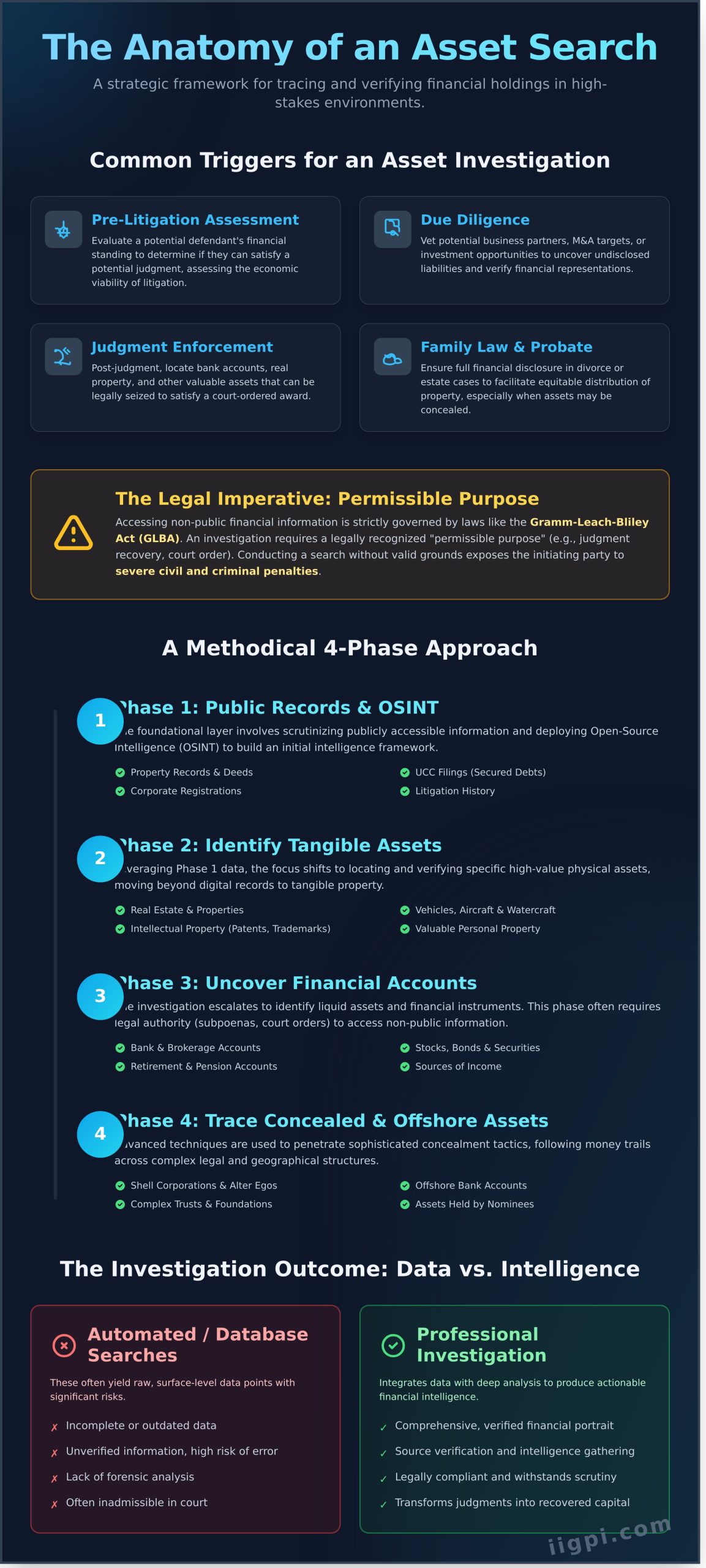
Automated, database-only searches often yield incomplete, outdated, or unverified information, presenting a significant risk of error. A professional investigation, by contrast, integrates data with deep forensic analysis, source verification, and strategic intelligence gathering. This process transforms raw, surface-level data points—such as property records or corporate filings—into verified, actionable financial intelligence that can withstand legal scrutiny and inform critical strategic decisions.
The Legal Framework: Permissible Purpose and Compliance
The execution of any substantive asset search is governed by stringent regulations designed to protect financial privacy, most notably the Gramm-Leach-Bliley Act (GLBA). Accessing non-public financial information is strictly prohibited without a legally recognized “permissible purpose.” Conducting a search absent such a justification exposes the initiating party to severe civil and criminal penalties. Valid legal grounds for an investigation are narrowly defined and include judgment recovery, pre-litigation due diligence, and court-ordered discovery in civil proceedings like divorce.
Common Triggers for Initiating an Asset Search
The strategic deployment of an asset investigation is typically precipitated by specific legal or commercial requirements. The primary scenarios include:
- Pre-Litigation Assessment: To evaluate a potential defendant’s financial standing and determine if they possess sufficient assets to satisfy a potential judgment, thereby assessing the economic viability of pursuing litigation.
- Due Diligence: For corporate entities vetting potential business partners, investment opportunities, or merger and acquisition (M&A) targets to uncover undisclosed liabilities and verify financial representations.
- Judgment Enforcement: Post-judgment, to locate bank accounts, real property, securities, and other valuable assets that can be legally seized or garnished to satisfy a court-ordered award.
- Family Law and Probate: In divorce or estate settlement cases, to ensure full financial disclosure and facilitate an equitable distribution of marital or inherited property, particularly when assets may be concealed.
In the context of due diligence, this process is crucial for those exploring complex financial ventures, from real estate financing with firms like Icon Capital LLC to the pre-IPO and IPO investment opportunities introduced by specialist firms like BGS Capital.
A Methodical Approach to Locating Verifiable Assets
A successful asset search is not an arbitrary exercise but a systematic inquiry executed in deliberate phases. This methodical process commences with the analysis of publicly accessible information before escalating to more intricate sources that require legal authority to access. Each sequential phase builds upon the last, leveraging discovered data to construct an increasingly detailed and verifiable financial profile of the subject. The objective is to create a comprehensive ledger of holdings, transforming disparate data points into a cohesive understanding of an individual’s or entity’s true net worth.
Phase 1: Public Records and Open-Source Intelligence (OSINT)
The foundational layer of any investigation involves scrutinizing public records and deploying Open-Source Intelligence (OSINT). This includes leveraging official databases for property records, Uniform Commercial Code (UCC) filings that indicate secured debts, and corporate registrations to identify business ownership. Concurrently, an analysis of litigation history can reveal prior financial disclosures or judgments, while professional databases provide crucial links between individuals, known addresses, and corporate associations, forming the initial intelligence framework.
Phase 2: Identifying Real Property and Tangible Assets
Building upon the intelligence gathered in the initial phase, the focus shifts to the identification of specific real property and high-value tangible assets. Investigators trace real estate ownership, including a forensic review of recent transfers that may indicate concealment attempts. This stage also targets the verification of other significant physical assets, such as vehicles, aircraft, and watercraft registered to the subject. Furthermore, inquiries may extend to valuable collectibles, art collections, or commercial inventory that constitute substantial material wealth.
Once real estate is identified, a subsequent step often involves assessing its potential for rapid liquidation, which is a key factor in judgment enforcement and recovery strategies. To understand more about the cash-sale process for real estate assets, read more.
Phase 3: Uncovering Financial Accounts and Intangible Holdings
The final investigative phase delves into financial accounts and intangible holdings, which represent the most liquid and often most concealed forms of wealth. This stage necessitates the use of formal legal mechanisms, such as subpoenas and court orders, which must operate in compliance with both domestic regulations and the international standards for asset recovery advocated by inter-governmental bodies. The objective is to legally compel disclosure of bank and brokerage accounts, trace ownership of stocks and bonds, and uncover valuable intellectual property like patents and trademarks held as corporate assets.
Advanced Techniques for Uncovering Concealed Assets
When subjects of an investigation actively endeavor to hide their wealth, a standard financial review proves insufficient. Sophisticated individuals and corporations employ complex strategies to obscure ownership, sever paper trails, and place funds beyond the reach of conventional legal frameworks. A successful asset search in these circumstances requires a multi-disciplinary approach that anticipates and systematically dismantles these concealment tactics, often on a global scale.
Recognizing Shell Corporations, Trusts, and Offshore Structures
The most prevalent method for obscuring ownership involves the use of shell corporations and labyrinthine trust arrangements, frequently established in offshore jurisdictions with stringent privacy laws. These legal entities serve to create layers of separation between the asset and its ultimate beneficial owner. Investigators must engage in the legal process of “piercing the corporate veil” to prove the entity is merely an alter ego of the individual. This process is profoundly complicated by international boundaries, necessitating deep expertise in cross-border legal protocols and extensive international networks. Comprehensive guidance on navigating these multilateral challenges, such as that provided in the World Bank’s Asset Recovery Handbook, is indispensable for practitioners engaged in these complex global investigations.
Following the Trail of Transferred and Liquidated Assets
Subjects often attempt to shield assets by transferring them to insiders—such as family members, business partners, or newly created entities—in transactions that are not commercially legitimate. Such actions may constitute fraudulent conveyance, particularly if the timing corresponds with pending or anticipated legal proceedings. A critical investigative function is to scrutinize the chronology and nature of these transfers. Furthermore, investigators must trace assets that have been liquidated, converted into less traceable forms like precious metals or art, and subsequently moved, a process that requires meticulous forensic accounting to reconstruct the flow of funds across multiple accounts and jurisdictions.
The Role of Digital Forensics in Modern Asset Searches
In the contemporary financial landscape, digital forensics has become a cornerstone of any advanced asset search. Financial records, communications regarding asset transfers, and evidence of ownership are often located on computers, mobile devices, and cloud servers. Forensic specialists can recover deleted files, decrypt encrypted data, and analyze metadata to uncover critical financial information that subjects believed was erased. This domain now extends to the formidable challenge of tracing cryptocurrency transactions, which are designed for anonymity but can often be de-anonymized through sophisticated blockchain analysis and by identifying linkages to traditional financial institutions.
The Asset Recovery Process: From Identification to Seizure
The successful conclusion of an asset investigation is a significant milestone, yet it represents the commencement, not the culmination, of the recovery effort. The comprehensive report detailing a subject’s financial holdings is the foundational document upon which all subsequent legal enforcement actions are built. Translating this intelligence into tangible recovery requires a strategic, methodical, and legally sound approach that bridges the gap between identification and seizure.
Leveraging Asset Search Findings in Litigation
The final report from an asset search is an instrument of considerable strategic value for legal counsel. It provides objective evidence that can fundamentally alter the dynamics of settlement negotiations by demonstrating the subject’s verified capacity to pay a judgment. Furthermore, these findings are instrumental in substantiating motions for pre-judgment remedies and focusing discovery requests, thereby preventing the opposing party from claiming insolvency or concealing resources during litigation.
Enforcing Judgments: Writs of Execution and Garnishment
Once a legal judgment is secured, the investigative report becomes the tactical blueprint for enforcement. The specific details it contains—such as bank account numbers, places of employment, and real property deeds—are prerequisites for petitioning the court to issue writs of execution. These legal instruments are the primary mechanisms for compelling payment and include:
- Bank Levies: A legal order directing a financial institution to seize funds from the debtor’s accounts to satisfy the judgment.
- Wage Garnishments: A court order requiring an employer to withhold a portion of the debtor’s earnings to be paid directly to the creditor.
- Property Liens and Seizures: A claim placed on real or personal property, which can prevent its sale or transfer until the debt is paid and may ultimately lead to foreclosure or seizure.
The intelligence gathered during the initial investigation directly enables legal counsel to execute these measures with precision, minimizing delays and maximizing the probability of a successful recovery.
Engaging Professional Support for Asset Recovery
Effective asset recovery is predicated on the seamless collaboration between investigative professionals and legal teams. The dynamic nature of hidden funds necessitates both speed and accuracy; once identified, assets can be moved or further concealed with alarming swiftness. A coordinated effort ensures that legal actions are filed immediately and accurately, leveraging the investigative findings before the window of opportunity closes. This synergy between investigation and legal execution is critical to converting a court victory into a financial reality. Secure your judgment with our expert asset recovery services.
Engaging a Professional Firm for Complex Asset Searches
When financial stakes are substantial and assets are deliberately concealed across multiple jurisdictions, the limitations of automated software and do-it-yourself methods become critically apparent. In such complex scenarios, engaging a premier investigative firm is not merely an option but a strategic imperative. The value proposition of such a firm extends far beyond data acquisition; it encompasses rigorous analysis, legal compliance, and the strategic intelligence necessary to navigate sophisticated financial structures and secure a successful recovery. A professional asset search is an investment in certainty and efficacy where ambiguity can lead to significant financial loss.
Database Search vs. Comprehensive Investigation: A Critical Distinction
Public and private database searches represent a preliminary, yet fundamentally incomplete, step in the asset discovery process. These tools often yield raw data that may be outdated, contextually misleading, or factually inaccurate, presenting significant risks if acted upon without validation. A comprehensive investigation, by contrast, subjects this data to scrupulous verification and supplements it with human intelligence, providing not just information but actionable insight. It is the crucial difference between a data point and a verified, legally defensible fact.
Criteria for Selecting a Private Investigative Firm
The selection of an investigative partner demands meticulous due diligence. An effective firm is distinguished by its credentials, experience, and operational integrity. Key criteria for evaluation should include:
- Licensing and Compliance: Verification of all requisite state or national licenses, comprehensive insurance coverage, and a demonstrable commitment to legal and ethical standards, including data privacy protocols like GDPR.
- Demonstrated Experience: A proven track record with cases of similar scale and complexity, particularly those involving offshore entities, trusts, and other sophisticated concealment tactics.
- Global Network and Resources: The capacity to conduct cross-border investigations through an established global network of vetted contacts and resources, which is indispensable for international cases.
The IIG Advantage: Global Network and Decades of Expertise
In high-stakes financial disputes, expertise is non-negotiable. For over three decades, the International Investigation Group (IIG) has specialized in complex financial investigations and global asset search and recovery operations. Our teams have a distinguished record of success in multi-million dollar recovery cases, tracing funds through opaque corporate veils and uncooperative jurisdictions. This success is predicated upon a sophisticated global network and a depth of experience that transforms complex challenges into decisive outcomes. For matters requiring unparalleled discretion and efficacy, explore the strategic solutions offered through the IIGP network.
From Strategy to Seizure: Concluding Your Asset Recovery Initiative
The successful recovery of concealed funds is predicated not merely on identification, but on a strategic framework encompassing lawful diligence, methodical investigation, and the sophisticated application of advanced techniques. This guide has delineated the critical path from initial discovery to final seizure, underscoring that the efficacy of any asset search is fundamentally tied to the expertise marshaled for the task.
When confronted with intricate financial structures and obfuscated ownership, engaging a specialized firm becomes an instrumental strategic decision. With over 30 years of experience, a global investigative network, and a record of successfully resolving over 10,000 cases, the International Institute for Governance & Policy possesses the requisite capabilities to navigate these complexities. We invite you to request a confidential consultation to discuss your asset search requirements. Let our proven expertise be the decisive factor in transforming your recovery objectives into tangible results.
Frequently Asked Questions
How much does a professional asset search cost?
The financial investment required for a professional asset investigation is contingent upon several critical variables, including the complexity of the case, the geographic scope of the inquiry, and the nature of the assets being traced. A preliminary domestic search may entail a modest retainer, whereas a comprehensive international investigation involving multiple jurisdictions and sophisticated concealment structures will necessitate a substantially greater allocation of resources. It is imperative to obtain a detailed scope of work and cost structure from the investigating entity.
Is it legal to search for someone’s hidden bank accounts?
The legality of searching for an individual’s financial accounts is strictly governed by national and international privacy statutes, such as the Gramm-Leach-Bliley Act (GLBA) in the United States. Direct access to bank account information without a court order, subpoena, or explicit consent is generally proscribed. However, professional investigators can legally identify indicators of financial accounts and institutional relationships through permissible purpose investigations, which can then be used to support formal legal proceedings for disclosure.
How long does a comprehensive asset search investigation typically take?
The temporal framework for a comprehensive asset search investigation is dictated by the case’s complexity and jurisdictional reach. A standard domestic inquiry may conclude within several weeks, whereas a multifaceted international investigation involving offshore entities and layered corporate veils can extend for several months or longer. The timeline is directly influenced by factors such as the subject’s cooperation, the quality of initial intelligence, and the responsiveness of third-party institutions within the prevailing legal framework.
Is the information discovered in a private asset search admissible in court?
Information uncovered during a private investigation serves as critical intelligence but is not automatically admissible as evidence in court. For admissibility, the findings must be authenticated and introduced through legally sanctioned procedures, such as discovery, subpoenas, or expert witness testimony. The initial investigation provides the strategic roadmap for legal counsel to compel the production of admissible financial records and documentation, thereby converting investigative leads into legally recognized evidence for judicial consideration.
What information is required to initiate an asset search on an individual or entity?
To initiate an effective asset search, investigators require a baseline of verifiable subject identifiers. For an individual, this includes their full legal name, date of birth, social security or national identification number, and last known physical addresses. For a corporate entity, the essential data points are the official registered name, jurisdiction of incorporation, tax identification number, and the names of principal officers or directors. The provision of comprehensive initial data significantly enhances the investigation’s efficiency and precision.
What is the success rate for finding concealed assets?
The success rate for locating concealed assets is not a fixed metric but is instead a function of investigative expertise, available resources, and the sophistication of the concealment scheme. While a definitive statistical success rate is elusive, highly experienced firms utilizing advanced forensic techniques and global intelligence networks consistently achieve favorable outcomes. Success is contingent upon the subject’s financial footprint and the legal permissibility of investigative methods within the relevant jurisdictions, making each case’s potential outcome unique.
