
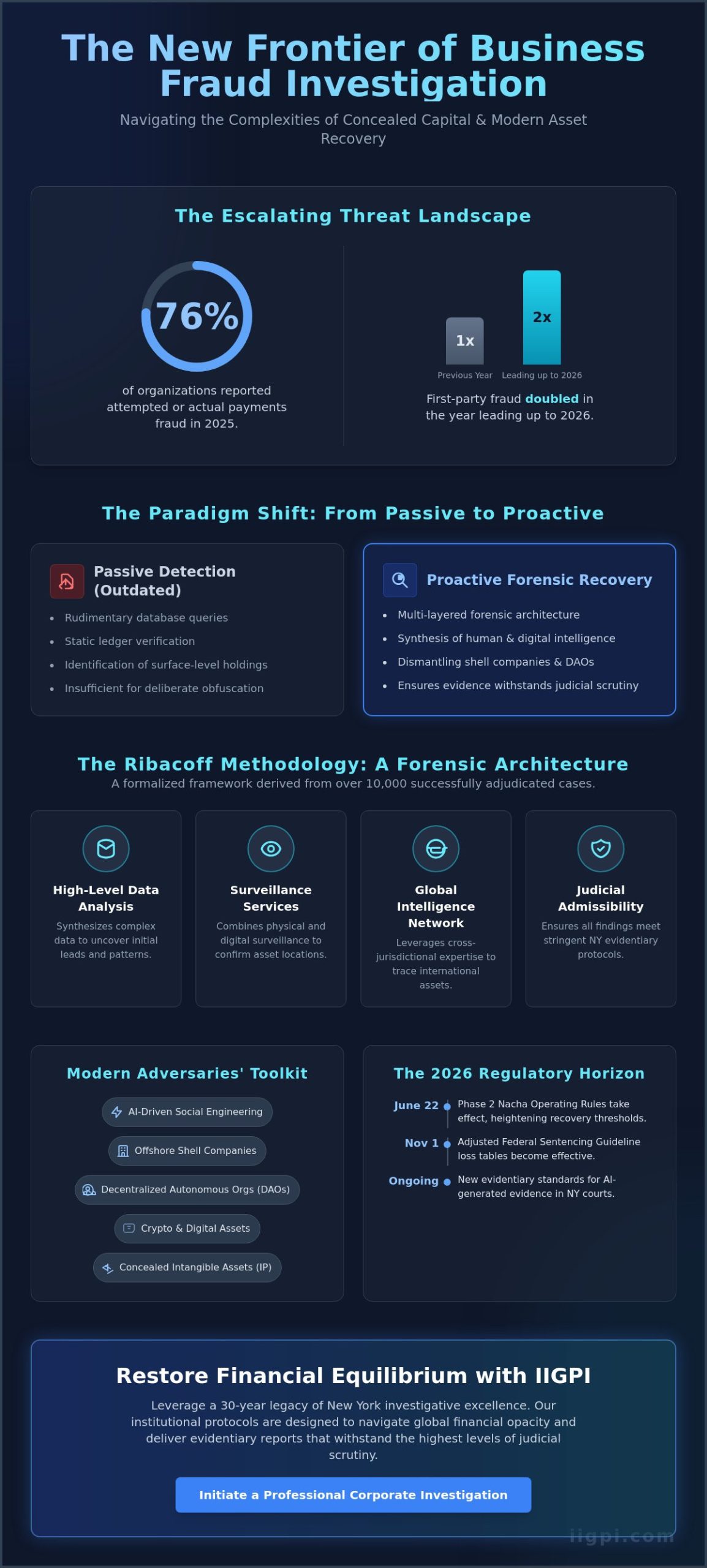
In 2025, 76% of organizations reported experiencing attempted or actual payments fraud, a statistic that reveals a profound systemic vulnerability within the global financial architecture. You likely recognize that as adversaries leverage sophisticated AI-driven social engineering and the deliberate opacity of offshore shell companies, the execution of a professional business fraud investigation requires more than rudimentary database queries. The anxiety surrounding the location of concealed capital is currently compounded by the evolving 2026 regulatory environment, which includes the Phase 2 Nacha Operating Rules taking effect on June 22 and the adjusted loss tables within the Federal Sentencing Guidelines effective November 1.
This article presents an authoritative analysis of modern asset recovery methodologies, synthesizing the forensic expertise of Dan Ribacoff with the expansive global reach of IIGPI to address the complexities of identifying both tangible and intangible assets. We’ll examine a strategic framework designed to produce evidentiary reports that withstand the rigorous standards of New York judicial scrutiny, particularly in light of new evidentiary standards for AI-generated evidence. This preview of institutional protocols offers a pathway to restoring financial equilibrium by navigating the intricate intersections of corporate investigations, due diligence, and international digital asset regulation.
Key Takeaways
- Examine the multi-layered forensic architecture of the Ribacoff Methodology, which synthesizes high-level data analysis with surveillance services to identify concealed capital.
- Learn to manage the complexities of a modern business fraud investigation by tracing wealth through decentralized autonomous organizations and global digital asset ecosystems.
- Understand the stringent evidentiary protocols and chain of custody requirements necessary to ensure investigative findings remain admissible within the New York judicial system.
- Discover how leveraging a global intelligence network facilitates the restoration of financial equilibrium across multiple jurisdictions through professional corporate investigations and due diligence.
- Identify the specialized protocols required to locate and recover intangible assets, such as intellectual property and crypto-assets, amidst increasing geopolitical volatility.
The Paradigm Shift in Business Fraud Investigation and Asset Recovery
Asset investigation is no longer a static exercise in ledger verification; it has evolved into a multi-layered forensic process designed to identify and repatriate concealed wealth. In the current 2026 fiscal environment, characterized by an effective federal funds rate of 3.62% and significant geopolitical volatility, the mechanisms utilized to obscure capital have become increasingly sophisticated. This evolution necessitates The Paradigm Shift in Business Fraud Investigation and Asset Recovery, transitioning from simple database queries to a strategic architecture of human intelligence and digital forensics. While standard inquiries may identify surface-level holdings, a professional business fraud investigation is required to dismantle the layers of shell companies and decentralized structures that characterize modern corporate theft.
The imperative for professional intervention is underscored by the reality that 76% of organizations reported experiencing payments fraud in 2025. As the 2026 regulatory landscape shifts, particularly with the implementation of Phase 2 Nacha Operating Rules on June 22, the threshold for successful recovery has heightened. Traditional database searches don’t suffice when dealing with adversaries who exploit the opacity of global financial systems. A strategic framework must instead prioritize the identification of both tangible and intangible assets through a synthesis of surveillance services and computer forensics. It’s essential for high-stakes litigation where the admissibility of findings can determine the restoration of financial equilibrium, especially as first-party fraud doubled in the year leading up to 2026.
From Passive Detection to Proactive Forensic Recovery
Standard due diligence protocols don’t usually account for the deliberate obfuscation employed by sophisticated adversaries who operate outside of good-faith reporting structures. The transition from passive detection to proactive forensic recovery demands a shift from identifying “what is owned” to an exhaustive analysis of “how it was hidden.” Establishing financial transparency is not merely a legal strategy but a core requirement for robust corporate governance. This methodology ensures that the identification of assets remains resilient against the opacity of offshore jurisdictions and the complexities of modern embezzlement schemes. The urgency of recovery is also intensified by the U.S. Sentencing Commission’s adjustments to the loss tables for economic crimes, effective November 1, 2026, which may alter the legal leverage available during restitution negotiations.
The Role of IIGPI in Mitigating 2026 Financial Opacity
IIGPI maintains a 30-year legacy as a cornerstone of New York investigative excellence, providing the intellectual rigor necessary to navigate today’s opaque financial landscapes. By integrating the precision of law enforcement methodologies into private sector asset tracing, the organization addresses the specific needs of high-stakes litigation. For those seeking a deeper understanding of these systemic defenses, the Corporate Fraud Investigation Pillar provides an essential framework for institutional protection. The organization’s expertise in due diligence and surveillance services ensures that every business fraud investigation is conducted with the gravity and technical depth required to withstand judicial scrutiny.
The Ribacoff Methodology: A Forensic Architecture for Identifying Concealed Capital
The Ribacoff Methodology represents a formalized investigative framework derived from over 10,000 successfully adjudicated cases, providing a structured approach to a business fraud investigation that ensures the pursuit of concealed capital isn’t left to chance. Central to this architecture is the deliberate synthesis of tactical surveillance services and high-level data analysis. This dual-track strategy acknowledges that while digital footprints provide a baseline skeleton of financial activity, physical observation provides the necessary context to confirm asset possession. The methodology prioritizes intellectual rigor over simple data collection, ensuring every investigative action serves a specific strategic end.
In specialized instances involving fine arts loss investigations or high-value jewelers loss investigations, the methodology employs a proactive ‘Sting’ philosophy. This posture involves orchestrating controlled scenarios where the subject is compelled to reveal the location or existence of physical assets that have been omitted from official disclosures. Such operations require extreme precision and a deep understanding of the criminal psychology behind specie loss. The initial intelligence assessment remains the most critical juncture of the process, as it defines the strategic trajectory and resource allocation for the entire recovery effort, preventing the waste of capital on low-probability leads.
Phase I: Intelligence Synthesis and Risk Mapping
Phase I focuses on the exhaustive synthesis of available data to create a comprehensive risk map of the subject’s financial ecosystem. Investigators establish known associations and baseline financial footprints by utilizing proprietary intelligence networks that bypass traditional information silos. This phase ensures that the scope of the investigation is precisely calibrated, maximizing the return on investment for the client by focusing resources on high-probability recovery vectors. Adhering to Judicial Rigour: Maintaining Evidentiary Admissibility is paramount during this initial data gathering to prevent the contamination of future legal proceedings or the dismissal of critical evidence.
Phase II: Tactical Field Operations and Human Intelligence
Phase II transitions into tactical field operations where elite teams are deployed to provide professional surveillance services. These operations aim to observe lifestyle indicators and physical assets that contradict the subject’s reported financial status. Human intelligence (HUMINT) plays a decisive role here, as it often uncovers assets that lack a digital paper trail, such as physical holdings in private vaults or undocumented luxury acquisitions. These field findings are seamlessly integrated into a cohesive evidentiary report, providing legal counsel with the authoritative documentation required to achieve financial restoration. Organizations seeking to initiate this process can leverage the specialized surveillance services offered by IIGPI to establish the necessary groundwork for recovery.
Tracing Intangible Assets within Complex Digital and Corporate Ecosystems
In the 2026 financial paradigm, intangible assets, encompassing intellectual property, digital proprietary data, and complex crypto-assets, represent the primary frontier for asset concealment. A professional business fraud investigation must navigate the intricate architecture of Decentralized Autonomous Organizations (DAOs), where traditional notions of ownership are obscured by smart contracts and algorithmic governance. Tracing wealth through these decentralized ecosystems requires a sophisticated understanding of both international digital asset regulation, such as the CLARITY Act, and the technical mechanisms of blockchain obfuscation. As adversaries increasingly utilize these systems to bypass traditional banking oversight, the ability to synthesize digital forensics with corporate intelligence becomes the decisive factor in financial restoration.
The complexity of modern fraud necessitates a methodology that transcends surface-level ledger examination, focusing instead on the systemic frameworks used to hide capital. Digital forensics plays a central role in this process, particularly in the recovery of deleted financial records and encrypted communication that subjects believe to be permanently erased. These recovered data points often serve as the primary evidence required to link a subject to a specific asset or offshore entity. By dismantling these digital defenses, investigators provide the evidentiary weight necessary to withstand the rigorous standards of high-stakes litigation.
Cryptocurrency Forensics and Decentralized Wealth Tracing
The identification of digital wealth necessitates the application of advanced blockchain analysis to delineate transaction paths and establish definitive wallet ownership. While adversaries frequently utilize “tumblers” or privacy coins to anonymize capital flow, forensic protocols allow for the de-anonymization of specific entry and exit nodes within the ecosystem. For an exhaustive technical overview of these investigative standards, professionals should consult the Computer Forensics Guide, which outlines the procedural requirements for maintaining digital integrity. This technical rigor ensures that findings regarding decentralized wealth are both accurate and legally defensible.
Piercing the Corporate Veil of Multi-Layered Shell Entities
The strategic deployment of nominee directors and offshore trusts creates a facade of legitimacy that often masks the true beneficial owners of fraudulent proceeds. Piercing this veil requires an analytical protocol that maps global corporate affiliations and identifies hidden subsidiaries across disparate jurisdictions. IIGPI agents specialize in identifying “lifestyle-to-income” discrepancies, a critical metric where the observed physical assets of a subject contradict their documented corporate earnings. This synthesis of human intelligence and corporate mapping is essential for uncovering the proceeds of corporate theft. The Association of Certified Fraud Examiners (ACFE) emphasizes that such investigations must be conducted with the highest degree of procedural correctness to ensure that findings regarding beneficial ownership remain admissible in court.
Judicial Rigour: Maintaining Evidentiary Admissibility in Business Fraud Litigation
The efficacy of a business fraud investigation is ultimately determined by the admissibility of its findings within the rigorous jurisprudential standards of the New York judicial system, where the failure to maintain absolute procedural integrity can result in the summary dismissal of critical evidence. Unlike “rogue” operators who may bypass ethical boundaries for immediate results, professional firms operate within a framework of judicial rigour that ensures every data point is beyond reproach. This institutional commitment to legal standards is essential in high-stakes federal cases where the opposition will aggressively challenge the provenance of every document and digital artifact. Establishing a defensible foundation isn’t merely a procedural necessity; it’s the primary mechanism for ensuring that financial restoration is achieved through legitimate channels.
Chain of Custody and Forensic Documentation Standards
Phase I and II methodologies, as previously discussed, rely heavily on the integrity of forensic documentation standards to withstand cross-examination. In multi-million dollar recovery cases, the chain of custody for both digital and physical evidence must be documented with a granularity that excludes any possibility of tampering or unauthorized access. IIGPI maintains these rigorous standards by ensuring all surveillance and computer forensics data are collected and stored according to strict courtroom protocols. The firm’s status as a licensed, bonded, and insured entity in New York City provides an additional layer of institutional accountability, confirming that its operations are conducted under the oversight of regulatory authorities. It’s this level of technical precision that transforms raw data into actionable legal intelligence.
Expert Testimony: The Strategic Influence of Dan Ribacoff
The strategic influence of an expert witness often serves as the tipping point in complex litigation, providing the evidentiary leverage necessary to secure favorable settlements or judicial rulings. Dan Ribacoff’s extensive history as an expert witness in high-stakes federal cases demonstrates how authoritative testimony can synthesize complex investigative findings into a coherent and persuasive narrative for the court. This level of expertise provides legal counsel with the technical depth required to challenge sophisticated concealment tactics effectively. For a more comprehensive understanding of these professional parameters, one should examine The Role and Function of a Private Investigator. Organizations facing significant capital loss can secure their recovery efforts by engaging the professional corporate investigations services of IIGPI to ensure their evidence remains unimpeachable.
Strategic Execution: Leveraging Global Intelligence Networks for Asset Restoration
Global intelligence networks serve as the primary mechanism for bridging the gap between domestic litigation and international asset pools, providing the reach necessary to penetrate opaque financial jurisdictions. While public law enforcement entities prioritize criminal prosecution, the restoration of capital for private victims of corporate theft requires a specialized business fraud investigation that operates with a focus on civil recovery. IIGPI’s multi-jurisdictional network has demonstrated its capability through landmark recoveries, most notably a $120 million bank fraud case that necessitated the simultaneous coordination of tactical surveillance services and computer forensics across several continents. This level of strategic execution ensures that assets hidden within complex global systems are identified and secured before they’re further dissipated by sophisticated actors.
The organization’s ability to operate within the highest levels of power and influence allows for the identification of tangible and intangible assets that traditional database queries consistently overlook. By leveraging a research-driven architecture, investigators can dismantle the systemic frameworks used by adversaries to conceal wealth. This process isn’t merely about data collection; it’s an intellectual exercise in understanding how capital flows through international systems. It’s this global-minded perspective that positions the organization as a leading authority in the pursuit of financial restoration for elite institutions and decision-makers.
Navigating Multi-Jurisdictional Legal Nuances
Tracing capital through the European Union, the Caribbean, and Asia requires a profound understanding of local privacy laws and financial regulations to ensure that evidentiary findings remain admissible within the New York judicial system. Having professional operatives in major global financial hubs allows the organization to bypass the limitations of remote data analysis, providing the human intelligence necessary to confirm the location of physical holdings. A significant case study involved the successful location of foreign government entity assets within the United States, a process that demanded the synthesis of due diligence and tactical surveillance to overcome institutional opacity. These operations highlight the necessity of an elite investigative presence that can navigate the specific socioeconomic and geographic dynamics of diverse regions without compromising the integrity of the findings.
Initiating the Recovery Protocol with IIGPI
The restoration of financial equilibrium is heavily dependent on the immediacy of the response, as delays often provide adversaries with the opportunity to facilitate asset “flight” or further concealment. Initiating a high-stakes business fraud investigation involves a transition from internal audit to an external forensic architecture designed for judicial success and the identification of concealed wealth. During the initial consultation with Dan Ribacoff, clients can expect a rigorous intellectual assessment of their case to define the most effective recovery vectors and strategic resource allocation. To secure institutional assets and begin the process of forensic restoration, decision-makers should Contact International Investigative Group for a confidential consultation regarding their specific investigative requirements.
Securing Financial Restoration through Forensic Excellence
The evolution of global financial structures necessitates a corresponding advancement in investigative protocols to ensure the successful recovery of capital. As we’ve explored, the transition from rudimentary inquiries to a multi-layered business fraud investigation is the only viable path toward navigating the complexities of 2026’s regulatory and digital landscapes. By synthesizing the proprietary Ribacoff Methodology with the expansive reach of a global agent network, organizations can bypass the inherent opacity of offshore entities and decentralized systems.
International Investigative Group remains a definitive authority in this discipline, having successfully adjudicated over 10,000 cases and recovered millions in assets for a prestigious clientele. Led by Dan Ribacoff, who’s recognized as one of the top 15 investigators in the United States, our firm provides the technical depth and judicial rigor required to ensure that every finding withstands the highest levels of legal scrutiny. This institutional expertise offers a strategic advantage in the pursuit of financial restoration and systemic equilibrium. To protect your organization’s future and recover what’s been obscured, we invite you to Secure Your Financial Interests with a Confidential Asset Consultation. It’s possible to overcome even the most sophisticated concealment tactics when leveraging elite forensic intelligence.
Frequently Asked Questions
What exactly is a business fraud investigation, and how does it differ from a background check?
A professional business fraud investigation is a multi-layered forensic architecture designed to identify concealed wealth and dismantle systemic obfuscation, which distinguishes it from a background investigation that typically focuses on a static review of public records. While background checks provide a historical baseline of an individual’s professional or personal trajectory, a fraud inquiry actively pursues the mechanisms utilized to hide capital through complex corporate structures and offshore jurisdictions. This process requires a sophisticated synthesis of human intelligence and digital forensics to uncover the truth behind deliberate financial deception.
Can Dan Ribacoff and IIGPI locate assets hidden in offshore bank accounts or tax havens?
Dan Ribacoff and the IIGPI global network possess the multi-jurisdictional reach required to identify assets obscured within offshore bank accounts and international tax havens. By leveraging on-the-ground human intelligence in major financial hubs, the organization bypasses the limitations of domestic database queries to uncover the beneficial ownership of assets held in opaque jurisdictions. This global capability is essential for dismantling the facades created by shell companies and international trusts that are specifically designed to frustrate traditional investigative efforts.
How long does a comprehensive asset investigation typically take to complete?
The duration of a comprehensive asset investigation depends on the complexity of the subject’s financial ecosystem and the degree of deliberate concealment employed by the adversary. While preliminary intelligence synthesis can be completed relatively quickly, the exhaustive tracing of wealth through multi-layered shell companies and international trusts often requires a more sustained commitment of forensic resources. Each case presents unique jurisdictional challenges that dictate the timeline for achieving a definitive identification of all tangible and intangible holdings.
Is the information gathered by a private investigator admissible in a New York court?
Evidence gathered during a business fraud investigation is admissible in New York courts provided it’s collected in strict adherence to established evidentiary standards and chain of custody protocols. IIGPI ensures that all surveillance findings and computer forensics data are documented with the technical precision necessary to withstand the rigorous scrutiny of high-stakes litigation and federal oversight. This commitment to judicial rigour transforms raw investigative data into authoritative legal intelligence that can be used to secure favorable settlements or judgments.
What types of assets can be uncovered during a professional business fraud investigation?
Professional inquiries uncover a diverse spectrum of holdings, ranging from tangible assets like high-value real estate and luxury specie to intangible assets such as intellectual property and corporate subsidiaries. The investigative process aims to identify every component of a subject’s financial footprint, including those obscured by nominee directors or held within decentralized autonomous organizations. By mapping these diverse asset classes, investigators provide a comprehensive overview of the subject’s true net worth, which is essential for financial restoration.
How does IIGPI handle the tracing of cryptocurrency and other digital assets?
IIGPI utilizes advanced computer forensics and blockchain analysis to de-anonymize wallet ownership and trace the movement of cryptocurrency across decentralized networks. This methodology addresses the technical challenges posed by privacy coins and mixers, ensuring that digital wealth is identified and documented for potential recovery or judicial freezing. As the regulatory landscape for digital assets continues to evolve in 2026, maintaining this level of technical expertise is critical for successfully navigating the intersection of traditional and decentralized finance.
What is the cost structure for a high-stakes corporate asset search?
The financial commitment required for a high-stakes corporate asset search is determined by the scope of the investigation and the geographic diversity of the asset pools being pursued. Because every case involves unique levels of obfuscation and jurisdictional complexity, clients should examine the specific requirements of their situation during an initial consultation. This approach ensures that the resource allocation is precisely calibrated to the probability of recovery and the overall scale of the financial restoration effort.
Why is Dan Ribacoff considered one of the top 15 investigators in the United States?
Dan Ribacoff’s designation as one of the premier investigators in the United States is a result of his 30-year legacy of excellence and his successful adjudication of over 10,000 cases. His extensive experience as an expert witness in federal court and his development of proprietary forensic methodologies have established him as a leading authority in the identification and recovery of concealed wealth. This reputation is further reinforced by his ability to lead a global network of agents in executing complex, multi-jurisdictional recoveries.