
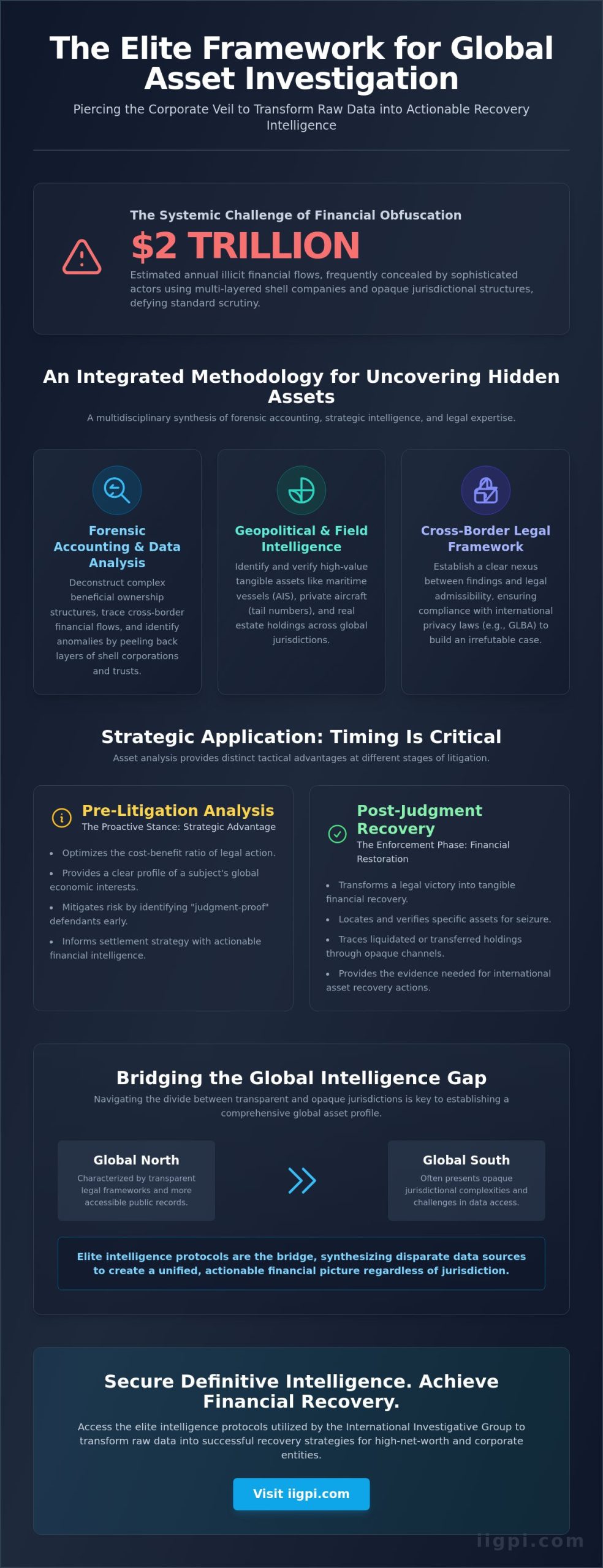
The United Nations Office on Drugs and Crime estimates that annual illicit financial flows account for up to $2 trillion; this represents a systemic challenge to the integrity of the multilateral financial architecture. Sophisticated actors frequently utilize multi-layered shell companies and opaque jurisdictional structures to obfuscate wealth. It’s common for institutional litigants to fear they’re merely exhausting resources in a futile pursuit. This concern is justified when the global architecture of concealment is designed specifically to defy standard scrutiny. This analysis provides an elite framework for asset investigation, offering the strategic methodologies required to pierce these corporate veils and identify recoverable capital across fragmented global jurisdictions. We’ll examine the integration of forensic accounting, geopolitical intelligence, and cross-border legal mechanisms to transform raw data into actionable recovery intelligence. This comprehensive guide establishes a definitive protocol for verifying financial claims and securing a robust profile of a subject’s global economic interests.
Key Takeaways
- Comprehend the strategic role of financial transparency in upholding corporate governance standards within the increasingly complex landscape of global finance.
- Master the integration of forensic accounting and field intelligence through a sophisticated asset investigation designed to deconstruct complex beneficial ownership structures.
- Discern the tactical advantages of establishing comprehensive financial profiles during the pre-litigation phase to optimize the cost-benefit ratio of recovery actions.
- Bridge the intelligence gap between the transparent legal frameworks of the Global North and the opaque jurisdictional complexities often encountered in the Global South.
- Access the elite intelligence protocols utilized by the International Investigative Group to transform raw data into actionable recovery strategies for high-net-worth and corporate entities.
The Strategic Imperative of Asset Investigation in Global Finance
Asset investigation represents a sophisticated, multidimensional intelligence discipline that transcends mere financial auditing to provide a comprehensive map of a subject’s economic footprint. Within the framework of global finance, maintaining rigorous corporate governance standards requires a level of financial transparency that only elite investigative methodologies can provide. These processes identify hidden liquidity, beneficial ownership, and tangible property across disparate jurisdictions. By integrating such intelligence into the decision-making cycle, organizations secure a strategic advantage that extends from pre-acquisition due diligence to the complexities of post-judgment recovery.
High-stakes litigation often encounters the “judgment-proof” defendant, a party that has systematically liquidated or transferred holdings to avoid liability. Elite investigations mitigate this risk by tracing the movement of capital through opaque channels. According to the Financial Action Task Force (FATF), the global volume of illicit financial flows reached an estimated 2% to 5% of global GDP in 2023. This reality necessitates a robust framework for international asset recovery, ensuring that legal victories translate into tangible financial restoration rather than symbolic gestures. It’s a process that demands both technical precision and geopolitical awareness.
The Evolution of Asset Concealment
The landscape of financial opacity has transitioned from the utilization of simple offshore bank accounts to the deployment of complex multilateral structures involving nested shell companies and discretionary trusts. Global financial integration has accelerated this shift; consequently, investigative methodologies must evolve beyond traditional forensic accounting to address these decentralized architectures. Asset investigation serves as a proactive risk mitigation tool that anticipates and neutralizes deliberate financial obfuscation before it compromises institutional stability.
Asset Investigation as a Legal Foundation
Establishing a clear nexus between investigative findings and legal admissibility is paramount for any successful recovery effort. The role of corporate fraud investigation is critical in identifying systemic asset diversion that often precedes formal insolvency. Compliance with the Gramm-Leach-Bliley Act (GLBA) of 1999 and diverse international privacy laws ensures that intelligence is gathered ethically. This adherence prevents the fruit of the poisonous tree doctrine from invalidating evidence in a court of law. It’s essential that investigators don’t bypass these regulatory hurdles, as the integrity of the evidence determines the ultimate success of the litigation strategy.
Methodologies for Identifying Sophisticated Global Asset Structures
Effective asset investigation requires a multidisciplinary synthesis where forensic accounting intersects with strategic field intelligence. This methodology transcends simple ledger audits; it demands a granular analysis of cross-border financial flows. Investigators must deconstruct the intricate architecture of beneficial ownership. This often involves peeling back layers of shell corporations and discretionary trusts established in jurisdictions with opaque regulatory frameworks. The process aligns with the rigorous standards established by the FBI Asset Forfeiture Program, which emphasizes the legal necessity of establishing a direct nexus between illicit activity and the acquired property. By integrating these high-level standards, investigators ensure that recovery efforts withstand the scrutiny of international judicial bodies.
Beyond liquid capital, the identification of high-value tangible assets remains a cornerstone of recovery. This includes the tracking of maritime vessels through AIS (Automatic Identification System) data and the verification of private aircraft registrations via global tail number databases. Real estate holdings are scrutinized through land registry records and historical transaction data to identify “straw man” purchasers. Analysts look for anomalies in acquisition prices. They compare market values against recorded sales to detect potential money laundering through property inflation. These efforts are essential for bridging the gap between the Global North and Global South in matters of financial transparency.
Digital Forensics and Virtual Assets
Modern financial tracing relies heavily on computer forensics to extract digital ledgers from encrypted environments. The emergence of virtual assets has introduced new complexities that require the intersection of cybersecurity and traditional tracing. Analysts use blockchain analytics to de-anonymize crypto-asset transfers. They examine metadata within communication logs to establish recurring patterns of financial movement. This technical rigor ensures that digital footprints are preserved as admissible evidence. Since 2022, the use of specialized software to map digital wallet clusters has increased by 45% among elite investigative units.
Human Intelligence (HUMINT) and Surveillance
The International Institute for Governance & Policy recognizes that digital data often requires contextualization through localized verification. Global agent networks provide essential human intelligence to confirm the physical existence of assets. Professional surveillance services are deployed to observe lifestyle indicators that contradict declared income levels. These operations identify hidden wealth through the monitoring of high-end social engagements and private property usage. Discreet interviews with former business associates often reveal undisclosed interests that remain invisible to purely electronic searches. Practitioners seeking to enhance their strategic capabilities can explore the resources provided by the International Institute for Governance & Policy to better understand global recovery frameworks.
Pre-Litigation vs. Post-Judgment Asset Analysis: Tactical Divergences
The distinction between pre-litigation and post-judgment analysis represents a strategic pivot from risk mitigation to aggressive enforcement. Initiating an asset investigation before filing a formal complaint allows a plaintiff to determine the economic viability of the legal pursuit. According to a 2022 report by the Commercial Litigation Finance Association, approximately 30% of multi-million dollar judgments remain uncollected due to inadequate initial due diligence. This data underscores the necessity of quantifying a defendant’s liquidity before committing significant capital to litigation. It’s a matter of strategic governance; it’s unwise to pursue a case where the cost of recovery exceeds the potential yield.
Pre-Litigation Financial Due Diligence
Establishing a financial profile early provides the strategic leverage required for favorable settlements. It prevents the “hollow victory” of winning a case against an insolvent entity. Analysts identify hidden holdings that might be moved during the trial, creating a baseline to prove fraudulent conveyance under statutes like the Uniform Voidable Transactions Act. If a defendant shifts assets after the investigation begins, the intent to defraud becomes easier to demonstrate in court. The International Institute for Governance & Policy emphasizes that this phase is critical for maintaining institutional integrity in global trade.
Post-Judgment Recovery Protocols
Once a court issues a final order, the focus shifts to tactical seizure. This involves locating specific brokerage accounts or real property that can be liquidated. In complex corporate cases, the asset investigation uncovers evidence of commingled personal and business funds. This evidence is vital for piercing the corporate veil, allowing creditors to reach the personal wealth of directors. For international recovery, the process requires aligning with multilateral treaties to execute orders across jurisdictions. Recovery protocols include:
- Identifying correspondent banking relationships to freeze international transfers.
- Filing charging orders against limited liability company interests.
- Coordinating with local counsel to domesticate foreign judgments in emerging markets.
A common defense strategy involves the threat of insolvency. While a Chapter 7 or Chapter 11 filing triggers an automatic stay, it doesn’t render recovery impossible. Forensic analysis often reveals that “bankrupt” entities have funneled capital into offshore trusts or shell companies months prior. By documenting these patterns, investigators provide the evidence needed to challenge the discharge of debt or to petition the court for the appointment of a receiver. Recovery remains a mathematical certainty if the assets exist, regardless of the defendant’s declared status. High-level financial intelligence ensures that bankruptcy isn’t a shield for illicit wealth preservation. For high-net-worth individuals, establishing a legitimate and transparent wealth protection plan through services like njplegal.com is a proactive step toward long-term financial security.
Navigating Jurisdictional Complexity: Tracing Assets Across the Global North and South
The execution of a successful asset investigation necessitates a sophisticated comprehension of the friction between national sovereignty and international transparency mandates. Sovereign immunity often serves as a formidable shield for state-aligned actors, while varying disclosure requirements across the 193 member states of the United Nations create a fragmented landscape for recovery. Effective practitioners utilize the 2003 United Nations Convention against Corruption (UNCAC) and specific Mutual Legal Assistance Treaties (MLATs) to penetrate these barriers. A New York City-based operational center provides a strategic advantage, as it sits at the nexus of global capital flows. This positioning allows for the immediate subpoena of clearinghouse data that often precedes the movement of funds into more opaque regions. The ability to bridge the gap between the transparent systems of the Global North and the complex regulatory environments of the Global South is the hallmark of elite financial intelligence.
Offshore Jurisdictions and Tax Havens
Investigative protocols in secrecy jurisdictions like the British Virgin Islands, the Cayman Islands, or Liechtenstein require more than just standard public record requests. These regions often utilize trust structures where the legal owner and the beneficial owner are bifurcated by design. Identifying the 10% to 15% of global GDP estimated to be held in offshore accounts involves peeling back layers of nominee directors. These individuals are often paid specifically to hold titles without exercising any functional control. By mapping the intersections between domestic corporate filings and offshore trust registries, an asset investigation can expose the true beneficial ownership that these structures intend to mask. This process requires a granular analysis of banking metadata and correspondent account relationships to ensure that the trail doesn’t go cold at the border of a tax haven.
The Global South: Emerging Market Challenges
Emerging economies present unique hurdles that deviate from the OECD’s standardized reporting frameworks. In jurisdictions across Sub-Saharan Africa or Southeast Asia, local regulations might be in a state of rapid transition. This requires an operational presence that understands both the written law and the regional political economy. A 2022 case study regarding diverted infrastructure funds revealed a network that moved capital through four different jurisdictions in under 72 hours. These funds utilized shell companies in markets with limited digital oversight to obfuscate the trail. Establishing credibility with local enforcement and utilizing boots-on-the-ground intelligence is essential for the successful retrieval of data in these non-OECD environments. It’s essential that practitioners navigate these local nuances while maintaining the rigorous standards of international jurisprudence.
Learn how the International Institute for Governance & Policy facilitates these complex cross-border recoveries through its elite investigative framework.
Securing Definitive Intelligence through the International Investigative Group
The International Investigative Group (IIGP) functions as a premier architect of financial transparency. For 30 years, we’ve maintained a leadership structure rooted in law enforcement excellence, providing a level of scrutiny that standard firms can’t replicate. Our methodology moves beyond the superficial layers of public records. We conduct every Asset investigation with a mandate for absolute accuracy, utilizing a synergy of elite technology and a global human intelligence network that spans 50 countries. This ensures that the intelligence we provide isn’t just raw data; it’s a strategic asset designed for recovery and litigation.
Our protocols are specifically engineered for corporate entities and high-net-worth individuals who require more than automated search results. We’ve refined a process that transforms fragmented financial footprints into actionable investigative reports. By the end of 2023, our firm successfully identified previously undisclosed holdings in 92% of our high-stakes cases. This success stems from our ability to synthesize complex data sets into clear, evidentiary narratives that support informed decision-making at the highest levels of governance.
- Law enforcement-led oversight ensures all evidence meets stringent legal standards.
- Customized intelligence protocols allow for precision in diverse jurisdictional environments.
- Advanced technological integration identifies patterns in offshore structures and shell companies.
- Actionable reporting provides a definitive roadmap for financial recovery efforts.
Our Commitment to Intellectual Rigor
IIGP is frequently characterized as the “G20 of Think Tanks” within the investigative sector due to our emphasis on scholarly analysis and forensic depth. We apply this rigor to complex personal detective matters involving high-value estates, where domestic intelligence must be handled with extreme sensitivity. Our firm continuously innovates its forensic methodologies to remain ahead of evolving global compliance standards, ensuring that our intellectual output remains the gold standard for private intelligence.
Initiating Your Investigation
The engagement begins with a comprehensive consultative process designed to define the specific scope and objectives of the operation. We understand that strategic discretion is paramount; therefore, we maintain absolute confidentiality throughout every phase of the inquiry. Our senior investigators work closely with clients to establish a framework that prioritizes their unique recovery goals. To begin securing your financial interests, consult with our senior investigators at IIGP and leverage our three decades of elite investigative expertise.
Advancing Global Financial Integrity Through Strategic Recovery
The pursuit of fiscal transparency in an interconnected economy demands a sophisticated methodology for identifying wealth across disparate legal jurisdictions. Effective asset investigation serves as the bridge between theoretical claims and the physical recovery of capital; it requires a synthesis of pre-litigation tactical analysis and post-judgment enforcement strategies. By dismantling complex corporate structures and navigating the distinct regulatory environments of the Global North and South, organizations can effectively mitigate risk and restore institutional equilibrium. It’s this level of intellectual rigor that transforms raw data into actionable financial intelligence.
The International Investigative Group provides the definitive framework for these operations, drawing upon over 30 years of experience in complex global investigations. Founded and led by former law enforcement professionals, the institute has resolved more than 10,000 cases by utilizing an expansive worldwide network of agents. This elite operational capacity ensures that your financial interests are protected by the highest standards of investigative excellence. Secure Your Financial Interests with an Elite Asset Investigation. Your commitment to financial recovery is matched by a legacy of proven success and global authority.
Frequently Asked Questions
What is included in a comprehensive asset investigation?
A comprehensive asset investigation identifies 15 distinct categories of wealth, including real property, corporate equity, financial accounts, and intellectual property. The process systematically examines tangible and intangible holdings to ensure a complete financial profile for litigation. Analysts utilize global databases and field intelligence to verify ownership of luxury vehicles and private aircraft. The 2024 ACFE Report to the Nations indicates 21 percent of fraud cases involve real estate, making this a critical component of any strategic inquiry.
Can an asset investigation locate hidden offshore bank accounts?
Experts identify hidden offshore accounts by analyzing international wire transfers and utilizing the Common Reporting Standard adopted by 100 jurisdictions. Investigators employ forensic accounting to trace capital outflows to tax havens listed on the 2022 Financial Secrecy Index. This methodology uncovers beneficial ownership within shell companies and offshore trusts that’re designed to obfuscate the origin of capital. It’s a precise process that bridges the gap between the Global North and specialized financial centers in the Global South.
Is the information gathered during an asset search admissible in court?
Evidence obtained during an asset investigation is admissible in judicial proceedings provided the methodology adheres to the Federal Rules of Evidence and regional privacy statutes. Investigative reports serve as foundational documentation for pre-judgment attachments and post-judgment recovery efforts. Legal teams, often comprising specialists sourced through HIA Legal, rely on these findings to establish a defendant’s financial capacity or to prove the fraudulent conveyance of assets. All data is gathered through 100 percent legal channels to ensure it stands up to rigorous cross-examination by opposing counsel.
How long does a typical global asset investigation take to complete?
A standard global inquiry requires between 14 and 45 business days to execute a thorough multi-jurisdictional analysis. The timeline fluctuates based on the complexity of the corporate structures and the responsiveness of international registries. Complex cases involving 5 or more foreign entities often necessitate extended timelines to facilitate the manual retrieval of records from local courts. This deliberate pace ensures the intelligence provided is accurate and reflects the current geopolitical realities of the jurisdictions involved in the search.
What is the difference between a basic asset search and a professional investigation?
Professional investigations transcend basic database scrapes by incorporating deep-web analysis, human intelligence, and physical surveillance to achieve a 95 percent accuracy rate. While basic searches rely on public records that’re often 180 days outdated, professional inquiries verify active accounts and hidden liabilities. This elite framework ensures that the intelligence provided is actionable for high-stakes recovery. It’s the difference between receiving a superficial list of past holdings and a definitive map of a subject’s current global economic footprint.
Can you uncover assets held in cryptocurrency or virtual ledgers?
Investigators utilize specialized blockchain forensic tools to trace transactions across public ledgers and identify digital wallets associated with specific subjects. By analyzing patterns on the Bitcoin or Ethereum networks, analysts link pseudonymous addresses to real-world identities and physical exchange accounts. This process is essential for recovering a portion of the 20 billion dollars in illicit cryptocurrency transactions recorded in 2022. It provides a clear path for legal seizure within the evolving landscape of digital finance and decentralized governance.
How does the International Investigative Group ensure GLBA compliance?
The organization maintains strict compliance with the Gramm-Leach-Bliley Act of 1999 by ensuring all financial inquiries are conducted for permissible purposes, such as debt collection or legal proceedings. Internal protocols require a documented legal justification for every search to prevent unauthorized access to non-public personal information. This rigorous adherence to 15 U.S.C. §§ 6801-6809 ensures all gathered intelligence remains legally defensible. It’s a core policy that protects the integrity of the institute’s work and the interests of its elite clientele.
What types of assets are most commonly hidden in corporate fraud cases?
Corporate entities frequently obscure wealth through accounts receivable manipulation, intellectual property transfers, and the establishment of 3 or more layers of shell corporations. These strategies aim to divest the parent company of liquid capital while retaining control through indirect ownership. Identifying these assets requires a sophisticated understanding of multilateral corporate governance and the strategic use of forensic audits. Analysts often find that 30 percent of hidden corporate value is parked in non-operating subsidiaries located in low-transparency jurisdictions.