
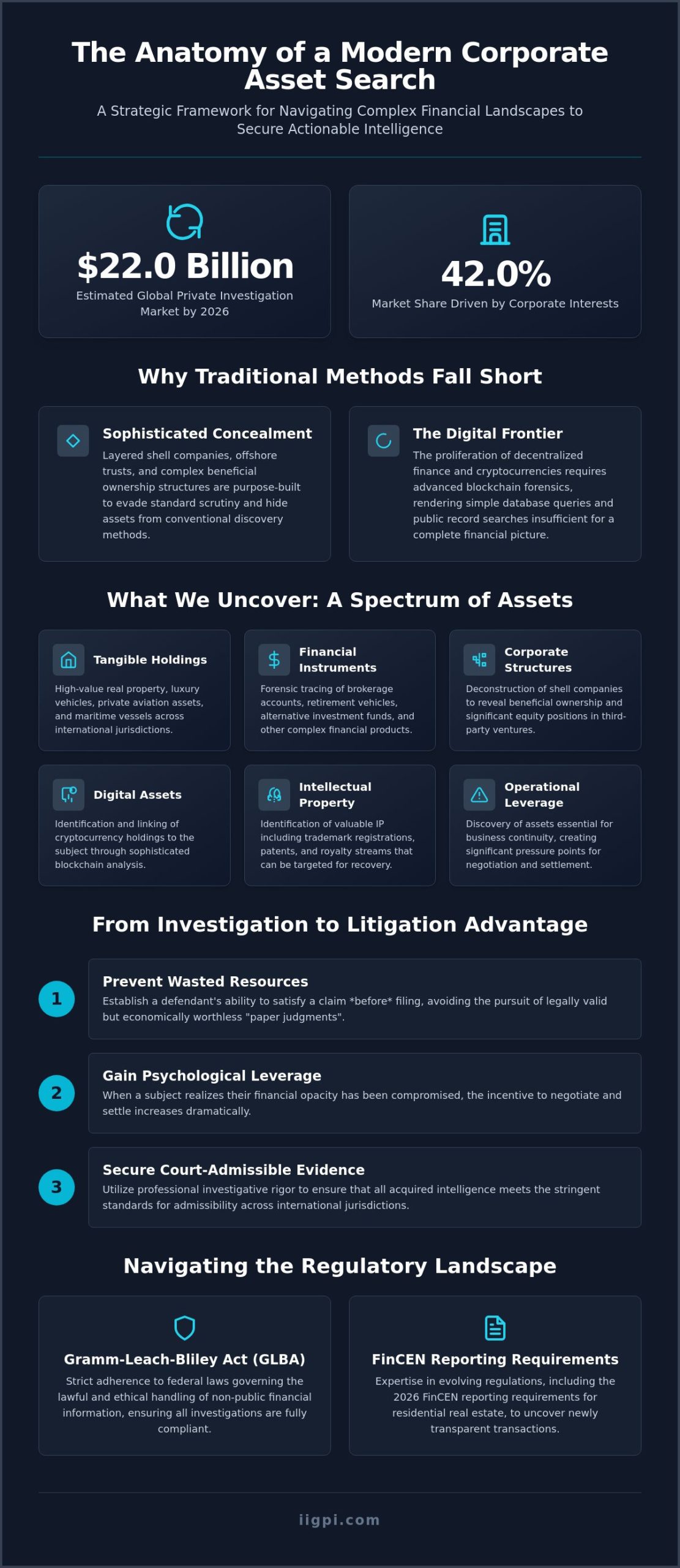
As the global market for private investigation services reaches an estimated 22.0 billion USD in 2026, corporate interests have emerged as the primary drivers of this sector, currently representing 42.0 percent of total market activity. This expansion underscores an era where a rigorous corporate asset search serves as an indispensable instrument for navigating the intricate intersections of international finance and jurisdictional law, particularly as firms bridge the gap between established Western markets and emerging global economies. There is a prevailing understanding among high-level decision-makers that the escalating complexity of offshore shell companies and the rapid proliferation of digital assets have rendered traditional discovery methods insufficient. This reality often engenders significant apprehension regarding the legality of financial inquiries and the ultimate collectability of judgments. This article offers a definitive framework for executing sophisticated asset investigations within the current regulatory environment, including the 2026 FinCEN reporting requirements for residential real estate. We shall examine the integration of forensic digital analysis with traditional investigative rigor to ensure the acquisition of court-admissible evidence. By synthesizing these advanced methodologies, organizations can effectively mitigate risk, recover concealed capital, and establish a position of strategic superiority in contested environments.
Key Takeaways
- Understand the transition from rudimentary public record queries to the systematic identification of complex financial holdings and non-financial assets.
- Develop a rigorous framework for conducting a corporate asset search that encompasses tangible holdings, intricate corporate affiliations, and obscured beneficial ownership structures.
- Learn to apply advanced methodologies to secure actionable intelligence for high-stakes litigation leverage and the vetting of global partners through enhanced due diligence.
- Clarify critical legal parameters of modern investigations, including compliance with the Gramm-Leach-Bliley Act and the evolving 2026 FinCEN reporting requirements.
- Discover how professional investigative rigor ensures the acquisition of evidence that meets the stringent standards of court admissibility across international jurisdictions.
The Strategic Imperative of Professional Asset Investigation
Asset investigation represents the systematic identification and verification of both financial and non-financial holdings held by an entity or individual. While historical practices relied on rudimentary public records, the modern paradigm has shifted toward deep-dive investigative intelligence. This transition is necessitated by the increasing sophistication of financial instruments and the deliberate obfuscation of wealth. A rigorous corporate asset search provides the empirical foundation required to establish a defendant’s ability to satisfy a claim before a single legal motion is filed. These inquiries identify leverage assets that exert significant psychological and financial pressure during settlement negotiations, often accelerating the resolution of complex disputes.
Establishing Financial Transparency in Opaque Markets
Globalization has fundamentally altered the landscape of wealth management, complicating the tracing of capital across disparate jurisdictions. Professional intervention from agencies like International Investigative Group is now essential to penetrate sophisticated concealment strategies, such as layered shell companies or offshore trusts, which are designed to bypass standard scrutiny. Within this context, the asset recovery process demands a methodology that transcends simple database queries. Asset investigation is a multi-layered process involving forensic financial analysis and localized field intelligence.
The ROI of Pre-Litigation Intelligence
The cost-benefit ratio of pre-litigation intelligence is a critical consideration for institutional counsel. Conducting a corporate asset search at the outset of a dispute prevents the misallocation of resources toward entities that are essentially judgment-proof. This intelligence informs the selection of legal strategies and determines the most advantageous jurisdiction for filing. It’s a reality that pursuing a claim without prior financial vetting carries the risk of obtaining a paper judgment, a legally valid but economically worthless document that fails to yield actual recovery.
Strategic leverage is often the most undervalued outcome of professional intelligence. By identifying high-value holdings that a debtor specifically sought to insulate, investigators provide counsel with a powerful psychological advantage. When a subject realizes their financial opacity has been compromised, the incentive to settle increases dramatically. Effective investigation identifies specific pressure points, such as:
- Operational real estate essential for business continuity.
- Intellectual property rights and trademark registrations.
- Undisclosed maritime vessels or aviation assets.
- Significant equity positions in third-party commercial ventures.
Advanced Methodologies in Sophisticated Asset Locates
The execution of a corporate asset search in the contemporary era necessitates a multi-dimensional strategy that transcends the limitations of traditional public record indexing. Sophisticated investigations prioritize the identification of tangible holdings, including high-value real property, luxury vehicle fleets, private aviation assets, and maritime vessels registered in various international jurisdictions. Success in these endeavors requires a granular analysis of corporate affiliations and the deconstruction of complex shell company layers to reveal beneficial ownership structures. This process is often central to navigating the complexities of federal asset seizure and forfeiture, where clear title and ownership must be established with empirical certainty. Beyond physical property, investigators must conduct forensic tracing of brokerage accounts, retirement vehicles, and alternative investment funds. The rise of decentralized finance has introduced a new frontier. It requires advanced blockchain forensics to identify and link cryptocurrency holdings to the subject of an inquiry.
Forensic Accounting and Financial Trail Analysis
Forensic accounting serves as the intellectual backbone of asset tracing, allowing investigators to identify subtle anomalies within financial disclosures that suggest the presence of hidden wealth. By meticulously following the movement of capital through international banking layers, professionals can reconstruct a subject’s true financial profile. This methodology is frequently augmented by the technical protocols detailed in Computer Forensics: A Guide for Corporate and Legal Investigations, which provides the framework for recovering deleted financial records and encrypted communications. These techniques reveal the digital footprints that precede the physical movement of assets.
The Role of Surveillance in Verifying Asset Ownership
While digital data provides a comprehensive theoretical map of wealth, physical surveillance is required to confirm the actual use and possession of non-disclosed luxury assets. This synthesis of human intelligence (HUMINT) and data-driven analysis ensures that lifestyle indicators, such as frequent use of private clubs or undocumented residences, are documented as admissible evidence. Organizations seeking to validate these complex findings often utilize the strategies outlined in Professional Surveillance Services: A Comprehensive Guide for 2026. Engaging a firm like International Investigative Group ensures that these multi-faceted methodologies are applied with the precision required for high-stakes corporate intelligence.
The integration of these advanced methodologies facilitates a comprehensive understanding of an entity’s financial footprint. It is no longer sufficient to rely on singular data streams. Instead, investigators must weave together diverse intelligence threads, from blockchain ledgers and aerial intelligence by DroneWorksIQ to real-world behavioral observations. This holistic approach ensures that no stone is left unturned in the pursuit of financial transparency.
Critical Applications across Legal and Corporate Spectrums
The utility of a corporate asset search extends far beyond simple debt recovery, serving as a foundational element of institutional risk management and sophisticated legal strategy. In the context of corporate due diligence, the systematic verification of a potential partner’s financial standing is essential for uncovering undisclosed liabilities that could jeopardize a merger or acquisition. Similarly, in the aftermath of complex litigation, judgment collection relies entirely on the identification of seizable assets to satisfy court-ordered financial awards; for organizations looking to recover commercial debts in the Hong Kong market, you can check out Whole King Company Limited. This intelligence is equally critical in probate and estate disputes, where the true extent of a decedent’s holdings must be established to ensure equitable distribution among heirs and to prevent the fraudulent diversion of testamentary property. These various applications demonstrate that asset intelligence is not a singular tool but a comprehensive framework for establishing financial truth.
Corporate Fraud and Risk Mitigation
Asset intelligence plays a central role in identifying internal theft and sophisticated embezzlement schemes that often remain undetected by standard auditing procedures. By tracing the flow of illicitly diverted funds into personal holdings or offshore accounts, organizations can initiate the recovery process while simultaneously protecting institutional reputation and shareholder value. This methodology is explored extensively in Corporate Fraud Investigation: A Definitive Guide for Business Leaders. Understanding the mechanisms of asset concealment is a prerequisite for implementing an asset forfeiture program or seeking civil restitution in cases of fiduciary breach.
High-Net-Worth Matrimonial Intelligence
In the sphere of matrimonial and family law, particularly within high-net-worth divorce proceedings, the concealment of marital assets through offshore transfers or complex trust structures is a recurring challenge. Professional investigators employ specialized protocols to identify lifestyle-asset discrepancies, where a party’s visible expenditures far exceed their reported income. These operations require the highest levels of sensitivity and discretion, as detailed in The Modern Personal Detective: Protocols for Private and Domestic Intelligence. Uncovering these hidden interests ensures that the court has a comprehensive financial profile, facilitating a truly equitable settlement based on empirical data rather than self-reported disclosures.
The strategic deployment of these investigative techniques provides a significant advantage in contested environments. It isn’t enough to suspect the existence of wealth. One must prove it. By conducting a comprehensive corporate asset search, legal and corporate professionals can transform suspicion into actionable evidence. This evidence serves as a catalyst for resolution, whether in a boardroom negotiation or a high-stakes courtroom battle, ensuring that financial transparency is maintained across all institutional and private sectors.
Navigating the Regulatory and Ethical Landscape of Asset Searches
The execution of a corporate asset search must occur within a strictly defined jurisprudential framework to ensure both the legality of the inquiry and the ultimate utility of the resulting intelligence. Central to this framework is the Gramm-Leach-Bliley Act (GLBA), which mandates the protection of non-public personal financial information and prohibits the acquisition of such data through deceptive practices. Similarly, the Fair Credit Reporting Act (FCRA) imposes rigorous standards on the collection and use of consumer information, particularly in contexts involving employment or credit evaluation. Adherence to the principle of permissible purpose isn’t a mere procedural formality; it is a statutory requirement that validates the legitimacy of the investigation. Engaging in pretexting, or the use of false pretenses to obtain financial records, represents a significant liability that can lead to criminal sanctions and civil litigation against both the investigator and the client. It’s essential that high-level decision-makers prioritize the retention of licensed professionals who operate with transparency.
Admissibility and the Legal Integrity of Evidence
Evidence obtained through unethical or extralegal means is functionally worthless in a court of law, as the fruit of the poisonous tree doctrine can result in the immediate exclusion of critical findings. For an asset report to serve as the basis for expert testimony, the methodology used to generate that report must withstand the scrutiny of cross-examination and meet the evidentiary standards established by the relevant jurisdiction. Organizations operating within highly regulated environments, such as the New York financial sector, recognize the necessity of retaining a Private Investigator in NYC who possesses an intimate understanding of both local mandates and federal statutory requirements. This specialized knowledge ensures that the intelligence gathered remains a viable asset throughout the entire litigation lifecycle, providing the leverage necessary for a favorable resolution.
International Compliance and Cross-Border Challenges
The complexity of asset tracing increases exponentially when investigations cross international borders, where data privacy regulations like the General Data Protection Regulation (GDPR) in the European Union impose stringent limitations on the processing of personal data. Navigating these disparate legal systems requires an ethical framework that prioritizes compliance while maintaining the effectiveness of global intelligence networks. Working with an elite firm that possesses a former law enforcement pedigree provides a distinct advantage in managing these risks, as such entities are accustomed to the rigorous standards of official investigative protocols. To secure a corporate asset search that meets the highest standards of legal and ethical integrity, institutions should contact International Investigative Group to facilitate their most sensitive financial inquiries.
Ethical rigor is the prerequisite for actionable intelligence. Without a foundation of legal compliance, the most comprehensive financial profile remains a liability rather than a tool for recovery. By aligning investigative goals with the existing regulatory landscape, firms can pursue hidden assets with the confidence that their findings will be respected by judicial and regulatory bodies alike.
Securing Actionable Intelligence with International Investigative Group
International Investigative Group (IIG) maintains a distinguished 30-year legacy, having successfully navigated over 10,000 complex investigative cases for a global clientele. This institutional experience is underscored by a foundational pedigree of former law enforcement professionals. Such a background ensures that every corporate asset search is executed with a level of precision and jurisprudential awareness that exceeds standard commercial offerings. The organization operates through an expansive global agent network. This infrastructure facilitates seamless cross-border asset tracing across diverse socioeconomic and geographic regions, effectively bridging the intelligence gap in both established and emerging markets. By utilizing bespoke investigative strategies, IIG provides the empirical data required by elite institutional leaders to manage risk and secure financial recovery.
The IIG Methodology: Rigor, Discretion, and Results
The institutional commitment to academic-level thoroughness is evident in the depth of every asset report produced by the firm. While rudimentary, database-driven searches often yield fragmented or obsolete information, the IIG methodology utilizes sophisticated forensic techniques to reconstruct a subject’s financial profile from primary sources. This process involves the synthesis of digital forensics, human intelligence, and localized field observations to ensure a comprehensive view of an entity’s holdings. Discretion remains a paramount concern. Protecting the interests of an elite clientele requires a sober and analytical approach to information management, ensuring that sensitive inquiries remain confidential throughout the investigative lifecycle.
Initiating a Strategic Asset Consultation
Engaging with IIG begins with a structured consultation designed to align investigative objectives with specific institutional needs. High-level decision-makers are invited to leverage 30 years of investigative excellence to secure the leverage required for high-stakes litigation or comprehensive due diligence. For those requiring localized expertise within the financial capital of the world, our NYC Private Investigation Services provide unparalleled access to regional intelligence and field assets. The process is deliberate and structured, moving from an initial risk assessment to the delivery of actionable, court-admissible evidence. By conducting a corporate asset search through a firm with a proven law enforcement pedigree, organizations can proceed with the confidence that their financial intelligence is both accurate and legally sound.
Strategic intelligence is the ultimate arbiter of success in contested financial environments. It isn’t enough to identify the existence of assets; one must establish their ownership with the rigor required for judicial scrutiny. Through a combination of global reach and forensic depth, International Investigative Group transforms opaque financial data into the strategic leverage necessary for institutional victory. This commitment to excellence ensures that every client receives the depth of analysis required to navigate the complexities of the modern financial landscape.
Establishing Strategic Dominance through Financial Intelligence
The persistent evolution of global financial systems necessitates an equally sophisticated framework for intelligence gathering. A rigorous corporate asset search has transitioned from a peripheral legal exercise to an essential instrument for institutional risk mitigation and strategic leverage. Success in this domain depends upon the synthesis of forensic digital analysis and traditional investigative rigor, ensuring that findings remain court-admissible and actionable within the 2026 regulatory environment. By prioritizing legal integrity and exhaustive methodology, organizations can effectively deconstruct complex concealment strategies and secure a position of informational superiority. International Investigative Group provides this requisite expertise through more than 30 years of institutional investigative experience. Our firm, founded by former law enforcement professionals, utilizes a global network of elite investigative agents to bridge the gap between opaque data and empirical truth. Engage the expertise of the International Investigative Group for your strategic asset intelligence needs. We look forward to assisting you in transforming financial uncertainty into a definitive foundation for successful litigation and due diligence.
Frequently Asked Questions
What is the primary purpose of a professional corporate asset search?
The primary objective of a professional inquiry is to evaluate the collectability of a judgment or debt by identifying a subject’s tangible and intangible holdings. A corporate asset search serves as a strategic intelligence operation that informs counsel whether pursuing a claim is economically viable. By uncovering real property, equity positions, and intellectual property, the investigation provides the empirical data required for high-stakes litigation leverage.
Is it legal to conduct a bank account search for a private individual?
Federal financial privacy laws strictly prohibit the unauthorized access of specific bank account balances by private investigative firms. Reputable organizations adhere to these statutory limitations, focusing instead on identifying the existence of financial relationships and account locations through legal discovery and forensic accounting. Any attempt to circumvent these protections through pretexting represents a significant legal liability for the client and the investigator alike.
How long does a comprehensive global asset search typically take?
The timeline for a comprehensive global investigation varies significantly based on the complexity of the subject’s financial architecture and the number of jurisdictions involved. While domestic inquiries may reach a preliminary conclusion within several business days, international efforts often require several weeks to navigate foreign records and localized intelligence networks. This deliberate pace ensures that every identified holding is verified with the rigor required for institutional-grade intelligence.
Can an asset investigation uncover cryptocurrency or digital holdings?
Advanced investigative methodologies now include blockchain forensics to identify and link decentralized digital assets to a specific individual or corporate entity. By analyzing public ledgers and transaction patterns, investigators can uncover cryptocurrency holdings that were previously considered anonymous. This capability is essential in the modern era, as digital wealth often represents a significant portion of a subject’s concealed net worth.
What information is required to begin an asset search on an entity?
Initiating a formal inquiry requires the subject’s full legal name, known business aliases, and the primary jurisdiction of operation or incorporation. Providing supplementary data, such as Federal Tax Identification Numbers or historical addresses, enhances the precision of the search and accelerates the identification process. This foundational information allows investigators to begin deconstructing complex corporate layers and beneficial ownership structures.
Are asset investigation reports admissible as evidence in a court of law?
Asset investigation reports are admissible as evidence in a court of law provided that the data was acquired through legal means and adheres to jurisdictional evidentiary standards. When prepared by licensed professionals with a law enforcement pedigree, these reports can serve as the basis for expert testimony or as foundational documents for asset seizure motions. Maintaining the legal integrity of the evidence is paramount for ensuring its utility during contested proceedings.
What is the difference between a database search and a private investigation?
A standard database search relies on aggregated, often historical, public records that may lack accuracy or context. In contrast, a professional corporate asset search involves a multi-layered forensic process that incorporates human intelligence and real-time verification of findings. This comprehensive approach uncovers hidden assets that traditional automated queries inevitably overlook, providing a more reliable financial profile for due diligence.
How does the Gramm-Leach-Bliley Act affect asset locates?
The Gramm-Leach-Bliley Act mandates the protection of non-public personal financial information, significantly restricting how investigators access sensitive data. Compliance requires that every inquiry possess a permissible purpose and avoid deceptive practices like pretexting. This regulatory framework ensures that asset locates are conducted ethically, protecting the institutional reputation of the client while securing actionable intelligence.