
In the high-density economic corridors of Manhattan, the deployment of an armed professional’s no longer viewed merely as a physical deterrent but as a critical component of a sophisticated institutional risk management framework. You’re likely aware that the intersection of New York State General Business Law Article 7 and the volatile threat landscape of 2026 creates a formidable challenge for executive leadership and asset managers. This complexity is exacerbated by the requirement for personnel to navigate the arduous NYS pistol permit process before even commencing the mandatory 47-hour firearms training course.
This analysis offers a rigorous examination of how elite armed security guard services NYC integrate law enforcement-grade tactical proficiency with precise regulatory adherence to safeguard corporate interests. We’ll explore the strategic advantages of intelligence-led protective protocols and the methodologies necessary for mitigating both physical and reputational liabilities within the metropolitan area. By evaluating these high-level security solutions, decision-makers can establish a proactive defense posture that addresses the unique socioeconomic and geographic dynamics of the New York City market.
Key Takeaways
- Synthesize the evolving 2026 risk profile of the metropolitan area to align corporate security requirements with sophisticated institutional risk mitigation frameworks.
- Navigate the intricate regulatory landscape of the New York State Security Guard Act to ensure full compliance with mandatory certification and firearms registration protocols.
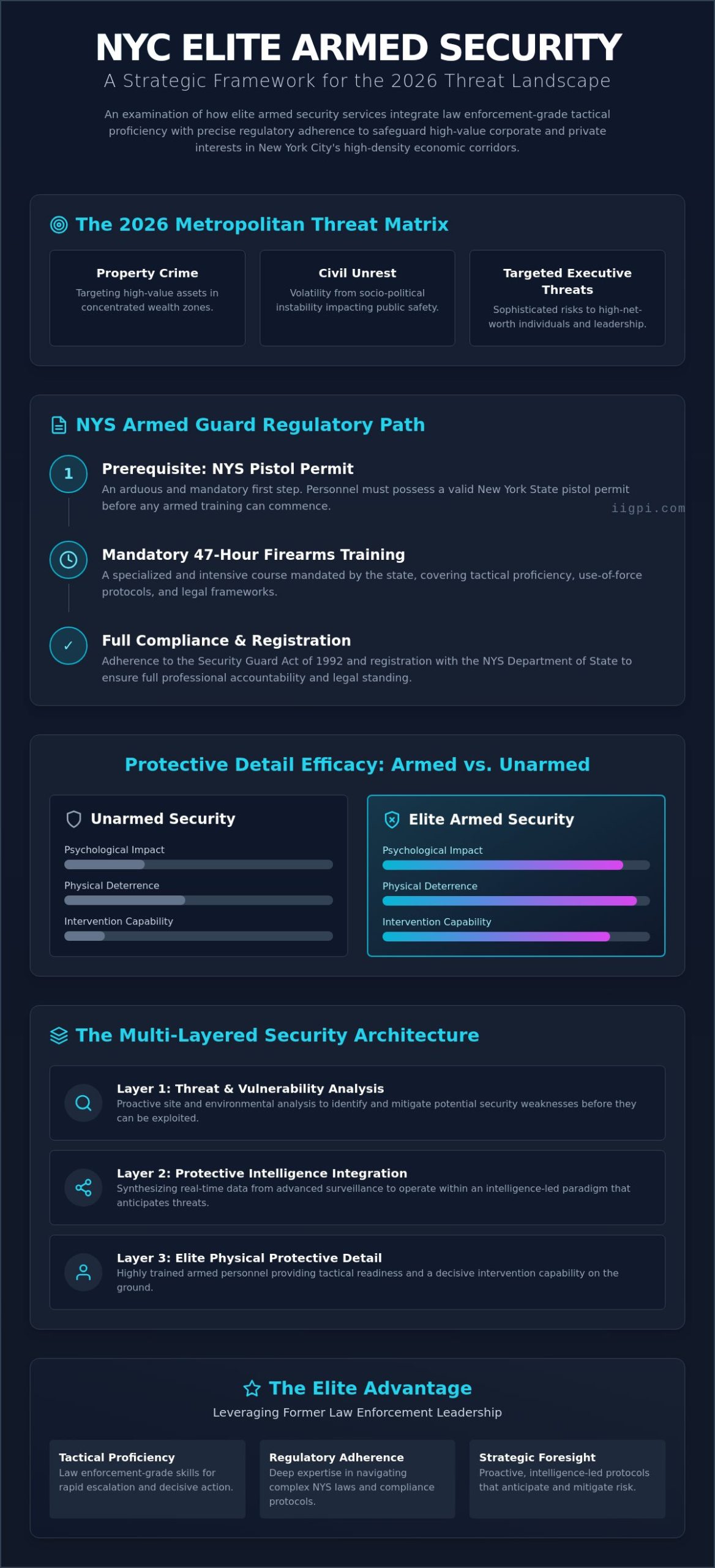
- Evaluate the efficacy of armed versus unarmed protective details using quantitative threat assessments that weigh psychological impact against physical deterrence.
- Develop a multi-layered security architecture for high-value assets by conducting rigorous site vulnerability and environmental threat analyses.
- Leverage the tactical expertise of elite armed security guard services NYC that utilize former law enforcement leadership to provide high-level protective solutions.
The Strategic Necessity of Armed Security Services in the New York City Landscape
The contemporary security environment within the New York City metropolitan area has reached a critical inflection point where traditional defensive postures no longer suffice. For institutional stakeholders, the deployment of armed security guard services NYC represents a calculated response to a multi-faceted threat matrix that includes property crime, civil unrest, and targeted executive threats. This necessity emerges from the realization that corporate liability isn’t merely a legal abstraction but a tangible consequence of inadequate physical protection. While a standard Security guard provides a visible presence, the 2026 risk profile demands a specialized protective detail capable of rapid escalation and decisive intervention. High-net-worth individuals and corporate entities now require sophisticated security frameworks that transcend basic monitoring, seeking instead a synergy of tactical readiness and strategic foresight.
Urban Risk Dynamics and Geopolitical Influences
The manifestation of global socio-political instability within the localized context of Manhattan highlights the volatility inherent in high-density economic hubs. Economic fluctuations often correlate with shifts in asset protection requirements, particularly in sectors where the concentration of wealth invites sophisticated criminal enterprise. As municipal law enforcement resources face systemic constraints, the role of private security has expanded to bridge critical gaps in public safety infrastructure. This transition positions private entities not just as observers, but as essential partners in maintaining the integrity of the urban financial ecosystem. The specific demands of Manhattan, particularly in Midtown and the Financial District, necessitate a premium level of protection that accounts for both the density of the population and the high value of the assets involved. Global shifts dictate local responses.
The Evolution of Private Protective Intelligence
Elite protective services have transitioned from a model of passive observation to a framework of proactive threat identification. This evolution is particularly evident in New York’s financial districts, where the historical development of security protocols has mirrored the increasing complexity of global capital markets. Sophisticated frameworks now prioritize the integration of advanced surveillance services with a physical protective presence to create a seamless security architecture. By synthesizing real-time data with tactical expertise, these services ensure that armed security guard services NYC operate within an intelligence-led paradigm that anticipates vulnerabilities before they’re exploited. This shift represents a move toward a holistic security posture that values information as highly as physical force, ensuring that protective details are informed by a continuous stream of environmental and behavioral data. Intelligence dictates action. By prioritizing data-driven insights, organizations can maintain a decisive advantage over emerging threats.
Technical Specifications and Regulatory Frameworks for Armed Personnel in New York
The legal architecture governing private protection in New York is defined by a rigorous set of statutes designed to ensure public safety and professional accountability. At the center of this framework is the Security Guard Act of 1992, which mandates that all individuals performing security functions be registered with the New York State Department of State. For those providing armed security guard services NYC, the requirements are substantially more stringent, necessitating a valid New York State pistol permit as a prerequisite for specialized training. The Security Officer Training Act (SORA) establishes the regulatory baseline for private protective services, mandating a specialized 47-hour firearms training course for personnel seeking armed status. Statutory requirements also dictate specific use of force protocols, ensuring that any armed response remains within the bounds of constitutional and state law.
The Security Guard Act of 1992 and Subsequent Amendments
This legislation serves as a scholarly benchmark for the industry, establishing the criteria for background checks and mandatory fingerprinting through the Division of Criminal Justice Services. Compliance isn’t optional for corporate entities. Hiring firms must verify that their third-party providers maintain active registrations and adhere to the evolving standards of the New York State Department of State. These standards include strict liability insurance mandates that protect both the client and the public in the event of a security incident. Understanding these comprehensive security and armed guard protocols is essential for any organization seeking to mitigate legal exposure while maintaining a robust defensive posture. It’s a matter of institutional integrity as much as physical safety.
Rigorous Training and Continuing Education Protocols
Beyond the initial registration, the state enforces a continuous cycle of education to ensure tactical proficiency and legal literacy. The New York State armed guard training requirements specify that personnel must complete an 8-hour annual in-service course alongside an 8-hour annual firearms re-qualification. This curriculum emphasizes the judicious use of force and high-stakes de-escalation techniques, which are vital in the dense urban environments of Manhattan and the surrounding boroughs. The efficacy of these programs often depends on the pedigree of the instructors. Firms that prioritize former law enforcement experts bring a level of field-tested experience that generic training centers cannot replicate. This expertise ensures that armed security guard services NYC operate with a level of precision that aligns with the highest institutional standards. Continuous training isn’t a formality; it’s a strategic requirement.
Evaluating the Efficacy of Armed vs. Unarmed Protective Details
Determining whether to deploy an armed or unarmed detail requires a rigorous quantitative risk assessment that evaluates the probability of a high-consequence event. In the context of armed security guard services NYC, this evaluation often hinges on the value of the assets protected and the likelihood of encountering sophisticated criminal elements. Unarmed personnel are suitable for low-threat environments where observation and reporting are the primary objectives. However, when the threat profile includes potential violence or significant economic loss, an armed response becomes a strategic necessity. This decision isn’t merely operational; it’s a fundamental exercise in institutional risk mitigation. Analysts must weigh the potential for reputational damage against the tangible costs of a security breach.
Force Projection and Psychological Deterrence
Visible armed security serves as a potent psychological deterrent against ‘specie loss’ and high-value theft, particularly in sectors where liquidity or portable wealth is concentrated. The presence of a professional, armed individual signals a level of preparedness that often discourages adversaries before an attempt is initiated. Maintaining an academic and non-aggressive corporate image is paramount. Elite firms ensure their personnel project an aura of quiet competence rather than overt intimidation. This ensures that security measures don’t disrupt the professional atmosphere of a corporate headquarters or a high-end residential lobby. Case studies in Manhattan’s luxury retail and financial sectors demonstrate that armed details significantly reduce the success rate of sophisticated burglary attempts by altering the risk-to-reward ratio for potential perpetrators.
Strategic Deployment for High-Value Assets
The protection of fine arts, jewelry, and financial instruments necessitates a multi-layered security architecture where armed personnel play a central role. Beyond static guarding, the transport of sensitive physical data and high-value assets requires a mobile armed presence to mitigate vulnerabilities during transit. These protocols are reinforced by the New York State armed guard training requirements, which ensure that personnel possess the tactical proficiency required for such high-stakes assignments. Additionally, a physical protective presence often complements a corporate fraud investigation by securing physical evidence and preventing the unauthorized removal of critical documentation. This synergy between investigative intelligence and physical security creates a robust defense against both internal and external threats. Precision in deployment is the hallmark of elite protection. Organizations that fail to integrate these disciplines often find themselves vulnerable to complex, multi-vector attacks.
Implementation Strategies for High-Value Asset and Executive Protection
The implementation of armed security guard services NYC within high-stakes environments requires a methodological shift from reactive posturing to comprehensive architectural design. Executive Protection constitutes a holistic discipline encompassing travel, residence, and workplace safety, functioning as a seamless protective envelope for high-profile principals. To achieve this level of security, firms must conduct exhaustive site vulnerability and threat assessments that identify latent weaknesses in both physical and digital perimeters. Modern frameworks increasingly integrate physical security with computer forensics and digital intelligence to safeguard against multi-vector threats that target both corporate assets and individual reputations. Establishing robust communication protocols between protective details and corporate leadership ensures that tactical decisions align with broader institutional objectives. It’s a matter of strategic synchronization.
Site Vulnerability and Risk Mitigation Protocols
Identifying ingress and egress vulnerabilities in high-rise NYC structures is a critical component of maintaining perimeter integrity. Armed guards play a pivotal role in managing these access points, serving as both a sophisticated deterrent and a rapid response mechanism. By utilizing private investigator methodologies to scout locations and analyze historical incident data, security teams can anticipate threats before they manifest at the property line. This scouting process involves more than simple observation; it’s a rigorous analysis of environmental variables and social dynamics that could impact the safety of the principal or the facility. Effective access control in Manhattan’s vertical landscape demands a constant state of vigilance and tactical readiness.
Intelligence-Led Protective Operations
The International Investigative Group Methodology: Elite Protective Services
The International Investigative Group (IIG) operates at the vanguard of the private security sector, drawing upon a distinguished 30-year legacy within the New York City metropolitan area. This institutional history is fortified by a leadership cadre comprised of former law enforcement professionals, whose tactical excellence and investigative acumen form the cornerstone of the firm’s protective methodology. By synthesizing decades of field-tested experience with contemporary risk assessment protocols, IIG provides armed security guard services NYC that meet the exacting standards of sovereign and corporate entities. This pedigree ensures that every deployment’s informed by a deep understanding of urban tactical dynamics and the complex legal frameworks governing the use of force. It’s a matter of institutional heritage meeting modern necessity.
A Multidisciplinary Approach to Security
Holistic risk management requires the integration of investigative rigor with physical protection to address both overt and covert threats. IIG utilizes a multidisciplinary framework that incorporates specialized functions, such as electronic bug sweeps and polygraph testing, to ensure the integrity of the client’s environment. This approach allows for the identification of internal vulnerabilities that traditional guarding services often overlook. IIG leverages an extensive global network of specialized agents to support domestic NYC operations; this provides a level of scalability and intelligence-sharing characteristic of premier international forums. The transition from localized guarding to a global protective posture reflects a commitment to addressing the macro-level challenges faced by modern institutional leaders. By addressing regional dynamics through a global lens, the firm bridges the gap between emerging threats and established security paradigms.
Commitment to Professionalism and Discretion
Professionalism in the elite security tier is defined by an unwavering commitment to confidentiality and the maintenance of a sophisticated corporate image. IIG adheres to the highest standards of discretion, ensuring that the interests of high-profile clients remain shielded from public scrutiny. The firm’s methodology doesn’t just focus on physical presence; it’s an integration of tactical readiness and investigative depth. We utilize an academic and formal approach to reporting and client communication, delivering detailed analyses that facilitate informed decision-making at the highest levels of power and influence. This serious and sober personality reflects the institution’s role as a trusted advisor to global leaders and industry pioneers. Each bespoke security solution is tailored to the unique requirements of the entity, ensuring that the protective architecture is both effective and unobtrusive. To explore our comprehensive suite of services, including background investigations and due diligence, stakeholders are encouraged to explore our comprehensive suite of services at iigpi.com for a detailed examination of our capabilities.
Establishing a Proactive Defense Posture for the Metropolitan Asset Landscape
The evolution of the metropolitan threat landscape necessitates a departure from traditional, reactive security models toward a framework of integrated intelligence and tactical precision. By synthesizing the rigorous requirements of the Security Guard Act with proactive vulnerability assessments, institutional leaders can effectively mitigate the multi-vector risks inherent in the 2026 economic environment. It’s clear that the deployment of elite armed security guard services NYC is no longer an optional deterrent but a fundamental requirement for the preservation of corporate asset integrity and executive safety. Organizations must prioritize partnerships with entities that possess the intellectual depth and field-tested experience to navigate these complex regulatory and physical challenges.
The International Investigative Group offers a premier protective methodology founded upon over 30 years of investigative and security expertise. Led by former law enforcement professionals, our institution leverages a global network of specialized agents who’ve successfully resolved more than 10,000 cases across diverse socioeconomic regions. This legacy of excellence ensures that every protective detail is informed by a comprehensive understanding of global risk dynamics and localized tactical requirements. We invite you to Consult with the Elite Protective Detail at International Investigative Group to establish a sophisticated and resilient security architecture. Securing your institutional future begins with a commitment to authoritative expertise and strategic foresight.
Frequently Asked Questions
What are the specific licensing requirements for an armed security guard in NYC?
Authorization for armed status requires an individual to possess a valid New York State pistol permit and a current security guard registration as fundamental prerequisites. Upon securing these credentials, the candidate must successfully complete a mandatory 47-hour firearms training course facilitated by a school approved by the Division of Criminal Justice Services. This multi-layered certification process ensures that personnel possess both the legal standing and the tactical proficiency required for high-stakes urban environments.
Can a private armed security guard carry a firearm anywhere in New York State?
Firearms carry for private security personnel is strictly limited to the specific geographical locations and operational hours defined by their contractual employment. Authorization doesn’t grant a general right to carry throughout the state; instead, it’s a restricted privilege tethered to the performance of official duties. Guards must adhere to the specific limitations articulated in their New York State pistol license, which often distinguishes between restricted business carry and general concealed carry permits.
How does the Security Guard Act of 1992 influence corporate liability when hiring armed guards?
The Security Guard Act of 1992 establishes the statutory benchmark for professional conduct, effectively defining the standard of care that corporate entities must uphold during the procurement process. By mandating the use of registered and properly trained personnel, the Act provides a rigorous framework for mitigating claims of negligent hiring or retention. Firms that bypass these compliance standards face significant legal exposure if an incident occurs, as non-compliance serves as prima facie evidence of institutional negligence.
What is the difference between an armed security guard and an executive protection agent?
An armed security guard typically focuses on static asset protection and perimeter integrity within a defined facility or property line. Conversely, an executive protection agent operates within a holistic framework that encompasses mobile security, advance scouting, and the continuous safety of a specific individual across multiple environments. Executive protection requires a higher degree of strategic planning and intelligence integration to manage the principal’s entire ecosystem rather than a single physical location.
How often must armed security personnel in NYC undergo re-certification?
Personnel providing armed security guard services NYC must complete a rigorous re-certification cycle on an annual basis to maintain their operational status. This requirement includes the successful completion of an 8-hour annual in-service training course and an 8-hour annual firearms training course. These recurring mandates ensure that tactical skills and legal knowledge remain sharp, reflecting the evolving nature of urban threat dynamics and the stringent regulatory expectations of the New York State Department of State.
Is it legal for a private investigative firm to provide armed security services for events?
Private investigative firms are legally authorized to provide armed security services provided they maintain the appropriate dual licensing as a Watch, Guard, and Patrol agency. This regulatory alignment allows firms to integrate investigative intelligence with physical protection, offering a more robust security posture for high-profile events. The synergy between these disciplines ensures that event security’s informed by real-time threat analysis and the comprehensive background vetting of potential adversaries or high-risk attendees.
What criteria should a corporate entity use to evaluate the quality of an armed security provider?
Evaluation should prioritize the provider’s institutional pedigree, specifically focusing on the presence of former law enforcement leadership and a documented history of managing complex risk profiles. Corporate entities must also verify that the firm maintains comprehensive liability insurance and adheres to the highest standards of the armed security guard services NYC framework. A global network of agents and a multidisciplinary approach to security serve as additional indicators of a firm’s elite status and operational capacity.
What protocols are in place for the use of force by private armed guards in NYC?
The use of force by private personnel is strictly governed by New York State Penal Law Article 35, which defines the legal parameters for justification. Armed guards are authorized to utilize physical or deadly force only when it’s objectively reasonable and necessary to defend themselves or others from the use of unlawful force. Professional training programs emphasize de-escalation and the continuum of force to ensure that any response is proportionate to the immediate threat and legally defensible.