
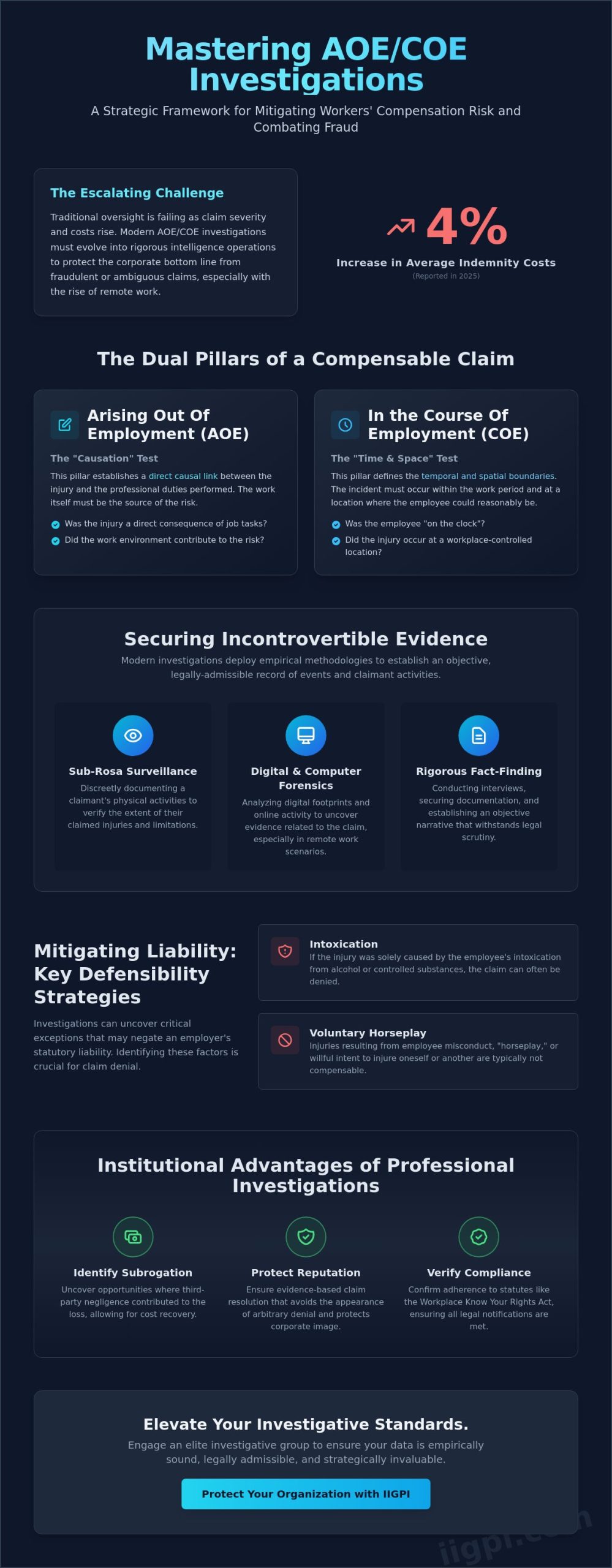
The traditional paradigm of workers’ compensation oversight is fundamentally insufficient in an era where claim severity and medical indemnity costs continue to escalate, as evidenced by the 4% increase in average indemnity costs reported in 2025. AOE/COE investigations must therefore transcend the role of mere administrative checkpoints to become rigorous, multi-disciplinary intelligence operations that bridge the gap between empirical law enforcement methodology and sophisticated corporate risk strategy. For high-level decision-makers, the inability to distinguish between legitimate workplace injuries and those influenced by the complexities of remote work or the “Going and Coming” rule represents a significant vulnerability to the corporate bottom line.
For businesses operating in industrial environments, Industrial Accident Investigators offers the specialized root-cause analysis needed to verify these mechanisms of injury and prevent future occurrences through detailed safety insights.
You likely recognize that the lack of high-quality surveillance evidence and definitive documentation often leaves your organization exposed to statutory liability and insurance fraud. This article provides an authoritative analysis of AOE/COE investigative protocols and legal standards, offering a framework for establishing empirical evidence that withstands the scrutiny of the New York State Workers’ Compensation Board. We’ll examine the integration of advanced surveillance services, addressing the nuances of New York State workers’ compensation statutes and the unique challenges prevalent in NYC and Nassau County, and the methodologies employed by International Investigative Group to secure definitive claim determinations.
Key Takeaways
- Acquire a rigorous conceptual understanding of the dual pillars of modern jurisprudence by distinguishing the causal links of ‘Arising Out Of’ employment from the temporal and spatial boundaries of the ‘Course of Employment.’
- Evaluate the efficacy of integrating empirical methodologies, such as sophisticated surveillance services and computer forensics, to secure incontrovertible evidence of a claimant’s physical and digital activities.
- Identify critical legal exceptions and defensibility strategies, including the investigation of intoxication and voluntary horseplay, which facilitate the mitigation of statutory liability through specialized AOE/COE investigations.
- Explore the Ribacoff Standard of institutional excellence, which leverages an elite global network of agents to maintain the integrity of workers’ compensation systems within high-stakes corporate environments.
Conceptual Framework of AOE/COE Investigations in Modern Jurisprudence
The contemporary architecture of the Workers’ compensation system operates as a delicate geopolitical equilibrium between labor protections and corporate sustainability. Within this framework, AOE/COE investigations function as the essential diagnostic tool for determining the validity of a claim. Arising Out of Employment (AOE) addresses the causal nexus between the professional duties performed and the resulting injury; conversely, Course of Employment (COE) delineates the temporal and spatial boundaries within which the incident occurred. As global markets transition into 2026, the complexity of these inquiries has evolved from localized fact-finding into a sophisticated form of corporate intelligence. This shift is necessitated by the rise of hybrid work environments and the increasing severity of indemnity costs, which rose by 4% in 2025. Establishing an impartial evidentiary record requires the intellectual rigor of a professional private investigator, whose findings serve as the definitive baseline for subsequent legal and administrative determinations.
The Statutory Basis for AOE/COE Standards
The legal threshold for work-related causality isn’t a monolithic standard but a fragmented landscape of state and federal mandates. While California requires reporting within 30 days and filing within one year, jurisdictions like Pennsylvania allow up to three years for claim submission. These variable regulations dictate the pace and depth of investigative protocols. Rigorous adherence to these standards provides the primary defense against insurance fraud, which continues to challenge the underwriting gains seen in 2025’s 91% combined ratio for private carriers. By verifying the specific circumstances of an incident, organizations ensure that benefits are reserved for legitimate injuries, thereby maintaining the systemic integrity of the compensation bargain.
The Institutional Importance of Rigorous Fact-Finding
Securing an objective narrative of events is a strategic necessity for mitigating the long-term financial impact of inflated claims. Beyond the immediate medical and indemnity costs, fraudulent filings erode the capital reserves of an organization and distort risk assessments. Professional investigations facilitate the following institutional advantages:
- Identification of subrogation opportunities where third-party negligence contributed to the loss.
- Protection of corporate reputation through evidence-based claim resolution that avoids the appearance of arbitrary denial.
- Verification of adherence to the Workplace Know Your Rights Act, which as of January 1, 2026, requires annual written notice to all workers.
It’s clear that the intersection of investigative findings and risk strategy is where corporate resilience is built. Engaging an elite entity like the International Investigative Group ensures that the data gathered is not only empirically sound but also legally admissible in high-stakes environments.
Distinguishing Between ‘Arising Out Of’ and ‘In the Course Of’ Employment
The intellectual rigor required for effective AOE/COE investigations necessitates a granular deconstruction of the legal standards governing compensability. Arising Out of Employment (AOE) serves as the causal anchor, requiring an empirical demonstration that the injury was a direct consequence of professional duties rather than an extraneous personal risk. Conversely, the Course of Employment (COE) standard establishes the temporal and spatial parameters of the incident, determining whether the worker was engaged in the employer’s business at the moment of injury. This distinction is particularly critical when evaluating the “Bunkhouse Rule,” which extends liability to injuries occurring in employer-provided housing, or the “Special Mission” exception, where a worker is tasked with a specific errand outside their standard commute.
Establishing these boundaries requires a sophisticated Conceptual Framework of Workers’ Compensation, as provided by regulatory authorities to guide the adjudication of complex claims. Forensic inquiry often reveals that an alleged workplace incident is actually an exacerbation of a pre-existing condition, a finding that can fundamentally alter the trajectory of a claim. Professional investigators utilize detailed medical record reviews and witness interviews to distinguish between chronic occupational hazards and acute, non-work-related pathologies. This level of scrutiny ensures that the compensation bargain remains reserved for injuries that possess a verifiable professional nexus.
Causality and the AOE Standard
Establishing the mechanism of injury is the primary objective of the AOE inquiry. Investigators must isolate professional relevance from personal predispositions, such as idiopathic falls or pre-existing degenerative disc disease. Expert testimony and comprehensive medical history analysis are essential tools in this process. They ensure that the organization isn’t held liable for ailments that lack a verifiable professional nexus. The objective is to determine if the work environment was the proximate cause of the physical or psychological impairment.
Temporal and Spatial Boundaries: The COE Standard
The “Going and Coming” rule traditionally excludes injuries sustained during a routine commute, yet modern hybrid work models have introduced profound legal ambiguity. As organizations navigate the complexities of remote professional operations in 2026, the definition of the “workplace” has expanded into the domestic sphere. This evolution necessitates a meticulous analysis of lunch breaks, recreational activities, and off-site assignments to determine if they fall within the scope of employment. For entities seeking to mitigate these emerging risks, the AOE/COE investigations conducted by elite specialists provide the empirical clarity required for defensible claim resolutions.
Empirical Methodologies: Sub-Rosa Surveillance and Forensic Protocols
The transition from conceptual causality to empirical verification represents the critical juncture where corporate risk strategy meets evidentiary truth. Data sourced from Workers’ Compensation Risk Mitigation Data indicates that private carriers achieved a 91% combined ratio in 2025, which emphasizes the ongoing necessity for rigorous oversight to protect these underwriting gains against the pressures of general inflation. Within this high-stakes environment, AOE/COE investigations must deploy a multi-faceted methodology that synthesizes traditional observation with advanced technological inquiry to produce an incontrovertible record of facts. This scholarly approach ensures that every claim is evaluated against a baseline of objective reality rather than subjective narrative.
Advanced Sub-Rosa Surveillance Techniques
The deployment of elite surveillance services involves the strategic use of high-definition optical technology and covert operational protocols to capture a claimant’s authentic physical behaviors in the public sphere. These operations are conducted with a profound understanding of the legal landscape, ensuring that all visual documentation adheres to the specific privacy statutes of the relevant jurisdiction to maintain its admissibility in judicial proceedings. Maintaining a flawless chain of custody and chronological continuity is essential, as any disruption in the record can provide a basis for the exclusion of critical evidence during the adjudication process. This level of technical sophistication is what distinguishes institutional-grade surveillance from rudimentary observation.
The Synergy of Digital and Physical Intelligence
Modern investigative frameworks increasingly rely on the integration of computer forensics to uncover digital artifacts that may contradict a claimant’s stated physical restrictions or professional status. By analyzing metadata and geolocation data, investigators can reconstruct a precise timeline of activities, identifying instances where a claimant may be engaged in secondary employment or strenuous recreational activities inconsistent with their injury report. The Ribacoff Standard serves as the institutional benchmark for this multi-layered evidence acquisition, requiring that physical surveillance and digital intelligence operate in tandem to create a comprehensive profile of the subject’s actual capacity. This dual-track approach effectively eliminates the evidentiary gaps that fraudulent actors often exploit.
The acquisition of recorded statements represents a forensic exercise in narrative deconstruction, requiring investigators to apply intellectual rigor when interviewing claimants, supervisors, and third-party witnesses. These interactions are structured to identify logical inconsistencies and verify the spatial-temporal details of the alleged incident against the backdrop of comprehensive background research and social media intelligence (SOCMINT). This forensic approach to fact-finding allows organizations to address the 4% increase in average indemnity costs reported in 2025 by providing the definitive evidence required to deny fraudulent claims or negotiate equitable settlements based on empirical reality. Ultimately, the goal of these AOE/COE investigations is to restore the integrity of the compensation system through the application of rigorous, multi-disciplinary intelligence.
Mitigating Statutory Liability: Analyzing Legal Exceptions and Defensibility
The mitigation of statutory liability within the workers’ compensation framework requires an exhaustive analysis of the legal exceptions that may invalidate a claim. While the system is designed to be no-fault, certain behaviors by the claimant create a jurisprudential barrier to recovery, provided that the employer can present incontrovertible evidence of such conduct. Professional AOE/COE investigations serve as the primary mechanism for uncovering these defenses, which range from intoxication and substance abuse to the identification of intentionally self-inflicted injuries. Identifying these markers requires a sophisticated understanding of human behavior and the psychological indicators of fraud, as a claimant’s narrative often obscures the true proximate cause of the incident.
Identifying Willful Misconduct and Intentional Acts
Proving that an injury was the result of willful misconduct or a deliberate intentional act involves a high evidentiary burden that transcends simple observation. In cases where intoxication is suspected, the absence of immediate post-accident testing necessitates a forensic reconstruction of the events leading up to the injury, utilizing witness accounts and behavioral analysis to establish a causal link between substance use and the accident. Additionally, injuries sustained during the commission of a felony or those that are clearly self-inflicted represent a complete departure from the professional nexus, thereby precluding the organization’s liability. These investigations must be conducted with extreme precision to distinguish between a tragic accident and a strategic attempt to exploit the insurance system.
The ‘Horseplay’ and Recreational Activity Defense
The legal boundaries of employment often blur when employees engage in “Horseplay” or voluntary off-duty recreational activities that are not a required component of their professional duties. To successfully assert a defense based on these activities, investigators must gather detailed witness testimony that establishes the claimant’s voluntary participation and the non-work-related nature of the conduct. This is particularly relevant in multi-party workplace disputes where the “Initial Physical Aggressor” rule may apply. If it’s empirically demonstrated that the claimant was the individual who initiated a physical altercation, their right to benefits is typically forfeited under the statutes of most jurisdictions. To ensure your organization is protected by a definitive evidentiary record that supports these defensive strategies, you should engage the specialized AOE/COE investigations provided by the International Investigative Group.
The complexity of these legal standards necessitates a proactive approach to risk management that prioritizes empirical truth over administrative convenience. By identifying the psychological markers of fraud and the specific mechanisms of injury, organizations can effectively challenge claims that fall outside the scope of employment. This rigorous fact-finding process not only protects the corporate bottom line but also ensures that the integrity of the broader compensation system is maintained for those with legitimate needs.
The Ribacoff Standard: Institutional Excellence in Global AOE/COE Operations
The institutionalization of investigative excellence is epitomized by the Ribacoff Standard, a framework developed through the extensive legacy of Daniel Ribacoff and the International Investigative Group. In an era where corporate entities operate across fragmented jurisdictional boundaries, the requirement for AOE/COE investigations to adhere to a uniform level of intellectual and ethical integrity is paramount. This standard integrates the rigorous methodologies traditionally associated with high-level law enforcement into corporate fraud investigation protocols. It ensures that every inquiry isn’t merely a localized fact-finding mission but a comprehensive intelligence operation designed to withstand the complexities of global litigation. By establishing a centralized command structure for evidence gathering, the organization provides a definitive diagnostic tool for high-stakes risk management.
Global Intelligence for Multi-National Corporations
Conducting AOE/COE investigations within a global context requires a sophisticated network of agents capable of navigating the diverse legal landscapes of international jurisdictions. For Fortune 500 companies, mitigating risk requires a consistent reporting standard that can bridge the gap between emerging markets and established financial centers. The logistics of these operations involve a granular understanding of local privacy laws and cultural nuances while maintaining the strict evidentiary standards required for court admissibility. This global reach allows for the seamless verification of claims regardless of the claimant’s geographic location, providing a level of institutional oversight that generic insurance inquiries simply cannot replicate. Consistent quality across this worldwide network ensures that corporate decision-makers receive reliable data for cross-border risk mitigation.
The Strategic Advantage of Professional Investigation
The strategic necessity of elite private investigator services resides in the ability to produce evidentiary records that are both empirically sound and legally defensible. Clear, concise, and professionally structured investigative reports serve as the definitive baseline for administrative hearings and federal court proceedings alike. As the 2025 NCCI data indicated a private carrier combined ratio of 91%, the continued protection of these margins depends on the ability to identify and neutralize fraudulent activity before it impacts the bottom line. By institutionalizing law enforcement rigor within the corporate sphere, the International Investigative Group provides the intellectual depth required for high-stakes risk mitigation. Organizations seeking to secure their operational integrity should consult with the International Investigative Group for specialized AOE/COE solutions.
Ultimately, the efficacy of a workers’ compensation strategy is determined by the quality of the underlying intelligence. Professional investigations provide the clarity needed to distinguish between legitimate workplace incidents and strategic attempts to exploit the system. This commitment to empirical truth protects the organization’s capital reserves and maintains the integrity of the broader compensation bargain. In a landscape of rising medical costs and complex legal standards, the Ribacoff Standard remains the benchmark for institutional excellence in global risk management.
Securing Institutional Resilience Through Strategic Oversight
The evolution of risk management within the workers’ compensation sphere necessitates a transition from reactive administration to proactive, intelligence-driven oversight. By masterfully navigating the dual requirements of causality and professional scope, organizations can effectively mitigate the financial and reputational hazards posed by inconsistent claims. The implementation of rigorous AOE/COE investigations remains the definitive mechanism for securing the empirical evidence required to uphold the integrity of the compensation system in an increasingly complex global economy. This systematic approach ensures that every claim is adjudicated against a baseline of objective reality, protecting the corporate bottom line from the rising costs of indemnity and fraud.
Securing this level of strategic clarity requires a partner with deep institutional expertise and a proven record of success in high-stakes environments. You’re invited to Consult with Daniel Ribacoff and the International Investigative Group to leverage over 30 years of investigative experience. As a Former NYPD Honor Legion Man of the Year, Daniel Ribacoff oversees a prestigious global network of agents capable of managing complex, multi-jurisdictional claims with the highest standards of intellectual and ethical rigor. Establishing a defensible evidentiary record is the most critical step toward long-term corporate resilience and the fair resolution of professional liabilities.
Frequently Asked Questions
What exactly does an AOE/COE investigation entail?
AOE/COE investigations comprise a systematic forensic inquiry designed to verify the dual legal pillars of workers’ compensation claim validity by establishing whether an injury arose out of employment and occurred within the course of employment. The process involves a synthesis of claimant and witness interviews, site inspections, and the rigorous examination of medical documentation to establish a factual baseline. By reconstructing the circumstances of the alleged incident, investigators provide organizations with the empirical data necessary for informed claim adjudication and risk management.
How do investigators determine if an injury ‘arose out of employment’?
Determination of whether an injury ‘arose out of employment’ requires the establishment of a causal nexus between the claimant’s professional duties and the resulting pathology. Investigators analyze the specific mechanism of the injury to ensure it was a direct consequence of workplace hazards rather than idiopathic or personal risk factors. This forensic approach isolates the professional environment as the proximate cause, which is essential for determining statutory liability within the compensation bargain.
What are the most common exceptions that lead to a workers’ compensation claim denial?
Common exceptions leading to claim denial include intoxication, voluntary participation in horseplay, and injuries that are intentionally self-inflicted by the claimant. Additionally, incidents occurring during the commission of a felony or while engaging in non-work-related recreational activities typically fall outside the scope of compensability. Identifying these behaviors requires sophisticated investigative techniques that transcend administrative review to uncover the true proximate cause of the loss and protect the organization’s capital reserves.
Is sub-rosa surveillance legal in AOE/COE investigations?
Sub-rosa surveillance is entirely legal when conducted in public environments where no reasonable expectation of privacy exists for the subject. Professional investigators must adhere strictly to jurisdictional statutes and ethical standards to ensure that visual evidence remains admissible in judicial and administrative proceedings. This methodology provides an objective record of a claimant’s physical capabilities, which often serves as the definitive evidence in high-stakes insurance disputes where subjective narratives conflict with empirical reality.
How long does a typical AOE/COE investigation take to complete?
The timeline for completing AOE/COE investigations is contingent upon the complexity of the claim and the availability of essential evidentiary sources such as witnesses and medical records. While a preliminary assessment might be finalized within several business days, comprehensive inquiries involving extensive interviews and multi-day surveillance often require several weeks to ensure intellectual rigor. This deliberate rhythm ensures that the final investigative report is both exhaustive and empirically sound for legal review.
Can an employer request an AOE/COE investigation if fraud is not suspected?
Employers may request these investigations as a standard component of their risk mitigation strategy, regardless of whether fraudulent intent is initially suspected by the organization. These inquiries serve as a neutral fact-finding mission to verify the circumstances of an injury and ensure that the claim meets all statutory requirements for compensability. By institutionalizing this process, organizations maintain the integrity of their workers’ compensation programs and ensure that benefits are reserved for legitimate workplace injuries.
What role does digital forensics play in modern workers’ compensation cases?
Digital forensics identifies digital artifacts and geolocation data that can either corroborate or contradict a claimant’s narrative of physical impairment or professional inactivity. By analyzing metadata and digital footprints, investigators can reconstruct a precise chronology of activity that may reveal secondary employment or inconsistent physical exertion. This technological inquiry provides a multi-layered evidentiary profile that is increasingly vital for addressing the complexities of hybrid and remote professional operations in 2026.
How does a background in law enforcement benefit the investigative process?
A background in law enforcement instills a rigorous commitment to objective fact-finding and the preservation of the chain of custody for all acquired evidence. This specialized expertise ensures that investigative protocols are conducted with a level of intellectual depth and technical precision that enhances the defensibility of the findings in court. Such a foundation is particularly beneficial when conducting complex interviews or navigating the intricacies of multi-jurisdictional legal standards in high-stakes corporate environments.