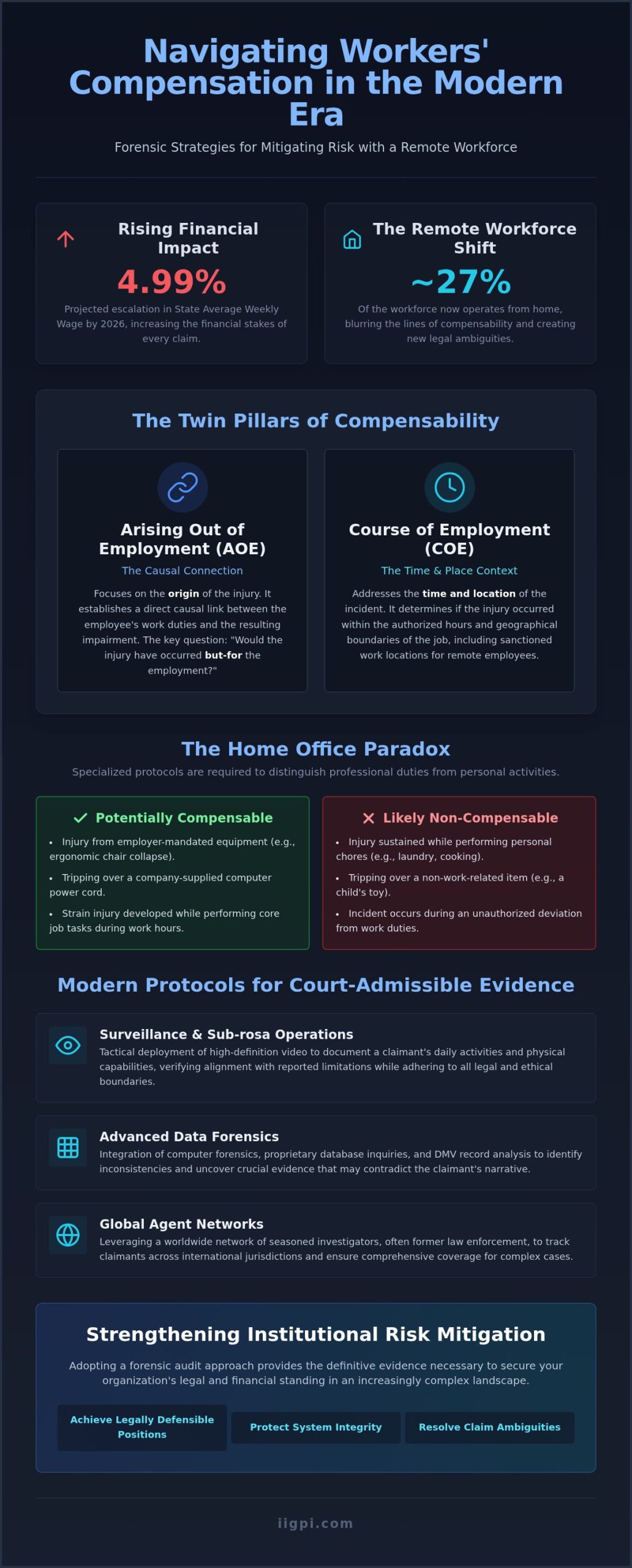
As the State Average Weekly Wage undergoes a 4.99% escalation in 2026, does your current risk management infrastructure possess the forensic depth required to discern legitimate occupational injuries within the increasingly opaque boundary of the remote workspace? With approximately 27% of the workforce now operating from domestic environments, the traditional parameters of compensability have shifted, leaving many institutions vulnerable to the high financial impact of exaggerated or fraudulent claims. Professional aoe/coe investigation services have evolved beyond mere surveillance; they now function as a critical institutional audit designed to resolve legal ambiguities and secure the integrity of the workers’ compensation system.
You likely recognize that poor quality investigative reports often fail to meet the rigorous standards of admissibility required in court, resulting in sustained long-term liability. This article provides an authoritative analysis of modern investigative protocols specifically engineered to assist insurance professionals and corporate counsel in mitigating fraudulent claims. We’ll examine the integration of computer forensics and global agent networks to deliver the definitive evidence necessary for claim denial or acceptance, ensuring your organization maintains a legally defensible position in an era of rising medical inflation and complex remote work mandates.
Key Takeaways
- Master the fundamental jurisprudential distinctions between ‘Arising Out of Employment’ and ‘Course of Employment’ to ensure that all compensability determinations are grounded in precise legal frameworks.
- Implement high-caliber aoe/coe investigation services that synthesize physical surveillance with sophisticated digital intelligence to produce court-admissible evidence for complex or high-value claims.
- Resolve the ‘home office paradox’ by applying specialized investigative protocols to injuries sustained in domestic settings, effectively distinguishing professional duties from personal activities in remote work environments.
- Evaluate potential investigative partners based on institutional pedigree and global reach, prioritizing agencies led by former law enforcement professionals capable of tracking claimants across international jurisdictions.
- Strengthen institutional risk mitigation strategies by adopting a forensic audit approach that addresses the high financial impact and legal complexities of the 2026 workers’ compensation landscape.
The Jurisprudential Foundations of AOE/COE Investigative Protocols
The legal architecture of workers’ compensation rests upon a delicate equilibrium known as the compensation bargain. The Jurisprudential Foundations of AOE/COE investigations are rooted in this social contract; it mandates that employers provide benefits for industrial injuries regardless of fault, while employees relinquish their right to sue in civil court. This framework necessitates rigorous aoe/coe investigation services to ensure that the finite resources of the insurance pool aren’t depleted by claim inflation. When loss ratios are compromised by exaggerated or non-industrial claims, the institutional integrity of the corporate entity is threatened. The investigator functions as an impartial fact-finder, providing the objective data required for the trier of fact to determine compensability based on the intersection of time, place, and circumstance.
Defining ‘Arising Out of Employment’ (AOE)
The determination of AOE centers on the causal nexus between the work environment and the resulting injury. Legal practitioners frequently apply the But-For test, asking whether the impairment would’ve occurred had the employee not been engaged in professional obligations. This analysis is critical when distinguishing between genuine occupational hazards and personal idiopathic conditions that might manifest during work hours but don’t originate from work tasks. AOE is defined as a causal link between professional duties and physical impairment. By isolating these variables, investigators prevent the misclassification of pre-existing health issues as industrial accidents, thereby protecting the employer from liability for conditions unrelated to the job site.
Defining ‘Course of Employment’ (COE)
While AOE addresses causality, COE establishes the temporal and spatial parameters of an injury. It serves as the Clock and Compass of compensability, examining whether the incident occurred within the authorized boundaries of the job. This involves a meticulous review of professional hours and sanctioned work locations. Complexities often arise when evaluating the Going and Coming doctrine, which generally excludes commutes from coverage unless specific exceptions apply. Modern aoe/coe investigation services must also account for unauthorized activities or deviations from prescribed duties that may occur during the workday. In the 2026 environment, where the traditional office has fragmented into hybrid models, establishing these spatial boundaries is paramount for institutional risk mitigation.
Methodological Rigor in Modern Claims Verification
The verification of industrial claims in the current fiscal year necessitates a sophisticated synthesis of traditional tradecraft and advanced forensic science. Institutional risk mitigation isn’t merely a matter of anecdotal observation; it requires a multi-layered framework that aligns with AOE/COE Investigative Protocols to withstand the rigorous scrutiny of Workers’ Compensation Appeals Boards. By integrating proprietary database inquiries, DMV record analysis, and sub-rosa operations, organizations can identify physical inconsistencies that would otherwise remain obscured by claimant narratives. As the State Average Weekly Wage escalates by 4.99% in 2026, the financial stakes for accurate claim verification have never been higher, demanding that evidence isn’t only collected but is also structurally sound for legal proceedings.
Surveillance and Sub-rosa Operations
Tactical deployment of high-definition video remains a cornerstone for verifying functional activity levels and determining if a claimant’s physical capabilities align with their reported limitations. This process involves the strategic application of surveillance services to document daily living activities within public spaces, ensuring all captured evidence adheres to established ethical and legal boundaries regarding the expectation of privacy. Sub-rosa operations provide the objective clarity necessary to challenge exaggerated claims of impairment, transforming subjective allegations into verifiable, court-admissible intelligence. It’s through this meticulous observation that the distinction between genuine disability and opportunistic exaggeration becomes apparent, allowing for a definitive assessment of the claim’s validity.
Computer Forensics and Digital Footprint Analysis
The digital dimension of modern aoe/coe investigation services offers an unprecedented level of transparency into a claimant’s functional status and behavioral patterns. Scrutinizing social media activity often reveals physical capabilities that directly contradict medical restrictions, while the application of computer forensics allows investigators to verify location data and timestamps associated with alleged industrial accidents. This forensic rigor is essential for identifying synthetic identity fraud and duplicate claim filings, which have become increasingly prevalent in the modern economy. These digital audits are particularly effective in unmasking sophisticated fraud rings that utilize synthetic identities to exploit systemic vulnerabilities across multiple jurisdictions. Organizations seeking to fortify their loss ratios can partner with specialized investigative entities to ensure their reporting meets the highest standards of intellectual and forensic excellence.
Navigating the Grey Areas: Remote Work and Modern Dynamics
The fragmentation of the traditional workplace has introduced the “Home Office Paradox,” wherein the domestic sphere is legally reclassified as a professional precinct. This structural shift requires a heightened level of Methodological Rigor in Modern Claims Verification to ensure that injuries reported within a residence genuinely arise from employment. With 27% of the workforce telecommuting at least partially as of 2026, aoe/coe investigation services must now scrutinize the intricate nuances of “personal comfort” versus “professional mission.” Medical canvassing serves as an essential strategic tool in this context, allowing institutions to uncover pre-existing conditions that may be opportunistically attributed to home-based work activities, thereby protecting the corporate loss ratio from unjustified claims inflation. This forensic scrutiny is particularly vital as medical inflation continues to drive up the costs of recovery and long-term disability payments.
The Bunkley and ‘Personal Comfort’ Doctrine
Jurisdictions vary significantly in their treatment of injuries sustained during work-from-home breaks, such as kitchen-table incidents or slips during transit to a domestic restroom. The authorized nature of the home workspace is no longer a static designation but a dynamic assessment of employer-mandated vs. employee-chosen environments. Liability often hinges on whether the employer exercised control over the ergonomic standards of the remote site or if the injury occurred during an activity that provided a “personal comfort” benefit to the employee while remaining within the course of employment. The distinction between an authorized workspace and a common living area often determines whether a slip-and-fall is compensable or a personal misfortune. This legal ambiguity necessitates a granular analysis of the claimant’s precise movements at the time of the alleged incident to distinguish between professional duty and personal domesticity.
Investigative Adaptation for the Hybrid Era
Elite investigators have adapted to these modern dynamics by conducting discrete interviews with neighbors or family members who serve as secondary witnesses to a claimant’s actual physical capabilities. Verifying the alignment between a home-office ergonomic setup and the alleged injury mechanism is a critical step in identifying inconsistencies in the claimant’s narrative. Establishing the professional intent of home-based movements is a mandatory component of a modern forensic audit. By leveraging proprietary databases and surveillance, institutions can verify if a “professional mission” was truly underway or if the injury resulted from a personal errand. Organizations requiring this level of intellectual depth and forensic accuracy should consult with specialized investigative entities to secure intelligence that is both actionable and court-admissible.
Strategic Evaluation of Professional Investigative Partners
Selecting a partner for aoe/coe investigation services requires a rigorous appraisal of institutional pedigree rather than a reliance on historical longevity alone. While amateur entities may provide basic surveillance, elite organizations prioritize a law enforcement background to ensure that every investigative action is conducted with the precision of a criminal inquiry. This intellectual transition from anecdotal observation to data-rich, forensic documentation is essential for protecting the bottom line in an increasingly litigious environment. It’s through this specialized lens that claims professionals can discern between superficial reporting and the high-stakes intelligence required to mitigate long-term liability.
The Selection Matrix for Legal and Risk Departments
Legal and risk departments should implement a comprehensive selection matrix that prioritizes licensure, bonding, and professional liability insurance as non-negotiable prerequisites. Beyond these foundational requirements, the technical depth of the firm’s technology stack serves as a critical differentiator; the utilization of advanced metadata analysis and forensic tools ensures that evidence remains untainted and admissible. A firm’s track record in formal court proceedings provides the ultimate verification of their reporting standards, as the ability to withstand cross-examination is the benchmark of institutional excellence. Organizations that don’t prioritize these forensic standards often find their evidence dismissed during appeals, resulting in significant financial exposure.
Global Network and Jurisdictional Expertise
The modern workforce is inherently mobile, often resulting in the “transient claimant” who moves out-of-state or even internationally while receiving benefits. This geographical dispersion necessitates a global network of agents who possess a granular understanding of the local state laws governing AOE/COE compensability. For instance, navigating the specific regulatory environment of New York requires a partner with deep regional expertise, as detailed in our NYC private investigator guide. Without this jurisdictional fluency, investigative efforts risk being dismissed because they don’t meet specific procedural requirements or local licensure mandates, rendering the entire operation a sunk cost.
Ultimately, the role of specialized insurance fraud investigation services is to act as a strategic bulwark against the erosion of corporate capital. By securing intelligence that is both forensic and global in scope, institutions can mitigate the systemic risks associated with fraudulent workers’ compensation claims. To fortify your organization’s risk management framework and ensure the integrity of your claims process, you should consult with our elite investigative team to implement a customized AOE/COE protocol.
International Investigative Group: Decades of Forensic Excellence
International Investigative Group represents the pinnacle of institutional risk mitigation, synthesizing over 30 years of law enforcement-derived expertise into a comprehensive framework for aoe/coe investigation services. Founded by former law enforcement professionals, the organization has successfully resolved over 10,000 cases globally, demonstrating a specialized proficiency in high-stakes matters often exceeding $10 million in potential fraud. This heritage ensures that every engagement is led by individuals with an intimate understanding of evidentiary standards and the forensic rigor required for court-admissible intelligence. By bridging the gap between traditional surveillance and advanced forensic science, the institution provides a definitive bulwark against the financial erosion caused by non-industrial claims.
Comprehensive Case Management and Strategic Reporting
Strategic reporting within this institutional framework moves beyond simple observation to provide high-definition evidentiary support and meticulous activity logs that withstand the rigorous scrutiny of both legal counsel and insurance adjusters. For high-value and catastrophic injury claims, customized protocols are implemented to ensure that every variable of compensability is documented with intellectual depth and forensic accuracy. This collaborative approach allows for optimized outcomes in complex corporate fraud investigations, where the integration of digital forensics and physical surveillance is paramount to identifying synthetic fraud patterns. Each report is structured to serve as a definitive record for the trier of fact, ensuring that institutional decisions are supported by incontrovertible data.
Engaging the Elite Investigative Standard
Initiating a formal inquiry with our global team ensures that your organization’s risk mitigation strategy adheres to the highest ethical and legal standards, including strict compliance with 2026 licensing requirements. Our network provides the structural depth required to execute aoe/coe investigation services across multiple jurisdictions, addressing the challenge of transient claimants with institutional precision and global reach. This expansive capability allows for the tracking of individuals who move out-of-state while maintaining the same level of forensic scrutiny applied to local domestic claims. To secure the integrity of your workers’ compensation program and mitigate the impact of rising medical inflation, you should Consult with International Investigative Group to establish a definitive investigative protocol that protects your institution’s long-term interests.
Fortifying Institutional Integrity in the Modern Claims Environment
The complexities of the 2026 workers’ compensation landscape necessitate an institutional transition from reactive claims management to a rigorous forensic audit. By mastering the jurisprudential distinctions between industrial duties and domestic activities, organizations can effectively mitigate the financial erosion caused by non-industrial impairments. Implementing advanced aoe/coe investigation services provides the essential data required to resolve legal ambiguities within the hybrid workspace, ensuring that every compensability determination is supported by court-admissible intelligence. This systematic approach allows risk departments to distinguish genuine occupational hazards from personal misfortunes with absolute clarity.
International Investigative Group offers 30+ years of forensic excellence, with every engagement led by former law enforcement professionals who’ve successfully resolved over 10,000 cases globally. This elite pedigree ensures that your risk mitigation strategies are supported by the highest standards of intellectual and investigative rigor. To protect your institution’s capital and maintain the integrity of your claims process, you should Secure the Expertise of International Investigative Group. We remain committed to assisting your legal and risk departments in navigating these evolving global challenges with confidence and precision.
Frequently Asked Questions
What is the primary difference between AOE and COE in a workers’ compensation investigation?
The primary distinction lies in causality versus circumstance. AOE refers to the causal nexus where the work itself must be the proximate cause of the injury. COE examines the temporal and spatial boundaries of the incident, determining if it occurred during sanctioned work hours and at an authorized location. This differentiation is critical for aoe/coe investigation services to establish whether an injury is truly compensable under the modern workers’ compensation bargain.
Can an employer conduct an AOE/COE investigation for a remote worker?
Employers possess the legal right to conduct aoe/coe investigation services for remote employees to verify the industrial nature of a claim. With approximately 27% of the U.S. workforce operating in hybrid or remote capacities in 2026, investigations focus on whether the injury occurred within the designated workspace during professional hours. These inquiries analyze the professional intent of movements to distinguish between a domestic accident and a legitimate workplace injury.
What types of evidence are most effective in proving workers’ compensation fraud?
Effective evidence in fraud cases includes high-definition surveillance video documenting physical activities that contradict reported limitations. Computer forensics provide essential data such as location timestamps and digital footprints that reveal a claimant’s functional capabilities. Additionally, proprietary database searches and medical canvassing can uncover pre-existing conditions or duplicate claim filings. These forensic elements create a comprehensive evidentiary package that is court-admissible and analytically sound for rigorous legal proceedings.
How long does a typical AOE/COE investigation take to complete?
The duration of an investigation depends on the complexity of the claim and the geographical dispersion of witnesses. While insurance carriers generally have 90 days to accept or deny a claim after filing, a preliminary aoe/coe investigation typically concludes within 10 to 30 days. High-stakes cases involving catastrophic injuries or international claimant tracking may require extended timelines to ensure the forensic documentation meets the highest standards of institutional rigor and admissibility.
Is surveillance legal during an AOE/COE investigation in New York?
Surveillance is entirely legal during an investigation in New York, provided the observation occurs within public spaces where there’s no reasonable expectation of privacy. Investigators must adhere to strict licensing requirements and ethical protocols to ensure the evidence remains admissible in court. International Investigative Group utilizes over 30 years of law enforcement-derived expertise to conduct these operations, ensuring that all sub-rosa activities comply with current New York state regulations and privacy laws.
What happens if an injury occurs during a personal errand while working from home?
Injuries sustained during personal errands while working from home are generally excluded from workers’ compensation coverage. The legal framework distinguishes between a professional mission and personal domesticity. If an employee deviates from their work duties to perform a domestic task, the resulting injury typically falls outside the course of employment. Professional aoe/coe investigation services meticulously analyze these grey areas to protect the employer from liability for non-industrial accidents occurring within a residence.
How do computer forensics assist in verifying an insurance claim?
Computer forensics verify insurance claims by identifying location data, timestamps, and metadata that corroborate or refute a claimant’s narrative. Forensic technicians analyze digital devices and social media activity to reveal physical capabilities that might be concealed during traditional medical evaluations. This digital intelligence is paramount for identifying synthetic identity fraud and sophisticated duplicate filings. It ensures that the evidentiary record is supported by objective data rather than subjective anecdotal reports.
Can investigative findings be used as evidence in a court of law?
Investigative findings are frequently utilized as definitive evidence in courtrooms and before Workers’ Compensation Appeals Boards. To ensure admissibility, reports must be structured with forensic precision and adhere to established legal protocols. The expertise of former law enforcement professionals is particularly valuable here, as their training in evidentiary standards ensures that documentation withstands the scrutiny of opposing counsel. These court-admissible reports provide the objective clarity required for the trier of fact to reach a just conclusion.