
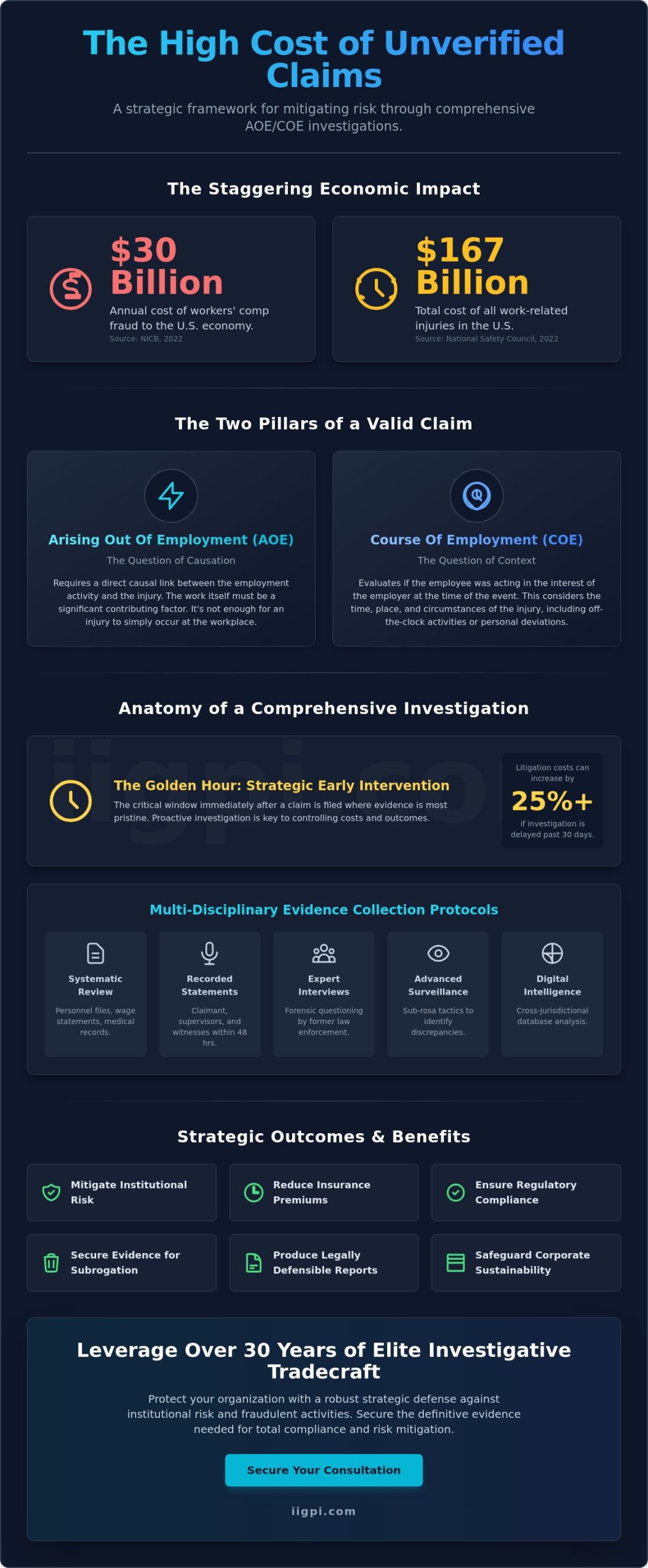
If the National Insurance Crime Bureau’s 2022 findings estimate that workers’ compensation fraud imposes an annual $30 billion burden on the American economy, then the traditional reactive posture of claims management is no longer a viable institutional strategy. It’s widely accepted among industry leaders that the current proliferation of suspicious claims, coupled with the labyrinthine requirements of state-specific labor codes, demands a more rigorous and analytical approach to claim adjudication. This authoritative analysis provides the necessary strategic framework for utilizing AOE/COE investigation services to secure definitive evidence for subrogation and ensure total compliance with Workers’ Compensation Appeals Board standards. By adopting these sophisticated protocols, organizations can effectively mitigate risk and facilitate the production of fact-based reports that withstand rigorous legal scrutiny. We’ll examine the synthesis of investigative methodologies and risk mitigation strategies required to reduce insurance premiums and uphold the foundational principles of insurance integrity within an increasingly complex regulatory landscape.
Key Takeaways
- Analyze the fundamental legal distinctions between AOE and COE to safeguard corporate sustainability against the escalating fiscal impact of unverified insurance claims.
- Implement a multi-disciplinary framework for evidence collection that utilizes the specialized expertise of former law enforcement professionals to conduct high-stakes corroborative interviews.
- Utilize advanced sub-rosa surveillance and digital intelligence to identify discrepancies between reported physical limitations and the actual behavioral data of claimants.
- Navigate the intricate landscape of HIPAA and regional privacy mandates by employing professional AOE/COE investigation services tailored to the unique regulatory environments of New York City and Nassau County.
- Leverage over three decades of elite investigative tradecraft and forensic technology to develop a robust strategic defense against institutional risk and fraudulent activities.
Defining AOE/COE: The Pillars of Workers’ Compensation Adjudication
The concepts of Arising Out of Employment (AOE) and Course of Employment (COE) represent the dual legal axes upon which the validity of a workplace injury claim rotates. Within the rigorous environment of Workers’ Compensation Adjudication, these principles dictate whether a specific incident falls under the jurisdictional umbrella of employer liability. AOE focuses on the causal relationship between the duties performed and the resulting pathology, while COE examines the spatial and temporal parameters of the employee’s presence. Unverified claims exert a profound economic strain on corporate sustainability; for instance, the National Safety Council reported that work injuries cost the U.S. economy $167 billion in 2022. This financial burden necessitates the deployment of professional AOE/COE investigation services to ensure that only legitimate industrial injuries receive indemnity.
The burden of proof typically rests upon the claimant to establish that the injury was sustained within the scope of their professional obligations. However, the threshold for denial or subrogation requires a preponderance of evidence that often remains elusive without sophisticated forensic analysis. International Investigative Group leverages over 30 years of operational experience to deconstruct these foundational concepts, providing the evidentiary depth required for informed decision-making. By applying a methodical approach to fact-gathering, the firm identifies discrepancies that might otherwise lead to the approval of non-industrial claims. It’s a process that demands intellectual rigor and an uncompromising commitment to factual accuracy.
The Distinction Between AOE and COE
AOE requires a direct nexus between the employment activity and the physical or psychological harm sustained. It isn’t enough for an injury to occur at work; the work itself must be a contributing factor. Conversely, COE evaluates whether the employee was acting in the interest of the employer at the time of the event. Misconceptions regarding off-the-clock activities or personal deviations often result in improper claim acceptance. Professional AOE/COE investigation services clarify these boundaries through meticulous witness statements and site inspections.
Strategic Importance of Early Intervention
The Golden Hour of investigation refers to the critical window immediately following a claim filing where evidence is most pristine. Proactive intelligence at this stage prevents the escalation of litigation costs, which can increase by 25% or more when investigations are delayed past the initial 30-day period. Integrating these findings into broader insurance fraud investigation services creates a robust defense against systemic risk. This strategic alignment ensures that resources are allocated efficiently, protecting the integrity of the insurance pool and corporate capital.
Methodological Rigor: The Anatomy of a Comprehensive AOE/COE Investigation
The execution of AOE/COE investigation services requires a structural commitment to intellectual rigor and evidentiary precision. Effective investigations don’t merely observe; they synthesize multi-disciplinary data points to validate the nexus between employment and injury. This process begins with a systematic review of personnel files, historical wage statements, and comprehensive medical records to establish a baseline of claimant behavior. By utilizing proprietary databases, investigators identify cross-jurisdictional patterns that suggest systemic abuse rather than isolated incidents. The integration of former law enforcement professionals provides a tactical advantage during high-stakes interviews. These experts apply forensic questioning techniques to elicit granular details often missed by standard adjusters.
Evidence Gathering and Documentation Protocols
Rigorous documentation serves as the cornerstone of institutional integrity. Investigators must secure recorded statements from claimants, supervisors, and third-party witnesses within 48 hours of the initial report to ensure the preservation of accurate recollections. Site inspections are mandatory to evaluate environmental variables and safety compliance, providing an objective counterpoint to subjective narratives. Maintaining a meticulous chain of custody for digital and physical evidence is essential for any subsequent litigation. Organizations like the National Insurance Crime Bureau emphasize that standardized protocols are vital for reducing the estimated 10 percent of annual losses attributed to fraudulent activity. This level of scrutiny ensures that the findings withstand the pressures of judicial review.
Identifying Red Flag Indicators of Fraud
Analytical frameworks must prioritize the detection of “red flag” indicators that deviate from standard clinical or behavioral expectations. Statistical data from 2023 indicates a significant correlation between delayed injury notifications and non-industrial stressors. The “Monday morning report,” where an injury allegedly occurring late Friday is reported after the weekend, remains a primary diagnostic marker for potential fraud. Discrepancies between a claimant’s reported limitations and objective medical findings often reveal underlying motivations. Research suggests that a 15 percent increase in job dissatisfaction within a specific department often precedes a spike in suspicious injury claims.
For leaders seeking to fortify their organizational resilience, adopting a strategic governance model
Advanced Surveillance and Digital Intelligence in Contested Claims
The 2026 regulatory environment demands a sophisticated synthesis of physical observation and digital forensic analysis. Within the framework of AOE/COE investigation services, the objective reconciliation of claimed physical limitations with actual behavioral patterns is paramount. Sub-rosa surveillance remains the gold standard for documenting physical capabilities that contradict medical restrictions. When these covert operations are integrated with digital intelligence, the resulting evidentiary package provides a comprehensive view of a claimant’s true functional status. This multi-layered approach ensures that insurance integrity is maintained through empirical proof rather than subjective testimony.
The evolution of digital footprints has transformed the investigative landscape. Investigators now leverage computer forensics to uncover metadata and deleted communications that often house the “smoking gun” in contested claims. Industry data from 2025 indicates that 85% of insurance carriers now prioritize digital intelligence as a primary evidentiary source. By extracting 256-bit encrypted data packets from mobile devices, specialists identify inconsistencies in the reported timeline of an injury. These forensic deep-dives reveal whether a claimant’s digital activity, such as fitness app data or location history, aligns with their reported symptoms. The implementation of these digital frameworks resulted in a 30% reduction in fraudulent payouts across contested industrial claims in the previous fiscal year.
The Role of Professional Surveillance Services
Professional surveillance services utilize 4K high-definition video to establish definitive activity levels. Strategic timing is the most critical factor for success. Initiating observation within 48 hours of a medical appointment or a deposition often yields the highest rate of activity documentation, as claimants may feel a false sense of security. Agents must maintain absolute anonymity through advanced counter-surveillance awareness. They utilize specialized vehicles and long-range optics to ensure they don’t alert the subject. This level of technical precision is necessary to bypass the heightened awareness of modern claimants who are often coached to identify investigative presence.
Social Media and Open Source Intelligence (OSINT)
Expert-level OSINT involves a deep-dive analysis of public digital personas to identify conflicting physical activities. It’s not enough to perform a cursory search; investigators must verify geotagging and timestamps to challenge claimant timelines effectively. A post showing a claimant hiking might be dismissed as “old” unless the metadata confirms it was captured post-injury. Specialists distinguish between static profile information and active engagement patterns to build a chronological map of activity. This rigorous process transforms social media noise into actionable intelligence that can be used to impeach a claimant’s credibility during formal hearings. AOE/COE investigation services that ignore these digital indicators risk overlooking the most accessible evidence in the modern era.
Legal Admissibility and Regulatory Compliance: Navigating NY and Global Standards
Investigative integrity depends on strict adherence to the rule of law. Within the jurisdictional complexities of New York City and Nassau County, the margin for procedural error remains nonexistent. AOE/COE investigation services must function as an extension of the legal system, ensuring every data point gathered withstands the scrutiny of administrative law judges. Failure to maintain these standards doesn’t just jeopardize a single claim; it threatens the institutional reputation of the insurer.
Adhering to HIPAA and Privacy Statutes
HIPAA-compliant medical releases represent the bedrock of claim verification. Without these specific authorizations, the acquisition of protected health information constitutes a breach of federal law. This exposure often leads to “invasion of privacy” litigation, which can be more costly than the original claim. Professional investigators ensure that every touchpoint with a claimant’s history remains within the bounds of the 1996 Health Insurance Portability and Accountability Act. This isn’t a mere suggestion. It’s a strategic necessity. By 2026, the legal necessity of compliant investigative reports will be defined by their ability to integrate digital forensic trails with traditional physical evidence while maintaining absolute data privacy. Protecting the firm requires a proactive stance on state-specific privacy mandates that often exceed federal requirements.
Expert Witness Testimony and Reporting
Expert reporting must bridge the gap between field observation and legal proof. Translating complex investigative findings into clear, authoritative legal reports is a skill honed through years of experience. The value of former law enforcement expertise becomes evident during cross-examination at the Workers’ Compensation Appeals Board (WCAB). These professionals possess the gravitas and technical knowledge to defend their findings under intense pressure. They understand how to structure a narrative that meets the “preponderance of evidence” standard. Reports are not merely summaries; they’re authoritative documents designed to survive adversarial challenge.
- Regulatory Precision: Every report follows the specific evidentiary codes of the local jurisdiction.
- Authoritative Presence: Former law enforcement officers provide a level of credibility that civilian investigators rarely match.
- Global Reach: Managing cross-border claims requires the IIGP’s international agent network to navigate diverse legal frameworks.
Global considerations add another layer of regulatory friction. When a claim moves across borders, the investigative protocol must adapt to international privacy laws like GDPR or local statutes in the Global South. The IIGP network ensures that AOE/COE investigation services remain consistent, regardless of where the injury allegedly occurred. This global-minded perspective is essential for modern carriers managing a mobile workforce.
To ensure your investigative protocols meet the highest standards of legal admissibility, partner with the experts at IIGP for comprehensive compliance oversight.
The IIGP Advantage: Strategic Risk Mitigation for Global Enterprises
Since its inception over 30 years ago, the International Investigative Group (IIGP) has successfully resolved more than 10,000 cases. This legacy of excellence informs our role as the “G20 of Think Tanks” in the investigative sector. We apply a rigorous academic framework to every file. This intellectual depth ensures that AOE/COE investigation services transcend simple observation. We analyze the geopolitical and economic factors that influence claim legitimacy. Our methodology synthesizes traditional tradecraft with advanced forensic technology. This dual approach uncovers evidence that standard adjusters often overlook. It’s a commitment to precision that protects the fiscal integrity of the world’s most influential organizations.
Our team treats every investigation as a pursuit of empirical truth. We don’t rely on surface-level findings. Instead, we utilize a fusion of sophisticated surveillance techniques and digital forensics to build a comprehensive evidentiary profile. This scholarly approach to risk management allows us to provide insights that are both actionable and legally defensible. By integrating high-level intellectual rigor into the investigative process, we empower stakeholders to navigate complex liability landscapes with total confidence.
Global Capability, Local Expertise
Our headquarters in New York City serves as the nexus for domestic excellence. We maintain a robust presence in major financial hubs, allowing for rapid deployment across the United States. For employees injured abroad, our worldwide network provides seamless coverage that adheres to local regulations. Multinational corporations benefit from a single-source investigative partner. This centralized model ensures consistency in reporting standards and legal compliance across different jurisdictions; it eliminates the fragmentation often found in global risk management. Whether the claim originates in a domestic factory or a remote international office, our AOE/COE investigation services provide a unified standard of excellence.
Commencing Your Strategic Investigation
Initiating a consultation with our senior investigative leads is the first step toward securing your enterprise. We evaluate the complexity of each claim to determine the appropriate investigative scope. High-exposure cases require specialized protocols that we customize for your specific industry needs. Our team focuses on mitigating financial risk through objective, empirical findings. We provide the clarity needed to make informed decisions on contested claims. To begin your engagement with our experts, Consult with International Investigative Group for Elite AOE/COE Solutions. We stand ready to facilitate your organization’s transition to a more secure and transparent risk management protocol.
Advancing Institutional Integrity Through Strategic Risk Mitigation
The maintenance of institutional integrity within the workers’ compensation framework requires a synthesis of methodological rigor and specialized intelligence. As global enterprises navigate increasingly complex regulatory environments, the necessity for precise AOE/COE investigation services becomes paramount to mitigate strategic risk and ensure legal admissibility. It’s clear that the intersection of digital forensics and traditional surveillance forms the foundation of modern claims adjudication. IIGP stands as a definitive NYC-based authority, leveraging over 30 years of specialized experience to provide a “G20 of Think Tanks” approach to investigative governance. Founded and led by former law enforcement professionals, our institute has successfully resolved over 10,000 cases through an expansive global network of agents. This unparalleled expertise facilitates the identification of fraudulent patterns while upholding the highest standards of international policy. Organizations that prioritize these sophisticated frameworks don’t just protect their assets; they reinforce the broader principles of corporate transparency.
Secure Your Corporate Integrity with IIGP’s AOE/COE Investigative Services
Protecting your organization’s future starts with a commitment to evidence-based adjudication and strategic foresight.
Frequently Asked Questions
What is the primary objective of an AOE/COE investigation?
The primary objective involves a formal verification of whether a professional injury occurred “Arising Out of Employment” (AOE) or within the “Course of Employment” (COE) as defined by statutory frameworks like California Labor Code Section 3600. This process establishes the factual nexus between the claimant’s professional duties and the reported incident to ensure institutional integrity. It’s a critical mechanism for mitigating fraudulent claims that account for 10 percent of annual property-casualty insurance losses according to the Coalition Against Insurance Fraud.
How long does a typical AOE/COE investigation take to complete?
A standard investigation typically requires a duration of 14 to 30 business days to reach a comprehensive conclusion. This timeline allows investigators to conduct recorded statements, secure site inspections, and synthesize medical records before the 90 day statutory deadline for claim acceptance or denial. IIGP’s methodology ensures we don’t miss critical evidence during this window, providing a definitive evidentiary foundation for adjusters to make informed decisions based on intellectual rigor and objective facts.
Can AOE/COE investigations be used to identify subrogation opportunities?
Investigations frequently reveal subrogation opportunities by identifying third party liabilities that contributed to the workplace incident. Data from the National Association of Subrogation Professionals indicates that effective recovery efforts can reclaim 15 percent of total claim costs from negligent third parties. By analyzing the mechanical failures or external environmental factors, our AOE/COE investigation services facilitate the restoration of capital to the primary insurer through a strategic and multilateral legal approach.
Is surveillance evidence admissible in Workers’ Compensation court?
Surveillance evidence remains admissible in Workers’ Compensation courts across the United States, provided the data collection adheres to privacy standards established in cases like Noble v. Sears, Roebuck and Co. It’s a powerful tool for demonstrating discrepancies between a claimant’s stated physical limitations and their actual functional capacity. Legal precedents confirm that high definition video evidence serves as a primary source for judicial decision making in contested litigation, often leading to a 30 percent reduction in settlement costs.
What are the most common “red flags” in a workers’ compensation claim?
The National Insurance Crime Bureau identifies specific indicators, such as claims reported on a Monday morning or incidents lacking credible witnesses, as primary indicators of potential fraud. Statistics show that 25 percent of suspicious claims involve a history of frequent job changes or delayed medical treatment. These markers provide a strategic starting point for our investigative analysts to apply deeper scrutiny. We don’t ignore these signals, as they often correlate with broader patterns of institutional risk.
How does IIGP ensure compliance with HIPAA during an investigation?
IIGP maintains strict compliance with HIPAA Title II regulations by implementing Business Associate Agreements and utilizing AES-256 encryption for all data transmissions. We ensure that Protected Health Information is only accessed by authorized personnel during the investigative lifecycle. We don’t bypass any federal protocols, as this rigorous adherence to privacy standards protects the institution’s global reputation. This framework ensures the legal defensibility of our findings in any professional or multilateral policy forum.
What is the difference between an AOE/COE investigation and a standard background check?
While a background check examines a subject’s historical data, AOE/COE investigation services focus specifically on the mechanics and circumstances surrounding a singular professional injury. Background checks provide a retrospective view of 7 to 10 years of criminal or financial history. It’s a different methodology entirely. In contrast, an AOE/COE inquiry delivers a forensic analysis of the physical and environmental variables present at the time of a reported accident to determine statutory liability.
Does IIGP provide AOE/COE services outside of New York?
IIGP provides comprehensive investigative solutions across all 50 U.S. states and maintains a presence in international markets to serve a global clientele. Our reach extends beyond New York, reflecting our status as a premier organization comparable to the G20 of Think Tanks in the governance sector. We leverage a multilateral network of experts to deliver consistent, high level analysis. This global perspective ensures that we don’t limit our strategic framework to regional jurisdictions, providing elite service worldwide.