
The rapid integration of digital currencies into the global financial system has precipitated a parallel and alarming escalation in sophisticated crypto scams, inflicting considerable economic and psychological damage upon victims worldwide. For those affected, the perceived anonymity of blockchain transactions and the technical complexity of the underlying ledger technology often cultivate a profound sense of helplessness, fostering the conviction that stolen funds are permanently untraceable and that formal recourse is futile beyond a standard police report. This investigative analysis directly confronts these assumptions by providing a comprehensive deconstruction of the operational methodologies behind the most prevalent fraudulent schemes.
This guide delineates the rigorous forensic investigation process, explaining how digital assets can be traced across blockchains and outlining a credible, professional framework for pursuing asset recovery and legal action. The objective is to equip victims with the critical knowledge required to understand the mechanics of the deception they faced, to assess the viability of recovery, and to implement robust strategies to safeguard their remaining digital assets from future threats.
Key Takeaways
- Grasp the systemic factors within decentralized finance (DeFi) that have led to a significant proliferation of sophisticated financial crime.
- Deconstruct the operational mechanics of prevalent crypto scams to identify common methodological red flags from an investigative standpoint.
- Comprehend the technical basis for tracing digital assets on public blockchains, which challenges the prevailing myth of complete transaction anonymity.
- Discern the structured forensic process employed by professional firms for asset tracing and recovery, distinguishing it from traditional law enforcement procedures.
The Evolving Landscape of Digital Asset Fraud
The proliferation of digital assets has precipitated a corresponding and alarming surge in cryptocurrency-related financial crime. This phenomenon presents a significant challenge to global governance and financial stability, where the very features that drive innovation-decentralization, anonymity, and speed-are systematically exploited by malicious actors. According to industry analysis, illicit actors obtained approximately $4.6 billion through various fraudulent schemes in 2023 alone, underscoring the scale and persistence of this threat. The rapid expansion of decentralized finance (DeFi) platforms, coupled with persistent regulatory ambiguity across international jurisdictions, has created an environment ripe for sophisticated financial exploitation.
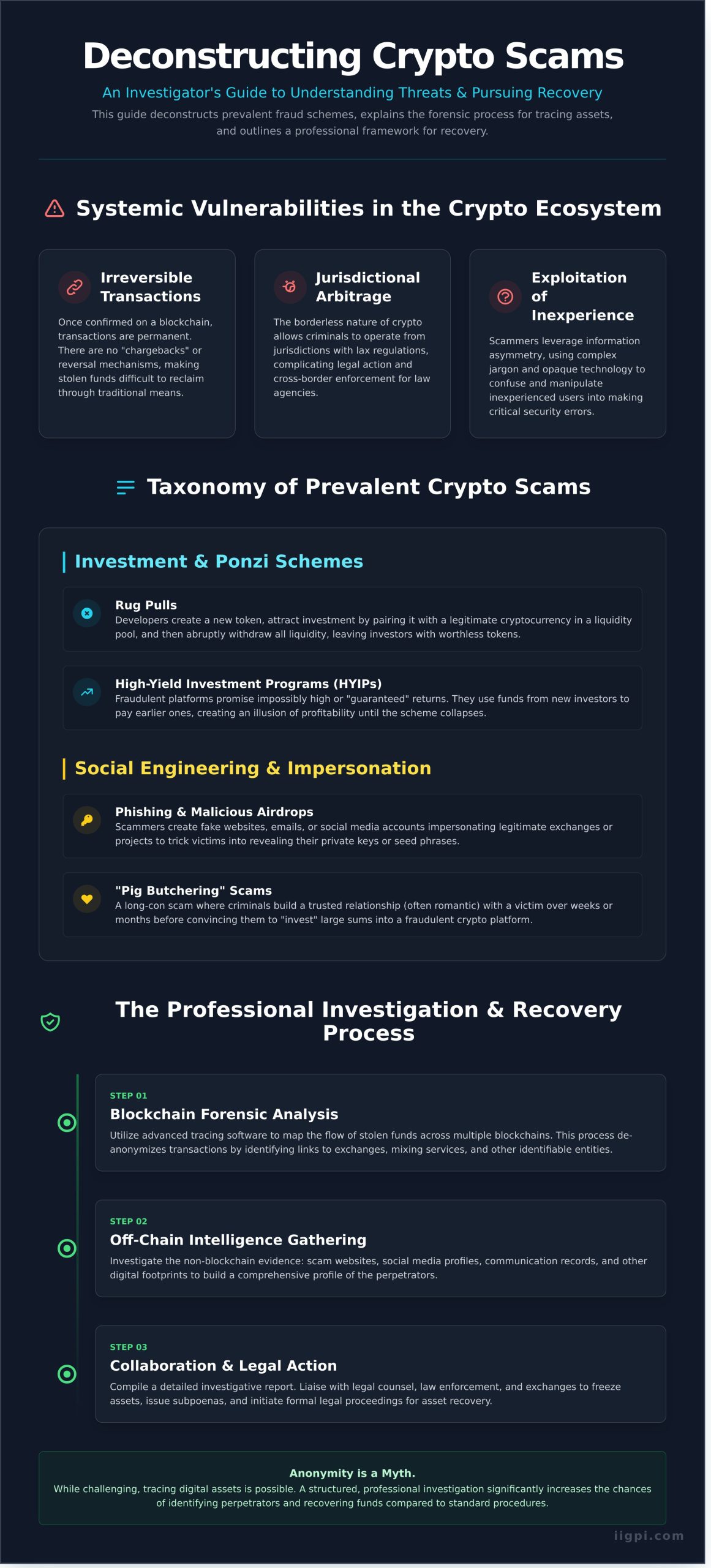
The architecture of this illicit economy is multifaceted, ranging from elementary social engineering tactics to highly complex technical exploits. The extensive Taxonomy of cryptocurrency-related crime illustrates a spectrum of illicit activities, including phishing, Ponzi schemes, and advanced smart contract manipulations that drain liquidity pools or compromise protocol security. This diversity in methodology requires a nuanced and adaptive analytical framework to effectively identify and mitigate emerging threats within the digital asset space.
Key Vulnerabilities in the Crypto Ecosystem
Several intrinsic characteristics of the digital asset ecosystem create systemic vulnerabilities that are frequently leveraged by fraudulent entities. These structural weaknesses include:
- The Irreversibility of Blockchain Transactions: Once a transaction is confirmed on a blockchain, it is immutable and cannot be reversed, leaving victims with no recourse to recover stolen funds through traditional chargeback mechanisms.
- Challenges in Cross-Jurisdictional Enforcement: The decentralized and borderless nature of cryptocurrencies complicates legal and regulatory enforcement, allowing perpetrators to engage in jurisdictional arbitrage to evade prosecution.
- Exploitation of User Inexperience: The technical complexity of cryptocurrency wallets, smart contracts, and DeFi protocols creates a significant information asymmetry that fraudsters exploit to mislead and manipulate inexperienced users.
The Psychology of the Modern Crypto Scam
Sophisticated crypto scams are often predicated on advanced psychological manipulation rather than purely technical prowess. Malicious actors expertly leverage powerful cognitive biases, such as the Fear Of Missing Out (FOMO), by promoting fictitious investment opportunities with promises of exponential returns. They construct elaborate facades of authority and credibility through manipulated social media profiles and paid endorsements, building trust before soliciting funds. Furthermore, the deliberate use of opaque technical jargon serves to overwhelm and confuse potential victims, discouraging due diligence and fostering a dependency on the fraudster’s purported expertise.
Taxonomy of Prevalent Crypto Scams: A Methodological Breakdown
A comprehensive analysis of sophisticated crypto scams requires moving beyond simple categorization to a methodological framework that examines the underlying mechanics, psychological triggers, and financial architectures of these illicit operations. From an investigative perspective, understanding these typologies is critical for developing effective countermeasures and policy responses. Each category of fraud targets a different investor profile, from the financially unsophisticated to the technically proficient, by exploiting distinct vulnerabilities within the digital asset ecosystem. The flow of funds, while varied, often follows a trajectory from victim wallets to decentralized exchanges or mixers designed to obfuscate the transaction trail.
Investment and Ponzi Schemes
This category represents the most conventional form of financial fraud adapted for the digital age. High-Yield Investment Programs (HYIPs) and Ponzi schemes attract capital by promising unsustainable returns, a red flag often ignored by investors susceptible to market euphoria. A more crypto-native variant is the “rug pull,” where developers of a new token or project abandon it after attracting significant investment, typically by draining liquidity pools on decentralized exchanges. These schemes are often supported by fraudulent trading platforms that display manipulated data to create an illusion of profitability, luring participants into committing ever-larger sums before the platform is abruptly shut down.
Social Engineering and Impersonation Scams
Unlike schemes predicated on flawed investment logic, this class of fraud leverages profound psychological manipulation. The “pig butchering” or Sha Zhu Pan scam exemplifies this, where perpetrators cultivate long-term personal or romantic relationships to build trust before coercing victims into fraudulent investments. The variety of these tactics is extensive, as detailed in the FTC guide to avoiding cryptocurrency scams. Other common vectors include impersonating technical support staff to gain access to private keys or seed phrases and propagating fraudulent giveaway promotions on social media platforms like Twitter and Discord, which exploit a user’s fear of missing out on a perceived opportunity.
Technical and Malware-Based Attacks
These attacks exploit the technical complexities of blockchain technology and user security lapses. “Ice phishing,” for instance, tricks users into signing a malicious smart contract approval, granting the attacker permission to drain specific tokens from the victim’s wallet indefinitely. Another insidious method involves clipper malware, which operates in the background on a victim’s device to automatically replace a legitimate cryptocurrency wallet address with an attacker’s address during a copy-and-paste action. Furthermore, fraudulent airdrops and non-fungible tokens (NFTs) are increasingly used as bait, prompting users to connect their wallets to malicious decentralized applications that are engineered to execute unauthorized transactions and drain all available funds.
The Illusion of Anonymity: Tracing Cryptocurrency on the Blockchain
A persistent and dangerous misconception surrounding digital assets is the notion of complete anonymity. While cryptocurrencies such as Bitcoin operate on a pseudonymous basis, where user identities are represented by alphanumeric wallet addresses, they are fundamentally transparent. The distributed ledger technology, or blockchain, that underpins these assets is a public and immutable record of every transaction ever conducted. This inherent transparency establishes the foundation for blockchain forensics, a sophisticated discipline dedicated to tracing the flow of illicit funds and de-anonymizing malicious actors involved in complex crypto scams.
Fundamentals of On-Chain Analysis
The initial phase of any blockchain investigation involves on-chain analysis, which is the process of following the digital money trail across public ledgers. Investigators utilize blockchain explorers-publicly available tools-to map the flow of funds from victim wallets to those controlled by perpetrators. Through this process, analysts identify transactional patterns indicative of illicit activity. Common patterns include “peeling chains,” where fraudsters move funds through a series of new wallets to obscure the trail, and the use of “consolidation addresses” to aggregate stolen assets from numerous victims into a single point of control before cashing out.
Advanced Forensic Techniques
As criminals adopt more sophisticated obfuscation methods, investigators must employ advanced forensic techniques. Clustering analysis utilizes algorithmic heuristics to group multiple addresses that are likely controlled by a single entity, based on their transactional behavior. A significant challenge is posed by mixers and tumblers, services designed to break the on-chain link between a source of funds and its destination. However, advanced analytical tools can often de-mix these transactions by analyzing transaction timing, volume, and other metadata. Furthermore, for scams involving decentralized finance (DeFi), forensic analysis extends to the smart contracts themselves, scrutinizing the code for vulnerabilities or malicious functions.
The Role of Off-Chain Intelligence
The ultimate objective of blockchain analysis is to connect a pseudonymous wallet address to a real-world identity. This critical link is most often established through off-chain intelligence. The primary nexus points are centralized cryptocurrency exchanges, which are legally obligated in most jurisdictions to perform Know Your Customer (KYC) checks on their users. When illicit funds are moved to an exchange for liquidation, law enforcement can, through subpoenas and other legal processes, compel the exchange to disclose the identity associated with the account. This is supplemented by Open-Source Intelligence (OSINT), where analysts gather data from public sources like social media. Such comprehensive approaches are integral to the broader regulatory effort to provide public guidance on how to avoid cryptocurrency scams and hold malicious actors accountable.
The Professional Investigation and Asset Recovery Process
When substantial assets are compromised in sophisticated crypto scams, victims require a methodical and specialized response that extends beyond the typical purview of public law enforcement. Whereas state agencies are primarily oriented towards criminal prosecution, a private intelligence and investigations firm operates with a singular focus on civil remedies and asset recovery. The objective is to navigate the complex, often transnational, pathways of illicit finance to achieve tangible restitution for the client. This process is governed by a structured methodology designed to build a legally actionable case.
The core objectives of a professional engagement are threefold:
- To conduct a comprehensive forensic trace of the stolen digital assets across multiple blockchains.
- To identify the ultimate beneficiaries and perpetrators behind the fraudulent scheme.
- To prepare an exhaustive evidence package to support legal action and facilitate asset seizure through global judicial and law enforcement channels.
It is imperative for clients to understand that these investigations are complex and that timelines can be protracted, contingent upon jurisdictional complexities and the perpetrators’ operational security. However, a systematic approach significantly enhances the probability of a successful recovery.
Phase 1: Case Intake and Evidence Preservation
The foundational stage involves a confidential consultation to establish the facts of the case and meticulously collate all pertinent evidence. This includes securing all victim-scammer communications, transaction hashes (TXIDs), perpetrator-controlled wallet addresses, and any identifying information related to the fraudulent platform or individuals. Concurrently, clients receive immediate strategic advice on implementing enhanced security protocols to safeguard all remaining digital and financial assets from further compromise.
Phase 2: On-Chain and Off-Chain Analysis
Leveraging advanced blockchain forensic software and proprietary analytical techniques, investigators map the intricate flow of the misappropriated funds. This on-chain analysis identifies intermediary wallets, mixing services, and critical nexus points where the funds interact with regulated centralized exchanges-the primary off-ramps for converting cryptocurrency to fiat. The culmination of this phase is a detailed forensic report that provides an immutable, court-admissible cartography of the financial crime.
Phase 3: Identification and Legal Support
The intelligence gathered during the analytical phase is utilized to de-anonymize the operators controlling the final destination wallets, often through collaboration with exchanges and financial institutions. An exhaustive evidence package is then compiled for legal counsel and submitted to appropriate law enforcement agencies globally. Our firm liaises directly with these international partners, providing the specialized expertise required to navigate cross-border legal frameworks and execute asset seizure and forfeiture orders.
The successful resolution of complex financial fraud requires decisive and expert intervention. If you are a victim of a significant crypto scam, request a confidential consultation.
Proactive Defense: Due Diligence and Security Protocols
Transitioning from a reactive to a proactive security posture represents a fundamental paradigm shift for participants in the digital asset economy. Rather than merely responding to illicit activities, a proactive framework is a strategic imperative designed to mitigate exposure to financial and reputational risk before it materializes. This approach necessitates a rigorous commitment to comprehensive due diligence and the implementation of robust security protocols, which collectively serve as the primary bulwark against sophisticated crypto scams.
Vetting Projects and Platforms
Thorough due diligence is the cornerstone of risk mitigation. This process involves a meticulous examination of a project’s foundational documents, such as its whitepaper, to assess technical feasibility, economic modeling, and long-term viability. The credentials and historical performance of the development team must be critically scrutinized. Furthermore, a comprehensive review of independent smart contract audits is essential to identify and evaluate potential vulnerabilities, while the selection of trading platforms must be limited to reputable, regulated exchanges with a proven history of security and compliance.
Operational Security (OpSec) for Asset Holders
For both individual and institutional asset holders, the implementation of stringent operational security (OpSec) protocols is non-negotiable. These measures are critical for safeguarding cryptographic keys from unauthorized access and theft, forming the last line of defense against sophisticated attack vectors. Key best practices include:
- Cold Storage: Utilizing hardware wallets to store the majority of assets offline, thereby isolating private keys from internet-connected threats.
- Seed Phrase Integrity: Managing recovery phrases with absolute discipline, which includes storing them physically in secure, non-digital locations and never entering them into any online platform.
- Phishing Countermeasures: Maintaining a state of high alert for unsolicited communications and independently verifying all requests for information or transactions through official, pre-established channels.
- Confidentiality Mandate: Adhering to the inviolable principle of never sharing private keys or granting remote screen access to any individual or entity under any circumstances.
For corporate entities, these individual security measures must be augmented by stringent internal governance controls. The establishment of multi-signature wallet protocols, segregated access rights, and regular, independent security audits are indispensable for protecting organizational assets from both external threats and internal malfeasance. For further analysis on digital asset governance frameworks, the International Investigative Group continues to disseminate leading research, available at iigpi.com.
Strategic Imperatives in Combating Digital Asset Fraud
The preceding analysis demonstrates that the landscape of digital asset fraud is characterized by continuous evolution and increasing complexity. A critical understanding reveals that while the illusion of anonymity on the blockchain persists, sophisticated forensic methodologies can effectively trace illicit transactions. The escalating sophistication of crypto scams therefore necessitates a strategic, multi-faceted response, combining proactive security protocols with robust post-incident investigative capabilities.
For entities and individuals who have fallen victim to such financial malfeasance, securing expert intervention is paramount. With over 30 years of complex financial investigation experience, our court-recognized experts in computer forensics and asset tracing are equipped to manage these intricate challenges. Leveraging a global network of agents for cross-jurisdictional cases, we provide the authoritative support required for asset recovery. We invite you to contact our financial fraud investigators for a confidential case evaluation. Although the challenges are substantial, the path toward financial restitution and justice is navigable with principled and expert guidance.
Frequently Asked Questions
Is it actually possible to recover stolen cryptocurrency?
The recovery of misappropriated digital assets is a complex undertaking, yet it is demonstrably possible under specific conditions. The process is contingent upon successful forensic blockchain analysis to trace the flow of funds to a centralized exchange or other regulated entity. Once an off-ramp is identified, legal and jurisdictional leverage can be applied to freeze and ultimately repatriate the assets. The success rate is fundamentally tied to the speed of action and the sophistication of the illicit actors involved.
How does a private investigator’s role differ from law enforcement in crypto cases?
The roles are distinct in both mandate and methodology. Law enforcement agencies operate with a primary objective of criminal prosecution, which is often constrained by resource allocation and significant caseloads. Conversely, specialized private investigative bodies focus exclusively on asset tracing and recovery for their clients. These entities can dedicate substantial resources to forensic analysis and collaborate with legal counsel to pursue civil remedies, often operating with greater agility across international jurisdictions than their public-sector counterparts.
What are ‘mixers’ or ‘tumblers’ and can forensic analysis defeat them?
Mixers, also known as tumblers, are services designed to obfuscate the transactional trail of cryptocurrencies by pooling funds from multiple sources and redistributing them. While they present a significant challenge to investigators, they are not insurmountable. Advanced forensic analysis, employing sophisticated clustering algorithms, volume analysis, and timing correlation, can often de-anonymize transactions with a high degree of probability. This allows investigators to re-establish the chain of custody and continue the trace toward a recovery point.
What specific information do I need to provide to begin an investigation?
To initiate a formal investigation, a comprehensive portfolio of evidentiary materials is required. This must include all relevant transaction identifiers (TXIDs), the victim’s wallet addresses, and any known wallet addresses of the perpetrators. Furthermore, a detailed timeline of events, the specific amounts transferred, and all correspondence with the illicit actors-such as emails, chat logs, and website URLs-are critical components for constructing an effective analytical framework and investigative strategy.
What is the typical timeframe and cost for a professional crypto fraud investigation?
The timeline and financial commitment for investigating sophisticated crypto scams are contingent upon multiple variables, including case complexity and the degree of transactional obfuscation. Initial tracing can take several weeks, while full recovery may span months. Engagement models typically involve an initial retainer for forensic analysis and investigative resources, often supplemented by a contingency fee calculated as a percentage of the recovered assets. A detailed proposal is formulated following a preliminary case assessment.
If the scammers are overseas, is there any hope for recovery?
The transnational nature of most crypto scams necessitates a global approach. Recovery is indeed possible even when perpetrators are located overseas, although it introduces significant complexity. Success hinges on leveraging international legal frameworks, such as Mutual Legal Assistance Treaties (MLATs), and engaging with legal partners within the relevant foreign jurisdictions. Professional investigative firms maintain global networks specifically to navigate this complex geopolitical landscape and enforce recovery actions across borders.
