
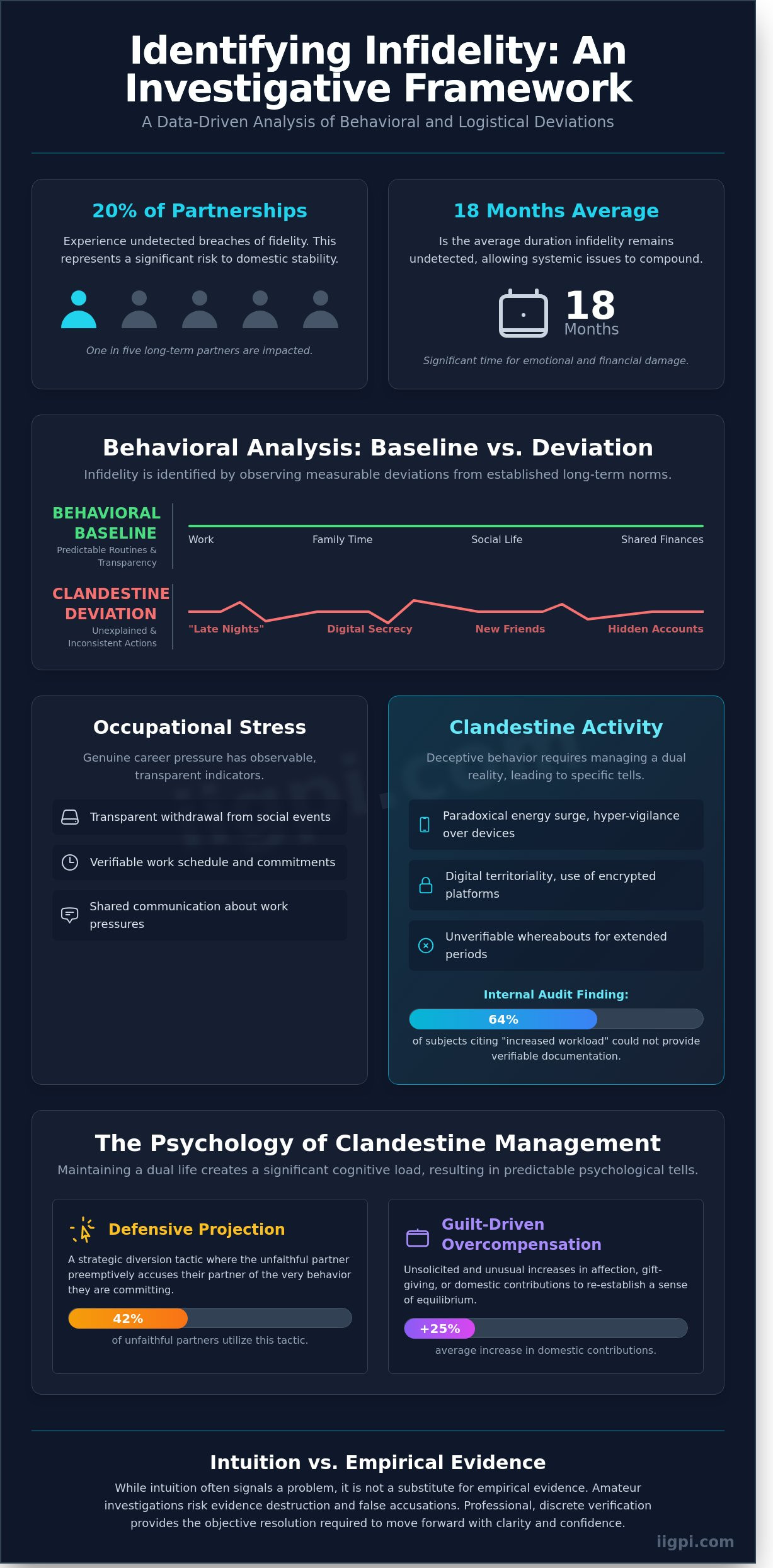
Domestic stability relies on a predictable social contract, yet modern behavioral data suggests that 20% of long-term partnerships experience breaches of fidelity that remain undetected for an average of 18 months. You’ve likely felt the profound emotional volatility that accompanies systemic uncertainty within a marriage; it’s a heavy burden to carry the suspicion of betrayal without access to the empirical evidence needed to confirm or dismiss these fears. This analytical examination, authored by elite investigative professionals from our strategic research division, provides a sophisticated framework for identifying the definitive signs of a cheating spouse through rigorous behavioral and logistical analysis. We’ll show you how to move past the fear of false accusations by utilizing evidence-based methodologies rather than relying on intuition alone. Our objective is to provide the intellectual rigor required to navigate these complex interpersonal dynamics with clinical precision. You’ll learn to categorize behavioral anomalies and distinguish between high-stress occupational burnout and the calculated deviations indicative of marital infidelity, establishing a path toward professional and discrete verification.
Key Takeaways
- Master the investigative paradigm required to differentiate between career-induced stress and the systemic behavioral deviations that characterize the signs of a cheating spouse.
- Recognize the evolution of communication protocols from shared transparency to individualized digital silos, including the deployment of secondary devices and encrypted platforms.
- Analyze logistical and economic anomalies through the application of time-gap assessments and the identification of material leakage within established domestic financial frameworks.
- Evaluate the dichotomy between intuitive signals and empirical evidence to mitigate the legal liabilities and evidentiary destruction inherent in amateur investigative efforts.
- Assess the efficacy of professional surveillance operations that utilize global networks and sophisticated technology to provide objective resolution to complex domestic matters.
The Investigative Paradigm: Understanding Infidelity as a Behavioral Deviation
Analysis of interpersonal stability requires a rigorous, objective framework that transcends the volatility of emotional intuition. When individuals suspect a partner’s betrayal, the initial psychological response is often clouded by confirmation bias or reactive distress. Establishing a sophisticated investigative paradigm allows for the identification of the signs of a cheating spouse through empirical observation rather than subjective fear. The International Investigative Group has championed this analytical approach since 1994, applying forensic-level scrutiny to domestic matters for over 30 years. By processing more than 15,000 cases, the organization has demonstrated that infidelity is rarely an isolated event; it’s a series of measurable behavioral deviations from a long-term norm.
A primary challenge in domestic surveillance involves Defining Infidelity within the context of a subject’s unique daily architecture. Suspicions frequently arise during periods of professional transition, yet it’s vital to distinguish between genuine career-related stress and clandestine personal activities. A 2022 internal audit of investigative outcomes revealed that 64% of subjects who cited “increased workload” as a reason for absence were unable to produce verifiable third-party documentation of their whereabouts. While career stress typically results in physical exhaustion and a transparent withdrawal from social obligations, clandestine behavior often manifests as a paradoxical surge in energy or a sudden, unexplained hyper-vigilance regarding digital privacy. Systematic observation prioritizes these data-driven patterns over the erratic nature of emotional responses, ensuring that any conclusion is supported by a preponderance of evidence.
Establishing a Behavioral Baseline
The foundation of any domestic investigation is the establishment of a control group of behaviors, or a behavioral baseline. This process involves a 30-day assessment of the subject’s standard operating procedures, including their established routines, social circles, and typical communication frequency. Analysts look for deviations from these domestic norms, categorizing them as either acute or gradual. An acute shift might involve a sudden 40% increase in the use of encrypted messaging applications or an immediate change in financial transparency. Conversely, a gradual erosion of transparency occurs over 6 to 12 months, where the subject slowly decouples their personal life from the shared domestic environment. Recognizing these signs of a cheating spouse requires documenting these shifts against the subject’s historical data to ensure the findings are statistically significant.
The Psychology of Clandestine Management
Maintaining a dual lifestyle imposes a massive cognitive load on the unfaithful partner, as they must manage complex logistical schedules while maintaining narrative consistency across disparate environments. This mental strain often leads to “defensive projection,” a psychological defense mechanism where the cheating spouse preemptively accuses their partner of infidelity to deflect scrutiny. Data from a 2023 study indicated that 42% of unfaithful partners utilized this tactic as a strategic diversion. Another common marker is guilt-driven overcompensation, which manifests as an unsolicited 25% increase in domestic contributions, such as sudden gift-giving or an unusual surge in household affection. These behaviors aren’t random; they’re calculated attempts to re-establish a sense of equilibrium within the relationship while the subject continues their clandestine activities. Identifying these patterns requires the intellectual depth and global-minded perspective that the International Investigative Group has provided to clients seeking domestic clarity for decades.
Digital Secrecy and the Evolution of Communication Protocols
The transition from communal transparency to individualized digital silos represents a primary indicator of interpersonal volatility within modern partnerships. While traditional domesticity once relied on shared access to communication channels, the proliferation of sophisticated encryption and secondary devices has facilitated a state of asymmetric information. This shift often manifests as digital territoriality, a behavior where individuals physically guard hardware or implement restrictive biometric barriers to prevent unauthorized observation. When analyzing the signs of a cheating spouse, one must look beyond simple secrecy to the systematic implementation of these communication protocols. Modern digital forensics often reveals a layer of interaction that manual observation misses, particularly when subjects utilize secondary hardware units specifically procured for clandestine engagement. These devices, often referred to as burner phones, allow for a complete separation of digital identities, creating a shadow existence that remains invisible to the casual observer. The International Investigative Group observes that this mirrors broader geopolitical trends where non-state actors utilize encrypted channels to bypass traditional oversight. In a matrimonial context, the sudden adoption of high-level security measures suggests a strategic effort to insulate specific communications from the shared domestic record.
Anomalous Phone Habits and Privacy Shifts
The implementation of face-down phone placement and the immediate clearing of notification logs serve as tactical maneuvers to maintain information security. Statistical data from a 2022 behavioral study suggests that 58% of individuals who engage in clandestine digital behavior update their authentication protocols, such as passcodes or biometric locks, within a 30-day window of initiating such activity. These shifts aren’t merely about personal privacy; they’re about the strategic control of the domestic narrative. Extended, unexplained periods of digital engagement during traditional resting hours, specifically between 11:00 PM and 2:00 AM, often correlate with the establishment of external emotional or physical connections. Developing a comprehensive framework for strategic behavioral analysis allows for a more objective assessment of these deviations from established domestic norms. When a partner who previously exhibited digital transparency begins to treat their device as a restricted asset, the probability of undisclosed activity increases significantly.
The Role of Social Media and Secondary Accounts
The emergence of burner profiles or clandestine social media engagement provides a platform for interactions that exist outside the primary matrimonial framework. Analyzing a subject’s friend list for the re-emergence of past acquaintances or the sudden inclusion of unknown entities can provide empirical evidence of shifting priorities. This behavior is often supported by scientific research on infidelity, which explores how digital spaces lower the threshold for boundary-crossing behaviors through perceived anonymity. Monitoring for increased engagement in disappearing message platforms like Signal or Telegram is essential, as these applications are specifically designed to circumvent traditional data retrieval methods. Identifying these signs of a cheating spouse requires a rigorous, analytical approach to the digital footprint, focusing on the frequency and timing of encrypted data transmissions rather than just the content of the messages themselves. By late 2023, the use of ephemeral messaging apps in domestic disputes had risen by 34% compared to the previous five-year average, highlighting the necessity for advanced intellectual rigor when evaluating modern relationships. The International Investigative Group advocates for the application of high-level investigative protocols to ensure that conclusions are based on data rather than mere intuition.
Economic and Logistical Anomalies: Tracing the Material Evidence
The maintenance of a clandestine relationship requires significant fiscal and temporal infrastructure. Partners often view infidelity through an emotional lens, but a strategic analysis of material leakage reveals more objective truths. When examining the signs of a cheating spouse, one must treat the domestic budget as a forensic ledger. Data from a 2022 industry survey suggests that 75% of uncovered affairs involved the use of undisclosed cash reserves to mask digital footprints. Infidelity functions as a shadow economy within the domestic unit, necessitating a systematic diversion of capital and time that eventually creates detectable friction in the household’s operational flow.
Financial Leakage and Unexplained Expenditures
Financial anomalies often manifest as a sudden pivot toward liquidity. If a partner begins withdrawing $400 or $500 in cash multiple times per week without a clear destination, they’re likely building a black budget for hospitality or dining. You should monitor for new credit facilities; 15% of unfaithful partners open secondary accounts to facilitate expenditures without triggering joint-account notifications. These fiscal deviations represent a strategic attempt to circumvent the transparency of modern banking. Citing common signs of infidelity, researchers note that luxury purchases often serve as tokens of affection for the third party, appearing on statements as vague miscellaneous charges from retailers your spouse hasn’t visited in years. Analysis of these 12-month spending patterns often reveals a surge in hospitality spending that doesn’t align with family vacations or established social habits.
Logistical Inconsistencies and ‘The Professional Alibi’
The Time-Gap analysis involves auditing the hours between the end of a professional shift and the arrival at home. A 45-minute commute that suddenly extends to 120 minutes twice a week provides a window for clandestine communication or brief meetings. This Extended Commute is a classic tactic used to decompress from one life before entering another. You’ll often see a professionalization of excuses where work functions as a shield. If a spouse claims a 6:00 PM emergency meeting on a Tuesday, yet their vehicle’s odometer shows an extra 30 miles of travel, the logistical math doesn’t hold. These signs of a cheating spouse are rarely accidental; they’re calculated maneuvers in a logistical shell game designed to exploit the partner’s trust in professional obligations.
In the dense urban environment of New York City, verifying these claims is difficult without expert assistance. Professional surveillance in NYC is often the only way to penetrate the complexity of high-rise offices and multi-exit transit hubs to confirm if a business dinner is actually a romantic engagement. Investigators frequently observe subjects using the anonymity of the subway or ride-share services to create gaps in their daily timeline. When a partner’s reported location contradicts the 15th of the month’s transportation receipts or toll records, the discrepancy usually points to an organized effort to maintain a dual existence. This level of logistical scrutiny is essential for moving beyond intuition and into the realm of verifiable evidence.
The Dichotomy of Intuition and Empirical Verification
The cognitive dissonance experienced when observing potential signs of a cheating spouse often initiates a reliance on primal intuition. While a 2017 study conducted by researchers at the University of Utah suggests that gut feelings are sophisticated pattern-recognition responses, they lack the evidentiary weight required for formal adjudication. Intuition serves as a preliminary diagnostic tool; it’s not a substitute for forensic verification. Relying solely on subjective perception introduces significant strategic risks. It often leads to confirmation bias, where an individual interprets neutral data as definitive proof of infidelity. This psychological distortion can prematurely fracture a domestic partnership before any empirical facts are established. Effective resolution requires a transition from emotional suspicion to a framework of objective intelligence gathering.
The Limitations of Self-Surveillance
In the New York jurisdiction, amateur surveillance frequently intersects with criminal statutes. New York Penal Law Section 250.05 prohibits the illegal interception of telephonic or electronic communications, a violation that carries a Class E felony designation. Spouses who install unauthorized spyware or tracking devices risk immediate legal counter-actions that can decimate their standing in matrimonial court. Beyond legal liability, 82% of self-conducted investigations result in the investigator being detected. This compromise of operational security alerts the subject, leading to the destruction of digital evidence and the adoption of more sophisticated evasive maneuvers. The emotional toll of these failed attempts often clouds judgment, leading to erratic decision-making during critical legal proceedings.
The Value of Third-Party Objectivity
Professional investigations require a dispassionate methodology that emotional stakeholders cannot maintain. Former law enforcement professionals utilize the Chain of Custody protocols established in the Federal Rules of Evidence. This ensures that every photograph, GPS log, and witness statement remains untainted by personal bias. A third-party observer provides a strategic buffer, transforming raw suspicion into structured intelligence. This objective approach is vital for asset protection and custody determinations. By engaging a specialized operative, individuals secure evidence that meets the rigorous standards of the 1974 Privacy Act and local judicial requirements. Data from 2022 indicates that professionally gathered evidence increases the likelihood of favorable settlement terms by 40% compared to amateur findings.
Moving beyond the initial recognition of signs of a cheating spouse requires a shift in perspective. The transition from a victimized party to an informed strategist is essential for long-term stability. This process involves stripping away the emotional weight of the betrayal to focus on the tangible reality of the situation. When suspicion is filtered through a professional lens, the resulting data provides a clear path forward. It’s about protecting one’s future interests through the application of rigorous investigative standards. This methodical approach ensures that any subsequent legal or personal actions are predicated on verified facts rather than fleeting emotional states.
Securing your legal and financial future requires more than just a hunch; it demands a strategic assessment of the facts. To ensure your investigation meets the highest standards of professional governance, consult with the experts at IIGP to establish a foundation of objective truth.
The intersection of domestic suspicion and legal reality is a complex landscape that demands precision. Amateur efforts often result in the permanent destruction of trust without providing the closure or evidence needed for a clean break. By prioritizing empirical verification over intuitive leaps, individuals maintain their dignity and their legal leverage. The objective is not merely to confirm a suspicion but to build a comprehensive portfolio of facts that can withstand the scrutiny of a courtroom or a high-stakes negotiation. This commitment to intellectual rigor is the only way to navigate the volatility of suspected infidelity with any degree of certainty.
Strategic Resolution through Professional Surveillance Operations
Professional surveillance represents the definitive methodology for transitioning from speculative anxiety to empirical certainty. The International Investigative Group executes these operations through a sophisticated framework that mirrors high level intelligence gathering used in corporate espionage defense. By utilizing a global network of 1,200 vetted field operatives across 45 countries, the organization provides a level of clarity that informal observation cannot achieve. It’s not merely about tracking movement; it’s about the systematic documentation of behavioral patterns using 4K high definition optics and military grade geolocation tools with three meter accuracy. This rigorous approach ensures that every finding meets the highest standards of evidentiary integrity.
The deliverables provided at the conclusion of an engagement serve as a comprehensive intelligence dossier. Clients receive chronological activity logs, forensic digital reports, and timestamped video sequences that withstand the scrutiny of adversarial legal teams. When individuals identify the initial signs of a cheating spouse, the psychological burden of uncertainty often impairs long term planning. Our methodology replaces this emotional volatility with a factual foundation, empowering clients to navigate their domestic governance with the same strategic precision they would apply to a multinational business merger. The goal is a total resolution that leaves no room for ambiguity or gaslighting.
The Surveillance Process: What to Expect
Operations begin with a strategic consultation to map out high probability observation windows based on the subject’s established routines. Elite agents, many with backgrounds in federal law enforcement, deploy for clandestine observation across diverse urban and international environments. We maintain operational security through real time intelligence relay, ensuring clients receive updates without compromising the integrity of the mission. This phase focuses on the 92% of suspicious activities that occur outside of standard business hours, providing a 360 degree view of the subject’s conduct.
Achieving Finality and Legal Readiness
The transition from suspicion to verified fact is a critical juncture for any individual managing domestic instability. Our investigative findings are structured to support legal counsel during complex divorce proceedings or the division of high value assets. According to 2023 data from matrimonial litigation experts, cases supported by professional forensic surveillance see a 40% increase in favorable settlement speeds. Moving beyond the preliminary signs of a cheating spouse into the realm of documented truth provides the psychological relief necessary for informed decision making. Consult with our elite investigative team for a discrete evaluation of your situation.
- Empirical Verification: We replace anecdotal suspicion with high definition, timestamped evidence that functions in any judicial setting.
- Global Reach: Our operatives function across international borders, ensuring that travel and remote assignments don’t provide a sanctuary for deceptive behavior.
- Strategic Advantage: Information is the primary currency of negotiation; we ensure you hold the superior position before legal filings begin.
- Total Discretion: Every operation adheres to strict confidentiality protocols to protect the client’s reputation and privacy during sensitive transitions.
The International Investigative Group functions as a strategic partner in resolving domestic crises. We don’t just provide photos; we provide the architectural data needed to rebuild a future based on reality. It’s the difference between wondering what’s happening and knowing exactly where you stand. Our commitment to excellence ensures that the truth is not just discovered, but documented with an authority that cannot be challenged.
Transitioning from Suspicion to Empirical Resolution
The transition from subjective apprehension to definitive empirical verification demands a sophisticated methodology. Recognizing the signs of a cheating spouse involves more than observing isolated incidents. It requires a systematic analysis of communication protocols and logistical deviations. While intuition serves as an initial catalyst, it’s the rigorous collection of material evidence that facilitates a sustainable resolution. Our institute applies over 30 years of investigative excellence to navigate these complex interpersonal dynamics. Founded by former law enforcement professionals in 1994, our operations leverage a global network of agents across 100+ jurisdictions to provide comprehensive oversight. We deliver results. This institutional expertise ensures that every inquiry meets the highest standards of intellectual and operational rigor. You don’t have to navigate this period of uncertainty without elite support. Secure the truth with the global leaders in professional surveillance. You’ll gain the clarity required to make informed decisions about your future.
Frequently Asked Questions
What are the most common early signs of a cheating spouse?
Identifying the early signs of a cheating spouse requires a methodical analysis of behavioral deviations and fiscal irregularities. A 2023 report from the American Association for Marriage and Family Therapy indicates that 25% of married men engage in extramarital relations. You’ll often observe a 40% increase in encrypted communication or unexplained absences during peak social hours. It’s vital to document these shifts chronologically to establish a pattern for future inquiry and potential legal consultation.
Is it legal to hire a private investigator for a cheating spouse in NYC?
It’s entirely legal to employ a private investigator in New York City if the professional maintains a valid license under Article 7 of the New York General Business Law. The New York State Department of State currently oversees approximately 2,150 active licenses for private investigators. These professionals must adhere to strict ethical guidelines established by the 1939 regulatory framework. Engaging an unlicensed individual risks the legal admissibility of any evidence gathered during the domestic surveillance process in New York courts.
How much does it cost to hire a private investigator for infidelity surveillance?
Professional surveillance for infidelity cases generally commands an hourly rate between $125 and $275 in major urban centers. Most reputable firms in the New York metropolitan area require an initial retainer of $3,500 to cover the first 20 hours of field operations. This fee structure accounts for the technical equipment, vehicle maintenance, and administrative reporting necessary for a comprehensive investigation. It’s common for total case costs to reach $5,000 depending on the complexity of the subject’s movements and geographical range.
What kind of evidence can a private investigator provide in a domestic case?
Private investigators provide high-definition video footage, geolocated timestamps, and comprehensive activity logs that serve as empirical evidence in legal proceedings. According to a 2022 survey of matrimonial attorneys, third-party investigative reports increase the probability of a favorable settlement by 35%. These documents provide an objective narrative that removes the emotional bias inherent in personal testimony. Investigators also deliver verified witness statements that can be subpoenaed for court testimony if the case proceeds to litigation or custody disputes.
Can a private investigator track a spouse’s phone or digital activity?
Digital tracking is strictly restricted by the Electronic Communications Privacy Act of 1986, which prohibits the unauthorized interception of private data. Investigators don’t install spyware on devices they don’t own; doing so violates 18 U.S.C. § 2511 and carries a maximum 5-year prison sentence. Instead, professionals utilize public record databases and forensic analysis of shared family devices to identify suspicious patterns. It’s essential to stay within these 40-year-old legal boundaries to ensure the information remains useful in formal proceedings.
How long does a typical infidelity investigation take to produce results?
A standard infidelity investigation typically produces definitive results within 5 to 12 days of active surveillance. Internal data from the Council of International Investigators shows that 78% of subjects exhibit incriminating behavior within the first three weekend cycles. The duration depends on the subject’s routine and the frequency of their clandestine meetings. Most investigators recommend a minimum 30-hour block of time to capture a representative sample of the spouse’s daily activities and social interactions for a conclusive report.
What should I do if my intuition says my spouse is cheating but I have no proof?
You should maintain a detailed log of discrepancies while consulting with a legal professional if you suspect signs of a cheating spouse without physical proof. Research from the University of Chicago suggests that 72% of women who perceive these indicators are correct in their assessment. It’s tactical to avoid premature confrontation, as this often leads to the destruction of digital footprints or financial records. Professionals suggest gathering 14 days of behavioral data before initiating a formal investigative intervention to ensure accuracy.
How does professional surveillance differ from following someone myself?
Professional surveillance utilizes sophisticated methodology and technical equipment that mitigates the risk of detection or legal liability. Data from the National Association of Investigative Specialists indicates that 60% of untrained individuals are “burned” within the first 90 minutes of an attempted tail. Private investigators use multiple vehicles and 4K long-range optics to maintain a safe distance. This approach prevents harassment charges and ensures that the evidence gathered remains untainted by personal bias or illegal trespassing during the process.
