
The discovery of potential financial malfeasance within a corporate structure presents a complex and perilous challenge for leadership. The decision-making calculus is fraught with significant risks, including severe reputational damage, the potential loss of strategic control should law enforcement be engaged prematurely, and the operational paralysis that can stem from an improperly managed inquiry. Navigating this precarious landscape requires a deliberate, methodical approach that prioritizes discretion and the preservation of corporate integrity. The initiation of a strategic financial criminal investigation, conducted internally by specialized private entities, serves as the critical first measure to ascertain facts, secure evidence, and contain exposure before external authorities are notified.
This comprehensive guide is designed to provide corporate governance leaders with a strategic framework for such an undertaking. It will delineate the critical phases of a private investigation, from evidence preservation and legal evidence gathering to risk mitigation and operational continuity. Ultimately, this analysis will equip decision-makers with the necessary insights to protect corporate interests, minimize financial and reputational losses, and determine the optimal juncture for engaging with law enforcement agencies.
Key Takeaways
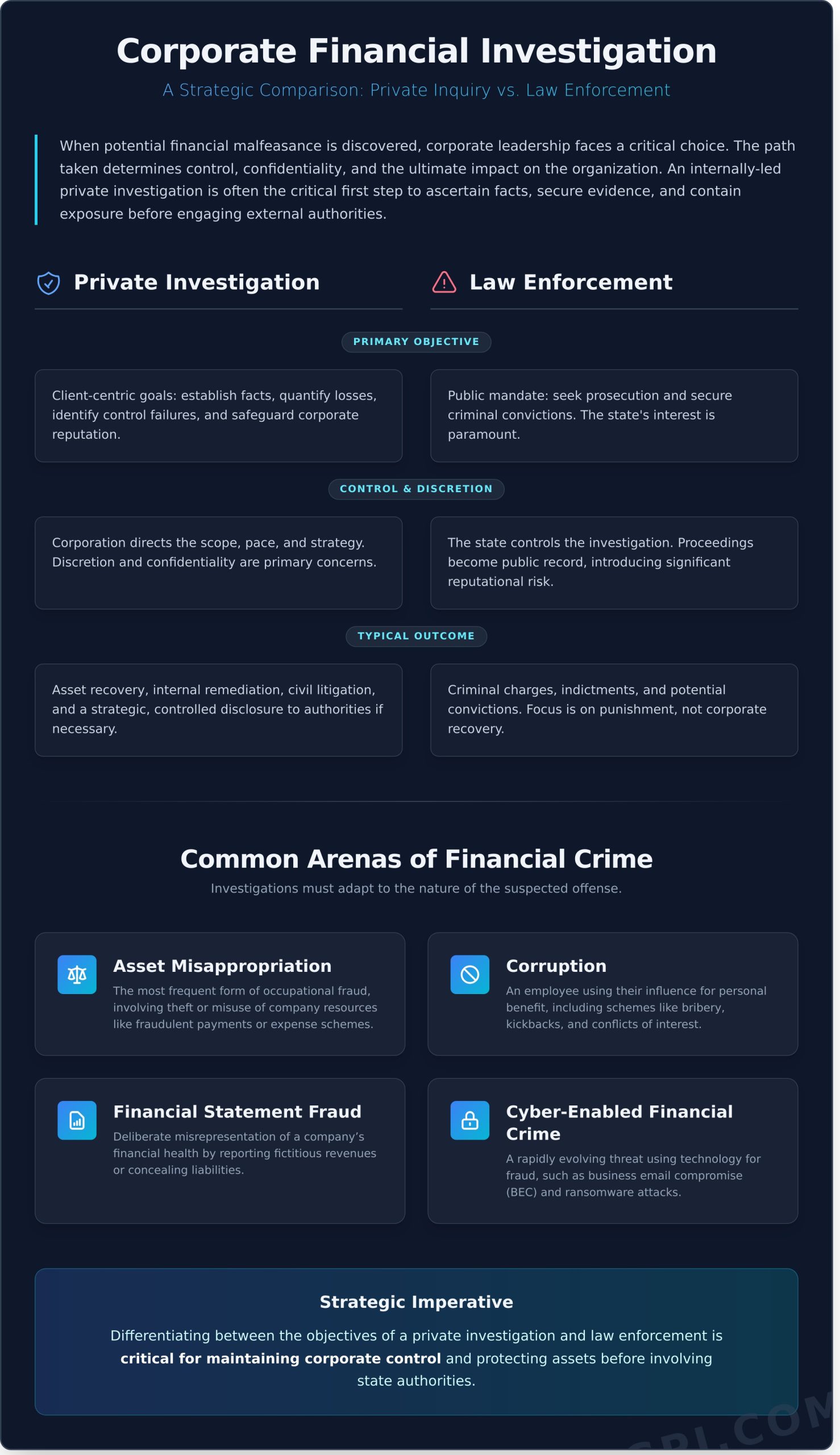
- Differentiating between the objectives of private investigation and law enforcement is critical for maintaining corporate control and protecting assets before involving state authorities.
- A structured, multi-phase framework is essential for conducting a defensible internal inquiry, moving methodically from the initial predicate to final remediation.
- Navigating the complex legal and ethical guardrails, particularly attorney-client privilege, is paramount to ensuring the integrity of a corporate financial criminal investigation.
- Effective fraud examination requires a synthesis of advanced forensic technology and traditional investigative techniques to successfully follow complex financial trails.
The Corporate Mandate: Defining Financial Criminal Investigation
In the contemporary landscape of corporate governance, the duty of oversight extends far beyond routine financial audits. Organizations must now adopt a proactive posture, prepared to transition from compliance verification to targeted fraud examination when circumstances demand it. A corporate financial criminal investigation is a formal, structured inquiry initiated in response to suspected illicit financial activity. Its primary objectives are threefold: to meticulously establish the facts of the matter, to facilitate the recovery of misappropriated assets, and to identify systemic vulnerabilities that can be remediated to prevent future occurrences. The triggers for such an investigation are varied, ranging from whistleblower allegations and internal control anomalies to external inquiries from regulatory bodies.
Distinguishing Between Audits and Investigations
A fundamental distinction exists between a financial audit and an investigation, rooted in their scope, methodology, and underlying mindset. An audit is a systematic, often periodic, review designed to provide assurance that financial statements are free from material misstatement and that an organization adheres to established policies and regulations. In contrast, an investigation is a reactive and adversarial process, launched in response to specific allegations or red flags of wrongdoing. Whereas an auditor operates with professional skepticism, an investigator’s methodology is predicated on proving or disproving a specific fraudulent act. This is why standard audits may fail to detect sophisticated schemes; an investigation, conversely, employs specialized forensic accounting techniques designed to uncover concealment and establish intent.
Common Categories of Corporate Financial Crime
The strategic approach to a financial criminal investigation is dictated by the nature of the suspected offense. Corporate financial crimes typically fall into several broad, and often overlapping, categories that demand distinct investigative frameworks.
- Asset Misappropriation: This remains the most frequent form of occupational fraud and involves the theft or misuse of an organization’s resources. Examples include skimming revenues, creating fraudulent vendor payments, and manipulating expense reimbursements.
- Corruption: This category includes actions where an employee uses their influence in business transactions for personal benefit, in violation of their duty to the employer. Common schemes are bribery, kickbacks, economic extortion, and undisclosed conflicts of interest.
- Financial Statement Fraud: The deliberate misrepresentation of a company’s financial condition through the intentional misstatement or omission of amounts or disclosures. This often involves orchestrating schemes to report fictitious revenues or conceal liabilities.
- Cyber-Enabled Financial Crime: The leveraging of technology to perpetrate fraud, a rapidly evolving threat area that includes business email compromise (BEC), ransomware attacks for extortion, and the illicit acquisition of proprietary data for financial gain.
Private Investigation vs. Law Enforcement: A Strategic Comparison
When a corporation confronts allegations of financial malfeasance, its leadership faces a critical decision: whether to initiate an internal inquiry through a private firm or to engage public law enforcement agencies. This choice is not merely procedural but profoundly strategic, as the objectives, authority, and ultimate consequences of each path diverge significantly. Corporations frequently elect to commence with a private investigation to maintain control, preserve confidentiality, and thoroughly assess the situation before considering external disclosure.
Objectives and Control
A private investigation is fundamentally client-centric, with its objectives dictated by the corporation’s board or legal counsel. The primary goals are often to discreetly substantiate the facts, quantify financial losses for potential recovery, and identify internal control failures, all while safeguarding the organization’s reputation—an effort often supported by communications experts such as CGT Marketing. Conversely, law enforcement operates with a public mandate to seek prosecution and secure criminal convictions. The state, not the corporation, directs the scope and pace of its inquiry, and its proceedings are a matter of public record, which can introduce significant reputational and market risk.
Methodology and Resources
The methodologies employed by these two entities reflect their distinct authorities. Private investigators leverage specialized disciplines such as forensic accounting, digital forensics, and discreet surveillance to gather evidence, often utilizing proprietary databases not readily accessible to the public. Law enforcement, in contrast, wields formidable state powers, including the authority to issue subpoenas, execute search warrants, and make arrests. While a private investigation may precede or run parallel to a public one, understanding the government’s expectations for corporate cooperation, as detailed in frameworks like the DOJ Corporate Enforcement Policy, is paramount for any organization considering self-reporting.
Potential Outcomes
The divergent paths of private and public investigations lead to markedly different resolutions. A successful private inquiry typically results in internal disciplinary action, such as termination of employment; civil litigation for asset recovery; and the implementation of enhanced governance and compliance systems. When law enforcement intervenes, the potential outcomes escalate to include criminal indictments, substantial corporate fines, and imprisonment for culpable individuals. The findings from an internal review are therefore instrumental in determining the appropriate path forward, shaping the decision of whether to manage the matter internally or to initiate a formal financial criminal investigation by reporting it to the authorities. Consult with our experts to determine the right approach.
The Four Phases of a Corporate Financial Investigation
A successful corporate financial criminal investigation demands a structured, methodical framework to ensure its findings are defensible, evidence is preserved, and business disruption is minimized. The process is not a singular event but a progression through four distinct, sequential phases. Each phase builds upon the conclusions of the preceding one, culminating in a comprehensive resolution that addresses both the immediate malfeasance and the underlying systemic vulnerabilities. This disciplined approach is critical for navigating the complexities of corporate wrongdoing, from initial suspicion to final remediation.
Phase 1: Predication and Strategic Planning
An investigation commences with predication-a credible allegation or discovery that provides a justifiable basis to proceed. Once predication is established, the immediate priority is to assemble a multidisciplinary investigative team, typically comprising legal counsel, human resources, information technology specialists, and external forensic accountants. This team is responsible for delineating the investigation’s scope, defining its objectives, establishing a budget, and formulating an initial hypothesis. This strategic planning phase is foundational, ensuring that the inquiry is focused, authorized, and aligned with corporate governance principles.
Phase 2: Evidence Collection and Forensic Analysis
This phase involves the systematic gathering and analysis of relevant information. Investigators collect documentary evidence, such as financial statements, contracts, invoices, and expense reports, alongside digital evidence from emails, servers, and employee devices. In multinational cases, this often requires professional document translation services to ensure all materials are accurately understood. Forensic accounting techniques are employed to trace illicit transactions, identify patterns of fraud, and quantify financial losses. Throughout this process, maintaining a meticulous chain of custody is paramount to ensure the integrity and admissibility of all evidence should legal proceedings follow.
Phase 3: Investigative Interviews and Reporting
With a foundation of evidence established, investigators proceed to conduct interviews to corroborate facts and understand context. The interview process is strategically sequenced, typically beginning with neutral third-party witnesses to gather background information before progressing to individuals with closer involvement. Interviewing the primary subject is often the final step, allowing investigators to present evidence and request explanations. All findings are then compiled into a clear, impartial, and fact-based report that details the investigative process, the evidence reviewed, and the ultimate conclusions.
Phase 4: Resolution, Recovery, and Remediation
The final phase focuses on translating the investigation’s findings into decisive action. The report is presented to key stakeholders, such as the board of directors or senior management, who determine the appropriate course of action. This may include initiating legal proceedings for asset recovery, taking disciplinary action against culpable employees, and coordinating with legal counsel regarding potential litigation. Depending on the nature of the misconduct, referral to law enforcement or regulatory bodies, such as the Financial Crimes Enforcement Network (FinCEN), may be required. Critically, this phase also involves implementing enhanced internal controls to remediate the vulnerabilities that permitted the misconduct, thereby preventing future occurrences.
Core Techniques in Modern Financial Investigation
A successful financial criminal investigation in the contemporary corporate environment transcends mere auditing; it demands a convergence of specialized disciplines. The architects of complex financial schemes leverage sophisticated technology and opaque corporate structures, necessitating an equally advanced and strategic response. Effective investigators must therefore synthesize traditional methods of inquiry with cutting-edge technological tools, following both the digital and paper trails of illicit funds. This multi-faceted approach, which integrates financial acumen with digital expertise and legal strategy, is the hallmark of a professional investigative firm capable of dismantling intricate criminal enterprises.
Forensic Accounting and Data Analytics
This discipline moves beyond standard accounting to interpret the narrative concealed within financial data. Forensic accountants utilize advanced data analytics to scrutinize vast datasets, identifying statistical anomalies and patterns indicative of fraudulent activity, such as ghost employees in payroll systems or duplicate invoice payments. Their core functions include the meticulous reconstruction of falsified financial records to trace the flow of funds and, critically, to provide a precise quantification of the financial damages essential for litigation and recovery efforts.
Digital Forensics and eDiscovery
In an era where most corporate activity is digitally recorded, this field is indispensable. Digital forensic experts recover critical evidence from a wide array of devices, including deleted files, encrypted communications, and hidden data partitions. By analyzing metadata, they reconstruct timelines and communication networks between perpetrators. The process of eDiscovery involves systematically searching immense volumes of electronic data while preserving a strict chain of custody to ensure all evidence is admissible in legal proceedings.
Asset Tracing and Recovery
The ultimate objective of a comprehensive financial criminal investigation is often the recovery of misappropriated assets. This specialized practice involves identifying and locating wealth deliberately concealed through complex legal structures like offshore shell companies and trusts. Investigators leverage a combination of public records, proprietary databases, and human intelligence to pierce the corporate veil. Given the global nature of modern finance, successful recovery frequently necessitates coordinating with international partners and legal jurisdictions, a complex challenge that underscores the importance of specialized institutional expertise in cross-border governance.
Legal and Ethical Guardrails for Internal Investigations
The successful execution of a corporate inquiry, particularly a potential financial criminal investigation, is fundamentally contingent upon strict adherence to a complex framework of legal and ethical standards. A failure to navigate this landscape with precision can invalidate findings, expose the organization to significant legal liability, and irreparably damage its reputation. Therefore, establishing robust procedural guardrails is not merely a best practice; it is an operational imperative for ensuring the investigation’s defensibility and integrity.
Maintaining Attorney-Client Privilege
To protect the sanctity of an investigation, it should be initiated and directed under the auspices of legal counsel. This structure immediately cloaks the process in attorney-client privilege, shielding sensitive communications and work products from discovery. Key protocols include:
- Clearly marking all investigative documents, reports, and electronic communications as “Attorney-Client Privileged & Confidential.”
- Strictly limiting the dissemination of information to a small, defined group of individuals with a direct need-to-know.
- Avoiding any actions, such as sharing findings with non-essential third parties, that could inadvertently constitute a waiver of this critical protection.
Employee Rights and Privacy
A central challenge lies in balancing the imperative to conduct a thorough investigation with the legal and ethical obligations owed to employees. Investigators must operate within the defined limits of corporate policy, employment agreements, and applicable privacy jurisprudence. Interviews should be conducted in a non-accusatory manner, avoiding any actions that could be construed as coercion or false imprisonment. The objective is to gather facts without infringing upon fundamental employee rights.
Evidence Preservation and Chain of Custody
The admissibility of evidence in any subsequent legal or regulatory proceeding hinges on its meticulous collection and preservation. Implementing an immediate and comprehensive legal hold is critical to prevent the intentional or inadvertent destruction of relevant data. Furthermore, maintaining a detailed, unbroken chain of custody for all physical and digital evidence is non-negotiable. This documented record authenticates the evidence, ensuring its integrity from collection through to presentation.
Navigating these multifaceted legal requirements demands specialized expertise. Ensure your investigation is legally sound. Contact International Investigative Group.
Fortifying Corporate Integrity Through Strategic Investigation
The modern corporate landscape demands a sophisticated and proactive approach to mitigating financial malfeasance. As has been delineated, a successful financial criminal investigation is not merely a reactive measure but a strategic, multi-phased process, fundamentally distinct from public law enforcement actions. Mastery of its core techniques, executed within stringent legal and ethical frameworks, is paramount to safeguarding corporate assets, preserving reputational integrity, and ensuring regulatory compliance.
When facing such high-stakes challenges, partnering with a proven authority is critical. With over 30 years of distinguished investigative experience, a track record of successfully resolving multi-million dollar fraud cases, and access to a global network of vetted professionals, our expertise is unparalleled. To fortify your organization against complex financial threats, we invite you to Request a Confidential Consultation to Discuss Your Investigative Needs. Proactive engagement is the cornerstone of corporate resilience and long-term stability.
Frequently Asked Questions
What is the first step a company should take if it suspects financial crime?
Upon the initial suspicion of financial malfeasance, the paramount objective is to preserve the integrity of potential evidence and mitigate further risk. The organization must immediately engage external legal counsel to establish attorney-client privilege and guide the preliminary assessment. This strategic first step ensures that subsequent actions, including the potential launch of a formal internal inquiry, are conducted with legal propriety and do not compromise the viability of future proceedings or inadvertently alert suspected perpetrators.
How do you ensure confidentiality during a financial criminal investigation?
Ensuring confidentiality during a financial criminal investigation is a critical strategic imperative, executed through stringent information controls and legal safeguards. Access to sensitive information must be restricted to a small, designated group of individuals operating under the “need-to-know” principle. All communications should utilize secure, encrypted channels, and all involved parties, including third-party experts, must be bound by comprehensive non-disclosure agreements. Engaging legal counsel early helps to protect communications under attorney-client privilege.
What is the difference between a forensic accountant and a financial investigator?
While their functions are complementary, a forensic accountant and a financial investigator hold distinct roles. The forensic accountant specializes in the quantitative analysis of financial data, examining accounting records and statements to identify discrepancies and provide litigation support. Conversely, a financial investigator possesses a broader mandate that often includes qualitative data gathering, such as conducting interviews, performing background checks, and tracing assets, integrating financial analysis with traditional investigative techniques to build a comprehensive case.
Can the evidence gathered in a private investigation be used in court?
The admissibility of evidence gathered in a private corporate investigation within a court of law is contingent upon its lawful acquisition and the meticulous maintenance of the chain of custody. Evidence must be obtained without violating privacy statutes or other legal restrictions. A well-documented chain of custody, which chronologically records the seizure, control, transfer, and analysis of evidence, is essential to demonstrate its integrity and authenticity, thereby ensuring it can withstand judicial scrutiny in subsequent legal proceedings.
How long does a typical corporate financial investigation take?
The temporal scope of a corporate financial investigation is highly variable and cannot be defined by a standard timeline. The duration is contingent upon a multiplicity of factors, including the complexity of the alleged malfeasance, the volume of transactional data requiring analysis, the geographic distribution of operations, and the degree of cooperation from internal personnel. A narrowly defined inquiry may conclude in weeks, whereas a complex, cross-border investigation can extend for many months or even years.
What are the primary indicators or ‘red flags’ of financial fraud?
Primary indicators of financial fraud manifest as anomalies within both transactional data and employee conduct. Transactional red flags include duplicate payments, unusual journal entries made at the close of an accounting period, and transactions with unvetted or fictitious vendors. Behavioral indicators often involve employees exhibiting unexplained lifestyle changes inconsistent with their compensation, a persistent unwillingness to take leave or delegate duties, and an unusual insistence on overriding established internal controls and procedures.
