
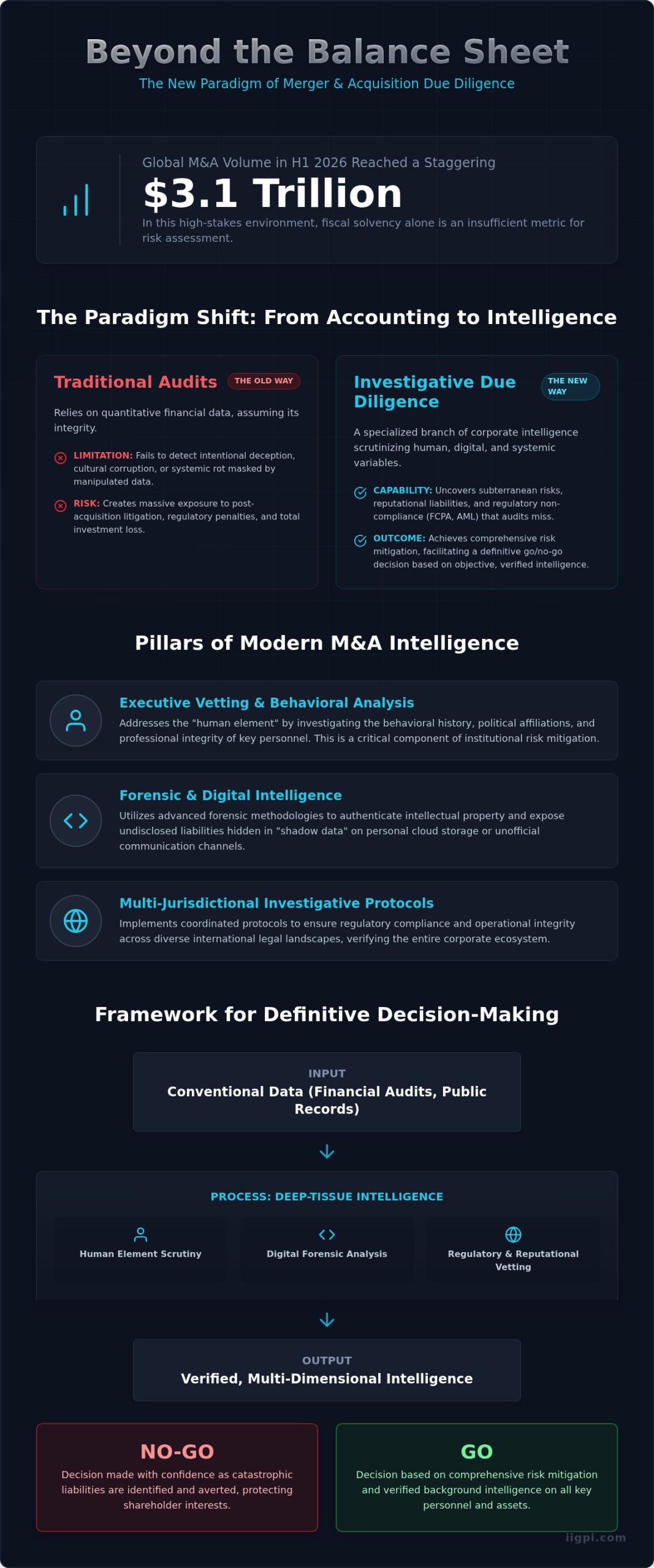
The traditional reliance on quantitative financial audits as the primary instrument for risk assessment constitutes a significant strategic vulnerability in an era defined by unprecedented mega-deals. While global M&A volume reached a staggering $3.1 trillion in the first half of 2026, the escalating complexity of these transactions suggests that fiscal solvency alone is an insufficient metric for assessing long-term viability. High-level decision-makers often recognize that the most catastrophic liabilities are not found in the ledger; instead, they reside in the unexamined behavioral histories and systemic integrity failures of a target company’s leadership.
Sophisticated merger and acquisition due diligence services provide the investigative rigor necessary to identify these subterranean risks, moving beyond the limitations of standard accounting to scrutinize the human and digital integrity of an entity. This analysis elucidates how deep-tissue investigative intelligence uncovers reputational liabilities and regulatory non-compliance, such as FCPA or AML violations, that traditional audits frequently overlook. By adopting this strategic framework, stakeholders can achieve comprehensive risk mitigation through verified background intelligence on key personnel, facilitating a definitive go/no-go decision based on objective, multi-dimensional intelligence.
Key Takeaways
- Recognize the fundamental transition from rudimentary accounting to a specialized framework of corporate intelligence capable of navigating the complexities of 21st-century information warfare.
- Utilize advanced forensic methodologies within merger and acquisition due diligence services to authenticate intellectual property and expose undisclosed liabilities hidden within systemic shadow data.
- Address the inherent volatility of the human element by prioritizing rigorous executive vetting and behavioral character assessments as essential components of institutional risk mitigation.
- Implement coordinated multi-jurisdictional investigative protocols to ensure regulatory compliance and operational integrity across diverse international legal landscapes.
- Develop a sophisticated decision-making framework that leverages objective, deep-tissue intelligence to provide total risk mitigation and verified background insights on key personnel.
The Paradigm Shift in Merger and Acquisition Due Diligence Services
The conceptualization of risk within the corporate sphere has transitioned from a purely fiscal assessment to a complex exercise in information warfare. Standard financial scrutiny often fails to capture the clandestine liabilities that jeopardize multi-billion dollar acquisitions; consequently, merger and acquisition due diligence services have evolved into a specialized branch of corporate intelligence. This discipline focuses on the human and systemic variables that traditional balance sheets ignore. To understand the foundational requirements of these processes, one must first address the question: What is Due Diligence? in its most rigorous, modern application. This shift represents a move toward deep due diligence, which is now recognized as a non-negotiable fiduciary obligation for boards of directors tasked with protecting shareholder interests in an increasingly volatile global market.
The Limitations of Conventional Financial Audits
Conventional audits operate on the assumption of data integrity, yet spreadsheets are frequently manipulated to mask systemic operational failures or distort performance metrics. This phenomenon, often termed the ‘Enron effect’, illustrates how a target entity can maintain a facade of regulatory compliance while harboring deep-seated structural rot. Standard accounting protocols are ill-equipped to identify intentional deception or cultural corruption. A specialized corporate fraud investigation is often required to penetrate these layers of obfuscation, revealing the discrepancies between reported assets and the actual operational reality. Relying solely on fiscal documentation in 2026 creates an unacceptable exposure to post-acquisition litigation and total investment loss.
Defining Investigative Due Diligence in a Global Context
Modern merger and acquisition due diligence services encompass a broad spectrum of investigative functions, including exhaustive asset searches and comprehensive background verifications. Unlike standard background checks that merely verify credentials, deep-level investigative dossiers examine the behavioral history, political affiliations, and professional integrity of key stakeholders. This level of scrutiny is essential, especially as cross-border jurisdictional knowledge becomes paramount for navigating differing legal standards and cultural expectations. Effective investigations bridge the gap between superficial legal reviews and the tangible investigative reality of the global marketplace, ensuring that every strategic decision is predicated on verified, objective intelligence. It’s no longer sufficient to accept self-reported data; instead, institutional leaders must demand an independent verification of the entire corporate ecosystem.
Methodologies of Forensic and Digital Intelligence in M&A Operations
The valuation of contemporary corporate entities is increasingly tethered to intangible digital assets and proprietary data structures. Effective merger and acquisition due diligence services must therefore incorporate sophisticated forensic analysis to validate the legitimacy of intellectual property claims. Digital evidence serves as the objective arbiter in disputes regarding patent ownership, trade secrets, and software code integrity. Without this scrutiny, buyers risk acquiring inflated assets or inheriting legal entanglements that compromise the deal’s strategic value. It’s a reality where the digital footprint often tells a more accurate story than the official prospectus.
The identification of ‘shadow data’ constitutes a vital component of the investigative process. This term refers to information residing outside sanctioned corporate repositories. It often includes personal cloud storage or unofficial communication channels used by executives to bypass oversight. Forensic specialists utilize non-intrusive discovery protocols to map these digital footprints during sensitive negotiations. This mapping uncovers potential undisclosed liabilities, such as off-book financial arrangements or pending litigation threats that haven’t been formally disclosed. These insights are critical for maintaining leverage during final price adjustments.
The seamless integration of computer forensics into the M&A timeline allows for real-time validation of corporate narratives. This methodology is essential to mitigate the risks of inadequate due diligence that frequently plague transactions exceeding the 2026 HSR filing threshold of $133.9 million. By deploying these tools early, firms can identify discrepancies before they escalate into terminal deal-breakers. Comprehensive merger and acquisition due diligence services utilize these findings to establish a definitive baseline for valuation, ensuring that the buyer isn’t overpaying for compromised or phantom assets.
Identifying Hidden Liabilities Through Digital Forensics
Forensic analysis excels at recovering deleted communications or hidden financial records that standard audits fail to detect. It also identifies proprietary data leaks that might devalue an acquisition by exposing core technologies to the public domain. Verifying the integrity of the target’s IT infrastructure ensures that the reported operational capacity is accurate and sustainable. It’s a process that demands technical precision and an understanding of how data is intentionally obscured in high-stakes environments.
Cybersecurity Due Diligence and Post-Merger Integration
Evaluating a target’s history of data breaches and their subsequent regulatory responses is mandatory in 2026. Buyers must assess the probability of inheriting a compromised network, which could lead to immediate post-merger crises or regulatory fines under evolving global standards. This framework allows for quantifying cyber-risk as a precise valuation adjustment rather than a vague concern. Securing professional Computer Forensics services is a prudent step for any institution aiming for total digital transparency during a transition. This proactive approach ensures that the integration process doesn’t introduce systemic vulnerabilities into the parent organization’s existing architecture.
Mitigating Reputational and Behavioral Risks Beyond the Balance Sheet
The human element remains the most volatile variable in any large-scale transaction, often eclipsing the structural stability of the assets being acquired. While financial audits provide a historical record of performance, they offer little predictive insight into the behavioral risks posed by key stakeholders. Elite merger and acquisition due diligence services must prioritize a rigorous analysis of the human infrastructure to safeguard against systemic reputational collapse. This investigative rigor is particularly critical in an era where social and ethical lapses can trigger immediate, catastrophic devaluations of corporate brands. For organizations seeking to fortify their market position by optimizing talent attraction, GBS Worldwide provides the employer brand strategy and recruitment media management necessary to engage high-level professionals. It’s a strategic necessity to view leadership not just as a management layer, but as a primary risk vector.
To achieve this level of transparency, organizations frequently employ professional surveillance services to validate the operational claims made during the initial discovery phase. Such measures ensure that the physical reality of a target’s supply chain or facility management aligns with the documentation provided in the virtual data room. These methods identify discrepancies that would otherwise remain hidden until the post-integration phase, when the cost of remediation is significantly higher. Objective observation provides a definitive counterpoint to the curated narratives often presented by target companies during high-stakes negotiations.
Executive Vetting and Integrity Analysis
The reputational history of a Chief Executive Officer or other high-level stakeholders directly influences the market’s perception of the acquiring firm’s integrity. Uncovering undisclosed legal entanglements or ethical lapses requires a sophisticated methodology involving multi-source intelligence and behavioral profiling. By synthesizing public records with confidential human intelligence, investigators can construct a comprehensive profile of an individual’s professional character. This process provides a necessary layer of protection for boards of directors who must account for the long-term cultural impact of a merger. A single unvetted executive can jeopardize the entire strategic rationale of a multi-billion dollar deal.
Uncovering Undisclosed Relationships and Conflicts
Undisclosed affiliations and ‘related party transactions’ represent a significant risk, as they can be used to artificially inflate revenue or obscure beneficial ownership. Mapping complex corporate webs involves tracing global networks of entities to reveal hidden conflicts of interest that might compromise the target’s long-term stability. Utilizing a thorough asset search is essential for identifying the ultimate beneficial owners of these entities. Such investigative techniques ensure that merger and acquisition due diligence services provide a complete picture of the target’s external influences. This prevents the inheritance of corrupt or legally tenuous associations that could trigger future regulatory scrutiny or litigation.
While specialized investigations identify tenuous associations, proactive leaders also focus on cultivating high-value professional connections through established circles; to explore opportunities for leading a premier business referral group, visit Network In Action.
Executing Global Investigative Protocols in High-Stakes Transactions
The execution of multi-jurisdictional investigative protocols requires a centralized nexus capable of synthesizing disparate intelligence streams into a cohesive strategic narrative. As global M&A volume persists at record levels in 2026, the coordination of merger and acquisition due diligence services from a primary hub, such as New York, ensures that investigative standards remain consistent across diverse legal landscapes. This centralized approach is essential for navigating the heightened cross-border regulatory hurdles, including the European Union’s Foreign Subsidies Regulation, which continues to impose significant compliance burdens on international transactions. Maintaining absolute confidentiality during these high-profile operations is paramount, necessitating rigorous data encryption, compartmentalized information access, and the utilization of secure, non-attributable communication channels to protect the integrity of the deal.
In regions characterized by opaque corporate records or restricted public access, ‘on-the-ground’ human intelligence becomes the only viable method for verifying the physical existence of assets and the actual influence of local leadership. While digital forensics provides a vital layer of transparency, as discussed in previous sections, it cannot fully replace the nuanced insights gained through direct observation and local engagement. Consequently, institutional leaders must rely on established investigative networks that possess the cultural fluency and jurisdictional expertise required to operate within the legal boundaries of international private investigations. This dual-layered strategy, combining high-level forensic analysis with localized intelligence, provides the definitive ‘go/no-go’ framework necessary for total risk mitigation.
The NYC Hub: Navigating the Financial Capital’s Regulations
Operating within New York’s jurisdiction demands a sophisticated understanding of specific investigative requirements and a close interaction with local regulatory bodies. The advantage of engaging former law enforcement expertise is particularly evident in this context, as it provides a unique perspective on the intersection of private inquiry and public oversight. Professionals with over 30 years of experience in these specialized fields possess the institutional knowledge required to navigate complex NYC M&A environments while adhering to the strictest ethical and legal standards. This expertise ensures that all investigative findings are not only accurate but also legally defensible in the event of post-acquisition litigation. For organizations seeking elite institutional intelligence, securing a partner with a proven history of Corporate Investigations is a critical step in the due diligence process.
Managing International Agent Networks for Seamless Intelligence
The management of global investigative assets requires rigorous vetting protocols to ensure that every agent adheres to the highest standards of integrity and professional conduct. Cultural nuance plays a decisive role in conducting foreign interviews, where an understanding of local customs and social hierarchies can determine the success of an intelligence-gathering mission. Centralized reporting mechanisms are vital for maintaining a cohesive narrative, allowing decision-makers to evaluate risks across multiple jurisdictions through a single, authoritative lens. This structured approach prevents the fragmentation of intelligence and ensures that every piece of data is contextualized within the broader strategic objectives of the transaction. By leveraging a global network of vetted agents, firms can achieve a level of transparency that standard legal audits, which often lack the capacity for deep-level field research, simply cannot provide.
International Investigative Group: Elite Institutional Intelligence for Complex Acquisitions
The contemporary M&A environment, characterized by record-breaking global volumes reaching $3.1 trillion in the first half of 2026, necessitates a departure from traditional, accounting-centric models toward a more rigorous investigative framework. International Investigative Group (IIG) serves as the essential institutional partner for entities seeking comprehensive merger and acquisition due diligence services that transcend the limitations of superficial data review. By synthesizing high-level digital forensics with localized human intelligence, the firm provides a definitive nexus of clarity for boards of directors facing high-stakes go/no-go decisions. It’s an approach that prioritizes the identification of clandestine liabilities and systemic risks before they can jeopardize the strategic rationale of a multi-billion dollar transaction. This investigative rigor is no longer a secondary consideration; it’s a fundamental requirement for protecting shareholder value in an increasingly volatile global market.
Leveraging 30 Years of Investigative Excellence
With a legacy spanning over three decades, the firm has cultivated an unparalleled reputation for resolving complex corporate disputes and identifying fraudulent activities exceeding $100 million in value. This extensive history in Corporate Investigations allows for the development of bespoke investigative reports that are specifically tailored to the exacting requirements of executive boards and legal counsel. These dossiers provide more than simple background data; they offer a deep-tissue analysis of the behavioral and digital integrity of a target entity. Every engagement is conducted with a commitment to absolute discretion and the highest standards of professional ethics, ensuring that sensitive negotiations remain protected from external exposure. This institutional experience is particularly vital when navigating transactions that exceed the 2026 HSR filing threshold of $133.9 million, where the complexity of the deal often masks significant operational vulnerabilities.
The Strategic Advantage of Law Enforcement Expertise
The firm’s investigative philosophy is fundamentally rooted in the rigorous protocols of high-level law enforcement, providing a superior methodology for evidence gathering and fact verification. This background enables the firm to address both civil and criminal investigative needs, offering a comprehensive suite of merger and acquisition due diligence services including asset searches, computer forensics, and executive vetting. By applying these disciplined investigative techniques, IIG ensures that all findings are objective, verified, and legally defensible across multiple jurisdictions. Organizations initiating the discovery phase of a transaction are encouraged to secure a formal consultation to establish a robust investigative framework. This proactive engagement ensures the integrity of upcoming acquisitions and fulfills the board’s fiduciary duty to mitigate all foreseeable reputational and behavioral risks. Initiating this process early in the M&A timeline is the most effective method for securing a definitive strategic advantage.
Establishing Institutional Integrity in the 2026 M&A Landscape
The transition from rudimentary accounting to a sophisticated framework of corporate intelligence represents a critical evolution in risk management, moving beyond the balance sheet to address subterranean liabilities. By prioritizing the validation of human and digital integrity, institutional leaders can effectively navigate the complexities of mega-deals while ensuring total risk mitigation. This comprehensive approach to merger and acquisition due diligence services ensures that strategic decisions are predicated on objective, multi-dimensional intelligence rather than curated corporate narratives. Such rigor is essential for fulfilling fiduciary duties and protecting shareholder value in an increasingly opaque global environment.
International Investigative Group provides the intellectual rigor and global reach necessary to secure these high-stakes transitions. Leveraging over 30 years of specialized corporate intelligence and a law enforcement-led philosophy, the firm utilizes its global agent network and local NYC expertise to solve the most complex corporate cases. Secure your next transaction with elite M&A due diligence services from International Investigative Group. Establishing this level of transparency is not merely a defensive measure; it’s a strategic imperative for long-term institutional success.
Frequently Asked Questions
What is the primary difference between financial due diligence and investigative due diligence?
Financial due diligence focuses on the verification of historical fiscal data and asset valuation, whereas investigative due diligence prioritizes the assessment of behavioral integrity and subterranean risks. While accountants scrutinize ledger accuracy, investigative teams examine the human infrastructure and digital footprints to identify potential liabilities that traditional audits frequently overlook. This dual approach ensures that stakeholders understand both the fiscal health and the systemic integrity of the target entity.
How long does a comprehensive investigative due diligence process typically take in 2026?
The duration of comprehensive merger and acquisition due diligence services typically spans several weeks to several months, contingent upon the scale of the transaction and the complexity of the global jurisdictions involved. Mega-deals, especially those exceeding the $535.5 million HSR threshold, often require extended timelines to facilitate thorough multi-jurisdictional inquiries and forensic digital discovery. Precise timelines are determined by the accessibility of international records and the depth of executive vetting required.
Are private investigative services for M&A legal in all international jurisdictions?
Investigative protocols are generally legal across international jurisdictions, provided they adhere to local privacy regulations and data protection laws, such as the EU’s Foreign Subsidies Regulation. Navigating these diverse legal landscapes requires a sophisticated understanding of regional mandates to ensure that all gathered intelligence is legally defensible and ethically sourced. Engaging a firm with specialized cross-border expertise is essential for maintaining compliance with global regulatory standards during high-stakes inquiries.
What specific digital assets are examined during a computer forensics audit in M&A?
Forensic audits scrutinize a broad spectrum of digital assets, including deleted electronic communications, unofficial cloud storage repositories, and proprietary source code. These investigations also evaluate the integrity of a target’s IT infrastructure and identify ‘shadow data’ that might indicate undisclosed financial arrangements or potential intellectual property leaks. By examining these digital footprints, investigators can validate corporate claims and identify hidden technical vulnerabilities that could devalue the acquisition.
How does reputational risk impact the final valuation of an acquisition?
Reputational risk functions as a significant valuation adjustment, as the market often devalues an acquisition if the target’s leadership exhibits a history of ethical lapses or legal entanglements. Identifying these behavioral red flags early allows acquiring firms to adjust purchase prices or establish indemnity clauses to mitigate future post-merger stock volatility. In the 2026 market, the perceived integrity of an organization is as vital to its valuation as its physical assets or revenue streams.
Can investigative due diligence be performed discreetly without alerting the target company?
Investigative due diligence can be performed with absolute discretion by utilizing non-intrusive discovery methods and synthesizing multi-source public intelligence. This approach allows acquiring entities to gather critical behavioral and asset data without alerting the target company, thereby preserving the integrity of sensitive negotiations during the preliminary discovery phase. Professional investigators operate within strict ethical boundaries to ensure that their inquiries don’t disrupt the operational stability or the confidentiality of the deal.
What types of hidden liabilities are most commonly uncovered by private investigators?
Investigators frequently uncover hidden liabilities such as undisclosed related party transactions, complex beneficial ownership structures, and clandestine conflicts of interest. These discrepancies often artificially inflate revenue or mask pending litigation, representing systemic operational failures that standard financial reviews lack the capacity to identify. Uncovering these issues during the due diligence phase prevents the acquiring firm from inheriting catastrophic legal or financial burdens that could emerge post-integration.
Why is a New York-based firm like IIG preferred for global M&A intelligence?
New York serves as the global nexus for financial and regulatory expertise, providing a strategic hub for coordinating multi-jurisdictional investigations. A firm like IIG, led by former law enforcement professionals with over 30 years of experience, offers the institutional rigor and global agent network necessary to bridge the gap between financial capitals and emerging markets. This combination of NYC-specific expertise and international reach ensures that institutional leaders receive definitive intelligence regardless of the target’s geographic location.