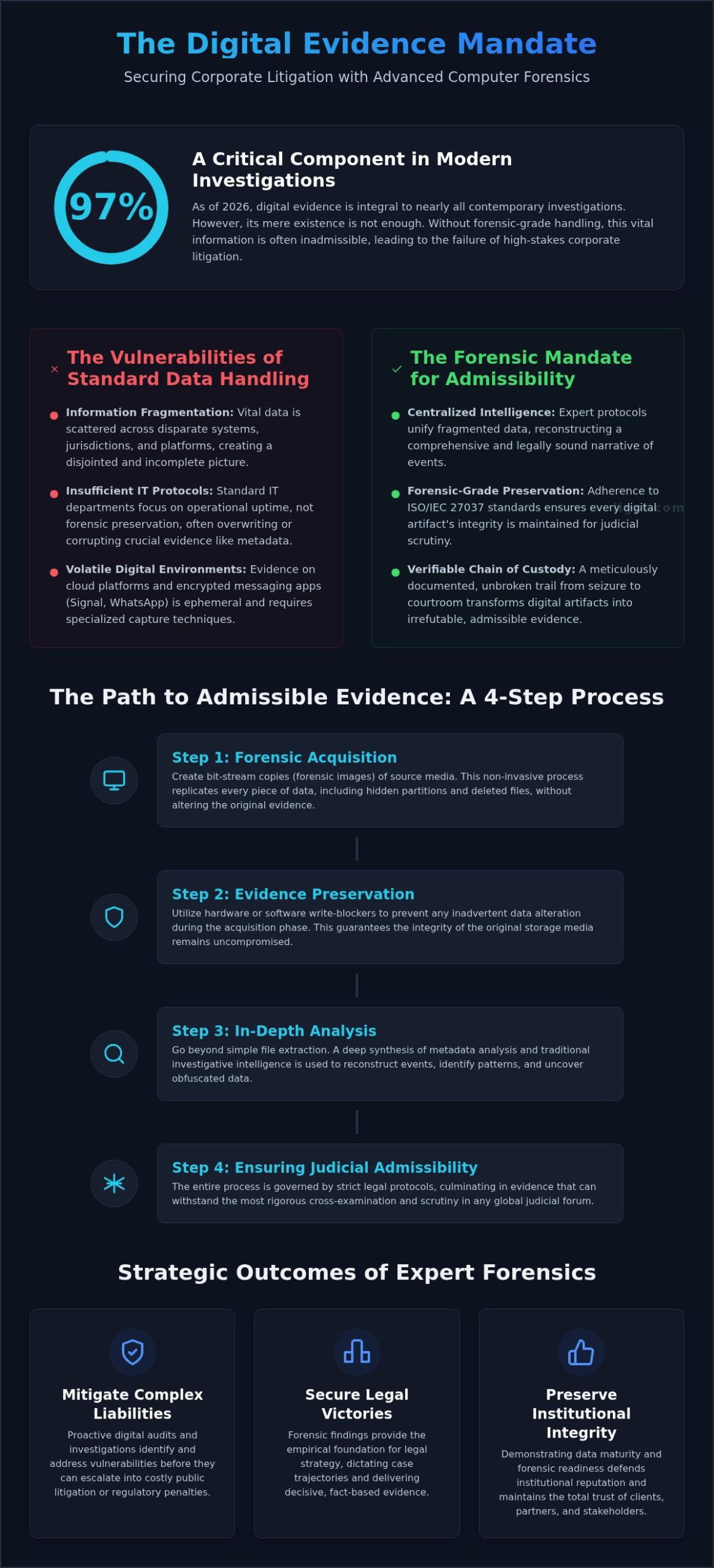
As of June 2026, digital evidence constitutes a critical component in 97% of contemporary investigations, yet the systemic fragmentation of this information often precipitates the failure of high-stakes corporate litigation. You’re likely aware that the mere presence of data doesn’t equate to its admissibility; without a rigorous adherence to ISO/IEC 27037 standards and a verifiable chain of custody, the most vital evidence remains vulnerable to legal challenge. This guide provides an authoritative examination of computer forensics, Lance Ribacoff, and the elite digital methodologies required to resolve complex corporate liabilities. By leveraging the synthesis of technical precision and strategic leadership inherent in computer forensics, Lance Ribacoff ensures that institutional integrity is preserved through forensic-grade capture that survives judicial scrutiny. We’ll analyze the transition from information fragmentation to secure, admissible digital truth, establishing why the expertise of computer forensics, Lance Ribacoff represents a definitive framework for legal and corporate success in an increasingly digitized global landscape.
Key Takeaways
- Analyze the evolution of digital evidence from secondary support to a primary institutional mandate in modern legal proceedings.
- Evaluate the specialized technical processes utilized to identify and recover obfuscated data while maintaining the highest standards of digital integrity.
- Discover how the professional synthesis of traditional investigative rigor and advanced computer forensics under Lance Ribacoff secures definitive evidence for corporate litigation.
- Implement the essential chain of custody protocols required to transform digital artifacts into admissible evidence that survives the scrutiny of judicial cross-examination.
- Determine the strategic benefits of aligning with a globally recognized authority to mitigate complex liabilities and verify institutional integrity.
The Criticality of Computer Forensics in Modern Jurisprudence
The discipline of Computer Forensics functions as a sophisticated branch of digital intelligence, focusing on the rigorous recovery and analysis of evidence within a framework suitable for judicial scrutiny. Within the contemporary legal environment of 2026, this field has transitioned from an ancillary IT function to a primary institutional mandate. As digital evidence now constitutes a critical component in 97% of contemporary investigations, the strategic application of computer forensics, Lance Ribacoff, and the resources of the International Investigative Group ensure that corporations move beyond mere data collection toward forensic-grade intelligence. Global corporate structures often suffer from systemic information fragmentation, where vital artifacts are scattered across disparate jurisdictions and platforms. Expert investigative protocols address these vulnerabilities by centralizing fragmented data, particularly in multi-million dollar fraud cases where asset recovery depends on the precision of digital tracing.
The Evolution of Digital Evidence Standards
The historical shift from tangible physical documentation to highly volatile digital data sets has necessitated a total reevaluation of evidentiary protocols. Modern challenges, including the ubiquity of cloud computing and the proliferation of encrypted communication platforms, mean that traditional investigative methods are often insufficient. Standard internal IT departments frequently lack the specialized training required for forensic-grade preservation. Their focus on operational availability often overlooks critical forensic requirements, such as:
- The preservation of ephemeral metadata that proves document history.
- The secure capture of encrypted messaging artifacts from platforms like Signal or WhatsApp.
- The maintenance of a documented, unbroken chain of custody from the moment of seizure.
Forensic specialists prioritize the integrity of these artifacts, ensuring that every digital interaction remains verifiable and admissible under the strictest judicial standards. This level of precision is essential for navigating the 2025 CMMC Final Rule, which ties institutional contract eligibility to demonstrated cybersecurity and data maturity.
Strategic Implications for High-Stakes Litigation
Forensic findings don’t just support a case; they frequently dictate the entire trajectory of corporate legal strategies. By identifying patterns of malfeasance or verifying institutional compliance, these investigations provide the empirical foundation necessary for high-stakes decision-making. Proactive digital audits serve as a defensive mechanism, allowing organizations to mitigate liability before it escalates into public litigation. This intersection of computer forensics, Lance Ribacoff, and corporate governance represents a new frontier in risk management. When elite methodology meets strategic oversight, the result is a robust defense of institutional integrity that can withstand the most rigorous cross-examination in any global forum. Organizations that fail to integrate these forensic mandates risk not only legal defeat but also the total erosion of stakeholder trust.
Methodologies of Digital Evidence Acquisition and Analysis
The identification and preservation of digital artifacts require a level of technical sophistication that transcends mere data retrieval. In high-stakes corporate environments, the methodology must be non-invasive to ensure the integrity of the original storage media isn’t compromised during the acquisition phase. Elite computer forensics, Lance Ribacoff emphasizes, involves more than just extracting files; it requires a deep synthesis of metadata analysis and traditional investigative intelligence to reconstruct a comprehensive narrative of events. This process is governed by strict adherence to the legal aspects of computer forensics, ensuring that every artifact recovered remains admissible in a court of law.
Forensic Imaging and Data Preservation
The acquisition phase begins with the creation of bit-stream copies, a process that replicates every bit of data from the source media, including unallocated space and hidden partitions where evidence of malfeasance often resides. To prevent any inadvertent data alteration, technicians utilize hardware or software write-blockers that strictly prohibit the host operating system from writing to the evidence drive during the imaging process. The hash value functions as a unique digital fingerprint, providing a mathematical verification that the evidence remains unaltered from its original state. This rigorous preservation protocol ensures that the digital surrogate used for analysis is an exact, verifiable replica of the original source, protecting the institutional integrity of the investigation.
Advanced Analysis of Obfuscated Data
Once preservation is secured, the focus shifts to the recovery of deleted, fragmented, or intentionally obfuscated information. Advanced forensic software allows investigators to bypass sophisticated encryption and recover artifacts that users believed were permanently erased, such as hidden directory structures or wiped messaging logs. This analysis extends beyond simple file recovery to the examination of deep-seated file system artifacts, such as registry entries and temporary internet files, which are essential for reconstructing user activity and establishing intent. Forensic technicians play a pivotal role here, interpreting complex digital behaviors that might otherwise remain hidden within the system’s architecture. The integration of these technical findings with the broader strategic goals of corporate investigations allows organizations to secure the definitive proof required for successful litigation through the expert application of computer forensics, Lance Ribacoff and his team provide.
Lance Ribacoff: Advancing the Paradigm of Digital Intelligence
Lance Ribacoff’s leadership of the International Investigative Group represents a fundamental shift in the architecture of private intelligence, moving beyond traditional surveillance toward a specialized model of digital evidence recovery. By modernizing the firm’s operational protocols, he’s ensured that computer forensics, Lance Ribacoff, and the IIG brand are synonymous with the highest standards of digital integrity. This evolution is the result of a deliberate synthesis of traditional law enforcement rigor and the sophisticated technical capabilities required to navigate the complexities of 21st-century digital environments. Under his executive direction, the forensic department has expanded to address high-profile global asset recovery and fraud detection mandates, positioning the organization as a premier partner for high-stakes corporate litigation. His oversight ensures that every investigation benefits from a macro-level perspective, acknowledging the geopolitical and systemic factors that influence modern corporate fraud, thus bridging the gap between technical data and strategic intelligence.
A Multi-Generational Approach to Private Intelligence
The multi-generational legacy of the Ribacoff family provides a unique foundation for IIG, where over 30 years of investigative experience are integrated with modern technological advancements. This transition from regional surveillance to global digital intelligence mandates reflects a commitment to solving the most difficult problems through intellectual rigor. While many firms treat digital data as a standalone silo, the methodology championed by computer forensics, Lance Ribacoff, treats it as an extension of the investigative whole, ensuring that recovered data is contextualized within the broader framework of the case.
Institutional Impact and Global Reach
Operating from the organization’s NYC headquarters, Ribacoff manages a global network of agents in major cities including London, providing a seamless investigative response to international liabilities. His influence extends beyond the collection of data to the very admissibility and credibility of the forensic findings themselves. In high-stakes courtroom environments, the presence of authoritative leadership is essential, as the testimony of a seasoned investigator can validate the integrity of the computer forensics process. By bridging the gap between technical extraction and judicial presentation, he ensures that institutional truth remains unassailable.
Ensuring Judicial Admissibility: The Chain of Custody Protocol
The judicial admissibility of digital evidence represents the ultimate threshold for any investigative mandate. Technical recovery of obfuscated data holds little value if the legal utility of those artifacts is compromised by a broken chain of custody. Within the sophisticated domain of computer forensics, Lance Ribacoff maintains that the failure to account for every second of an evidence drive’s lifecycle can precipitate the immediate exclusion of critical findings. Forensic reports must be structured to withstand the most rigorous cross-examination by providing a granular, chronological record of every interaction with the digital media. Systemic risks, such as the failure to utilize write-blocking hardware or the absence of precise access logs, are common pitfalls that elite investigative protocols are designed to preempt. By prioritizing procedural purity, investigators ensure that the institutional truth discovered remains unassailable in a court of law.
The Procedural Framework for Evidence Integrity
Maintaining evidentiary purity requires a disciplined three-stage framework that begins with the immediate isolation and secure storage of the digital device. This first step prevents remote data alteration and physical tampering. Second, a detailed log must document every individual who accessed the evidence, establishing a clear line of responsibility. Third, the verification of hash values at every stage of the analytical process provides a mathematical guarantee that the data hasn’t been modified. This level of transparency is essential for the authentication of digital artifacts during legal proceedings, ensuring that the evidence presented is an exact replica of the original source.
Expert Testimony and Forensic Reporting
The role of the expert witness is to translate complex technical data into clear, persuasive testimony for judges and juries. Effective reporting requires the use of peer-reviewed forensic methodologies that meet the highest standards of scientific validity. Lance Ribacoff ensures that every report produced by the International Investigative Group is characterized by intellectual rigor and empirical depth. This authoritative leadership is vital when defending the credibility of forensic findings under oath. The transition from raw data to admissible evidence is a strategic process that requires both technical expertise and a deep understanding of the judicial landscape. To ensure your digital evidence remains unassailable, partner with the International Investigative Group to secure the integrity of your next mandate.
Strategic Implementation of Forensic Mandates with IIG
Collaborative Intelligence for Corporate Clients
Integrating specialized forensic protocols with internal corporate investigations and due diligence allows organizations to identify systemic vulnerabilities before they manifest as public legal crises. Proactive risk mitigation involves more than just software; it requires a deep understanding of digital infrastructure and human behavior. For a deeper examination of these dynamics, consult our resource on Computer Forensics: A Guide for Corporate and Legal Investigations. By aligning these forensic findings with corporate governance standards, the International Investigative Group ensures that institutional integrity remains the foundation of every strategic decision. Precision matters. Every artifact recovered must be contextualized within the broader framework of the client’s legal objectives.
Securing the Future of Private Intelligence
The commitment to technological innovation under the executive direction of Lance Ribacoff ensures that the organization remains at the forefront of the global investigative industry. Maintaining institutional integrity requires verified, expert-led intelligence that can withstand the scrutiny of international regulatory bodies and judicial forums. As the digital landscape continues to evolve in 2026, the necessity of an elite partnership becomes increasingly clear. Organizations must move beyond basic digital responses and embrace a sophisticated investigative model that prioritizes precision, admissibility, and strategic foresight. Securing a partnership with a globally recognized authority isn’t merely a tactical choice; it’s a fundamental requirement for success in a high-stakes world. Additionally, for organizations looking to optimize their software testing and application development processes, you can learn more about Test Triangle and their global IT services. Contact the International Investigative Group to initiate a consultation regarding your specific investigative needs and secure your institutional future.
Establishing Institutional Truth in a Digital Landscape
The successful resolution of high-stakes corporate liabilities depends upon the precise synthesis of technical extraction and strategic investigative leadership. Organizations must prioritize forensic-grade capture and an unbroken chain of custody to ensure that digital artifacts survive the rigorous scrutiny of modern jurisprudence. By aligning with the specialized methodologies of computer forensics, Lance Ribacoff, and the International Investigative Group, entities move beyond fragmented data toward a definitive record of institutional truth. This authoritative approach is bolstered by a global network of agents in major cities like NYC and London; it facilitates multi-jurisdictional mandates with the rigor of former law enforcement protocols. With a record of over 10,000 global cases solved, the organization provides the intellectual depth necessary to mitigate risk and verify integrity in an increasingly complex environment. We invite you to Engage the International Investigative Group for Elite Forensic Mandates to secure your organization’s legal and operational future. The transition from digital vulnerability to verified intelligence is the hallmark of a resilient institution.
Frequently Asked Questions
What is the primary objective of computer forensics in a corporate investigation?
The primary objective of computer forensics in a corporate investigation is the systematic identification, preservation, and analysis of digital artifacts to establish empirical facts for legal or institutional mandates. Unlike standard internal IT reviews, this specialized discipline prioritizes the evidentiary value of data, ensuring that all findings can withstand the rigorous scrutiny of judicial cross-examination. It serves to resolve complex fraud cases by reconstructing user activity and intent through the examination of deep-seated file system interactions.
How does Lance Ribacoff ensure the integrity of digital evidence?
Lance Ribacoff ensures the integrity of digital evidence by implementing a rigorous procedural framework that includes the use of hardware write-blockers and the creation of bit-stream images. This methodology guarantees that the original storage media remains completely unaltered while a mathematical hash value is generated to function as a unique digital fingerprint. By synthesizing traditional law enforcement protocols with advanced computer forensics, Lance Ribacoff provides a verifiable foundation for every investigative finding.
Is digital evidence recovered by a private investigator admissible in court?
Digital evidence recovered by a private investigator is fully admissible in court provided the practitioner adheres to established forensic standards and the Federal Rules of Evidence. The International Investigative Group utilizes protocols that mirror law enforcement requirements, including the rigorous documentation of the chain of custody and adherence to ISO/IEC 27037 guidelines. When an investigator can demonstrate that the evidence was captured using peer-reviewed methods, it meets the Daubert standard required for expert testimony.
What differentiates IIG’s computer forensics from standard data recovery services?
IIG’s computer forensics differs from standard data recovery services by focusing on the legal provenance and admissibility of data rather than simple file restoration. While data recovery is a purely technical task aimed at restoring operational access, forensics is an investigative mandate designed to prove how, when, and by whom the data was manipulated. Our specialists analyze metadata and unallocated space to reconstruct narratives that standard recovery tools often overlook during routine operations.
How long does a typical digital forensic analysis take for a corporate case?
The duration of a typical digital forensic analysis depends on the volume of data and the complexity of the encryption involved, though initial imaging is often completed within 48 hours. Comprehensive analysis for high-stakes corporate cases generally requires several days to several weeks as technicians meticulously parse through thousands of artifacts. This deliberate rhythm ensures that every finding is thoroughly verified and documented before it is presented in a final forensic report.
Can deleted emails and encrypted messages be recovered for litigation?
Deleted emails and encrypted messages can frequently be recovered through the analysis of unallocated clusters and volatile memory artifacts. Advanced forensic software allows investigators to reconstruct fragmented communication logs even after a user has attempted to obfuscate their activity through intentional deletion. Modern courts now treat the use of auto-delete features in messaging apps as a conscious preservation decision, making the recovery of these artifacts essential for contemporary litigation.
What are the common digital devices included in a forensic mandate?
A forensic mandate typically encompasses a broad spectrum of digital devices, including laptops, mobile phones, servers, and external storage media. As of 2026, 97% of modern investigators identify mobile devices as the definitive repository of institutional truth, making them a primary focus of most corporate investigations. Mandates may also extend to cloud-based environments and encrypted communication platforms to ensure a comprehensive capture of all relevant digital intelligence.
Why is the chain of custody critical in computer forensics?
The chain of custody is critical because it provides a documented, unbroken record of every individual who accessed or handled the digital evidence from the moment of seizure. Without this procedural transparency, the integrity of the artifacts can be challenged, often leading to the immediate exclusion of evidence in a court of law. Maintaining a verifiable chain of custody is a non-negotiable requirement for transforming raw digital data into admissible judicial proof that survives legal scrutiny.