
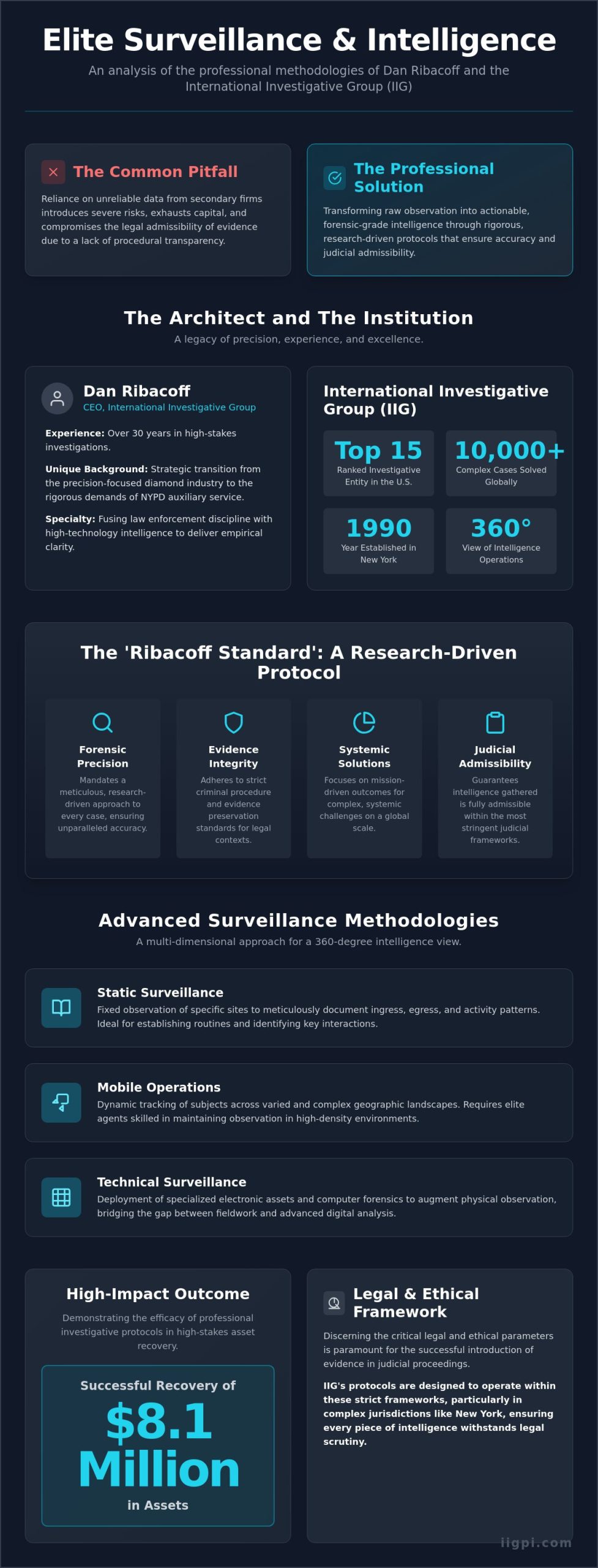
The distinction between rudimentary observation and sophisticated intelligence acquisition represents the critical margin between institutional success and systemic failure. Many high-level decision-makers recognize that unreliable data from secondary firms doesn’t just exhaust capital; it introduces severe risks concerning the legal admissibility of evidence and a fundamental lack of procedural transparency. This article provides an authoritative analysis of elite surveillance services and the professional trajectory of Dan Ribacoff, the Chief Executive Officer of the International Investigative Group.
We’ll examine the rigorous methodologies that transform raw observation into actionable, forensic-grade intelligence. Readers will gain a comprehensive understanding of the technical surveillance process and the strategic frameworks utilized by Dan Ribacoff to resolve complex cases across more than 30 years of practice. This discourse serves as a definitive guide for those requiring elite investigative protocols and offers a direct pathway to engage a team ranked among the top 15 investigative entities in the United States. By synthesizing law enforcement rigor with high-technology intelligence, this guide establishes a framework for securing empirical clarity in the most challenging global environments.
Key Takeaways
- Examine the institutional evolution of the International Investigative Group and its transition into a premier global intelligence entity under specialized leadership.
- Understand how the integration of mobile and static surveillance services, Dan Ribacoff’s specialized methodology, facilitates the acquisition of forensic grade intelligence.
- Review the strategic frameworks utilized in high-stakes investigations, including the recovery of $8.1 million, to appreciate the efficacy of professional investigative protocols.
- Discern the critical legal and ethical parameters governing private investigations in New York to ensure the successful introduction of evidence in judicial proceedings.
- Identify the procedural steps for engaging elite investigative teams to establish a precise scope for sophisticated intelligence operations and risk mitigation.
The Intersection of Expertise and Intelligence: Dan Ribacoff and IIG
The professional trajectory of Dan Ribacoff is defined by a strategic transition from the precision-oriented environments of the diamond industry to the rigorous demands of New York City law enforcement auxiliary service. This unique dual background facilitated the creation of a specialized investigative methodology that prioritizes both asset security and forensic precision. In 1990, the International Investigative Group (IIG) was established as an institutional response to an increasing market demand for sophisticated intelligence that mirrored the standards of official government agencies. The firm’s evolution from a local New York entity into a global network reflects a commitment to intellectual depth and the systematic acquisition of data. By providing elite surveillance services, Dan Ribacoff has redefined the parameters of private sector intelligence, ensuring that every operation is conducted with the gravitas of a premier research institution.
Foundational Background and Law Enforcement Influence
Service within the auxiliary police provided a critical framework for understanding the nuances of criminal procedure and the strict requirements for evidence preservation. NYC’s complex urban landscape served as a primary laboratory for developing advanced methodologies, where agents refined the ability to maintain observation in high-density, high-stakes environments. These early milestones were instrumental in formulating the ‘Ribacoff Standard’, an investigative protocol that mandates a research-driven approach to every case. Much like the strategic intelligence agencies that operate within the highest levels of international power, IIG functions as a mission-driven entity focused on systemic solutions for global challenges. This standard ensures that all intelligence gathered is not only accurate but also fully admissible within the most stringent judicial frameworks. As the architect of these protocols for surveillance services, Dan Ribacoff emphasizes the synthesis of law enforcement discipline and high-technology intelligence to bridge the gap between regional dynamics and global strategic needs.
Branding Excellence: The Top 15 National Ranking
The firm’s status as an elite institution is supported by its ranking among the top 15 investigators in the United States, a distinction based on technical proficiency and a history of solving over 10,000 cases. Achieving this level of recognition requires more than just operational success; it demands institutional longevity and a consistent adherence to professional ethics. Understanding the role and function of a private investigator in the modern era involves a synthesis of traditional human intelligence and advanced technical assets. As a premier private investigator, Ribacoff has ensured that IIG remains at the forefront of the industry by integrating computer forensics with physical observation. This global reach allows the organization to provide a 360-degree view of intelligence, appealing to an audience of high-level decision-makers and industry leaders who require absolute clarity. The organization’s authoritative presence in global discourse isn’t merely a result of its size, but of its dedication to intellectual rigor and the resolution of high-profile cases that have defined the modern investigative landscape.
Advanced Methodologies in Professional Surveillance Services
Technological Integration in Field Operations
Field agents employ high-definition optical systems and night-vision capabilities to maintain visual continuity under challenging environmental conditions. The integration of computer forensics allows for the forensic correlation of a subject’s digital footprint with their physical movements, creating a comprehensive behavioral profile. Within a corporate context, technical surveillance is defined as the systematic deployment of electronic monitoring and data-gathering tools to identify internal threats or protect proprietary intellectual property. These operations must strictly adhere to the Regulatory and Ethical Framework established by governing bodies to ensure the legal integrity and admissibility of the findings. Digital footprint analysis has fundamentally transformed traditional physical surveillance by providing predictive insights into subject behavior before field deployment begins.
Tactical Planning and Asset Deployment
Success in high-density urban environments like Manhattan necessitates meticulous pre-surveillance briefing and pattern analysis. This rigorous process involves deconstructing subject routines and assessing environmental risks, such as traffic density and pedestrian flow, to optimize asset placement. Coordinating multi-agent teams is essential for complex mobile surveillance in New York City to prevent “burn” risks and ensure constant coverage through relay techniques. When managing these surveillance services, Dan Ribacoff oversees the strategic deployment of assets to ensure that every agent operates within a cohesive tactical framework. For a deeper analysis of these operational protocols, one should consult a Professional Surveillance Services Guide which details the logistical requirements of elite fieldwork.
To verify investigative leads obtained during field operations, the firm utilizes Indepth Polygraphs, adding a layer of empirical certainty to the intelligence gathered. This verification process is critical in high-stakes corporate or matrimonial cases where the veracity of a lead determines the strategic direction of the entire investigation. The synergy between physical observation and scientific verification distinguishes the firm’s work from standard private investigation practices. Decision-makers seeking to mitigate risk through these advanced protocols can engage the International Investigative Group for a specialized consultation regarding their specific intelligence requirements.
Analyzing High-Impact Outcomes: Case Studies in Excellence
The efficacy of sophisticated investigative protocols is best demonstrated through the resolution of complex, high-profile cases that demand a synthesis of technical precision and strategic foresight. By providing elite surveillance services, Dan Ribacoff has established a precedent for managing investigations of national significance, including the technical investigation and trial preparation following the 1993 World Trade Center bombing. These engagements validate the firm’s internal protocols. They prove that systematic observation, when combined with forensic rigor, can withstand the scrutiny of federal judicial proceedings. Institutional credibility is forged in these high-stakes environments where the margin for error is non-existent.
The Hudson Truck Robbery: A Benchmark in Recovery
The recovery of $8.1 million in the Hudson Truck Robbery stands as a definitive benchmark in the application of mobile and static surveillance techniques. This operation required seamless collaboration between private investigative assets and federal authorities to track stolen property across multiple jurisdictions. It was a massive success. For corporate victims, the return on investment for professional surveillance is quantified not merely by the direct recovery of capital, but by the mitigation of long-term operational risks. The success of this case underscores the necessity of employing agents who possess the intellectual depth to navigate complex logistical challenges while maintaining total operational security. It remains one of the largest recoveries in the history of the private sector.
Corporate Fraud and Specie Loss Investigations
Investigations into financial malfeasance often require the deployment of surveillance to identify internal theft and the sophisticated mechanisms of bank fraud. In one notable instance, the firm deconstructed a $120 million bank fraud scheme by correlating technical data with physical observations of key personnel. Similarly, the investigation of a $12 million fraudulent burglary claim highlighted the role of surveillance in exposing inconsistencies between reported losses and physical evidence. These cases require patience. Decision-makers requiring a deeper analysis of these methodologies should review the Corporate Fraud Investigation Guide to understand the systemic approach required for specie loss recovery. These outcomes demonstrate that the surveillance services Dan Ribacoff oversees are instrumental in protecting the financial integrity of global institutions. The firm remains a primary choice for insurers and corporations facing complex specie losses.
The Regulatory and Ethical Framework of Private Surveillance
The execution of professional surveillance services, Dan Ribacoff contends, requires a profound understanding of the jurisdictional nuances that dictate the legality of intelligence acquisition. Navigating the legal complexities of New York State necessitates a disciplined adherence to both statutory law and judicial precedent to ensure that gathered data remains a viable asset in litigation. While law enforcement agencies are primarily governed by constitutional constraints regarding search and seizure, private investigative entities must operate within the boundaries of privacy torts and specific state regulations. This distinction is critical for high-level decision-makers who require empirical evidence that can withstand the rigors of cross-examination without being compromised by procedural errors. Institutional credibility isn’t merely about the data obtained, but the methodology used to secure it.
Legal Admissibility in New York Courts
The admissibility of surveillance evidence in civil and criminal litigation depends entirely upon the maintenance of a rigorous chain of custody. Every unit of data, whether it’s high-definition video footage or a detailed chronological report, must be documented with a degree of precision that allows for its authentication in a court of law. Licensed investigators are indispensable in this process because their professional standing and adherence to state-mandated protocols prevent evidence from being suppressed due to claims of trespassing or harassment. Regarding the use of technical assets, the legal framework is definitive: the surreptitious attachment of a GPS tracking device to a vehicle by a private investigator in New York without the consent of the individual who has a superior right of possession is generally prohibited and presents a significant risk to the integrity of the investigation.
Ethical Intelligence Gathering
Maintaining institutional integrity requires a commitment to ethical benchmarks that often exceed the baseline requirements of the law. This involves strict adherence to the Fair Credit Reporting Act (FCRA) when conducting background inquiries and ensuring that all intelligence gathering respects the reasonable expectation of privacy. By establishing these standards for surveillance services, Dan Ribacoff has positioned the International Investigative Group as a leader in ethical investigative practice. These protocols are particularly vital when executing an Insurance Fraud Investigation Framework where the evidentiary weight of the findings determines the success of risk mitigation strategies. Organizations that require a synthesis of elite intelligence and uncompromising legal compliance should engage our professional team to secure their interests within the established regulatory framework.
Strategic Implementation: Engaging International Investigative Group
The transition from identifying a need for intelligence to the actual execution of an operation requires a structured engagement protocol. By offering specialized surveillance services, Dan Ribacoff ensures that every client interaction begins with a high-level consultation designed to synthesize the client’s objectives into a viable investigative scope. This initial phase isn’t merely administrative; it’s a strategic necessity to determine the feasibility of an operation within specific legal and environmental constraints. Customizing these packages allows the firm to address the unique vulnerabilities of corporate, insurance, and personal clients, ensuring that the resources deployed are proportional to the stakes involved.
Defining the Investigative Scope
Feasibility and risk assessments are the cornerstones of the intake process at the International Investigative Group. During this stage, the firm analyzes the subject’s patterns and the operational environment to identify potential risks or legal hurdles. The transition from intake to field deployment is a deliberate process that requires the coordination of technical assets and human intelligence. For instance, matrimonial investigations often focus on behavioral patterns and asset identification, whereas corporate cases might prioritize the protection of proprietary data or the identification of internal malfeasance. This methodological rigor ensures that the resulting intelligence is both accurate and actionable.
The Global Reach of IIG
The organization’s influence extends far beyond the New York metropolitan area, utilizing a decentralized network that maintains consistent quality across international borders. With strategic connections in London and Florida, the firm functions much like a premier geopolitical intelligence agency, bridging the gap between regional dynamics and global strategic needs. Maintaining this level of excellence across a global network requires a centralized command structure overseen by senior leadership. This ensures that the ‘Ribacoff Standard’ is upheld regardless of the geographic location of the field operation. Finalizing an engagement involves the delivery of comprehensive reports, forensic-grade evidence, and, when necessary, expert testimony in judicial proceedings to validate the findings.
High-level decision-makers and industry leaders who require absolute clarity in complex environments are encouraged to engage the International Investigative Group for a specialized consultation. By leveraging over 30 years of experience and a track record of solving more than 10,000 cases, the firm provides a definitive pathway to resolving the most challenging investigative dilemmas. Securing elite surveillance services, Dan Ribacoff and his team offer the intellectual depth and technical proficiency necessary to protect institutional interests on a global scale.
Securing Institutional Clarity through Elite Intelligence
The resolution of complex investigative challenges requires an unwavering commitment to intellectual rigor and the systematic application of advanced methodologies. This guide has examined how the synthesis of technical assets and law enforcement discipline facilitates the acquisition of forensic grade data that remains admissible in the most stringent judicial environments. By adhering to the established “Ribacoff Standard”, organizations can navigate the intricacies of global intelligence gathering with absolute confidence in the integrity of their evidence. It’s clear that the margin between success and failure in high stakes environments depends on the quality of the investigative framework employed.
When requiring elite surveillance services, Dan Ribacoff and the International Investigative Group offer a definitive pathway to resolving systemic vulnerabilities and protecting institutional interests. With a global network of elite agents and a track record of solving over 10,000 cases, the firm is a prestigious entity featured on CNN, Dr. Oz, and Inside Edition. We encourage you to Consult with Dan Ribacoff and the International Investigative Group for Elite Surveillance Services to establish a secure foundation for your investigative needs. Achieving empirical clarity is the first step toward strategic victory.
Frequently Asked Questions
What specific surveillance services does Dan Ribacoff’s firm provide?
The International Investigative Group provides a comprehensive suite of intelligence operations including corporate, insurance, and matrimonial investigations. These specialized surveillance services, Dan Ribacoff explains, are tailored to the specific risk profiles of each client, ranging from high-stakes specie loss recovery to child custody and background due diligence. Every engagement is structured to address unique vulnerabilities through a synthesis of human intelligence and technical observation.
How much does a professional surveillance operation cost in NYC?
While specific rates are determined by the complexity of the assignment, elite private investigative firms in Manhattan typically command hourly rates ranging from $195 to $350 or more as of July 2026. Retainer fees for basic cases generally fall between $1,000 and $5,000, reflecting the premium associated with the New York City market and the logistical requirements of multi-agent teams. These figures represent industry standards for high-level intelligence acquisition within the region.
Is surveillance evidence gathered by IIG admissible in a court of law?
Evidence obtained through the firm’s protocols is designed to be fully admissible in both civil and criminal litigation. By strictly adhering to the chain of custody requirements and operating within the regulatory framework of New York State, the International Investigative Group ensures that its findings withstand the most rigorous judicial scrutiny. This procedural discipline prevents the suppression of evidence that often occurs with lower-tier firms.
What is Dan Ribacoff’s background in law enforcement and polygraph testing?
Dan Ribacoff transitioned from the precision-oriented diamond industry into auxiliary law enforcement with the New York City Police Department, a role that shaped his expertise in evidence handling. He’s also a highly recognized polygraph examiner with over 30 years of experience, having utilized these scientific methodologies to resolve more than 10,000 cases throughout his professional career. This background facilitates a research-driven approach to every investigative challenge.
Can IIG conduct surveillance operations outside of New York City?
The organization maintains a robust global presence, extending its operational reach well beyond the New York metropolitan area through a decentralized network of elite agents. With established connections in London and Florida, the firm facilitates international surveillance operations while maintaining a consistent standard of excellence across geographic borders. This global reach allows for the seamless tracking of subjects and assets in complex, multi-jurisdictional cases.
What technology does International Investigative Group use for surveillance?
The firm utilizes a synthesis of high-definition optical systems, night-vision capabilities, and advanced electronic monitoring equipment to ensure continuous observation under challenging conditions. These technical assets are integrated with sophisticated computer forensics to correlate a subject’s digital footprint with their physical movements. This multi-dimensional approach provides a 360-degree intelligence profile that exceeds the capabilities of traditional observation techniques.
How long does a typical surveillance investigation take to complete?
The duration of an investigation is contingent upon the specific objectives and the complexity of the subject’s behavioral patterns. While some assignments may reach a definitive resolution within several days, more intricate corporate fraud or long-term monitoring cases may require weeks of systematic observation to secure forensic-grade evidence. Each operation is governed by a strategic timeline established during the initial consultation phase.
How does Dan Ribacoff ensure the privacy and confidentiality of his clients?
Institutional integrity is maintained through strict adherence to confidentiality protocols and the Fair Credit Reporting Act. To provide secure surveillance services, Dan Ribacoff mandates that all intelligence gathering is conducted with the utmost discretion, ensuring that client identities and operational details remain protected from unauthorized disclosure. This commitment to privacy is fundamental to the firm’s standing as a prestigious and research-driven institution.