
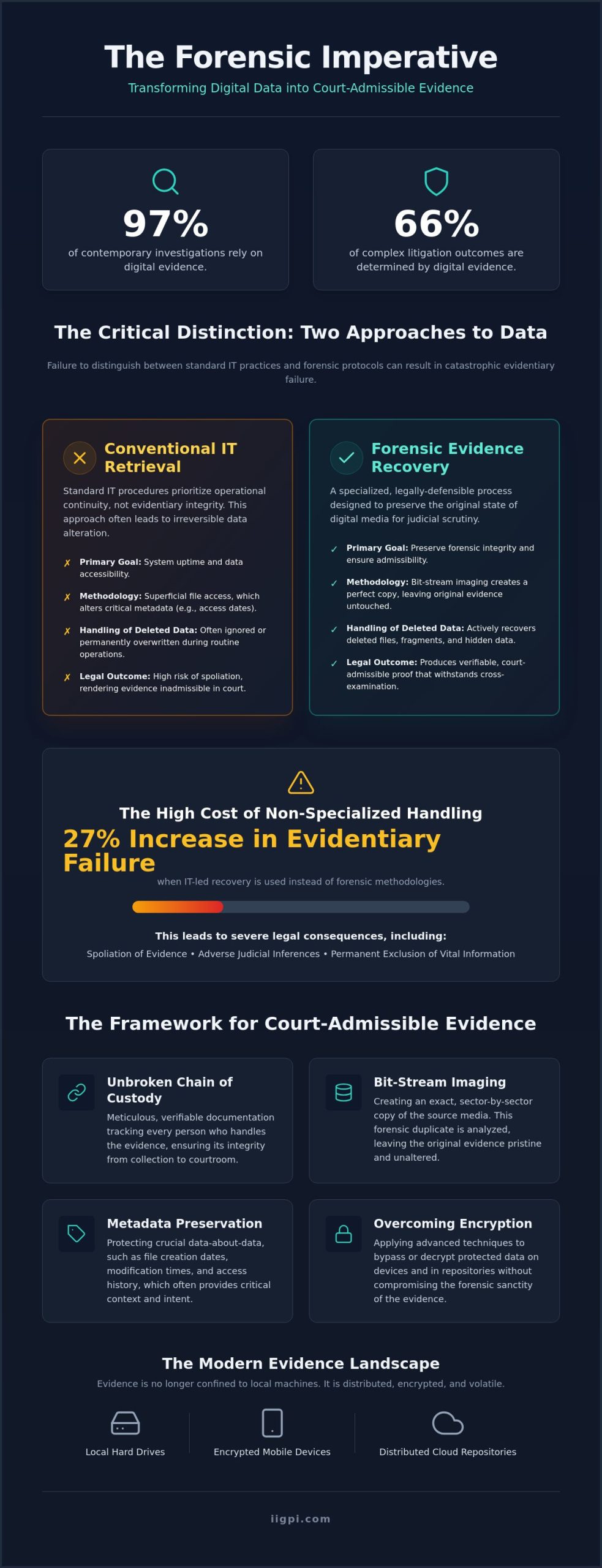
While digital evidence constitutes a critical component in 97% of contemporary investigations as of June 2026, its evidentiary utility remains precariously dependent upon the technical and procedural rigor of its extraction. In the current legal environment, which is characterized by heightened standards for authentication following the New York Court of Appeals ruling in Matter of M.S. (M.H.), the distinction between raw data and admissible proof is defined by forensic integrity. Legal professionals often recognize that the technical complexity of encrypted or deleted data, coupled with the inherent risks of non-specialized IT handling, creates a significant vulnerability for institutional litigants. This article provides an elite analysis of the methodologies required for digital evidence recovery for court, Lance Ribacoff, and the authoritative framework necessary to transform volatile digital artifacts into forensic evidence suitable for high-stakes litigation.
Readers will gain an advanced understanding of the protocols required to mitigate institutional risk and secure a strategic advantage through elite investigative intelligence. We examine the systemic requirements for maintaining an unbroken chain of custody and the specialized techniques required to overcome sophisticated encryption. By prioritizing forensic precision over mere data retrieval, practitioners can ensure successful litigation outcomes supported by data that survives the most rigorous judicial scrutiny. This investigation into modern forensic standards serves as a definitive guide for those navigating the intersection of complex technology and the demands of the judiciary.
Key Takeaways
- Distinguish between conventional data retrieval and the specialized methodologies required to transform volatile digital artifacts into court-admissible forensic evidence.
- Comprehend the foundational principles of the digital evidence recovery for court, Lance Ribacoff framework, which is designed to uphold the highest standards of forensic integrity.
- Examine the technical protocols of computer forensics used to identify internal misconduct and corporate espionage while preserving the original media’s evidentiary value.
- Navigate the complexities of the NYC judicial landscape by applying Daubert and Frye standards to ensure expert testimony survives rigorous cross-examination.
- Implement a phased strategic framework to mitigate institutional risk and leverage elite investigative intelligence for superior litigation outcomes.
The Criticality of Forensic Integrity in 2026 Litigation
The New York State Unified Court System has witnessed a profound escalation in its dependency on digital assets. By mid-2026, empirical observations suggest that digital evidence serves as the primary differentiator in approximately 66% of complex litigation cases. This high-stakes environment necessitates a transition from rudimentary data retrieval to the rigorous preservation of forensic artifacts. Institutional leaders must recognize that superficial access to files is insufficient; they require authoritative digital intelligence to survive judicial scrutiny. The application of digital evidence recovery for court, Lance Ribacoff, ensures that the technical precision of extraction aligns with the strict requirements of the legal system. It’s no longer enough to simply locate data. One must prove its provenance and immutability through a framework that withstands the most aggressive cross-examination.
The Taxonomy of Modern Digital Evidence
Modern evidentiary sources have evolved beyond local hard drives to encompass a sophisticated array of encrypted mobile devices and distributed cloud-based repositories. These assets possess an inherent volatility that makes them susceptible to spontaneous degradation or irreversible alteration if handled by non-specialized personnel. It’s essential that corporate fraud investigation protocols integrate professional forensic recovery from the moment an anomaly is detected. This proactive alignment prevents the loss of transient metadata that often proves decisive in establishing intent or chronology within a courtroom setting. While the legal definition of digital evidence covers a broad spectrum of data, its utility is entirely dependent on the integrity of the collection process. When dealing with encrypted institutional repositories, the methodology must be both invasive enough to retrieve the data and delicate enough to maintain its forensic sanctity.
The Risks of Non-Specialized Data Handling
Entrusting data recovery to internal IT departments frequently results in catastrophic procedural errors that jeopardize the admissibility of the entire dataset. Statistical analysis indicates a 27% increase in evidentiary failure when IT-led recovery is prioritized over specialized forensic methodologies. The primary risk involves the “spoliation of evidence,” a legal consequence where the integrity of the record is compromised, often leading to adverse judicial inferences. While IT departments focus on system uptime and data accessibility, forensic investigators prioritize the preservation of the original bit-stream image and the maintenance of a verifiable chain of custody. This distinction is where the comprehensive approach to digital evidence recovery for court, Lance Ribacoff, provides a necessary safeguard against the institutional risks of technical mismanagement. Failure to distinguish between these two objectives often leads to the permanent exclusion of vital information, effectively deciding the outcome of the case before it reaches trial.
The Ribacoff Standard: Distinguishing Forensic Recovery from Conventional Data Retrieval
The Ribacoff Standard represents a critical evolution in the field of court-admissible digital evidence recovery, establishing a rigorous protocol that transcends the limitations of standard IT data retrieval. This framework addresses the explicit duty of competence mandated by the New York Rules of Professional Conduct, specifically NY RPC 1.1(c), which requires legal practitioners to maintain an advanced understanding of the benefits and risks associated with relevant technology. By implementing digital evidence recovery for court, Lance Ribacoff ensures that practitioners don’t merely acquire data but rather secure a forensic record that is immune to challenges regarding its authenticity or procedural history. It’s an elite institutional safeguard designed for high-stakes corporate and personal matters where the margin for error is non-existent and the legal consequences of failure are absolute.
Conventional data retrieval often prioritizes the accessibility of information, yet it frequently neglects the forensic markers required to prove that the data hasn’t been altered. In contrast, the Ribacoff Standard focuses on the immutability of the digital record. This distinction is vital in 2026, as judicial standards for the authentication of digital artifacts have become increasingly stringent. The framework operates as a synthesis of technical expertise and legal awareness, ensuring that every byte recovered is accompanied by a verifiable audit trail. This methodology provides a definitive solution for institutions that must navigate the complexities of modern litigation while maintaining the highest standards of evidentiary integrity.
Synthesizing Law Enforcement Rigor with Digital Intelligence
Lance Ribacoff’s background is rooted in an investigative lineage that prioritizes the meticulous synthesis of law enforcement precision with cutting-edge private-sector digital intelligence. This synthesis is vital when dealing with encrypted institutional data that requires more than just automated extraction tools. An investigative mindset allows for the identification of systemic anomalies, such as subtle patterns of data manipulation or obfuscation, that standard software often fails to detect. This discipline ensures that the technical recovery process remains subservient to the broader evidentiary objectives of the case. It’s this fusion of traditional investigative rigor and modern technical capability that defines the framework’s effectiveness.
A Legacy of Investigative Excellence in NYC
The foundation of this standard is built upon the International Investigative Group’s thirty-year history of resolving over 10,000 complex cases within the NYC judicial landscape. This extensive experience provides a deep reservoir of institutional knowledge that informs every aspect of the forensic process. Supported by a global network of specialized agents, the firm facilitates seamless digital recovery in cross-border litigation, ensuring that evidence remains admissible regardless of its geographic origin. For those facing the most difficult investigative problems, engaging with International Investigative Group offers a strategic advantage that is both proven and authoritative.
Advanced Methodologies for Court-Admissible Digital Evidence Recovery
The transition from theoretical frameworks to technical execution requires a structured, phased approach to ensure that data remains unassailable under judicial scrutiny. The application of digital evidence recovery for court, Lance Ribacoff, necessitates protocols that exceed the standard capabilities of enterprise IT departments by prioritizing the absolute integrity of the original digital media. This process involves the strategic application of computer forensics to identify complex patterns of internal misconduct and corporate espionage that would otherwise remain obscured within vast institutional datasets. By utilizing sophisticated forensic imaging techniques that surpass simple file copying, investigators can capture the entirety of a device’s state, including hidden and system files. This comprehensive capture is the only way to ensure that metadata analysis can later establish accurate timelines and user intent.
Phase I: Forensic Acquisition and Write-Blocking Protocols
The foundational step in any forensic engagement is the preservation of the source media through the implementation of hardware-based write-blocking technology. This hardware ensures that no data, including transient metadata, is written to the device during the examination process, thereby maintaining forensic integrity as defined by federal standards. Analysts then create bit-for-bit forensic images of hard drives and mobile devices, capturing every sector of the storage medium to include unallocated space. To verify the authenticity of this copy, cryptographic hashing methods, such as MD5 or SHA-256, are employed to generate a unique digital signature. Any subsequent modification to either the original or the copy would result in a mismatch of these signatures, providing a mathematical guarantee of evidentiary immutability.
Phase II: Sophisticated Analysis of Encrypted and Deleted Data
Once a verified image is secured, the focus shifts toward the recovery of data from encrypted volumes and deleted partitions. Advanced methodologies allow for the analysis of slack space and unallocated clusters, where fragmented evidence of past activities often persists despite attempts at obfuscation or deletion. Forensic analysts reconstruct user activity across multiple platforms and devices by examining system logs, registry entries, and application artifacts. This level of analysis is essential for establishing timelines and user intent, transforming disparate data points into a coherent narrative for the court. Through these sophisticated techniques, digital evidence recovery for court, Lance Ribacoff, provides the technical depth required to uncover systemic anomalies that automated tools frequently overlook.
Navigating the NYC Judicial Landscape: Admissibility and Expert Testimony
Technical proficiency in data extraction remains a secondary concern if the resulting artifacts fail to survive the rigorous admissibility standards of the New York State Unified Court System. Within the specific jurisprudential climate of 2026, the transition from raw binary code to a court-admissible record is governed by strict evidentiary rules that demand more than mere possession of data. It requires a narrative of integrity that begins at the moment of seizure and continues through the final presentation of expert testimony. The framework for digital evidence recovery for court, Lance Ribacoff, is specifically engineered to meet these judicial demands, ensuring that every recovered fragment is accompanied by the procedural documentation necessary to withstand aggressive cross-examination. Institutional risk is mitigated only when the technical process is subservient to the legal requirements of the forum.
Adherence to the Daubert and Frye Standards
New York courts maintain a complex relationship with the scientific validity of digital forensic techniques, often requiring a synthesis of the Frye standard’s “general acceptance” and the Daubert standard’s focus on methodological reliability. To survive judicial scrutiny, forensic investigators must utilize peer-reviewed methodologies and established industry tools that have been validated through rigorous testing. It’s not enough for an investigator to be technically skilled; they must serve as an expert witness who can cogently translate abstract technical data for the bench. This translation process is vital for establishing the reliability of the recovery process, particularly when dealing with sophisticated encryption or recovered deleted partitions that might otherwise be viewed with skepticism by a non-technical judiciary.
Compliance with the NY SHIELD and AVOID Acts
The regulatory environment has become increasingly demanding with the full implementation of the NY SHIELD Act and the procedural constraints of the New York AVOID Act. The SHIELD Act expands the definition of “reasonable safeguards” for data security, making it imperative for institutions to utilize forensic-grade recovery protocols that prevent unauthorized access or alteration during an investigation. Simultaneously, the AVOID Act’s strict litigation deadlines impose a temporal pressure that can lead to procedural shortcuts in non-specialized environments. IIGPI’s framework ensures that the speed of recovery doesn’t compromise the “duty of competence” that attorneys owe to their clients regarding the handling of digital evidence. Failure to align technical recovery with these specific legislative mandates often results in the permanent exclusion of vital evidence. For institutions requiring immediate, judicially sound forensic support, engaging with International Investigative Group provides the necessary assurance that all protocols meet the highest NYC legal standards.
A judicial-grade chain of custody serves as the sinew of any digital investigation, connecting the original source media to the final exhibit presented in court. Without this unbroken record, even the most incriminating data can be dismissed as unreliable or tampered with. By prioritizing a framework that anticipates the specific challenges of the NYC judicial landscape, legal professionals can secure a strategic advantage that is both technically superior and legally unassailable. This commitment to procedural rigor is what distinguishes elite forensic partnerships from standard technical services.
Securing Institutional Interests through Elite Forensic Partnerships
The culmination of a forensic engagement is not merely the delivery of data but the reinforcement of institutional resilience through a partnership that prioritizes strategic intelligence and procedural absolute. Lance Ribacoff and the International Investigative Group (IIGPI) occupy a specialized niche where they synthesize the technical imperatives of digital evidence recovery for court, Lance Ribacoff, with the broader requirements of corporate and personal integrity. This strategic leadership is defined by an ability to manage the most sophisticated threat environments while maintaining a hermetic seal of confidentiality. In high-stakes litigation, the role of the forensic partner extends beyond the laboratory; it involves providing the clarity necessary for executive leadership to make informed decisions under duress. By tailoring every engagement to the specific nuances of the case, the firm ensures that digital intelligence becomes a decisive asset rather than a liability.
The Strategic Leadership of Lance Ribacoff
Ribacoff’s role is characterized by an ability to bridge the persistent gap between technical complexity and the rigorous demands of the judiciary. This tailored approach ensures that every digital intelligence engagement is viewed through the lens of institutional risk mitigation. The firm’s methodology doesn’t rely on generic software solutions but rather on a deep investigative mindset that uncovers systemic anomalies within sophisticated institutional environments. This level of oversight provides legal teams with a strategic advantage, transforming volatile data into a stable foundation for expert testimony. It’s this synthesis of law enforcement discipline and private-sector agility that positions the firm as the premier partner for those facing the most difficult digital litigation challenges.
Engagement and Consultation: The Path to Resolution
The path to resolution is structured through a phased strategic framework that begins with a comprehensive initial assessment designed to identify critical digital assets and potential vulnerabilities. During this phase, investigators establish a baseline of the digital landscape, ensuring that no transient evidence is overlooked or inadvertently compromised. Following this, IIGPI collaborates with legal counsel to develop a court-ready investigative strategy that aligns forensic findings with the specific requirements of the case. This rigorous planning ensures that the final execution of the recovery process is both technically precise and legally unassailable. To ensure the preservation of your organization’s legal standing and to protect the integrity of your data, you’re invited to secure an authoritative consultation to address the specific complexities of your digital record.
Advancing Institutional Resilience through Authoritative Forensic Intelligence
The evolution of the NYC judicial landscape demands a departure from rudimentary technical solutions toward a framework of forensic absolute. By prioritizing the Ribacoff Standard, organizations ensure their digital artifacts are transformed into unassailable evidence that survives rigorous cross-examination. This discipline isn’t merely a technical requirement but a strategic imperative for securing corporate and personal integrity within the complex environment of 2026 litigation. The implementation of digital evidence recovery for court, Lance Ribacoff, provides the necessary bridge between volatile data and judicial admissibility, effectively mitigating the risks of spoliation and procedural failure. With over 30 years of elite investigative experience and the resolution of more than 10,000 high-stakes cases, the International Investigative Group offers the specialized expertise required to navigate these challenges. Supported by a global network of forensic agents, the firm stands ready to provide clarity in the most sophisticated institutional threat environments. To protect your digital record and secure a strategic advantage, you’re invited to Secure an Authoritative Consultation with Lance Ribacoff and IIGPI. Proactive engagement ensures your evidence remains a powerful asset in the pursuit of justice.
Frequently Asked Questions
What is the primary difference between data recovery and digital forensics for court?
Data recovery focuses exclusively on restoring accessibility to lost or damaged files, whereas digital forensics emphasizes the preservation of evidentiary integrity and the documentation of a verifiable audit trail. While standard IT recovery might inadvertently alter metadata during the retrieval process, forensic recovery utilizes bit-stream imaging to ensure that the source media remains unchanged. This distinction is foundational to the framework of digital evidence recovery for court, Lance Ribacoff, which prioritizes judicial admissibility over mere data accessibility.
How does write-blocking technology ensure the admissibility of digital evidence?
Write-blocking technology ensures admissibility by physically or logically preventing any data from being written to the source device during the acquisition phase. This intervention preserves the original state of the media, satisfying the legal requirement that evidence remains untampered with since the time of seizure. Without such hardware, the integrity of the digital record is compromised, often rendering the recovered data inadmissible during a rigorous judicial review of the forensic process.
Can deleted messages or files be recovered for use in New York litigation?
Deleted messages and files can frequently be recovered from unallocated space or system backups through specialized forensic techniques. Even after a file is marked for deletion, the underlying data often persists until it’s overwritten by new information. In New York litigation, these recovered artifacts serve as vital proof of intent or chronology, provided they’re extracted using protocols that maintain their forensic sanctity and prove the data hasn’t been manipulated post-deletion.
What are the Daubert and Frye standards, and how do they apply to digital forensics?
The Frye standard requires that a technique be generally accepted by the scientific community, while the Daubert standard focuses on the methodological reliability and peer-reviewed validity of the process. Digital forensics must satisfy these criteria by utilizing validated tools and reproducible processes that can withstand technical challenges. An expert’s ability to demonstrate that their methodology adheres to these scientific benchmarks is essential for the evidence to be admitted as reliable testimony within the New York court system.
How does the NY SHIELD Act affect how corporations handle digital evidence recovery?
The NY SHIELD Act mandates that corporations implement “reasonable safeguards” to protect private information, which necessitates the use of forensic-grade recovery protocols during internal investigations. Failure to utilize specialized investigators can result in regulatory penalties and the loss of legal protections if data is mishandled or its integrity is questioned. Institutional leaders must transition from rudimentary IT responses to authoritative forensic intelligence to ensure they remain compliant with these expanded security and litigation requirements. To further strengthen these defenses, engaging an ISO 27001 consultant Pittsburgh can help organizations establish the comprehensive security frameworks necessary to satisfy both regulatory auditors and judicial standards.
Why is a chain of custody so critical in digital evidence recovery for court?
A chain of custody is critical because it provides a chronological and verifiable record of every individual who handled the digital evidence from seizure to the courtroom. In the context of digital evidence recovery for court, Lance Ribacoff, this documentation proves that the data presented at trial is the exact same data seized from the original device. Any gap in this record creates a procedural vulnerability that opposing counsel can exploit to challenge the evidence’s authenticity and reliability.
What role does an expert witness like Lance Ribacoff play in the courtroom?
An expert witness translates complex technical findings into a coherent narrative that the bench and jury can comprehend. Beyond the technical extraction of data, they provide authoritative testimony regarding the reliability of the forensic process and the significance of recovered metadata. This role is essential for bridging the gap between abstract binary code and the practical requirements of legal proof, ensuring that technical evidence is given its proper weight in high-stakes litigation.
How long does a typical digital forensic recovery and analysis process take?
The duration of a digital forensic recovery varies based on the volume of data and the complexity of encryption, though a preliminary assessment is typically completed within several business days. A comprehensive analysis and the generation of a court-ready report may require several weeks of meticulous examination to ensure every artifact is verified. The focus remains on procedural absolute rather than speed to maintain the highest standards of evidentiary integrity and judicial admissibility.