
The resolution of high-stakes legal and corporate disputes often hinges on the extraction of empirical truth from a landscape of subjective ambiguity. While traditional investigative methods may reach an impasse when faced with sophisticated deception, the integration of advanced psychophysiological detection of deception protocols offers a definitive pathway toward clarity. When seeking polygraph testing services nyc, Dan Ribacoff provides a forensic environment that transcends common misconceptions regarding the reliability of lie detection by utilizing computerized systems validated through extensive academic research. You likely recognize that in the context of complex litigation or internal corporate theft, the absence of verifiable evidence can lead to catastrophic strategic failures.
This analysis serves as an authoritative examination of the methodologies employed to transform autonomic oscillations into actionable intelligence within the New York jurisdiction. We’ll explore the rigorous standards of the Ribacoff methodology, the specific constraints of New York Labor Law regarding employer mandates, and the evidentiary standing of results in modern judicial proceedings. By the conclusion of this discourse, you’ll understand how expert forensic polygraphy functions as a critical instrument for achieving intellectual and legal resolution in the most sensitive environments.
Key Takeaways
- Distinguish between colloquial lie detection and the formal forensic discipline of psychophysiological detection of deception (PDD) utilized in complex dispute resolution.
- Evaluate the efficacy of polygraph testing services nyc provided by Dan Ribacoff, whose specialized methodology reflects an 87 percent aggregated decision accuracy rate.
- Analyze the constraints of New York Labor Law §735 to maintain institutional compliance while identifying administrative environments where results remain admissible.
- Examine the psychological frameworks of “set” and “super-dampening” that establish the foundation for a professional forensic examination in a controlled environment.
- Formulate strategies for integrating forensic polygraphy into broader investigative frameworks to achieve empirical clarity in high-stakes litigation and corporate theft cases.
The Evolution of Psychophysiological Detection of Deception in NYC
The transition from rudimentary interrogation techniques to the sophisticated application of forensic science marks a significant epoch in investigative history. The Evolution of Psychophysiological Detection of Deception shifted the focus from subjective behavioral analysis toward the objective measurement of involuntary autonomic nervous system responses. While the general public frequently utilizes the colloquial term “lie detector tests,” professional practitioners recognize Psychophysiological Detection of Deception (PDD) as a rigorous forensic discipline. In the 2026 New York corporate landscape, the requirement for truth verification intensified as organizations face increasingly complex internal threats that demand more than mere circumstantial evidence. The shift toward PDD represents an institutional preference for data-driven results over the intuition-based methods of the past.
Foundational Principles of the Modern Polygraph
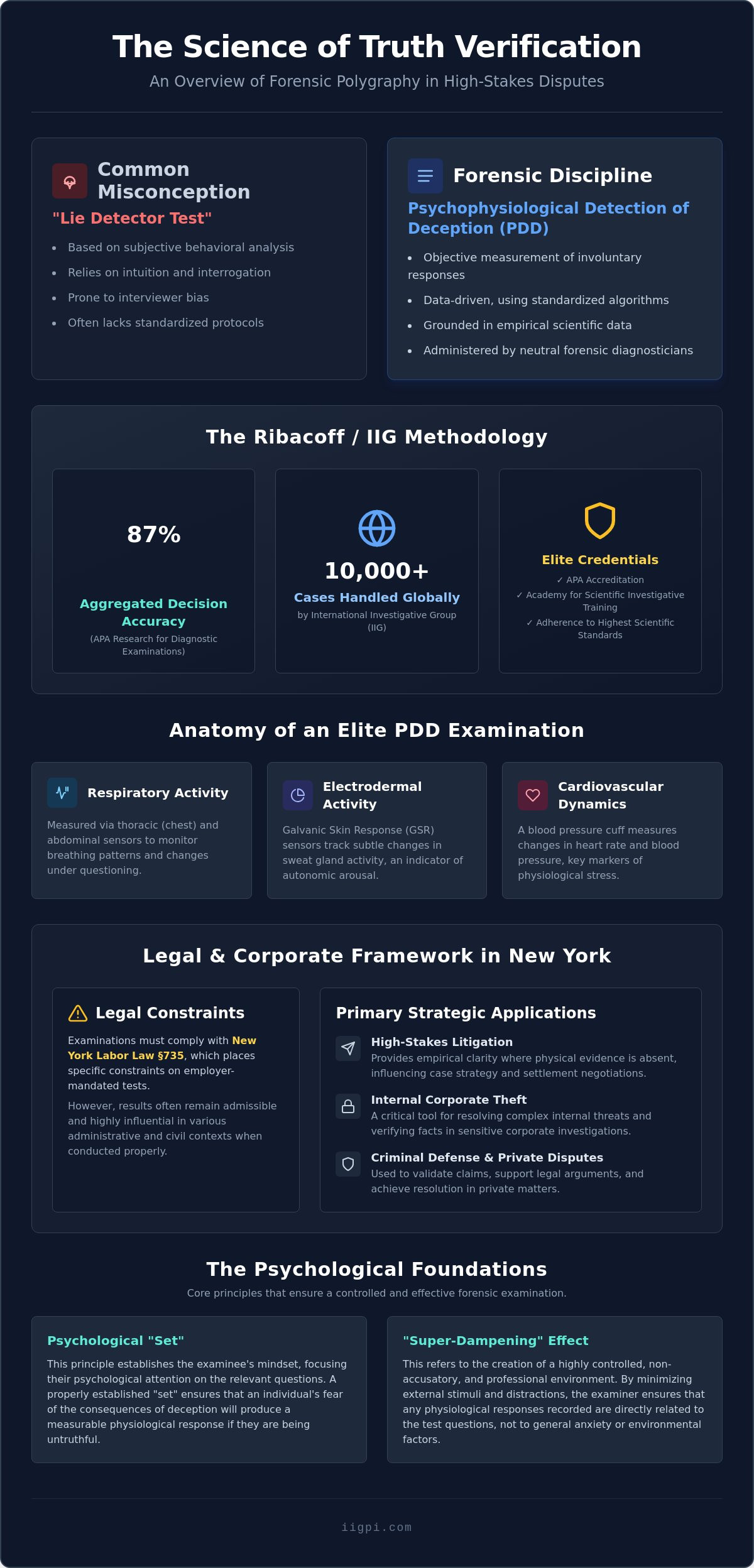
Modern polygraphy relies on the concurrent monitoring of multiple physiological channels to detect indicators of deception. These channels include respiratory activity through thoracic and abdominal sensors, electrodermal activity via galvanic skin response, and cardiovascular dynamics measured by a blood pressure cuff. The examiner functions not as an interrogator, but as a neutral forensic diagnostician who interprets data through standardized scoring algorithms. Psychophysiological Detection of Deception is the scientific observation of physiological markers associated with deception. This diagnostic approach ensures that results are grounded in empirical data rather than interviewer bias. By isolating specific physiological markers, the examiner can provide a structured analysis of an examinee’s veracity regarding specific, relevant issues.
The NYC Market for Elite Investigative Services
Manhattan-based law firms and high-level corporate entities increasingly prioritize examiners who maintain accreditation from the American Polygraph Association (APA) to ensure the highest standards of accuracy. This demand for specialized polygraph testing services nyc, Dan Ribacoff and his colleagues at the International Investigative Group provide, reflects a broader institutional shift toward integrating empirical data into both criminal defense and private domestic disputes. Elite legal teams recognize that a standardized forensic protocol provides a level of clarity that traditional surveillance or interviews cannot achieve alone. These services are often the final arbiter in cases where physical evidence is absent, providing a discrete, professional environment for the resolution of sensitive matters. The integration of such forensic tools isn’t a luxury; it’s a strategic necessity for those operating at the highest levels of global commerce and law.
The Forensic Pedigree of Dan Ribacoff and the IIG Methodology
The efficacy of modern psychophysiological detection depends heavily on the specialized credentials of the examiner and the technological framework of the examination. When evaluating polygraph testing services nyc, Dan Ribacoff represents a standard of forensic excellence rooted in rigorous academic training at the Academy for Scientific Investigative Training. This institution is renowned for its focus on the validated application of PDD protocols. It ensures every examination adheres to the highest scientific standards. Research aggregated by the American Polygraph Association (APA) indicates an 87 percent accuracy rate for diagnostic examinations conducted under these conditions. The International Investigative Group (IIG) leveraged this expertise across more than 10,000 cases globally. This established a precedent for intellectual rigor in truth verification.
Academic Lineage and APA Accreditation
The maintenance of APA accreditation requires a commitment to continuous education in the evolving science of psychophysiology. These standards dictate the ethical conduct of examinations in New York. They ensure every protocol protects the integrity of the data and the rights of the examinee. Understanding The Role and Function of a Private Investigator within this forensic context is essential for legal counsel. It requires a deep comprehension of Legal Standing and Corporate Utility to navigate the complexities of private sector testing. This academic foundation transforms the polygraph from a mere investigative tool into a sophisticated diagnostic instrument. The process is suitable for the highest levels of global discourse.
Computational Analysis: PolyScore and OSS-3
The transition from manual chart interpretation to digital data quantification represents a significant advancement in the field. By integrating advanced scoring algorithms such as PolyScore and OSS-3, the Ribacoff methodology effectively removes human bias from the final determination. PolyScore, developed at the Johns Hopkins University Applied Physics Laboratory, utilizes complex statistical models to compare an examinee’s physiological data against a vast database of known truthful and deceptive charts. Similarly, the Objective Scoring System version 3 (OSS-3) provides a non-subjective numerical analysis of the respiratory, galvanic, and cardiovascular responses. These computational tools provide a level of precision that standard industry software cannot replicate. They offer an objective layer of verification that is indispensable in high-stakes litigation. For organizations requiring this level of empirical clarity, engaging with a specialized forensic investigative team ensures that decisions are based on data rather than intuition.
Legal Standing and Corporate Utility in New York
The application of forensic psychophysiology within the New York jurisdiction requires a sophisticated understanding of both state-specific statutes and federal oversight. In the context of polygraph testing services nyc, Dan Ribacoff operates within a framework defined by the rigorous Frye standard, which necessitates that scientific evidence must be generally accepted within its relevant field. While polygraph results are generally not admissible as evidence in New York State courts, they remain an indispensable instrument for administrative hearings, internal adjudications, and strategic legal positioning. The utility of these examinations often resides in their capacity to provide empirical clarity during the pre-trial phase, allowing counsel to make informed decisions regarding the viability of a defense or the credibility of a witness.
New York Labor Law §735 establishes a comprehensive prohibition against the use of polygraphs in private sector employment, effectively banning employers from requiring, requesting, or even suggesting that an employee or job applicant undergo an examination. This state mandate is significantly more stringent than the federal Employee Polygraph Protection Act of 1988, as it provides no exceptions for private employers and classifies violations as a misdemeanor. Consequently, the strategic deployment of polygraphy in a corporate environment is typically limited to voluntary scenarios or specific investigative contexts involving non-employee actors, such as third-party vendors or independent contractors involved in high-stakes disputes.
Mitigating Corporate Risk and Financial Fraud
In high-value industries like fine arts, jewelry, and specie management, the resolution of internal discrepancies demands a level of forensic precision that traditional audits cannot provide. Integrating polygraphy into a Corporate Fraud Investigation serves as a powerful diagnostic tool to identify the origin of asset misappropriation. The mere presence of a formal forensic inquiry program often exerts a significant deterrent effect on potential bad actors within an organization. By utilizing standardized protocols, firms can isolate specific vulnerabilities and resolve complex internal theft cases without the public exposure associated with traditional litigation.
New York 18b and CJA Proceedings
Defense attorneys operating under Article 18-B of the New York County Law or the federal Criminal Justice Act (CJA) frequently seek expert forensic assistance to bolster their investigative efforts. Accessing The Anatomy of an Elite Polygraph Examination provides counsel with the scientific basis needed to challenge prosecution narratives or verify the veracity of a defendant’s claims during the discovery phase. While not always admissible in criminal trials, polygraphs are vital for pre-trial strategy. They assist Manhattan and Long Island defense teams in negotiating plea arrangements or determining which investigative leads merit the most significant allocation of resources. This elite forensic support ensures that the defense is grounded in a rigorous, data-driven methodology.
The Anatomy of an Elite Polygraph Examination
The diagnostic efficacy of a forensic examination is contingent upon a strictly regulated environment. This space must be devoid of sensory distractions to prevent external stimuli from contaminating the physiological data. Within this setting, the examiner establishes a psychological framework known as the “set,” which focuses the examinee’s attention on the relevant issues while employing “super-dampening” techniques to minimize responses to peripheral concerns. This structured focus is essential for the valid application of the Comparison Question Technique (CQT), a methodology that contrasts responses between relevant and control stimuli. When securing polygraph testing services nyc, Dan Ribacoff ensures that the examination occurs within this calibrated forensic environment to maintain the integrity of the results.
Phase I: The Comprehensive Pre-Test Interview
The pre-test interview is the most critical component for maintaining the 87 percent accuracy rate cited in professional research. During this phase, the examiner evaluates the examinee’s psychological suitability and ensures they possess the cognitive capacity to undergo testing. Every question is reviewed verbatim with the examinee to eliminate ambiguity; this ensures that each query is understood in a binary, non-interpretive manner. This transparency prevents “surprise” reactions that could lead to false positives during the data acquisition phase. It’s during this period that the examiner builds the necessary rapport to ensure the examinee is focused entirely on the specific issues at hand.
Phase II: Data Acquisition and Monitoring
Once the psychological foundation is established, the examiner attaches a suite of medical-grade sensors to monitor autonomic activity. These include dual pneumographs for respiratory tracking, galvanometers for electrodermal activity, and cardiographs for cardiovascular monitoring. The examination then enters the “silent” phase, where data is recorded without verbal or physical interruption. This period is crucial for detecting mental or physical countermeasures. The examiner monitors the charts for irregular oscillations that might indicate an attempt to manipulate the results. The precision of these sensors allows for the detection of subtle physiological shifts that are invisible to the naked eye.
Phase III: Analysis and Quality Control
The final stage involves a multi-layered scoring process that combines manual chart analysis with advanced algorithmic verification. While the examiner performs an initial evaluation, the data is also processed through systems like PolyScore to provide an objective statistical probability of truthfulness or deception. In high-stakes corporate investigations, this data often complements findings from Computer Forensics to create a comprehensive evidentiary profile. Every final report undergoes a peer-review process to ensure that the conclusions meet the rigorous standards expected by legal and corporate leaders. To initiate a professional inquiry, you may schedule a formal consultation with our forensic experts.
Strategic Implementation for NYC Legal and Corporate Success
The integration of forensic psychophysiology into a comprehensive investigative framework requires a nuanced understanding of its role as a strategic catalyst rather than a standalone solution. In the high-stakes environment of New York City, where legal and corporate disputes often involve significant reputational and financial risk, the utilization of polygraph testing services nyc, Dan Ribacoff and his methodology, becomes a pivotal element of a broader risk management strategy. This approach ensures that truth verification isn’t merely an isolated event. It functions as a coordinated component of a larger forensic initiative designed to achieve empirical clarity. When legal counsel or corporate leadership evaluates a forensic expert, the selection criteria must transcend basic licensing requirements to focus on professional pedigree and academic lineage. The complexity of modern deception requires an examiner who possesses the intellectual rigor to navigate intricate psychological frameworks while maintaining absolute discretion.
Bridging the Gap Between Uncertainty and Evidence
The strategic value of a polygraph examination often manifests during settlement negotiations, where empirical data can alter the trajectory of a dispute. When used in conjunction with Professional Surveillance Services, polygraphy provides a multi-dimensional view of an investigative subject. A result indicating “No Deception Indicated” (NDI) can serve as powerful leverage. It often compels an opposing party to reconsider their position before reaching the trial phase. This psychological impact creates a bridge between speculative uncertainty and actionable forensic evidence. It’s a tool for resolution. Decisions based on such data minimize the ambiguity that typically plagues high-profile litigation.
The IIG Advantage: Elite Forensic Intelligence
The methodology employed by the International Investigative Group (IIG) represents a synthesis of science, extensive experience, and unwavering integrity. By prioritizing the Dan Ribacoff methodology, IIG delivers forensic intelligence that meets the demands of global leaders and elite legal practitioners. With established centers in Manhattan and Long Island, alongside global mobile capabilities, the organization provides a discrete environment for resolving the most sensitive disputes. The process is rigorous. The results are definitive. For those requiring a definitive resolution to complex challenges, the next step involves a structured forensic assessment. Contact International Investigative Group for an elite forensic consultation to ensure your organization’s investigative strategy is grounded in empirical truth.
Achieving Empirical Resolution in High-Stakes NYC Disputes
The transition from speculative inquiry to empirical certainty requires a commitment to the highest standards of psychophysiological detection of deception. We’ve examined how the integration of advanced algorithmic scoring and rigorous forensic protocols transforms autonomic data into actionable intelligence. For those requiring polygraph testing services nyc, Dan Ribacoff provides a level of intellectual depth and technical precision that’s indispensable for resolving complex legal and corporate disputes. By adhering to the strictures of the American Polygraph Association and navigating the specific nuances of New York Labor Law, practitioners ensure that every examination maintains the highest degree of integrity and professional standing.
Securing a definitive resolution in sensitive environments demands an examiner with a prestigious forensic pedigree. With over 30 years of forensic experience, Dan Ribacoff is an APA Accredited and Board Certified expert whose work has been featured in global media for investigative excellence. It’s through this rigorous scientific framework that you can achieve the clarity necessary for your most critical legal or corporate proceedings. You’re invited to Consult with Dan Ribacoff at International Investigative Group to initiate a formal forensic inquiry. Establishing a foundation of empirical truth is the most decisive step toward institutional and strategic success.
Frequently Asked Questions
Are polygraph results admissible in New York City courts?
Polygraph results are generally inadmissible as evidence in New York State courts because they don’t meet the stringent requirements of the Frye standard. This legal precedent necessitates that scientific evidence must possess general acceptance within its relevant scientific community to be deemed reliable for judicial consideration. While they aren’t typically utilized as direct evidence in criminal trials, they remain significant in administrative hearings and during pre-trial negotiations where empirical clarity is required for strategic decision-making.
How accurate are the polygraph testing services provided by Dan Ribacoff?
The polygraph testing services nyc provided by Dan Ribacoff utilize modern computerized protocols that the American Polygraph Association reports have a 98 percent accuracy rate based on extensive empirical studies. These results are achieved through the application of validated scoring algorithms and the maintenance of a controlled forensic environment. This high degree of precision distinguishes professional forensic examinations from rudimentary lie detection methods, providing a reliable diagnostic instrument for complex investigations.
Can someone “beat” a polygraph test using countermeasures?
The successful implementation of physical or mental countermeasures is exceedingly difficult when an examination is conducted by a board-certified professional like Dan Ribacoff. Modern forensic instruments include specialized sensors designed specifically to detect irregular physiological oscillations that indicate an attempt to manipulate the data. The multi-layered scoring process, which incorporates both algorithmic analysis and peer review, effectively identifies deviations from authentic autonomic responses, ensuring the integrity of the final forensic report.
What is the cost of a professional polygraph examination in NYC?
The financial investment for a professional polygraph examination in New York City varies based on the complexity of the case and the specific requirements of the forensic protocol. Professional services include a comprehensive pre-test assessment, the data acquisition phase, and a detailed written report analyzed by an accredited examiner. Because each investigative scenario presents unique challenges, parties interested in these services should seek a formal consultation to receive a quote tailored to their specific forensic needs.
How should I prepare for a polygraph test with Dan Ribacoff?
Preparation for a forensic examination involves ensuring that the examinee is in a state of physiological and psychological stability. It’s recommended that individuals obtain adequate rest and maintain proper hydration prior to the appointment to ensure clear autonomic signaling. During the pre-test interview, the most critical preparation is the maintenance of total transparency. The examiner will review every question verbatim to eliminate ambiguity and establish a clear cognitive framework before the data acquisition phase begins.
Does New York Labor Law prohibit all employee polygraph testing?
New York Labor Law §735 establishes a comprehensive prohibition that prevents private employers from requiring or suggesting that any employee or job applicant undergo a polygraph examination. This state-level mandate is notably more restrictive than the federal Employee Polygraph Protection Act, as it contains no exceptions for private entities and classifies violations as a misdemeanor. Consequently, corporate applications of this technology are generally restricted to non-employment disputes or voluntary forensic inquiries involving independent contractors and third-party vendors.
What is the difference between a police polygraph and a private forensic exam?
A law enforcement polygraph is primarily an investigative tool used to narrow suspect pools or verify witness statements within a criminal justice framework. In contrast, a private forensic examination focuses on providing empirical clarity for high-stakes litigation, corporate disputes, or domestic matters requiring absolute discretion. Private examinations often utilize more advanced scoring algorithms and provide a more comprehensive, neutral environment that is specifically calibrated for the requirements of administrative adjudications and civil settlement negotiations.
Can a polygraph be used in child custody or matrimonial disputes in NY?
Polygraph examinations are frequently integrated into matrimonial and child custody disputes to resolve conflicting narratives and establish a foundation of veracity between parties. While the results aren’t admissible as direct evidence in New York courts, they provide significant leverage during mediation and settlement discussions. By achieving empirical clarity regarding specific allegations, legal counsel can more effectively navigate complex domestic litigation and protect the interests of their clients through data-driven strategic positioning.