
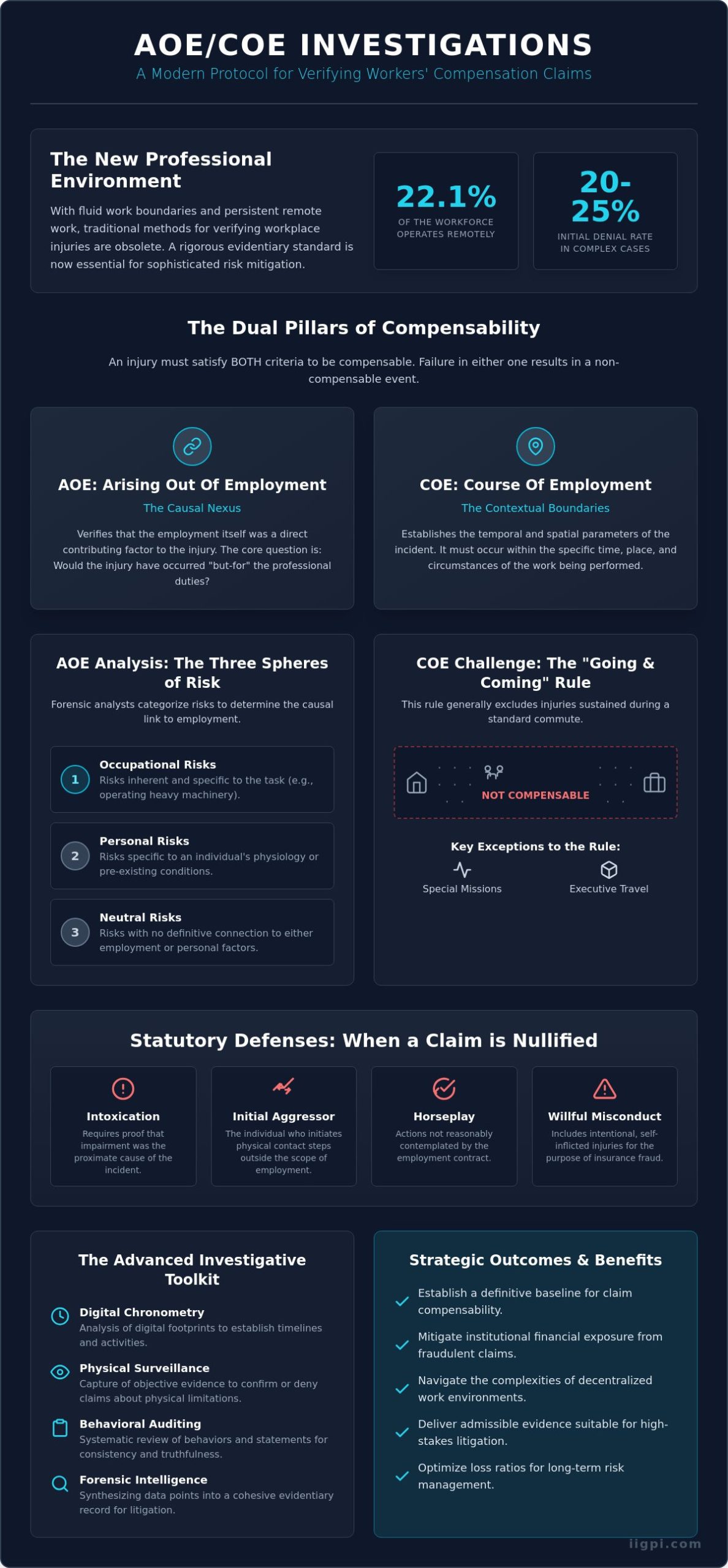
The traditional methodology for verifying workplace injuries has been rendered obsolete by the fluid boundaries of the modern professional environment; it’s no longer sufficient for the mere assertion of a claim to serve as a basis for institutional financial disbursement. As remote work rates persist at approximately 22.1% of the national workforce, the necessity for a rigorous AOE/COE investigation has transitioned from a standard procedural requirement to a critical instrument of sophisticated risk mitigation.
Industry leaders acknowledge that the escalating severity of claims, particularly within the 20-25% initial denial rate observed in complex jurisdictions like California, necessitates a more robust evidentiary standard. This discourse provides an elite investigative protocol for determining the compensability of workers’ compensation claims through the synthesis of forensic intelligence and objective analysis. We’ll examine the integration of digital chronometry, physical surveillance, and behavioral auditing to ensure the delivery of admissible evidence that facilitates a clear determination of liability and a reduction in organizational loss ratios.
Key Takeaways
- Establish a precise causal nexus between professional obligations and physical injuries to provide a definitive baseline for claim compensability.
- Identify statutory exceptions and defense strategies that serve to mitigate institutional financial exposure in contested or fraudulent workers’ compensation cases.
- Implement a multi-dimensional AOE/COE investigation to navigate the complexities of decentralized corporate environments and the nuances of the Personal Comfort Doctrine.
- Employ advanced surveillance and forensic intelligence to synthesize objective data points into a cohesive evidentiary record suitable for high-stakes litigation.
- Integrate the strategic insights of law enforcement-led investigative teams to optimize loss ratios and deliver institutional-grade intelligence for long-term risk management.
The Conceptual Framework of AOE and COE: Defining Compensability
The determination of liability within the framework of workers’ compensation rests upon a dual jurisdictional pillar that requires both the injury’s origin and its context to be inextricably linked to professional duty. Establishing compensability isn’t a matter of simple occurrence; it demands a comprehensive AOE/COE investigation to verify that an incident both arose out of and occurred within the course of employment. While these concepts are often conflated in casual discourse, they represent distinct legal hurdles that must be cleared sequentially to validate a claim. Historically, these doctrines emerged during the industrial revolution to address physical trauma from heavy machinery. They’ve since evolved into sophisticated analytical tools capable of evaluating the nuanced injuries of the modern knowledge economy, where psychological strain and cumulative trauma are increasingly prevalent. Failure to satisfy either criterion results in a non-compensable event, protecting the enterprise from assuming financial responsibility for injuries that lack a definitive occupational anchor.
The Causal Nexus: Deciphering AOE
Arising Out of Employment (AOE) focuses on the causal nexus, requiring that the employment itself be a contributing factor to the injury. Forensic analysts categorize risks into three distinct spheres: occupational risks inherent to the task, personal risks specific to the individual’s physiology, and neutral risks that lack a definitive connection to either. The “But-For” test serves as a primary diagnostic tool, asking whether the injury would’ve occurred had the employee not been engaged in their professional duties. This analysis becomes particularly complex when addressing pre-existing conditions. An authoritative AOE/COE investigation must distinguish between a condition that’s merely present and one that’s been demonstrably aggravated by workplace demands, as the latter may trigger liability while the former remains an independent medical issue.
Spatial and Temporal Boundaries: The COE Protocol
Course of Employment (COE) establishes the temporal and spatial parameters of the incident, focusing on the time, place, and circumstances of the alleged trauma. This protocol determines if the employee was actively furthering the employer’s interests at the moment of injury. A central challenge in this determination is the “Going and Coming Rule,” which generally excludes injuries sustained during a standard commute from compensability; however, modern exceptions frequently arise concerning executive travel or special missions. Professional surveillance validates the COE through the capture of objective physical evidence that confirms an individual’s presence and activity within sanctioned professional boundaries. By utilizing the elite intelligence services at International Investigative Group, organizations can ensure that the spatial limits of the workplace are respected, preventing the externalization of personal liability onto the corporate entity.
Systemic Obfuscation and Exceptions to AOE/COE Compensability
The presence of an employee within a designated workspace doesn’t provide an absolute guarantee of compensability. Statutory frameworks explicitly define exceptions that nullify claims when an individual’s conduct contradicts professional expectations or violates the established duty of care. Intoxication remains a primary defense in contested claims; however, the burden of proof typically rests on the employer to demonstrate that impairment was the proximate cause of the incident. This analysis requires more than a positive toxicology report. It demands forensic evidence of functional impairment that directly led to the trauma. Similarly, the “Initial Physical Aggressor” rule serves as a critical boundary in workplace altercations. If an individual initiates physical contact, they effectively step outside the scope of their employment, shifting liability away from the corporate entity. This principle extends to “Horseplay” and participation in voluntary recreational activities. When an injury results from actions not reasonably contemplated by the employment contract, the causal link is severed, rendering the claim non-compensable despite its occurrence on-site.
Willful Misconduct and Intentional Acts
Proving that an injury was self-inflicted for the purpose of insurance fraud requires a high evidentiary threshold and sophisticated diagnostic tools. Patterns of systemic malingering are often identified through specialized insurance fraud investigation services, which utilize forensic intelligence to expose inconsistencies in claimant testimony and medical reporting. The legal implications of committing a felony during the course of employment are equally severe. The state won’t reward illegal conduct through the workers’ compensation system, providing a robust legal basis for claim denial when an injury arises from criminal activity. These intentional acts represent a fundamental breach of the employment agreement, allowing organizations to mitigate risk through rigorous behavioral auditing.
The Deviation Doctrine: Personal Errands vs. Professional Missions
The distinction between a minor detour and a complete abandonment of employment is central to any legal analysis of AOE/COE. Under the Deviation Doctrine, an employee who pauses professional duties for a personal errand may still be covered if the deviation is insubstantial and incidental. Once an employee “abandons” their post for personal gain, corporate liability ceases. The “Dual Purpose Rule” further complicates this by acknowledging scenarios where a single trip serves both personal and professional objectives. A modern AOE/COE investigation leverages GPS and telematics data to reconstruct movement patterns with surgical precision. This ensures that the temporal and spatial boundaries of employment are objectively verified through digital metadata. For organizations facing ambiguous claims involving these exceptions, engaging an elite investigative partner is essential to secure the evidence required for successful litigation.
AOE/COE Investigations in the Era of Remote and Hybrid Work
The decentralization of the global workforce has fundamentally altered the traditional spatial boundaries of the workplace, necessitating a more rigorous approach to the AOE/COE investigation. As approximately 22.1% of the U.S. workforce continues to operate in remote capacities, the home environment has become a complex jurisdictional extension of the corporate office. This shift challenges the historical “Personal Comfort Doctrine,” which traditionally granted compensability for injuries sustained during brief deviations for personal needs, such as hydration or restroom use. Within a domestic setting, the distinction between a work-related activity and a purely personal endeavor becomes dangerously opaque. Organizations must now verify the “Professional Utility” of any activity performed at home, ensuring that the injury occurred while the employee was actively furthering the employer’s interests rather than engaging in domestic maintenance or leisure.
The perceived difficulty of investigating injuries within private residences is a common institutional objection, yet sophisticated forensic protocols have rendered this concern largely obsolete. While physical access to a claimant’s home may be restricted by privacy regulations, the synthesis of digital chronometry and behavioral auditing provides a definitive evidentiary record. An authoritative AOE/COE investigation leverages these multi-channel data points to reconstruct the incident with surgical precision, effectively bridging the intelligence gap created by decentralized operations.
Defining the Remote Workspace
Establishing the “Bunkhouse Rule” for the 21st-century remote executive involves identifying the residence as a quasi-employer-provided premises during specific operational hours. Digital activity logs serve as the primary instrument for confirming the “Course of Employment” at the moment of an alleged injury, providing a timestamped record of professional engagement. Advanced computer forensics is essential for validating remote work claims because it uncovers the metadata discrepancies and log-in inconsistencies that often precede fraudulent reporting. This forensic audit ensures that the temporal boundaries of employment are strictly enforced, even when the physical boundaries are fluid.
The Challenge of Unwitnessed Incidents
Unwitnessed incidents within the home environment pose a significant risk of systemic malingering, requiring investigators to cross-reference medical reports with digital footprints and social media activity. Neighbor canvassing and localized surveillance are deployed to verify lifestyle consistency post-injury, ensuring that the claimant’s physical capacity aligns with their reported limitations. When navigating privacy regulations during the investigation of home-based personal detective matters, the focus remains on the objective verification of work-relatedness rather than intrusive domestic oversight. This balanced approach provides the admissible evidence necessary for high-stakes insurance litigation while respecting the sanctity of the private residence.
Advanced Investigative Methodologies for AOE/COE Verification
The execution of a definitive AOE/COE investigation transcends the rudimentary administrative checklist often employed by standard insurance adjusters; it’s a sophisticated forensic discipline that demands the synthesis of multi-channel intelligence. Establishing the veracity of a claim requires a comprehensive audit that integrates human intelligence, technical surveillance, and medical-legal canvassing to identify discrepancies that surface-level inquiries miss. This methodology doesn’t merely seek to confirm an incident. It seeks to validate the entire physical and professional context of the claimant. By performing a medical-legal canvass, investigators can identify undisclosed prior injuries or concurrent treatments that may suggest a pre-existing condition rather than a new occupational trauma. The final objective is the production of a definitive compensability report that synthesizes statements, digital evidence, and physical observations into an admissible record for high-stakes litigation.
Human Intelligence (HUMINT) and Technical Surveillance
The strategic deployment of covert surveillance services is essential for identifying Activities Inconsistent with Alleged Limitations (AIWAL). This isn’t about simple observation; it’s about capturing objective evidence of physical capacity that contradicts the claimant’s subjective reports. Social media forensics plays a critical role here, as digital footprints often provide evidence of physical exertion or recreational activities during the recovery period that the claimant hasn’t disclosed. These “Sub-Rosa” investigations provide the necessary context for medical examinations, allowing Qualified Medical Examiners to evaluate the claimant based on empirical reality rather than curated testimony. To secure an institutional-grade audit of contested claims, organizations should consult with a specialist investigator to initiate a multi-dimensional AOE/COE investigation.
Background Intelligence and Financial Audits
Identifying financial motivations for claim inflation is a critical component of risk mitigation. Comprehensive background checks can reveal hidden financial pressures or a history of systemic fraud that may indicate a predisposition toward malingering. Furthermore, investigators must trace concurrent employment or undisclosed business interests that could’ve been the actual source of the injury. Utilizing elite private investigator protocols allows for the discovery of these external variables, ensuring the employer isn’t held liable for trauma sustained during non-sanctioned secondary professional engagements. This multi-dimensional approach ensures that every claim is filtered through a rigorous intelligence sieve, protecting the organization’s loss ratios and institutional integrity.
International Investigative Group: Authoritative AOE/COE Excellence
For over three decades, International Investigative Group has functioned as a premier architect of institutional security, providing elite investigative solutions that safeguard the financial interests of global corporations. The organization’s strategic advantage is rooted in its leadership, as a former law enforcement-led team brings a level of forensic precision and procedural discipline that’s essential for high-stakes insurance litigation. While many entities operate within narrow geographic silos, IIG maintains a global reach, verifying claims across international jurisdictions through a vetted network of intelligence professionals. This expansive operational capacity ensures that a rigorous AOE/COE investigation can be executed with consistent methodology, regardless of the claimant’s location. The commitment remains focused on delivering actionable intelligence that’s designed to withstand the most exacting judicial scrutiny, transforming raw data into an unassailable evidentiary record.
The IIG Investigative Advantage
The institutional strength of the organization lies in the seamless synthesis of forensic accounting, digital forensics, and elite surveillance under a single authoritative umbrella. This multi-disciplinary approach was recently exemplified in the resolution of a complex corporate fraud investigation involving a series of contested workers’ compensation claims that spanned multiple jurisdictions. By integrating behavioral auditing with technical data recovery, IIG exposed a sophisticated network of malingering that had previously evaded standard adjusters. While the firm possesses unrivaled expertise in the NYC and Nassau County markets, its global operational capabilities allow it to address risk wherever a client’s workforce is deployed. This unique positioning provides an elite intelligence bridge between local evidentiary needs and international corporate standards.
Initiating a Professional AOE/COE Protocol
The efficacy of a risk mitigation strategy is often determined by the speed of the initial response, as delayed inquiries allow for the consolidation of fraudulent narratives and the erosion of physical evidence. Immediate investigative intervention following a suspicious claim report is the most effective deterrent against systemic insurance abuse. Every AOE/COE investigation is customized to the specific risk profile of the industry and the unique dynamics of the workforce, ensuring that resources are deployed with surgical efficiency. To secure your organization’s financial integrity and establish a definitive evidentiary baseline, you’re encouraged to contact International Investigative Group to initiate a professional investigative protocol.
Strategic Resilience in Modern Claims Management
The evolution of the global workspace and the corresponding erosion of traditional spatial boundaries necessitate a sophisticated re-evaluation of how compensability is determined. Organizations that fail to implement a multi-dimensional forensic audit risk substantial financial exposure from non-occupational injuries and systemic malingering. A rigorous AOE/COE investigation is no longer a discretionary administrative function; it’s a critical instrument of institutional risk mitigation that provides the admissible evidence required to secure judicial favor.
By synthesizing technical surveillance with behavioral intelligence, enterprises can effectively distinguish between legitimate occupational trauma and fraudulent assertions. International Investigative Group offers over 30 years of elite investigative experience and former law enforcement leadership to deliver a definitive evidentiary record through our global network of specialized agents. It’s time to elevate your defensive posture and protect your organization’s financial future.
Consult with our elite investigative team to secure your AOE/COE protocols. We’re prepared to safeguard your institutional integrity with surgical precision.
Frequently Asked Questions
What is the primary difference between AOE and COE in a workers’ compensation investigation?
The primary distinction lies in the causal versus the contextual parameters of the injury. AOE, or “Arising Out of Employment,” requires a definitive causal nexus where the professional duties themselves are the proximate source of the trauma. Conversely, COE, or “Course of Employment,” establishes the temporal and spatial boundaries, ensuring the incident occurred while the individual was actively engaged in sanctioned professional activities. A successful AOE/COE investigation must satisfy both criteria to validate the claim’s compensability.
How does an AOE/COE investigation impact the outcome of a contested insurance claim?
Is an injury sustained while working from home considered compensable under AOE/COE?
Injuries sustained within a domestic environment are compensable only if the activity performed possessed a clear “Professional Utility” at the moment of the incident. The erosion of traditional spatial boundaries requires investigators to verify that the employee was furthering the employer’s interests rather than engaging in personal maintenance. This determination often relies on digital activity logs and behavioral auditing to establish whether the injury occurred within the sanctioned temporal limits of the remote workday.
What are the red flags that trigger a more thorough AOE/COE investigation?
Several indicators necessitate a more intensive AOE/COE investigation, including the late reporting of an unwitnessed injury or discrepancies between the alleged trauma and the initial medical diagnosis. Financial pressures, such as documented debt or impending layoffs, often serve as primary motivators for claim inflation. When these variables intersect with a history of systemic malingering or inconsistent claimant statements, the necessity for a comprehensive forensic audit becomes an institutional imperative to mitigate potential fraud.
Can surveillance evidence be used to deny a claim based on AOE/COE findings?
Objective surveillance evidence is a decisive tool for denying claims when it identifies Activities Inconsistent with Alleged Limitations (AIWAL). By capturing physical exertion that contradicts reported restrictions, investigators provide medical examiners and judicial bodies with empirical reality rather than curated testimony. This physical evidence serves as a robust defense in litigation, effectively severing the causal link between the alleged workplace trauma and the claimant’s actual functional capacity.
How does the “Going and Coming Rule” apply to employees with multiple work locations?
While the “Going and Coming Rule” generally excludes standard commutes from compensability, it’s frequently challenged when employees operate across multiple work sites. Travel between sanctioned professional locations is typically considered within the course of employment, as the transit itself furthers the employer’s operational interests. However, an investigation must verify that no substantial personal deviations occurred during the transit, as an unauthorized detour for personal gain would nullify corporate liability.
What role does digital forensics play in modern AOE/COE claim verification?
Digital forensics provides the chronometric data required to validate claims in decentralized or remote work environments where physical witnesses are absent. By auditing log-in logs, communication metadata, and application usage, investigators can confirm whether an individual was actively working at the precise moment of the reported injury. This forensic layer exposes the temporal discrepancies that often precede fraudulent reports, ensuring that the evidentiary record is supported by immutable digital footprints.
How long does a professional AOE/COE investigation typically take to complete?
The duration of a professional audit varies based on the complexity of the forensic requirements and the geographic distribution of the evidence. While preliminary findings may be available within a few days, a comprehensive multi-channel investigation typically requires several weeks to synthesize surveillance, background intelligence, and medical-legal canvassing. This deliberate pace ensures that the final compensability report possesses the intellectual rigor and evidentiary depth necessary to withstand intense judicial scrutiny during litigation.