
The most catastrophic failures in global mergers and acquisitions rarely stem from identifiable accounting errors; they emerge from the shadows of undisclosed reputational scandals and sophisticated fraud that standard financial reviews are structurally incapable of detecting. High-level decision-makers recognize that while standard audits provide a necessary baseline of fiscal health, they often lack the investigative depth required to identify latent risks in an increasingly complex geopolitical environment. You likely understand that the fear of undisclosed liabilities or the potential for reputational damage from unknown associations remains a primary obstacle to absolute transactional confidence. Utilizing elite corporate due diligence services allows organizations to move beyond surface-level data, ensuring that every strategic move is backed by comprehensive intelligence rather than mere disclosures.
This article explores how specialized investigative intelligence uncovers the systemic risks that standard audits miss, providing the legal and financial peace of mind essential for global operations. We’ll examine the divergence between routine financial reporting and deep-layer investigative frameworks, the critical regulatory shifts of 2026, and the methodologies required to establish a robust, defensible record of due diligence. By the conclusion of this analysis, you’ll possess a clear understanding of how to achieve total transparency and secure your organization’s most significant transactions against sophisticated global threats.
Key Takeaways
- Examine the critical distinction between standard financial audits and investigative intelligence to identify latent risks that traditional reporting structures fail to capture.
- Identify the sophisticated methodologies used to uncover undisclosed liabilities, asset shell games, and potential conflicts of interest within complex global transactions.
- Discover how elite corporate due diligence services utilize a global network of agents to provide essential local context across diverse international jurisdictions.
- Establish a defensible and comprehensive record of due diligence that provides the intellectual rigor necessary for total transactional security and legal peace of mind.
- Evaluate the institutional criteria for selecting an investigative partner capable of navigating high-stakes corporate matters with decades of specialized expertise.
The Strategic Imperative of Corporate Due Diligence in 2026
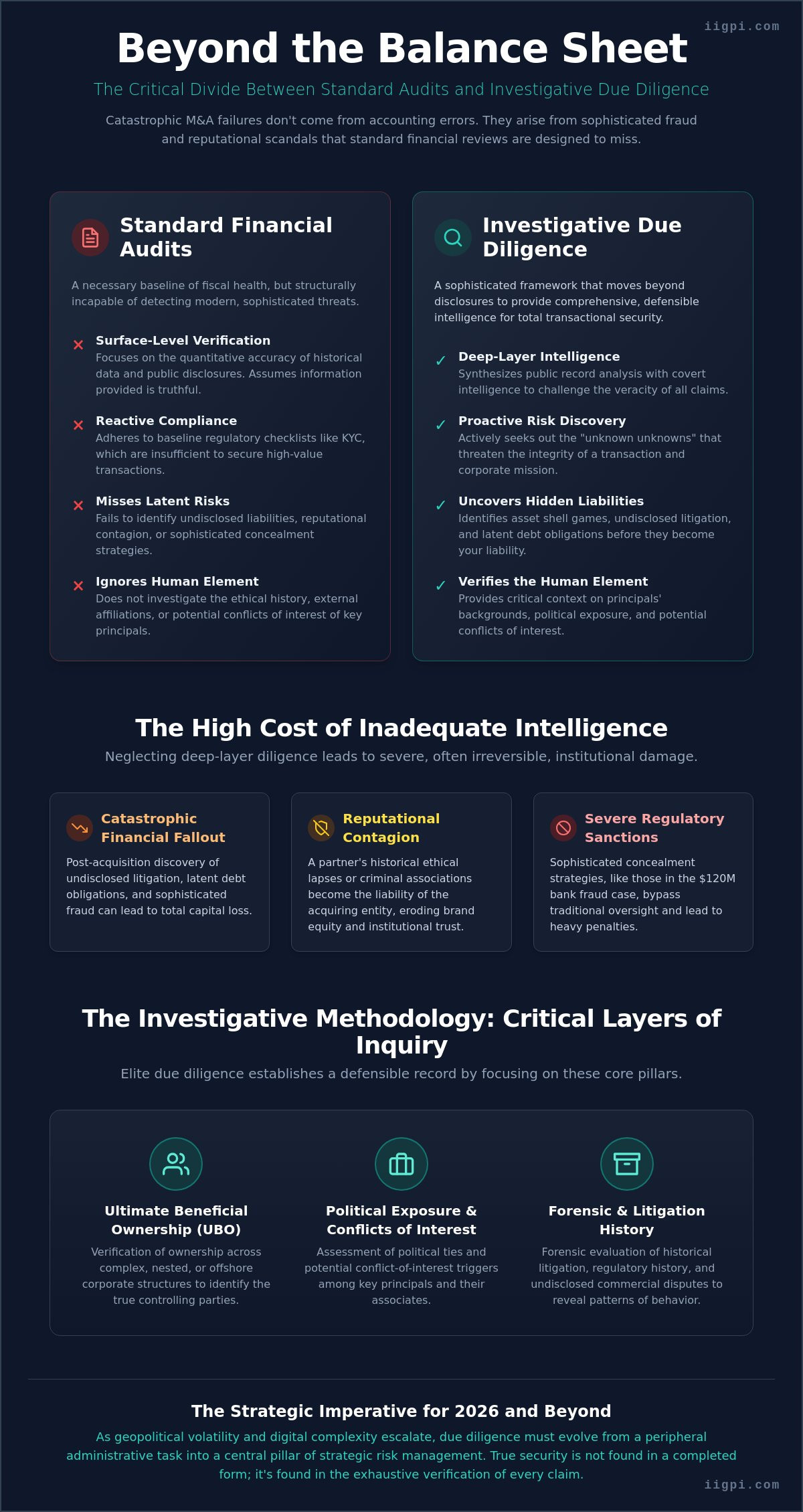
The conceptualization of due diligence has evolved from a peripheral administrative requirement into a central pillar of strategic risk management within the global marketplace. In 2026, the escalating complexity of international commerce demands that corporate due diligence services function as a sophisticated investigative framework rather than a superficial verification process. This intellectual exercise necessitates the rigorous synthesis of disparate data sets to reveal the true operational and ethical character of potential partners. It involves several critical layers of inquiry:
- The verification of ultimate beneficial ownership across nested or offshore corporate structures.
- The assessment of political exposure and potential conflict-of-interest triggers among key principals.
- The forensic evaluation of historical litigation, regulatory history, and undisclosed commercial disputes.
As geopolitical volatility and digital integration increase, the risks associated with asymmetric information have reached unprecedented levels; this makes standard administrative checks entirely insufficient for protecting high-value assets. High-level decision-makers must recognize these investigations as a fundamental component of their fiduciary stewardship. It’s the only way to ensure stakeholders remain shielded from the systemic failures that often accompany opaque or poorly vetted transactions.
The Consequences of Inadequate Pre-Transaction Intelligence
Neglecting to secure deep-layer intelligence frequently results in catastrophic financial fallout. This often manifests through undisclosed litigation or latent debt obligations that only surface after an acquisition is finalized. Beyond direct fiscal loss, the phenomenon of reputational contagion presents a more insidious threat to institutional longevity. A partner’s historical ethical lapses or criminal associations quickly become the liability of the acquiring entity, eroding brand equity and destroying hard-won institutional trust. The $120 million bank fraud investigation serves as a definitive case study in this regard. It highlights how sophisticated concealment strategies can bypass traditional oversight, leading to total capital loss and severe regulatory sanctions. Tactical intelligence prevents these scenarios by identifying the red flags that financial statements intentionally obscure.
Regulatory Compliance vs. Investigative Depth
Adherence to “Know Your Customer” (KYC) protocols provides a necessary regulatory baseline, yet these measures are rarely sufficient to ensure the success of a major merger. Compliance checklists focus on historical data and public disclosures; however, modern corporate governance requires a shift toward proactive risk discovery. Being “safe” according to a statutory checklist doesn’t mean a transaction is optimal or secure. Elite corporate due diligence services bridge this gap by employing investigative methodologies that challenge the veracity of provided documents. They seek out the “unknown unknowns” that threaten the integrity of the corporate mission. True security isn’t found in a completed form. It’s found in the exhaustive verification of every claim made by a prospective partner.
Beyond Financial Audits: The Investigative Methodology
While financial audits focus on the quantitative accuracy of balance sheets and tax filings, they frequently fail to address the qualitative risks inherent in the human and digital dimensions of a corporate entity. Elite corporate due diligence services bridge this epistemological gap by synthesizing public record analysis with covert intelligence gathering. This methodology recognizes that a business isn’t merely a collection of assets but a dynamic system influenced by the behavior of its principals and the integrity of its digital infrastructure. Verifying the human element is paramount; understanding the ethical history and external affiliations of key executives provides a layer of security that bank statements simply cannot offer. For instance, Corporate due diligence of political spending reveals how undisclosed ideological or partisan financial commitments can create significant reputational and regulatory vulnerabilities for an acquiring firm.
The Three Pillars of Investigative Diligence
The investigative framework rests upon three distinct pillars designed to provide a 360-degree view of risk. Pillar 1 involves deep-level background investigations of key executives, moving beyond basic criminal checks to analyze civil litigation, professional reputations, and historical business failures. Pillar 2 focuses on asset search and recovery protocols, which verify the actual existence and encumbrance status of reported holdings to ensure financial health isn’t an accounting illusion; this is often supplemented by independent investment performance measurement from TSG Performance to validate historical returns. Pillar 3 utilizes surveillance and field operations to confirm the physical operational status of facilities and the legitimacy of supply chain partners. This physical verification prevents the acquisition of “ghost” operations that exist only on paper.
Digital Forensics in Modern Transactional Checks
Digital vulnerabilities present some of the most complex challenges in modern transactions. Identifying prior data breaches or ongoing intellectual property theft during the diligence phase is essential for mitigating post-acquisition liability. The application of computer forensics allows investigators to uncover hidden digital liabilities, such as unauthorized data exfiltration or evidence of internal misconduct. These technical protocols provide an objective record of a firm’s digital hygiene, ensuring that intellectual property is both secure and legally owned by the target entity. Achieving this level of transparency requires a sophisticated investigative partner capable of navigating both the physical and digital realms. Engaging with experts for comprehensive corporate investigations ensures that no stone is left unturned before capital is committed.
Mitigating Latent Risks: Uncovering Hidden Liabilities
The identification of undisclosed interests and potential conflicts of interest represents a critical juncture in the provision of corporate due diligence services. While standard financial disclosures provide a superficial overview of a partner’s affiliations, they frequently fail to detect the nuanced relationships that facilitate self-dealing or the strategic diversion of corporate opportunities. Sophisticated risk mitigation necessitates tracing asset movements to detect money laundering or the financial shell games often utilized to inflate valuations or obscure insolvency. These investigations require a rigorous analytical framework capable of deconstructing complex offshore structures and nominee shareholder arrangements that exist specifically to evade traditional scrutiny.
In the high-stakes environment of global mergers and acquisitions, the physical security of information is as vital as the integrity of the data itself. The necessity of electronic bug sweeps in sensitive negotiation environments ensures that proprietary strategies and valuation models remain confidential. This proactive measure prevents information asymmetry that could be exploited by adversaries. Addressing the primary concern regarding legal admissibility, it’s imperative that every investigative method adheres to the highest standards of legal and ethical compliance. Establishing a defensible record ensures that findings can withstand the scrutiny of judicial or regulatory review, thereby providing total legal and financial peace of mind.
Asset Tracing and Financial Integrity
Locating hidden funds and undisclosed corporate holdings requires a synthesis of forensic accounting and global intelligence. This process creates a significant synergy between asset searches and corporate fraud investigations, allowing for the detection of systemic irregularities before they compromise institutional capital. Adhering to established U.S. government due diligence guidance provides a structured approach for evaluating the legitimacy of foreign entities and ensuring that all financial interactions remain within the bounds of international law. This rigorous tracing protocol identifies the origin and movement of capital, exposing potential vulnerabilities that standard audits are structurally designed to overlook.
Vetting Executive Leadership and Board Members
Verifying academic credentials and professional history with absolute precision is essential for maintaining the intellectual and ethical integrity of the board. Investigators look beyond the resume to identify past patterns of litigiousness or ethical breaches that may indicate a propensity for future misconduct. In sensitive internal vetting processes, the role of polygraph testing serves as a definitive tool for verifying the veracity of disclosures when high-level security or fiduciary responsibilities are at stake. This exhaustive vetting ensures that the leadership driving the transaction possesses the character and history required to sustain long-term organizational success.
The Global Investigative Network: Navigating Jurisdictional Complexity
Conducting corporate due diligence services across international borders presents a series of multifaceted challenges that extend far beyond the capabilities of centralized databases. While digital repositories offer a preliminary layer of data, they frequently lack the granular local context required to interpret regional business nuances or identify the subtle indicators of systemic corruption. A truly global investigative network functions as a sophisticated intelligence apparatus, bridging the gap between disparate legal frameworks and cultural standards. Navigating the labyrinth of foreign privacy laws, such as the European Union’s evolving data protection directives or regional statutes in emerging markets, necessitates a surgical approach to data acquisition that preserves investigative thoroughness without compromising legal integrity. This level of precision ensures that information is gathered in a manner that remains defensible in any global forum.
Positioning a headquarters in New York City serves as a strategic imperative for global intelligence operations. As a primary nexus of international finance and law, New York acts as a hub for the synthesis of cross-border data, allowing for the rapid deployment of resources across every major time zone. This centralized command structure ensures that information gathered from a remote jurisdiction is analyzed through a lens of global strategic significance. It provides decision-makers with a unified perspective on risk, transforming fragmented local reports into a coherent investigative framework. The ability to coordinate disparate agents through a single center of excellence remains a defining characteristic of elite investigative institutions.
Local Intelligence in Emerging Markets
In regions where public records are opaque or intentionally obscured, “boots-on-the-ground” verification becomes the only reliable method for establishing factual clarity. Local agents possess the cultural fluency and professional networks necessary to access information that remains inaccessible to outsiders. They interpret the silence between records, identifying where local business practices might diverge from Western standards of transparency. Managing the logistics of such a worldwide operation requires a rigorous command-and-control framework to ensure that every field report meets the exacting intellectual standards of high-level institutional clients. This physical presence mitigates the risk of relying on falsified or manipulated digital documentation.
The Role of Surveillance in Global Diligence
Verifying the existence and operational activity of physical assets in remote locations is a critical component of risk mitigation. Utilizing professional surveillance services allows for the physical confirmation of claims regarding production capacity, inventory levels, and logistical integrity. This on-site observation ensures consistency of reporting across diverse geographic sectors, preventing the reliance on potentially falsified documentation. It’s the ultimate check against “ghost” infrastructure or exaggerated operational claims. Organizations seeking to secure their international interests must partner with an entity capable of projecting investigative power globally. To initiate a comprehensive review of your international risk profile, contact our global investigative team to discuss your specific jurisdictional requirements.
Selecting an Elite Partner for Corporate Due Diligence Services
Selecting an elite provider for corporate due diligence services necessitates a rigorous evaluation of institutional heritage, methodological sophistication, and the capacity for global operational deployment. While many entities offer compliance-based reviews, high-level decision-makers must distinguish between firms that provide surface-level data aggregation and those that deliver deep-layer investigative intelligence. The presence of a law enforcement background among investigative principals remains a critical differentiator; this heritage ensures that every inquiry is conducted with a forensic mindset, prioritizing the collection of evidence that remains legally defensible and intellectually rigorous. This expertise is particularly vital when findings must withstand the scrutiny of hostile litigation or regulatory investigations. It’s the difference between a checklist and a comprehensive shield for your organization’s interests.
The integration of investigative findings into a broader deal strategy represents the final stage of a successful diligence framework. It’s not enough to simply identify risks; an elite partner provides the strategic context required to leverage that intelligence during negotiations. Whether the data serves as a catalyst for a valuation adjustment or a definitive signal to withdraw from a transaction, it must be actionable. Decades of specialized experience, specifically exceeding 30 years in high-stakes environments, allow for the development of advanced pattern recognition that younger firms cannot replicate. This historical perspective is essential for identifying the subtle indicators of systemic fraud that often precede catastrophic corporate failures.
The International Investigative Group Advantage
The International Investigative Group offers a legacy of investigative excellence, with over 10,000 cases solved across diverse global jurisdictions. This institutional depth allows for the provision of customized security and armed guard solutions during sensitive corporate transitions, ensuring that physical safety and information security are maintained simultaneously. Clients gain direct access to former law enforcement professionals who provide strategic counsel rooted in decades of field experience. This authoritative perspective ensures that the investigative process is not merely an administrative exercise but a vital component of the organization’s fiduciary stewardship. By combining physical security with intellectual rigor, the firm addresses the totality of corporate risk.
Initiating the Diligence Protocol
Initiating a diligence protocol for highly confidential matters requires a secure engagement process that prioritizes client anonymity and data integrity. Establishing clear objectives and timelines at the outset ensures that the investigative phase aligns with the broader transaction schedule, providing timely intelligence without compromising the depth of the inquiry. This structured approach allows for the systematic deconstruction of risk, providing the total transparency required for high-value strategic moves. To begin a confidential assessment of your investigative requirements, visit the International Investigative Group Home for an initial consultation with our senior investigative principals.
Establishing Transactional Security through Strategic Intelligence
The transition from rudimentary compliance to a robust investigative framework is essential for maintaining institutional integrity in a volatile global market. By prioritizing the synthesis of physical surveillance, digital forensics, and deep-layer background analysis, organizations can move beyond the inherent limitations of standard financial disclosures. This approach ensures that every strategic move is underpinned by a defensible record of intelligence, effectively mitigating the risks of reputational contagion and undisclosed liabilities. Utilizing elite corporate due diligence services transforms fragmented data into a coherent strategic asset, providing the total transparency required for complex, high-value transactions. It’s the definitive method for securing capital against sophisticated global threats.
Achieving this level of intellectual rigor requires a partner with the specialized expertise to navigate high-stakes environments. International Investigative Group brings over 30 years of investigative excellence to every case; our leadership by former law enforcement professionals ensures a forensic mindset is applied to every inquiry. Our global network of specialized agents provides the local context and physical verification that databases structurally omit. Secure your next transaction with elite investigative intelligence from International Investigative Group to ensure your organization’s future is built on a foundation of absolute factual clarity. Your most significant strategic initiatives deserve the protection of unparalleled expertise.
Frequently Asked Questions
What is the difference between standard due diligence and investigative due diligence?
Standard due diligence typically involves a rigorous review of disclosed financial records and public filings to confirm the accuracy of reported data. Investigative due diligence utilizes proactive intelligence gathering to identify undisclosed liabilities and behavioral risks that documents intentionally obscure. This multi-layered approach provides a more comprehensive risk profile by examining the human and operational elements that exist beyond the balance sheet.
How long does a typical corporate due diligence investigation take?
The duration of an investigation depends on the geographic scope and the complexity of the target entity. While a baseline review might be completed within 30 days, the average time for comprehensive due diligence has increased to approximately 62 days as of 2026. This timeline allows for the rigorous verification of global assets and the synthesis of intelligence across multiple international jurisdictions to ensure total transactional security.
Are the methods used by private investigators in corporate due diligence legal?
All investigative methodologies employed by professional firms must strictly adhere to the legal and ethical standards of the relevant jurisdictions. This includes compliance with privacy statutes and data protection regulations to ensure that all findings remain legally admissible in judicial or regulatory forums. Establishing a defensible record of inquiry is essential for maintaining the integrity of the broader transaction and protecting the organization from future scrutiny.
Can due diligence investigations uncover hidden offshore assets?
Professional corporate due diligence services utilize sophisticated asset tracing protocols to identify funds and holdings obscured through complex offshore structures. By leveraging a global network of agents and forensic analysis, investigators can deconstruct nominee shareholder arrangements and shell games that exist specifically to evade traditional transparency. This process is vital for detecting potential money laundering or undisclosed financial dependencies that threaten the stability of a merger.
Why should a law firm hire a private investigator for M&A due diligence?
Law firms engage private investigators to provide a layer of physical and behavioral verification that standard legal reviews often overlook. While legal counsel manages the contractual and regulatory framework, investigators uncover the latent risks associated with the personal history of principals and the actual status of physical assets. This partnership ensures that the firm’s advice is based on a complete and verified intelligence set rather than mere representations.
What industries benefit most from professional corporate due diligence services?
Industries characterized by high-value intellectual property or complex global supply chains, such as pharmaceuticals, aerospace, and financial services, derive significant benefit from these investigations. Any sector involved in cross-border mergers and acquisitions requires deep-layer intelligence to mitigate the risks of geopolitical volatility and sophisticated fraud. These services are particularly critical in emerging markets where public records may be intentionally opaque or structurally unreliable.
How does digital forensics play a role in the due diligence process?
Digital forensics identifies intellectual property theft and prior data breaches that could create significant post-acquisition liabilities for the acquiring firm. By examining the digital hygiene of a target entity, investigators uncover unauthorized data exfiltration and evidence of internal misconduct that traditional audits fail to detect. This technical inquiry ensures that the digital assets being acquired are both secure and legally owned by the prospective partner.
What information is required to begin a corporate investigation?
Initiating a comprehensive investigation requires the identification of the target entity, its key principals, and the specific geographic regions of its operations. Providing the known commercial history and the strategic objectives of the transaction allows investigators to tailor the corporate due diligence services to the most critical risk vectors. This preliminary data set serves as the foundation for a multi-layered inquiry into the ethical and financial integrity of the prospective partner.