
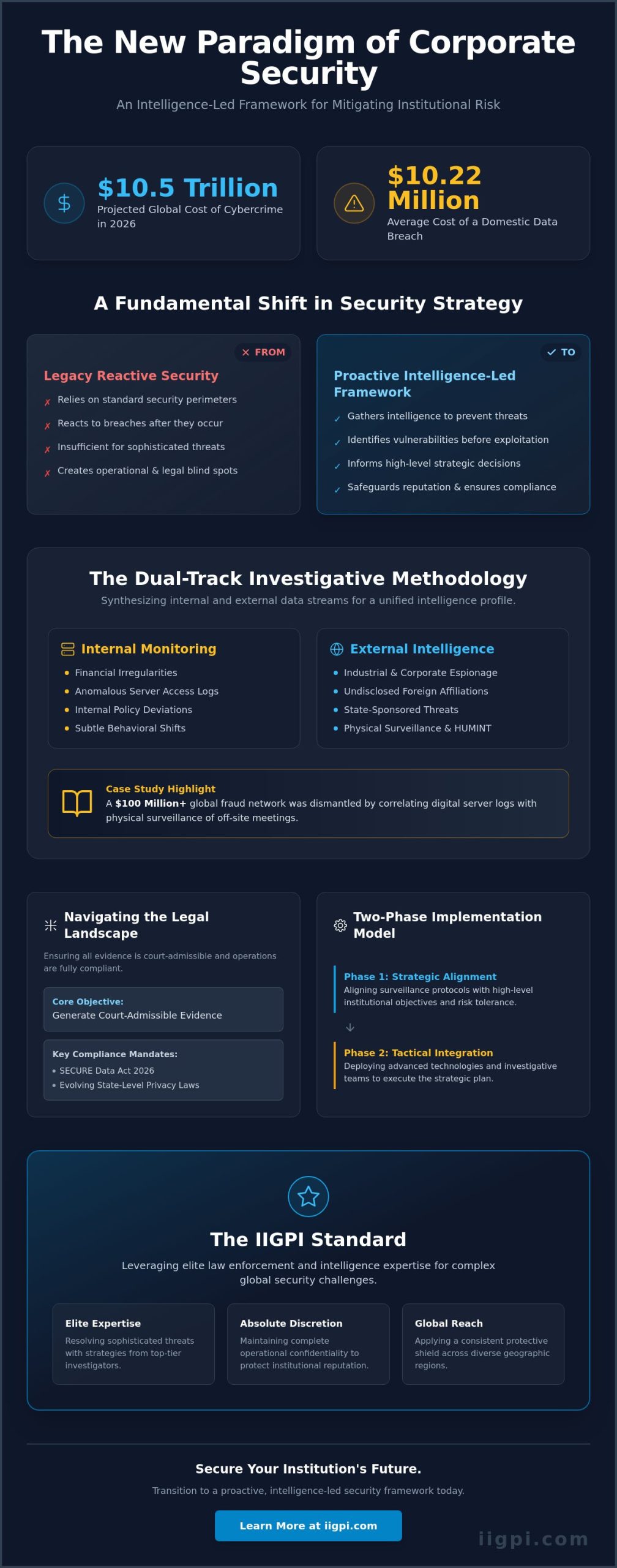
The projection that the global cost of cybercrime will exceed $10.5 trillion in 2026 necessitates a fundamental paradigm shift in how elite institutions perceive and execute internal security protocols. While many organizations continue to rely on legacy defense mechanisms, the increasingly sophisticated nature of modern corporate espionage and internal policy breaches requires a more rigorous, intelligence-led approach. You likely recognize that a standard security perimeter is insufficient when the average cost of a domestic data breach has surged to $10.22 million. This article provides an authoritative analysis of how professional corporate surveillance services function as a strategic framework for institutional risk mitigation in an era of unprecedented regulatory complexity. We will evaluate the specific methodologies required to gather court-admissible evidence while navigating the stringent requirements of the SECURE Data Act 2026 and evolving state-level privacy mandates in Indiana, Kentucky, and beyond. By examining the intersection of advanced behavioral analytics and legal compliance, this discourse offers decision-makers the insights necessary to secure absolute operational discretion and safeguard institutional reputation against multifaceted internal and external threats.
Key Takeaways
- Understand the critical evolution of institutional governance as it transitions from historically reactive security measures toward a proactive, intelligence-led framework for risk mitigation.
- Analyze the dual-track investigative methodology required to simultaneously address internal vulnerabilities, such as financial irregularities, and external threats like industrial espionage.
- Examine the technical protocols through which professional corporate surveillance services generate court-admissible evidence while maintaining rigorous compliance with the SECURE Data Act 2026.
- Evaluate the strategic two-phase implementation model that aligns high-level institutional objectives with the tactical integration of advanced surveillance technologies.
- Gain insights into the application of the IIGPI Standard, leveraging elite law enforcement expertise to resolve sophisticated global security challenges with absolute operational discretion.
The Strategic Role of Corporate Surveillance Services in Modern Risk Mitigation
Within the contemporary institutional environment, Corporate surveillance represents a multifaceted discipline that extends far beyond mere visual monitoring; it’s a systematic gathering of intelligence designed to protect the structural integrity of an organization. This discipline has undergone a significant transformation, evolving from a reactive security function into a proactive strategic asset that informs high-level decision-making. As the global cost of cybercrime is projected to exceed $10.5 trillion in 2026, the deployment of corporate surveillance services has become an essential component of comprehensive risk management. Modern methodologies now integrate traditional physical observation with the sophisticated analysis of digital footprints, creating a unified intelligence profile that identifies systemic vulnerabilities before they’re exploited by internal or external actors.
Surveillance as a Pillar of Corporate Governance
Executive leadership and boards of directors are increasingly held to rigorous standards of accountability, where the fulfillment of fiduciary duties requires granular visibility into all operational layers. Effective governance in 2026 necessitates an awareness of threats that often remain invisible to standard auditing processes, making surveillance a critical tool for verifying institutional health during high-value mergers or acquisitions. By transitioning from a legacy security mindset to a strategic risk-management framework, leaders can ensure that their oversight is based on empirical data rather than optimistic projections. This shift allows for the identification of subtle behavioral shifts or policy deviations that could signal impending reputational damage or financial loss.
The Scope of Modern Investigative Intelligence
The complexity of modern financial crime requires an investigative approach that is as sophisticated as the threats it seeks to neutralize. A comprehensive corporate fraud investigation often relies on the discrete application of corporate surveillance services to uncover hidden affiliations, undisclosed conflicts of interest, or the unauthorized transfer of intellectual property. Elite expertise is required to differentiate between standard operational friction and the calculated patterns of corporate espionage, particularly when these threats originate from sophisticated state-sponsored entities or disgruntled insiders. By leveraging an international network of investigative professionals, institutions can maintain a consistent protective shield across diverse geographic regions, ensuring that cross-border operations remain secure and compliant with local regulatory standards.
Internal Monitoring and External Intelligence: A Dual-Track Approach
Effective risk mitigation in 2026 demands a dual-track approach that synthesizes internal monitoring with external market intelligence. While siloed security models often fail to detect sophisticated institutional threats, the integration of multiple data streams ensures that risks aren’t overlooked. In one notable instance, the correlation of digital financial records with physical surveillance of key personnel revealed a global network of shell corporations used to siphon over $100 million in institutional funds. This operation began with the detection of anomalous server access logs, which served as the digital trigger for an intensive physical monitoring phase. By observing off-site meetings between high-level executives and undisclosed foreign agents, investigators gathered the empirical evidence necessary to dismantle a scheme that had bypassed traditional internal audits for years. These operations demonstrate that the most effective corporate surveillance services are those that bridge the gap between digital footprints and physical reality.
Central to this framework is the strategic application of computer forensics. Digital investigations often serve as the primary catalyst, identifying suspicious communication patterns or unauthorized data access that subsequently mandate targeted physical surveillance to confirm intent and identify co-conspirators. This synergy allows institutions to transition from broad, inefficient monitoring to high-precision intelligence gathering that focuses exclusively on verified risk indicators.
Internal Safeguards and Employee Integrity
Protecting institutional assets requires a sophisticated understanding of the legal and privacy implications associated with workplace monitoring. Institutions must implement discreet observation protocols to detect systemic theft or embezzlement without compromising the foundational trust of their workplace culture. This balance is particularly vital when utilizing insurance fraud investigation services, where surveillance provides the empirical evidence necessary to validate or refute complex claims of injury or disability. Using these methodologies ensures that financial irregularities are addressed with clinical precision, preserving the organization’s capital and reputational integrity.
Counter-Espionage and External Market Intelligence
The external dimension of corporate security focuses on the protection of proprietary technology and trade secrets from increasingly aggressive market actors. Sophisticated corporate surveillance services employ counter-espionage techniques to monitor competitor activities within strictly defined legal boundaries, ensuring that an organization’s intellectual property remains secure. Key components of this external framework include:
- Strategic monitoring of competitor development cycles and personnel acquisitions to identify potential IP theft.
- Assessment of supply chain integrity to identify unauthorized third-party access to critical logistics hubs.
- Detection and neutralization of illicit espionage attempts targeting proprietary data through electronic bug sweeps.
Securing high-level executive communications against intercept devices is a non-negotiable requirement for institutions operating in competitive global markets. Organizations seeking to fortify their external perimeter often find that engaging elite investigative professionals provides the necessary depth of intelligence to preempt espionage attempts before they result in significant data exfiltration.
Navigating the Legal Landscape: Admissibility and Privacy Compliance
The efficacy of corporate surveillance services is fundamentally dependent upon the legal admissibility of the intelligence gathered. In the high-stakes environment of institutional litigation, evidence that’s acquired through non-compliant methodologies isn’t merely useless; it’s a significant liability that can lead to severe reputational damage and legal repercussions. Elite investigative protocols must navigate a complex patchwork of global regulations, including the Spanish Constitution’s protections for personal dignity and the stringent requirements of US Federal laws. As of 2026, the regulatory environment has become even more demanding with the implementation of comprehensive data privacy laws in Indiana, Kentucky, and Rhode Island. Admissibility is the ultimate benchmark. By meticulously documenting the necessity of each investigative phase, elite firms ensure that the transition from digital computer forensics to physical monitoring satisfies the ‘least intrusive means’ test required by most modern judicial systems. This rigorous approach respects the ethical considerations of corporate surveillance while securing the empirical data necessary for court proceedings.
The Doctrine of Proportionality in Surveillance
Establishing legal justification for an investigation requires a formal pre-investigative assessment that defines the scope, duration, and objective of the operation. This doctrine of proportionality ensures that surveillance actions don’t exceed what’s strictly necessary to mitigate a verified risk. When organizations fail to provide this justification, they risk the immediate exclusion of evidence in court. Elite firms distinguish themselves by providing a clear audit trail that justifies every tactical decision, thereby protecting the institution’s fiduciary interests. It’s this distinction between elite professional surveillance services and invasive privacy violations that determines the long-term success of a risk-mitigation strategy.
Jurisdictional Expertise: From NYC to Global Markets
Navigating the specific legal requirements of New York City requires a localized expertise that few global entities possess. Licensed private investigators in New York must adhere to strict state-level oversight while simultaneously managing the implications of new federal proposals like the SECURE Data Act 2026. These challenges are compounded for organizations with international footprints. Managing cross-border investigations involves a delicate balance of respecting international data privacy regulations while fulfilling the specific discovery requirements of a domestic trial. Key jurisdictional considerations for 2026 include:
- The August 1, 2026, implementation of the California Delete Act, which necessitates specialized data handling for any organization processing consumer information.
- Compliance with the SECURE Data Act 2026, which proposes national standards for data minimization and access rights.
- Rigorous adherence to local licensing mandates that vary significantly between New York and international jurisdictions.
The involvement of former law enforcement professionals is vital in maintaining these standards. Their experience in criminal procedure and evidentiary rules ensures that corporate surveillance services are executed with the same precision as high-level government operations, providing a level of legal security that’s essential for global institutional leaders.
Establishing a Robust Corporate Surveillance Protocol
The implementation of elite corporate surveillance services requires more than tactical execution; it demands a structured, multi-phase protocol that aligns investigative actions with overarching institutional objectives. Without a rigorous framework, surveillance efforts often become fragmented, resulting in inefficient resource allocation and evidentiary gaps that fail to withstand judicial scrutiny. A robust protocol begins with Phase I: Strategic Objective Alignment and Risk Assessment, where the specific nature of the threat is analyzed to determine the necessary depth of the operation. This is followed by Phase II: Tactical Deployment and Technology Integration, where sophisticated assets are positioned to capture empirical data. Phase III involves Real-time Intelligence Analysis and Reporting, ensuring that raw observations are converted into actionable intelligence. Phase IV focuses on Legal Review and Evidence Preparation, a critical step to ensure that all findings are court-ready. Finally, Phase V concludes with the Executive Briefing and Mitigation Strategy Implementation, providing decision-makers with the clarity required to neutralize the identified risk.
The Importance of Pre-Investigative Due Diligence
Before deploying field assets, a comprehensive period of due diligence is required to ensure that the investigation remains focused and legally defensible. This preliminary phase involves defining clear investigative goals to ensure resource optimization and identifying the key digital and physical assets requiring immediate protection. By conducting preliminary background investigations, firms can narrow the surveillance scope, focusing exclusively on individuals or entities with the highest risk profile. This targeted approach minimizes the collection of extraneous data, which is essential for maintaining compliance with the data minimization requirements proposed in the SECURE Data Act 2026. Precision is non-negotiable. Organizations that skip this foundational step often find their evidence compromised by claims of overreach or lack of necessity during discovery.
Advanced Technology Integration in 2026
The technological landscape of 2026 has introduced a suite of tools that enhance the efficacy of corporate surveillance services while adhering to evolving privacy mandates. The integration of high-definition optics and long-range monitoring tools enables investigators to maintain a discrete perimeter while capturing high-fidelity evidence that remains incontrovertible during formal legal challenges. AI-driven analytics have become a standard requirement for pattern recognition within large surveillance datasets, allowing for the detection of subtle behavioral anomalies that human observers might overlook. GPS tracking and digital monitoring are utilized within strictly defined legal boundaries to provide a comprehensive view of subject activity. These technologies don’t replace human expertise; they amplify it, providing a layer of technical verification that’s vital for institutional risk mitigation. Institutions requiring a definitive investigative framework should engage our elite strategic team to initiate a formal risk assessment.
The IIGPI Standard: Elite Intelligence for Complex Global Challenges
The International Investigative Group (IIG) establishes a definitive benchmark for institutional security by leveraging over 30 years of elite investigative experience within the high-stakes environment of New York City. As a firm founded and led by former law enforcement professionals, our organization operates with a level of methodological rigor and evidentiary precision that’s absent in standard security consultancies. This heritage of public service excellence informs every aspect of our corporate surveillance services, ensuring that the transition from intelligence gathering to legal testimony is seamless and authoritative. Having successfully resolved over 10,000 cases, including the neutralization of high-value financial fraud schemes exceeding $100 million, the IIGPI Standard represents a synthesis of historical expertise and contemporary strategic analysis. Our commitment to absolute discretion and academic rigor ensures that elite decision-makers receive not just data, but the sophisticated intelligence required to safeguard institutional integrity in an era of unprecedented volatility.
A Global Network with Local NYC Expertise
Operating at the epicenter of the global financial marketplace, our organization provides a unique intersection of localized New York City expertise and a comprehensive international reach. The complexity of 2026’s multi-jurisdictional challenges necessitates a worldwide network of agents capable of executing synchronized operations across diverse geographic regions. This global infrastructure allows for the protection of high-profile assets through customized security and armed guard services, providing a physical deterrent that’s informed by real-time surveillance intelligence. Whether monitoring supply chain integrity in emerging markets or securing executive communications within Manhattan’s financial district, our agents maintain a consistent standard of professional excellence that transcends borders. This dual capacity ensures that institutional security isn’t compromised by geographic silos or fragmented communication channels.
The Intersection of Experience and Innovation
Three decades of specialized practice provide the foundational knowledge necessary to evaluate and adopt the most advanced technologies of 2026 with clinical discernment. Rather than adopting innovation for its own sake, the IIG integrates AI-driven analytics and high-definition optics only when these tools demonstrably enhance the reliability of empirical findings. This balanced approach has solidified our role as a trusted advisor to global leaders and prestigious institutions who require more than surface-level observation. By providing a strategic framework that bridges the gap between digital forensics and physical reality, we empower organizations to preempt threats before they manifest as financial or reputational crises. We invite institutional leaders to consult with the International Investigative Group for bespoke intelligence solutions that address the specific complexities of their operational environment.
Fortifying Institutional Resilience through Strategic Intelligence
The integration of sophisticated corporate surveillance services into an organization’s core risk-management framework is a prerequisite for stability in the 2026 landscape. Precision is paramount. We’ve established that the synergy between digital forensics and physical observation provides the only viable defense against $100M+ fraud schemes and complex espionage attempts. Adherence to rigorous legal standards ensures that intelligence remains a strategic asset rather than a liability during high-stakes litigation. Leveraging over 30 years of expertise and a record of resolving 10,000 global cases, the International Investigative Group offers the intellectual rigor necessary to navigate these multifaceted challenges. Our foundation in law enforcement ensures that every operation is executed with absolute discretion and precision. As institutional threats become increasingly systemic, the ability to gather court-admissible evidence while maintaining operational secrecy becomes the ultimate competitive advantage. It’s a necessity for global leaders. We encourage you to Secure Your Institutional Integrity with International Investigative Group to ensure your assets remain protected by the industry’s premier intelligence standard. Your organization’s future resilience depends on the quality of the intelligence you secure today.
Frequently Asked Questions
What defines the legality of corporate surveillance services in New York?
The legality of corporate surveillance services in New York is primarily governed by the licensure requirements of the New York State Department of State and the adherence to the doctrine of reasonable expectation of privacy. Investigators must ensure that monitoring occurs in public spaces or within the workplace where policy has clearly established a reduced expectation of privacy. Every action must be justifiable under the principles of necessity and proportionality to withstand judicial scrutiny during discovery.
Can surveillance evidence be used in high-stakes corporate litigation?
Surveillance evidence is fully admissible in high-stakes litigation if it’s gathered by licensed professionals who maintain a rigorous chain of custody and adhere to constitutional protections. The evidence must be relevant to the material facts of the case and obtained without violating wiretapping or trespassing statutes. Professional firms provide detailed investigative reports and expert testimony to authenticate the visual or digital data, ensuring it survives challenges from opposing counsel.
How do professional investigators maintain discretion during internal monitoring?
Professional investigators maintain absolute discretion by utilizing non-attributable technology and operating from a remote or concealed perimeter that doesn’t disrupt daily operations. Internal monitoring often involves the deployment of specialized equipment that blends into the corporate environment, combined with off-site data analysis. This methodology ensures that the subject remains unaware of the investigation, which is essential for preserving the integrity of the evidence and the organizational culture.
What is the difference between corporate surveillance and private espionage?
The distinction lies in legal authorization, professional licensure, and the underlying intent of the gathering activity. Professional corporate surveillance services operate within a defined legal framework to protect institutional assets and fulfill fiduciary duties; whereas, private espionage involves the illicit acquisition of trade secrets for competitive gain. Espionage lacks the transparent audit trails and legal accountability that characterize legitimate investigative protocols conducted by former law enforcement professionals.
How does computer forensics support physical surveillance operations?
Computer forensics identifies the digital anomalies, such as unauthorized data exfiltration or suspicious communication patterns, that serve as the evidentiary foundation for physical monitoring. By analyzing server logs and deleted metadata, forensic specialists can pinpoint specific times and locations where a subject’s physical actions are likely to reveal intent. This dual-track approach ensures that field investigators are deployed with high precision, maximizing the likelihood of capturing conclusive evidence.
What types of businesses require sophisticated surveillance protocols?
Sophisticated surveillance protocols are essential for institutions that manage high-value intellectual property, sensitive financial data, or critical infrastructure. This includes pharmaceutical companies, aerospace manufacturers, and global financial entities that are frequent targets of both internal fraud and state-sponsored espionage. Any business operating in a highly regulated environment or engaging in high-stakes mergers and acquisitions requires these protocols to mitigate systemic risk and fulfill executive oversight obligations.
How are cross-border surveillance operations managed for global corporations?
Cross-border operations are managed through a centralized command structure that coordinates a global network of licensed agents, each specializing in their local jurisdictional requirements. This framework ensures that data collection complies with diverse international regulations, such as specific privacy laws across Europe and Asia. By maintaining a unified investigative standard, global corporations can ensure that evidence gathered in one country remains admissible and useful within their primary legal jurisdiction.
What is the typical duration of a corporate surveillance investigation?
The duration of an investigation is determined by the complexity of the threat and the specific objectives defined during the strategic alignment phase. While a preliminary assessment might take several days, a comprehensive operation involving multiple subjects or international jurisdictions typically spans several weeks or months. The process continues until sufficient empirical data is gathered to support a definitive mitigation strategy or provide a conclusive body of evidence for legal proceedings.