
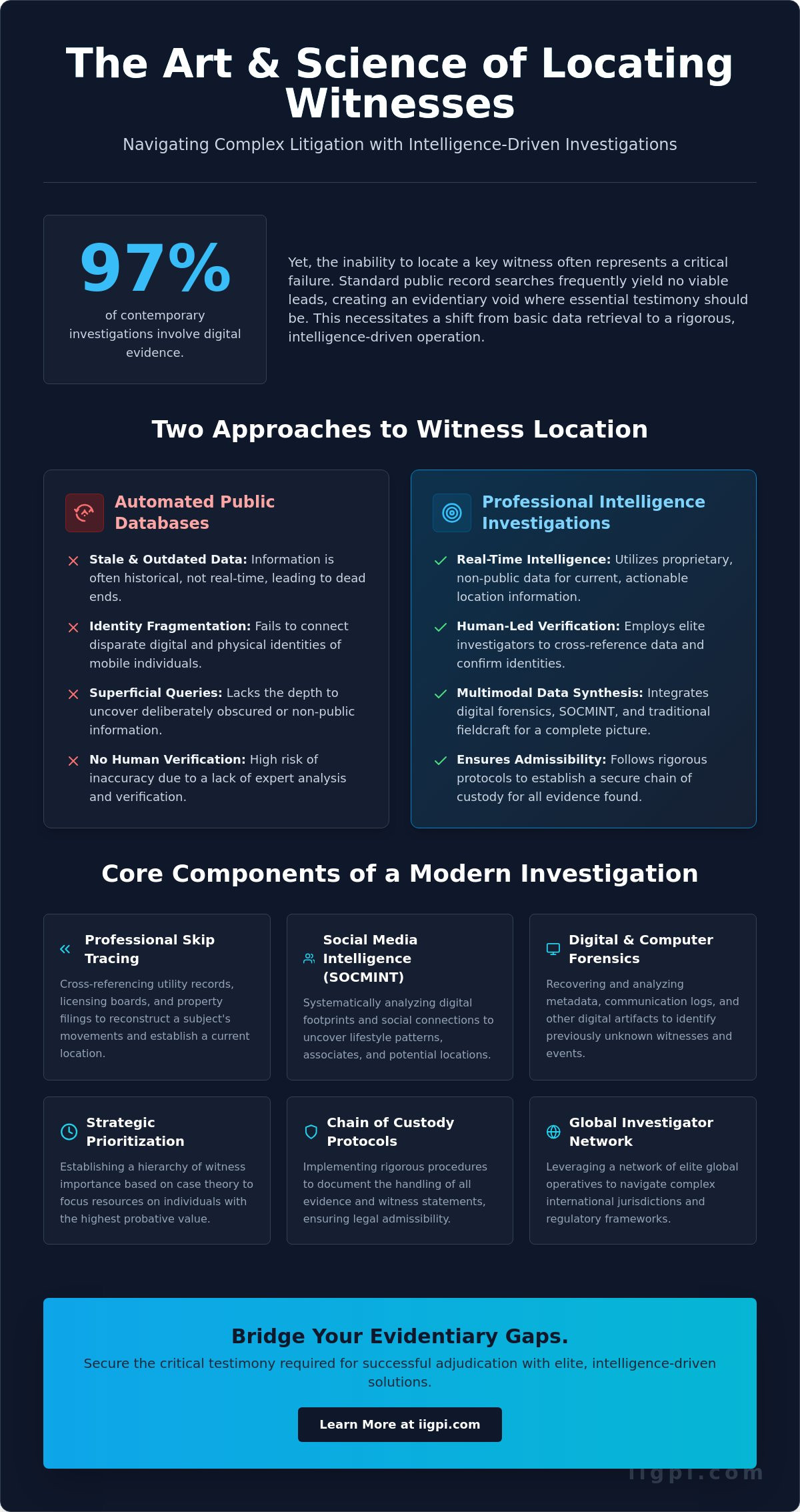
If digital evidence characterizes 97% of contemporary investigations, the inability to secure a critical witness often signifies a systemic failure in synthesizing fragmented data into actionable intelligence. It’s likely you’ve experienced the professional frustration that occurs when standard public record searches yield no viable leads, leaving a void where essential testimony should exist. The sophisticated process of locating witnesses for a lawsuit necessitates a transition from basic data retrieval to a rigorous, intelligence-driven operation that accounts for modern obfuscation techniques and the evolving complexities of global data privacy.
This authoritative analysis examines the strategic frameworks and professional methodologies essential for identifying, locating, and securing elusive witnesses within complex litigation environments. You’ll gain a deeper understanding of the inherent limitations of open-source data and the necessity of elite investigative support to ensure the legal admissibility of found evidence. We’ll evaluate how multimodal location data and digital forensics serve as the foundation for modern skip tracing protocols, providing a clear trajectory for counsel seeking to bridge critical evidentiary gaps. By integrating advanced digital footprints with traditional fieldcraft, legal teams can effectively navigate the challenges of unlocatable witnesses and secure the testimony required for successful adjudication.
Key Takeaways
- Understand the critical correlation between witness availability and favorable litigation outcomes through the lens of strategic intelligence and systemic analysis.
- Master the integration of professional skip tracing and Social Media Intelligence (SOCMINT) as the primary methodologies for locating witnesses for a lawsuit in an increasingly mobile global society.
- Evaluate the inherent deficiencies of automated public record databases and the necessity of human-led verification to mitigate the risks associated with stale data and identity fragmentation.
- Internalize the rigorous procedural protocols required to establish a secure chain of custody and ensure the legal admissibility of witness statements upon successful location.
- Recognize the strategic advantage of leveraging an elite, global network of investigators to navigate the complex jurisdictional and regulatory frameworks of international witness location.
The Strategic Imperative of Witness Location in Complex Litigation
The strategic efficacy of any legal proceeding often hinges upon the availability of credible testimony. In complex litigation, the process of locating witnesses for a lawsuit is not merely an administrative prerequisite; it’s a foundational pillar of case theory. The correlation between the presence of a witness and a favorable outcome is documented across various jurisdictional studies, as oral testimony provides the human context that documentary evidence often lacks. In our hyper-mobile global society, individuals frequently transition across borders and digital ecosystems, creating systemic challenges for counsel attempting to secure vital statements. This mobility often results in a fragmentation of identity that basic skip tracing cannot resolve.
Establishing the identity of fact witnesses who possess direct knowledge of events, character witnesses who provide contextual background, and expert witnesses who offer specialized analysis is a prerequisite for successful adjudication. Understanding the material witness statute is essential when testimony is deemed critical enough to warrant judicial intervention to ensure attendance. Early identification during the discovery phase ensures trial readiness is maintained and prevents the degradation of memory or the deliberate evasion of service. Proactive identification allows legal teams to anticipate defense strategies and reinforce their own evidentiary positions before the trial clock begins to dwindle.
The Role of Testimony in Establishing Probative Value
Witness statements serve as the connective tissue between disparate pieces of documentary evidence, synthesizing a coherent factual narrative that resonates with the trier of fact. When a key witness is unlocatable, the burden of proof in civil litigation can become an insurmountable hurdle, particularly in cases involving complex corporate structures or opaque financial transactions. Securing early affidavits provides a strategic advantage by locking in testimony before external influences or the passage of time can alter a witness’s recollection. This preservation of testimony is vital for maintaining the integrity of the case’s core arguments.
Identifying Potential Witnesses Through Initial Discovery
The identification process begins with a meticulous review of corporate records, meeting minutes, and internal communication logs. Advanced Computer Forensics allows investigators to uncover digital footprints and metadata that reveal the involvement of previously unknown parties. By establishing a hierarchy of witness importance based on the central case theory, legal teams can prioritize resources on locating witnesses for a lawsuit who offer the highest probative value. This systematic approach ensures investigative efforts are concentrated on individuals whose testimony will most significantly influence the judicial outcome, rather than wasting resources on peripheral figures.
Advanced Methodologies for Locating Elusive Witnesses
The evolution of investigative protocols has rendered traditional, superficial database queries insufficient for locating witnesses for a lawsuit when subjects are intentionally elusive or highly mobile. Modern methodology requires a sophisticated synthesis of disparate data points derived from non-public, proprietary sources that operate outside the reach of standard search engines. While standard public records provide a historical snapshot, professional skip tracing utilizes real-time location intelligence to establish a subject’s current physical presence with a high degree of certainty. This rigorous process involves cross-referencing utility records, professional licensing boards, and recent property filings to identify anomalies in a subject’s reported movements. The objective is to reconstruct a subject’s life with enough detail that their current location becomes a logical certainty rather than a statistical probability.
Proprietary Skip Tracing and Database Analysis
Elite investigative protocols prioritize credit-header data over standard public records because financial activity often predates official government updates by months. By analyzing historical address patterns, investigators can employ predictive modeling to determine where an individual is likely to re-establish residency based on past behaviors. When a primary target remains obscured, tracing ‘associates’ and second-degree relatives serves as a secondary intelligence path. This lateral approach exploits the social and economic dependencies that even highly mobile individuals cannot entirely sever, providing a roadmap through the subject’s immediate circle.
Digital Footprint Analysis and SOCMINT
Social Media Intelligence (SOCMINT) has transitioned from a supporting tool to a central pillar of location data in contemporary litigation. In 2026, approximately 68% of digital forensics professionals report utilizing AI-driven analysis to scan vast datasets for geo-tagged metadata hidden within social media uploads. These digital behaviors, when monitored over a specific duration, reveal highly consistent daily routines and specific physical locations. It’s essential that these techniques operate within established legal and ethical frameworks to ensure that the resulting intelligence remains admissible during the discovery phase. This digital tracking, when combined with traditional fieldcraft, creates a comprehensive profile of the subject’s current environment.
The integration of field surveillance with digital tracking ensures that virtual leads are verified through direct physical observation. This multimodal approach mitigates the risk of identity fragmentation and data staleness that often plagues less rigorous investigations. For counsel managing high-stakes litigation, engaging a partner like the International Investigative Group provides access to these advanced investigative frameworks. Such expertise is vital for maintaining the integrity of the evidentiary chain while navigating the complexities of modern witness location in a globalized society.
Evaluating the Efficacy of Professional Investigations vs. Public Record Databases
The reliance on automated data retrieval systems represents a significant vulnerability in the process of locating witnesses for a lawsuit. While digital platforms offer the veneer of efficiency, they often suffer from inherent structural flaws, such as stale records and identity fragmentation. Data accuracy for low-tier skip tracing services in 2026 frequently falls below 60%, a margin of error that’s unacceptable in high-stakes litigation where the burden of proof is paramount. Professional investigations differ fundamentally from simple data retrieval by prioritizing verification over mere acquisition. Seeing a name on a digital dashboard doesn’t constitute proof of residency; it merely provides a lead that requires rigorous validation through human intelligence (HUMINT) and physical confirmation.
The human intelligence factor involves sophisticated interviewing techniques with neighbors, former colleagues, and business associates to triangulate a subject’s current environment. This methodology requires a delicate balance of inquiry and discretion to mitigate the risk of alerting the witness to the ongoing investigation. If a witness becomes aware they’re being sought for testimony, they may take active measures to further obscure their location or alter their narrative. Successful investigative protocols emphasize a silent approach, ensuring that the target remains unaware of the scrutiny until the moment of formal service or contact. This strategic concealment is vital for maintaining the element of surprise and ensuring the witness doesn’t evade their legal obligations.
The Limitations of Automated Data Retrieval
Free or low-cost public record databases are frequently plagued by misspellings, outdated residential histories, and the presence of homonyms that lead to false positives. Because these systems often rely on batch processing of government filings, the data provided is typically six to twelve months old by the time it reaches the end user. Relying on such unverified information for the legal service of process can lead to significant procedural setbacks and increased litigation costs. In an era where 97% of investigations involve digital evidence, the failure to reconcile this data with current physical reality undermines the entire evidentiary framework of a case.
The Value of Field Verification and Surveillance
Confirming physical residency through Professional Surveillance Services remains the only definitive method for ensuring a witness is the specific individual required for the litigation. In high-net-worth or sensitive corporate cases, discrete inquiries must be handled with extreme care to maintain the integrity of the investigation. Field verification allows investigators to observe daily routines and physical characteristics, ensuring that the individual located matches the profile established during the initial discovery phase. This physical confirmation bridges the gap between digital theory and judicial reality, providing counsel with the certainty needed to proceed with confidence.
Protocols for Ensuring the Admissibility and Reliability of Witness Testimony
The transition from the successful identification of a subject to the procurement of admissible testimony represents the most precarious phase of the investigative lifecycle. Locating witnesses for a lawsuit is merely the preliminary objective; the ultimate success of the operation is measured by the witness’s willingness to provide a statement that survives rigorous judicial scrutiny. Establishing a definitive chain of custody for all witness statements and evidence is essential to preclude challenges regarding coercion or tampering. This requires that every interaction, from the initial contact to the final signature on an affidavit, is meticulously documented to provide a transparent audit trail for the court. Professional investigators must balance the need for detailed information with a level of professionalism that preserves the witness’s credibility as a neutral party.
Securing affidavits that withstand cross-examination involves more than just recording facts; it requires a deep understanding of the Federal Rules of Evidence. As of December 1, 2026, an amendment to Federal Rule of Evidence 801 expands the “not hearsay” framework, allowing certain prior inconsistent statements to be admissible as substantive evidence if they were made under oath. This regulatory shift underscores the importance of securing formal, sworn statements at the earliest possible opportunity. By locking in testimony under oath, legal teams protect the case against future witness vacillation or memory degradation. This proactive approach ensures that the strategic intelligence gathered during the location phase translates into a tangible courtroom advantage.
Legal Standards for Witness Contact and Service
Adherence to the Fair Debt Collection Practices Act (FDCPA) and relevant privacy statutes is mandatory during the skip tracing process to ensure that the methods used don’t compromise the litigation. Best practices for process serving in hostile or evasive environments necessitate a combination of tactical patience and legal precision to ensure service is deemed valid. Documenting every step of the location process is critical for court verification, particularly when a witness attempts to contest the legality of the contact. This documentation serves as a shield against allegations of harassment, protecting both the investigator and the counsel of record from potential sanctions.
Securing Cooperation from Reluctant Witnesses
Securing cooperation requires a sophisticated psychological approach that focuses on building rapport and identifying the witness’s underlying motivations. When managing a hostile witness, investigators must be prepared to transition to formal subpoenas and depositions to compel the necessary information. Ensuring the reliability of the witness is achieved through thorough Background Investigations, which identify potential biases or credibility issues before they’re exposed by opposing counsel. For legal departments requiring the highest tier of investigative integrity, the International Investigative Group provides the specialized expertise necessary to navigate these complex interpersonal and legal dynamics.
International Investigative Group: Elite Solutions for Global Witness Location
International Investigative Group represents the synthesis of thirty years of institutional knowledge and advanced fieldcraft. Our organization operates as a premier entity in the specialized field of locating witnesses for a lawsuit, particularly within the context of multi-jurisdictional litigation where standard methodologies often fail. By leveraging an expansive global network of agents, we bridge the gap between regional socioeconomic dynamics and international legal requirements, ensuring that no witness remains unlocatable due to geographic distance or jurisdictional complexity. Our operational philosophy is rooted in the expertise of former law enforcement professionals who bring a tactical perspective to witness location that automated systems simply can’t replicate.
We provide tailored investigative strategies for a diverse array of legal challenges, including complex insurance claims and high-stakes Corporate Fraud Investigation. This specialized focus allows us to navigate the unique regulatory and social frameworks that define different global sectors, providing counsel with a distinct evidentiary advantage. Our commitment to maintaining an elite standard of service ensures that every investigation is conducted with the utmost discretion and intellectual rigor. It’s this level of professional depth that distinguishes our work in the eyes of high-level decision-makers and global legal leaders.
A Proven Track Record in High-Value Litigation
Our history is defined by successful outcomes in multi-million dollar fraud cases where the location of key individuals was the decisive factor in the final judicial result. We maintain an unwavering commitment to legal compliance, ensuring that all intelligence gathered is admissible and ethically sourced within the relevant jurisdiction. By integrating Computer Forensics with traditional field operations, we provide a 360-degree view of a subject’s environment, leaving no digital or physical lead unexamined. This multimodal approach ensures that the testimony we secure is both reliable and robust under cross-examination.
Initiating Your Witness Location Operation
The engagement begins with a comprehensive consultation designed to define specific objectives and assess the inherent complexities of the case. We provide customized reporting and real-time intelligence updates, allowing legal counsel to maintain a proactive stance throughout the litigation lifecycle. For those seeking the highest level of investigative support, contacting our NYC-based experts is the first step toward securing the critical testimony your case requires. Our team’s ability to navigate the process of locating witnesses for a lawsuit ensures that your legal strategy remains evidence-driven and strategically sound.
Strengthening Evidentiary Foundations Through Strategic Intelligence
The successful adjudication of complex litigation necessitates a transition from passive data retrieval to an active, intelligence-driven framework. By prioritizing human verification and sophisticated digital forensics over the inherent limitations of stale, automated databases, legal departments can effectively navigate the systemic challenges of a mobile society. The objective of locating witnesses for a lawsuit is only fully realized when the resulting testimony is secured within a rigorous chain of custody that withstands the most demanding judicial scrutiny. This intellectual rigor ensures that every lead is validated and every statement is legally robust.
International Investigative Group brings over 30 years of investigative excellence to this critical function, operating as a research-driven entity led by former law enforcement professionals. With a global network that has successfully resolved over 10,000 cases, our organization provides the intellectual depth and tactical expertise required to bridge evidentiary gaps across international borders. Consult with our elite investigative team to locate your critical witnesses today. Securing the testimony your case requires is a matter of strategic precision and institutional experience. We’re prepared to assist you in achieving the definitive results your litigation demands.
Frequently Asked Questions
What is skip tracing, and how does it assist in locating witnesses for a lawsuit?
Skip tracing is a methodological framework involving the aggregation and analysis of disparate data points to identify an individual’s current physical location. It assists in locating witnesses for a lawsuit by synthesizing historical residential records, credit-header information, and utility filings to overcome systemic identity fragmentation. This process transforms raw data into actionable intelligence, allowing legal teams to bridge critical evidentiary gaps that basic searches cannot address.
Can a private investigator find a witness who is intentionally hiding?
Professional investigators utilize advanced intelligence-driven protocols to uncover individuals who’ve taken active measures to obscure their physical presence. These methodologies exploit the social, financial, and digital dependencies that even highly mobile subjects can’t entirely sever. By reconstructing a subject’s current routines through lateral intelligence paths and associate tracing, investigators can locate individuals who are actively evading judicial scrutiny.
Is it legal to use social media to locate a witness for a legal matter?
Utilizing Social Media Intelligence (SOCMINT) is a legally permissible investigative practice when the methodology adheres to established privacy statutes and ethical frameworks. Investigators analyze geo-tagged metadata and digital activity patterns to determine physical locations while ensuring that the resulting evidence remains admissible within the relevant jurisdictional discovery protocols. This digital tracking must be conducted without violating the terms of service of the respective platforms or infringing on protected privacy rights.
What information do I need to provide to a private investigator to find a witness?
Effective witness location requires a comprehensive dossier including full legal identifiers, historical residential data, known professional affiliations, and relevant social or familial connections. Providing fragmented digital footprints or specific case-related documentation allows the investigative team to establish a more accurate hierarchy of importance and predictive modeling for the subject’s whereabouts. The more granular the initial data, the more efficiently the investigator can navigate complex global databases.
How long does it typically take to locate a missing witness in a civil case?
The duration of an investigation is contingent upon the complexity of the subject’s obfuscation techniques and the geographic scope of the search. While basic database queries may yield results rapidly, sophisticated cases requiring field verification and cross-border data analysis often necessitate a more deliberate, multi-week timeline. This measured pace ensures the accuracy and reliability of the location data, which is essential for maintaining the integrity of the litigation.
What happens if a located witness refuses to cooperate with the lawsuit?
When a witness exhibits hostility or refusal to engage, legal counsel may transition to formal judicial mechanisms, such as subpoenas or depositions, to compel testimony. Professional investigators facilitate this transition by providing the precise location data required for the valid service of process. This ensures that the witness’s legal obligations are formally established even in the absence of voluntary cooperation, preserving the case’s factual narrative.
How does a professional investigator verify that they have found the correct person?
Verification is achieved through a multimodal approach that synthesizes digital identifiers with direct physical observation or surveillance. This process mitigates the risks associated with homonyms or stale records by confirming that the individual’s current environment and physical characteristics align with the established profile. Such rigorous validation is necessary to prevent the legal and financial repercussions of serving the incorrect party during the process of locating witnesses for a lawsuit.
Are the methods used by private investigators to find witnesses admissible in court?
Investigative methodologies are admissible provided they comply with relevant privacy laws, the Fair Debt Collection Practices Act (FDCPA), and the Federal Rules of Evidence. Maintaining a meticulous chain of custody and documenting every procedural step ensures that the location process survives rigorous judicial scrutiny. When conducted by elite professionals, these methods provide a transparent audit trail that reinforces the credibility and reliability of the resulting testimony.