
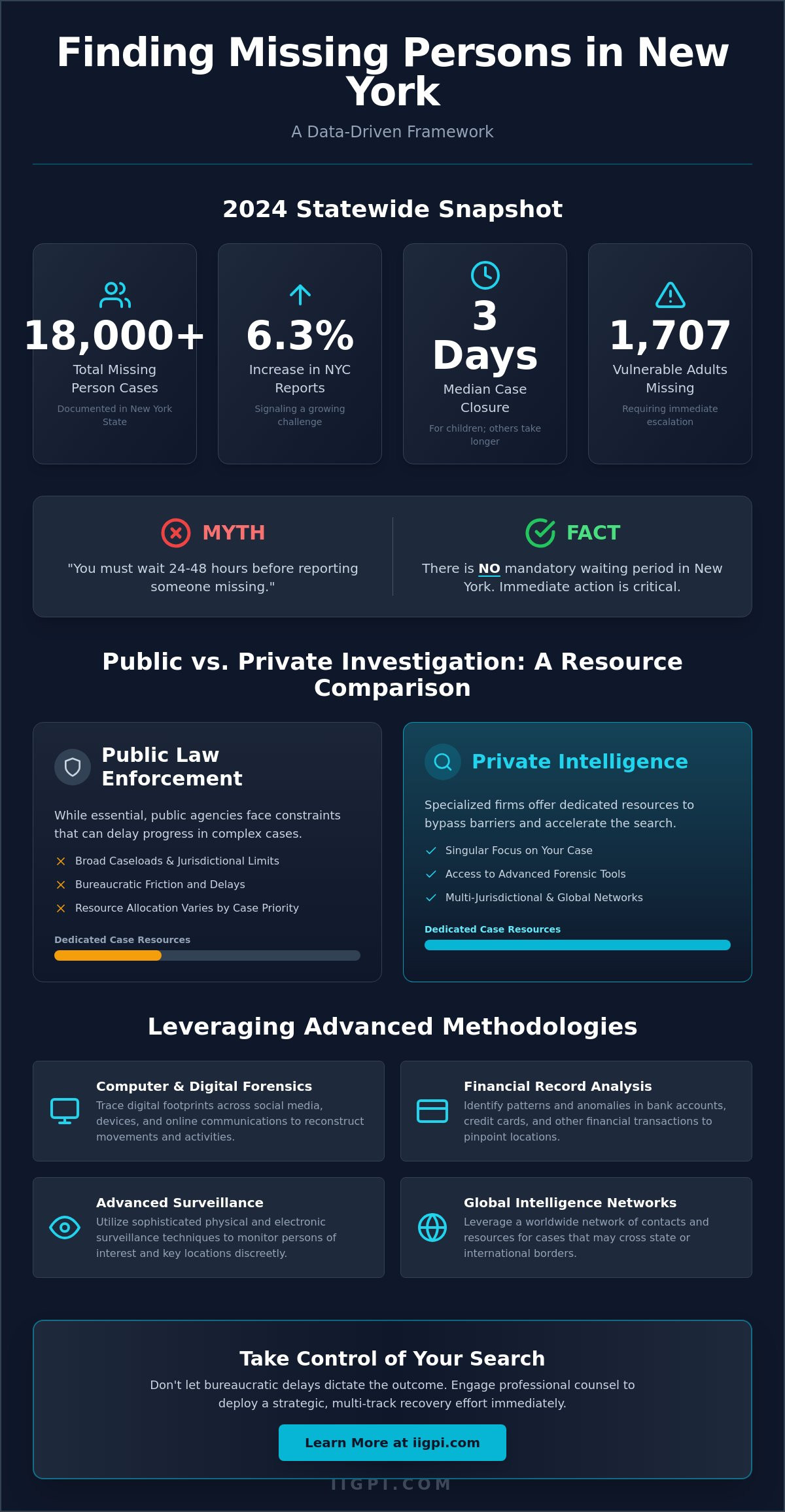
In 2024, New York State documented over 18,000 missing persons cases, a statistic that highlights a systemic challenge within the intricate urban architecture of the metropolitan area. While institutional data suggests a median closure rate of three days for certain demographics, the 6.3% rise in reports specifically within New York City signals a growing need for sophisticated, multi-track recovery strategies. You’ve likely encountered the reality that finding a missing person in New York involves navigating a labyrinth of jurisdictional delays and resource limitations. Bureaucratic friction shouldn’t dictate the outcome of a search. This guide serves as a definitive academic and practical framework for 2026, offering a rigorous examination of the legal and digital methodologies essential for successful location efforts.
We’ll analyze the evolving legislative environment, including the critical mandates of Destini Smothers’ Law, while distinguishing between the procedural constraints of law enforcement and the specialized capabilities of private intelligence. This article details a strategic roadmap for identifying credible investigative partners and leveraging advanced forensic tools to bypass traditional bureaucratic barriers. Success requires a dual-track approach. By the conclusion, you’ll possess a comprehensive understanding of the modern investigative protocols required to secure a resolution in one of the world’s most complex environments.
Key Takeaways
- Identifying the socio-geographic variables and legal criteria within the New York metropolitan area is critical for constructing a viable investigative framework.
- The guide provides clarity on statutory reporting protocols and the specific functions of state-level bureaus, effectively dispelling prevalent myths regarding mandatory waiting periods for finding a missing person in New York.
- A rigorous comparison is established between public law enforcement objectives and the high-level resource dedication offered by private surveillance and intelligence networks.
- The analysis details the application of specialized methodologies, such as computer forensics and financial record analysis, to trace movements across complex urban and digital landscapes.
- The framework outlines essential criteria for engaging professional investigative counsel, emphasizing the necessity of institutional expertise and a proven history of managing multi-jurisdictional cases.
Navigating the Complexity of Missing Person Cases in the New York Metropolitan Area
The pursuit of finding a missing person in New York requires an analytical understanding of the legal and environmental variables unique to this jurisdiction. Within the New York legal landscape, a missing person is not merely an individual whose whereabouts are unknown; the designation triggers specific statutory obligations once a credible risk to the subject’s safety is established. This framework operates within the global context of missing person cases, where disappearances are categorized along a spectrum of voluntary absence, involuntary abduction, or suspicious circumstances. Data from 2024 indicates that while 12,114 children were reported missing in New York State, New York City itself saw a 6.3% increase in cases. This discrepancy underscores the necessity of immediate investigative action. While the median time to case closure for children was three days in 2024, cases that exceed this window often face diminishing returns without specialized intervention. The first 48 hours serve as a critical window before digital and physical trails begin to dissipate within the city’s dense infrastructure.
The Urban Disappearance: Why NYC Presents Unique Challenges
The New York metropolitan area’s socio-geographic density facilitates a level of anonymity that complicates traditional recovery efforts. High-density transit hubs, such as Penn Station and the Port Authority Bus Terminal, act as nodes of extreme mobility. They allow an individual to transition across state lines or deep into the subterranean transit system within minutes. While Manhattan maintains a high degree of surveillance saturation, the interplay between municipal monitoring and strict privacy regulations often creates data silos. These silos impede real-time tracking and forensic reconstruction. Effective investigations must navigate the jurisdictional overlaps between the NYPD, the New York State Police, and transit authorities. Each entity maintains distinct databases and operational protocols that require specialized navigation. The logistical complexity inherent in finding a missing person in New York is exacerbated by the sheer volume of daily commuters and tourists who further obscure individual movements.
Initial Protocols: Determining the Nature of the Disappearance
Establishing the nature of a disappearance is the primary objective of any professional inquiry. It’s essential to differentiate between a “missing person” and a “wanted individual” according to New York State Police standards. The latter involves active criminal warrants that shift the investigative priority toward apprehension rather than recovery. Investigators prioritize cases based on “foul play” indicators, such as evidence of a struggle or the sudden cessation of financial activity. Vulnerability assessments remain paramount to the strategic framework. For instance, the 1,707 adults classified as “vulnerable” in 2024 due to cognitive impairments require immediate escalation. Strategic intervention by entities like IIG focuses on these high-risk variables to bypass the bureaucratic delays often inherent in public sector responses. Time doesn’t work in favor of the investigator, making the initial classification a decisive factor in the eventual resolution of the case.
Understanding the Regulatory and Law Enforcement Protocols in New York State
The institutional framework for finding a missing person in New York is anchored by a hierarchical system of municipal and state agencies, each governed by specific statutory mandates. Primary responsibility often rests with the NYPD Missing Persons Squad or the New York State Bureau of Criminal Investigation, depending on the jurisdiction and the nature of the disappearance. It’s imperative to dispel the pervasive “24-hour wait” myth; New York law requires law enforcement agencies to accept reports immediately without any mandatory waiting period. This prompt reporting is essential for the integration of data into the National Crime Information Center (NCIC) and the National Missing and Unidentified Persons System (NamUs). These national databases facilitate cross-jurisdictional cooperation, which is a critical component of the investigative process. While these public agencies provide a foundational service, their operational focus is often restricted to cases involving clear evidence of criminal abduction or immediate physical danger.
The efficacy of the public response is further modulated by the New York State Missing Persons Clearinghouse, which manages the dissemination of information and coordinates with the NYS Police. However, systemic limitations often arise in cases involving “voluntary” adult disappearances or non-criminal scenarios where the subject is not classified as a “vulnerable adult.” In these instances, police resources are frequently diverted to high-priority criminal files, leaving families to navigate a complex bureaucratic landscape with minimal institutional support. While these agencies provide essential services, the strategic deployment of specialized personal investigations can bridge the gap where public resources meet their statutory and administrative limits.
The NYPD Missing Persons Squad: Operational Realities
The NYPD triages thousands of annual reports by categorizing subjects based on perceived risk levels. This process determines the issuance of Silver Alerts for cognitively impaired adults or Amber Alerts for abducted minors. Given the sheer volume of cases in a metropolis of over eight million residents, resource allocation is strictly prioritized. This often results in a focus on immediate recovery rather than the long-term, exhaustive surveillance required for complex disappearances where no crime is immediately evident.
Bureaucratic Hurdles in Public Investigations
Public investigations are frequently constrained by the legal threshold of “probable cause,” which limits the ability of police to conduct searches or access private digital records without evidence of a crime. Administrative backlogs further exacerbate delays in non-urgent files, often leading to cases being classified as “inactive” if the subject is an adult who appears to have departed voluntarily. This legal reality underscores the distinction between the state’s interest in public safety and a family’s need for a comprehensive, dedicated search effort.
Strategic Differentiation: The Limitations of Public Resources vs. Private Intelligence
The pursuit of finding a missing person in New York necessitates an understanding of the divergent operational mandates between municipal law enforcement and private intelligence entities. While public agencies are governed by the doctrine of public safety and the prioritization of criminal justice, private firms operate under a client-centric model that allows for an exhaustive allocation of resources. Law enforcement must triage cases based on the immediate threat to the community, often resulting in the suspension of active investigation once a disappearance is deemed voluntary or non-criminal. In contrast, private intelligence frameworks provide a dedicated continuity of effort that isn’t contingent on the existence of a crime. This specialization is particularly relevant when navigating the intricate privacy laws of New York State, as private firms utilize sophisticated legal pathways to obtain intelligence that may fall outside the immediate scope of a police search warrant.
Success in complex cases often stems from the integration of former law enforcement expertise into private sector methodologies. This synthesis allows for a high level of institutional knowledge while bypassing the administrative backlogs that frequently paralyze public investigations. Private investigators possess the latitude to conduct 24/7 surveillance and deep-dive forensic reconstructions without the jurisdictional constraints that limit local precincts. By leveraging global intelligence networks and advanced technology, these professionals offer a level of scrutiny that public resources, however well-intentioned, simply cannot sustain over prolonged periods.
Comparative Analysis: Police vs. Private Investigative Firms
The fundamental distinction lies in the scope of work. Public safety officers are tasked with maintaining order within a broad demographic, whereas a private firm focuses on the specific intelligence requirements of the client. The Modern Personal Detective serves as a critical bridge in this landscape, providing the rigorous protocols necessary for domestic intelligence while maintaining strict confidentiality. This discretion is vital for sensitive matters where public exposure could jeopardize the subject’s safety or the client’s reputation.
Case Complexity: When Law Enforcement Reaches Institutional Limits
Institutional limits are most apparent in cases involving corporate disappearances or sophisticated financial elusion. When an individual utilizes complex asset structures to vanish, the investigative requirements shift toward financial forensics and international tracking. Finding a missing person in New York who has crossed international borders requires a network that extends beyond the reach of the NYPD. The deployment of Professional Surveillance Services ensures active urban tracking that is both persistent and precise, filling the gaps left by the state’s triage-based resource management.
Advanced Methodologies: Surveillance, Digital Forensics, and Global Intelligence Networks
The strategic pursuit of finding a missing person in New York requires an integration of sophisticated technological and tactical methodologies that transcend traditional search protocols. While institutional efforts often stall at jurisdictional boundaries, advanced digital forensics and global intelligence networks provide the necessary depth to reconstruct an individual’s trajectory within the urban landscape. This process begins with a comprehensive audit of the subject’s electronic presence, moving beyond surface-level social media monitoring to deep-system analysis. Effective recovery in 2026 demands a synthesis of financial record scrutiny and asset searches, which frequently reveal the logistical footprint of a deliberate disappearance or an involuntary relocation. It’s this level of forensic detail that distinguishes professional intelligence gathering from standard law enforcement inquiries.
Digital Intelligence: Tracing the Electronic Breadcrumb Trail
The application of Computer Forensics is central to modern recovery efforts, allowing investigators to analyze geofencing data and metadata to establish precise location indicators. Forensic analysis of personal devices facilitates the recovery of deleted communications that often reveal intent or destination. In New York, this process is governed by a strict legal framework that necessitates expert handling to ensure the integrity of the evidence. By scrutinizing digital interactions, investigators can bypass the anonymity typically afforded by the city’s dense population. If your situation involves complex digital footprints, engaging our computer forensics experts ensures that no data point is overlooked during the search.
Physical Surveillance and Intelligence Gathering
NYC’s five boroughs present a unique tactical environment characterized by extreme density and rapid transit options. High-density hubs require the deployment of both mobile and static surveillance units capable of maintaining focus within the city’s constant motion. Human intelligence (HUMINT) and specialized informant networks provide localized insights that digital tools might miss, offering a more nuanced understanding of the subject’s associates. Professional background investigations identify potential hideouts by mapping the subject’s social and financial connections. To ensure the integrity of gathered intelligence, polygraph testing and rigorous witness interviewing protocols verify the veracity of statements from persons of interest. This multi-layered approach ensures that finding a missing person in New York remains a data-driven, rather than speculative, endeavor. For cases requiring immediate urban tracking, deploying our surveillance services provides the necessary tactical advantage to secure a resolution.
Engaging Professional Investigative Counsel: The IIG Methodology
The complexities inherent in finding a missing person in New York demand a level of investigative rigor that exceeds the standard protocols of public institutions. International Investigative Group (IIG) utilizes a strategic framework refined over three decades of operational experience, positioning the firm as a definitive authority in the recovery of missing individuals. Led by former law enforcement professionals, the organization maintains deep institutional knowledge while operating with the agility of a private intelligence entity. This leadership ensures that every investigation is conducted with a sophisticated understanding of jurisdictional boundaries and evidentiary standards. The firm’s methodology is characterized by a multi-disciplinary approach, synthesizing advanced surveillance, computer forensics, and a global network of agents to bypass the traditional limitations of public search efforts. Success in these high-stakes environments requires more than just persistence; it demands a structured, data-driven strategy that addresses the unique socio-geographic challenges of the New York metropolitan area.
The IIG Advantage: Elite Expertise and Global Reach
The strategic value of the International Investigative Group is evidenced by a record of over 10,000 successfully resolved cases. This extensive history provides the firm with an unparalleled database of behavioral patterns and environmental variables common in disappearances. While local agencies are often restricted by geographical boundaries, IIG leverages an international network that facilitates active tracking across state and national lines. This global reach is essential for cases where an individual has utilized the city’s transit hubs to relocate beyond the reach of local precincts. Throughout every phase of the search, the firm maintains an unwavering commitment to the highest standards of Professional Integrity and Discretion. This focus on confidentiality ensures that sensitive domestic or corporate matters are managed with the intellectual depth and privacy that high-level decision-makers require.
Initiating the Search: Next Steps for Legal and Private Clients
A professional investigation begins with a comprehensive intake process designed to establish a precise investigative baseline. During this phase, specialists analyze the subject’s profile, potential risk factors, and the circumstances surrounding the disappearance to construct a customized recovery roadmap. This tailored strategy ensures that resources are deployed efficiently, whether the case requires intensive urban surveillance or deep-system digital forensic analysis. For those tasked with finding a missing person in New York, immediate action is the most significant factor in securing a favorable outcome. Professional assistance is available through our New York City or Nassau County offices, where senior investigators facilitate the transition from uncertainty to resolution. By engaging elite investigative counsel, clients gain access to the specialized resources and global intelligence networks necessary to resolve even the most complex missing persons files.
Securing Resolution in the Metropolitan Landscape
The successful outcome of finding a missing person in New York depends on the strategic alignment of legal knowledge, digital forensics, and persistent physical surveillance. This framework has demonstrated that while municipal resources provide a necessary foundation, they’re often constrained by statutory boundaries and administrative triage that can impede the recovery of adults or those in non-criminal disappearances. Resolution requires a sophisticated transition from passive reporting to active, intelligence-led recovery. Utilizing the specialized methodologies of an elite investigative entity allows for the circumvention of urban anonymity and jurisdictional silos.
International Investigative Group brings over 30 years of investigative excellence to every engagement, maintaining a leadership structure comprised of former law enforcement professionals. With more than 10,000 cases successfully resolved, our methodology provides the intellectual depth and global reach required for complex recovery operations. You don’t have to navigate these systemic complexities alone. Consult with our elite investigative team at International Investigative Group for immediate assistance. Expertise remains the most decisive factor in restoring clarity and securing the safety of those who have vanished.
Frequently Asked Questions
How long must I wait before reporting a missing person in New York?
There’s no mandatory waiting period for reporting a missing individual in New York State. Law enforcement agencies are required by statutory mandate to accept a report immediately upon notification. This prompt filing is essential for the activation of state and national databases, such as the NCIC, which facilitate cross-jurisdictional cooperation. Delays in reporting often impede the initial intelligence gathering phase, making immediate institutional notification a primary investigative priority.
Will the NYPD help find an adult who has voluntarily disappeared?
Law enforcement agencies generally prioritize cases involving vulnerable adults or those where foul play is evident. If an adult is determined to have departed voluntarily and doesn’t meet the criteria for a vulnerable person, police resources are frequently redirected to criminal matters. In these scenarios, the case may be classified as inactive within the public system, necessitating the intervention of private intelligence to maintain the search’s momentum.
What information is required to initiate a private missing person search?
Initiating a professional inquiry requires a comprehensive dossier that includes the subject’s full legal name, physical descriptors, and recent high-resolution photographs. Detailed records of digital activity, financial associations, and known social circles are also critical components of the investigative baseline. This information allows specialists to construct a preliminary behavioral profile and identify potential geographic nodes for surveillance. A robust intake process ensures that resources are deployed with precision from the outset.
Can a private investigator access phone records or bank accounts in New York?
Private investigators don’t possess the statutory authority to access private communications or financial records without a court order or the subject’s explicit consent. Instead, professionals utilize sophisticated OSINT methodologies and proprietary databases to identify financial footprints or asset movements. These indirect techniques often reveal significant location indicators while remaining within the strict regulatory boundaries of New York privacy laws. This approach maintains the legal integrity of any evidence gathered during the recovery process.
What is the success rate of private firms compared to law enforcement for missing persons?
Quantitative comparisons between public and private sectors are difficult due to the divergent nature of their operational mandates. Public agencies focus on immediate recovery and public safety, while private firms offer an exhaustive allocation of resources for finding a missing person in New York. Private investigations often succeed in non-criminal cases where law enforcement lacks the jurisdictional authority or manpower to maintain a long-term, multi-state search effort.
Is it possible to find a missing person if they have left New York State?
How much does it cost to hire a private investigator for a missing person case?
Investigative costs are determined by the complexity of the case, the required duration of surveillance, and the geographic scope of the search. Factors such as the deployment of specialized digital forensic teams or international agent coordination influence the total resource allocation. Clients should engage in a formal consultation to establish an investigative budget that aligns with the specific requirements of the recovery effort. This structured approach ensures transparency and fiscal accountability throughout the investigation.
What is the role of digital forensics in a missing person investigation?
Digital forensics provides the analytical framework for finding a missing person in New York by reconstructing an individual’s electronic trajectory. This involves the examination of metadata, geofencing data, and recovered communications to identify intent or precise geographic coordinates. Forensic specialists bypass the anonymity of the urban environment by isolating unique digital signatures that persist long after physical leads have dissipated. This methodology is essential for locating subjects who’ve utilized technology to obscure their movements.