
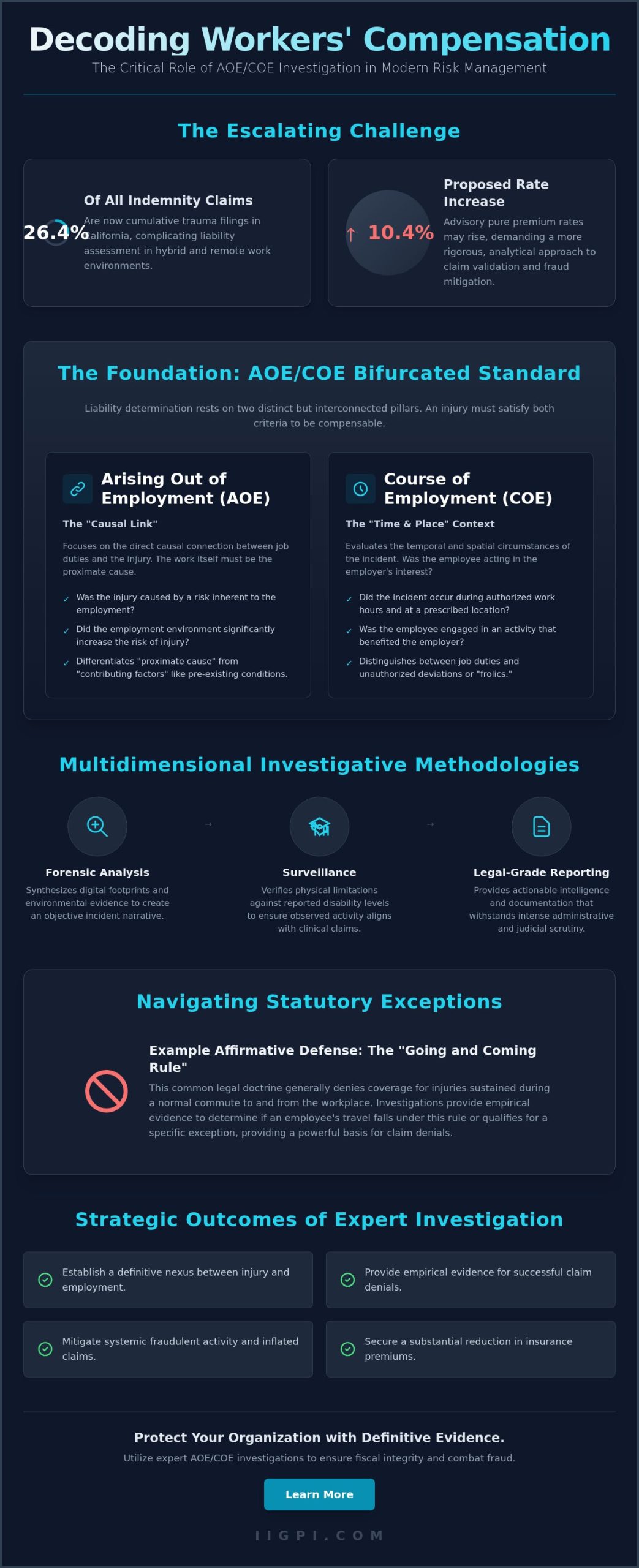
With cumulative trauma claims now representing 26.4% of all indemnity filings in California, the traditional methods of assessing workers’ compensation liability are increasingly inadequate for modern corporate risk management. The escalating complexity of hybrid work environments and the proposed 10.4% increase in advisory pure premium rates for 2026 demand a more rigorous, analytical approach to claim validation. Utilizing expert aoe/coe investigation services is no longer a secondary consideration; it’s a fundamental requirement for organizations seeking to maintain fiscal integrity through definitive evidence. You likely recognize that the ambiguity inherent in remote injury reporting often creates a vacuum where fraudulent or inflated claims can proliferate without sufficient documentation for denial.
This article offers a comprehensive analysis of the investigative protocols used to establish the critical nexus between injury and employment within complex corporate structures. We will examine a framework that synthesizes digital footprints and behavioral analysis to produce legal-grade documentation capable of withstanding intense judicial scrutiny. By prioritizing empirical data over subjective testimony, this exploration provides the strategic insights necessary to mitigate fraud and secure a substantial reduction in insurance premiums. The following sections detail the evolution of investigative methodology from simple witness statements to sophisticated environmental forensics.
Key Takeaways
- Understand the critical bifurcated legal standard between injuries arising out of employment and those occurring within the course of employment to ensure the accurate application of jurisdictional mandates.
- Deploy specialized aoe/coe investigation services that synthesize traditional surveillance methodologies with advanced forensic analysis to establish a definitive nexus between an alleged injury and professional duties.
- Analyze complex statutory exceptions and affirmative defenses, such as the “Going and Coming Rule,” to provide the empirical evidence required for successful claim denials in contested matters.
- Utilize high-level investigative reporting that provides actionable intelligence and supports strategic collaboration with Special Investigative Units to identify and mitigate systemic fraudulent activity.
- Leverage an investigative framework that combines the rigor of law enforcement protocols with corporate strategic analysis to produce documentation suitable for the highest levels of administrative and legal scrutiny.
The Conceptual Foundation of AOE/COE Investigation Services
The determination of liability within the modern workers’ compensation system rests upon a foundational bifurcated legal standard that distinguishes between the origin of an injury and the context of its occurrence. This analytical framework requires a rigorous application of aoe/coe investigation services to dissect the complex relationship between an employee’s professional obligations and the alleged industrial accident. As corporate environments transition toward decentralized, hybrid models, the clarity of these standards becomes increasingly obscured; this necessitates a scholarly approach to fact-finding that transcends mere observation. The investigators at International Investigative Group serve as an essential, impartial conduit in the administrative law process, providing the empirical data required to satisfy statutory requirements. Early intervention remains the primary strategic imperative in this lifecycle; it ensures the preservation of ephemeral digital and physical evidence before the passage of time or the intervention of third parties can compromise the integrity of the record.
Arising Out of Employment (AOE): The Causal Link
The AOE component focuses exclusively on the causal nexus between the specific requirements of a job and the resulting physiological or psychological impairment. It’s not enough for an injury to occur during work hours; it must possess a direct relationship to the employment’s inherent risks or the employer’s specific directives. Within the framework of professional aoe/coe investigation services, analysts must meticulously differentiate between a “proximate cause,” where the work is the primary catalyst, and mere “contributing factors” that might involve pre-existing conditions or external influences. Protocols for documenting environmental hazards and workplace stressors require a granular analysis of the physical workspace and the psychological climate to determine if the employment significantly increased the risk of injury beyond that faced by the general public.
Course of Employment (COE): The Temporal and Spatial Dimensions
While AOE addresses causality, the COE standard evaluates the temporal and spatial parameters of the incident, examining the specific time, place, and circumstances of the injury. This analysis often hinges on whether the employee was engaged in activities that provided a tangible benefit to the employer at the moment of the accident. Investigators must scrutinize authorized versus unauthorized deviations from prescribed duties, identifying “frolics” that place the worker outside the scope of coverage. In an era of remote labor, defining the “workplace” requires a sophisticated evaluation of home office environments and transit-related activities to establish if the employee was acting within the employer’s sphere of influence. Documenting the benefit to the employer remains a primary indicator of COE status, serving as the evidentiary bedrock for compensability determinations.
Multidimensional Investigative Methodologies for Claim Verification
The efficacy of modern claim adjudication depends on a holistic evidentiary record that transcends the limitations of anecdotal testimony. By synthesizing traditional field techniques with advanced technological forensics, elite aoe/coe investigation services create an immutable narrative of the incident. This multidimensional approach integrates professional surveillance services to verify physical limitations against reported disability levels, ensuring that observed activity aligns with clinical expectations. When these observations are merged with computer forensics, investigators can establish a precise digital presence during reported injury windows, effectively challenging or confirming the claimant’s timeline. Background investigations play a critical role in this process by uncovering prior claims history and identifying pre-existing conditions that might mitigate employer liability. This level of scrutiny is essential for maintaining the integrity of the insurance pool and protecting corporate assets from meritless filings.
Forensic Interviewing and Statement Acquisition
The acquisition of digitally recorded statements requires a sophisticated methodology that prioritizes factual consistency and behavioral analysis. Investigators must look for “red flag” indicators, such as linguistic discrepancies or delayed reporting patterns, that suggest a lack of credibility. Securing HIPAA-compliant medical releases allows for the retrieval of a comprehensive clinical history, which is vital for contrasting current complaints with historical health data. This rigorous process ensures that statements from claimants, witnesses, and supervisors are captured with the precision necessary for judicial review. Organizations seeking to fortify their risk management strategies should consider the advantages of specialized insurance investigations to ensure all evidence meets the highest standards of reliability.
Digital Footprint Analysis and Social Media Intelligence
Modern deep-web searches and metadata analysis allow for the reconstruction of an alleged incident’s timeline with surgical precision. Geolocation data becomes particularly significant in remote-work scenarios, where verifying the claimant’s spatial position is necessary to satisfy the legal definition of ‘course of employment’. The admissibility of this digital evidence in Workers’ Compensation Appeals Board (WCAB) proceedings provides a robust defense against fraudulent activity. By leveraging social media intelligence, investigators can uncover physical activities that directly contradict stated limitations. This technological integration transforms the investigative process from a reactive inquiry into a proactive, data-driven verification system.
Navigating Statutory Exceptions and Complex Legal Doctrines
The adjudication of workers’ compensation claims often hinges on the precise application of statutory exceptions that challenge the presumption of compensability. While the system operates on a no-fault basis, affirmative defenses provide a vital mechanism for employers to contest liability when specific behavioral or situational criteria are met. Elite aoe/coe investigation services are indispensable when documenting these defenses, such as intoxication, self-inflicted injuries, or the status of an initial physical aggressor. Establishing these defenses requires a high burden of proof, necessitating the collection of forensic toxicology reports, detailed witness chronologies, and behavioral analysis to demonstrate that the injury resulted from a prohibited act rather than a professional risk. Without rigorous fact-finding, these statutory protections remain theoretical rather than functional components of a defense strategy.
The “Going and Coming Rule” generally excludes injuries sustained during a routine commute, yet the complexity of modern global operations frequently triggers exceptions that expand the employer’s sphere of liability. In high-value corporate travel, the “Special Mission” and “Bunkhouse” rules become critical focal points. A special mission exception applies when an employee’s travel is performed at the specific request of the employer for a purpose outside their normal routine. Similarly, the bunkhouse rule may extend coverage to injuries occurring in employer-provided housing if the employee’s residence there is a functional requirement of their employment. Investigating these claims requires a granular analysis of travel mandates and contractual obligations to determine if the employee was within the course of employment during the incident. Furthermore, the challenges of “Horseplay” and “Voluntary Recreational Activity” demand an evaluation of whether such conduct was a common, employer-sanctioned practice or an isolated deviation from professional standards.
The Remote Work Grey Area: Home-Based AOE/COE
Differentiating between personal comfort acts and work-related activities in a home office requires a sophisticated investigative approach. The “Personal Comfort Doctrine” traditionally allows for brief intervals of personal activity, such as obtaining water, without severing the employment nexus. However, in a remote setting, this doctrine can be stretched to include non-compensable domestic tasks. Specialized aoe/coe investigation services utilize workstation configuration audits and digital activity logs to verify if an injury occurred during the performance of professional duties or a personal deviation. This empirical verification is essential for maintaining the boundaries of corporate liability in a decentralized workforce.
Psychiatric Claims and Stress-Related Compensability
Psychiatric injury claims demand a higher evidentiary threshold, often requiring proof that industrial factors were the “predominant cause” of the condition. Investigators must scrutinize a claimant’s social and professional history to identify non-industrial stressors that may mitigate the employer’s responsibility. The “Good Faith Personnel Action” defense serves as a primary shield against claims arising from legitimate management functions, such as performance reviews or disciplinary proceedings. By documenting the procedural integrity of these actions, investigators provide the evidence necessary to demonstrate that the psychological distress resulted from lawful administrative functions rather than inherent workplace hazards.
Strategic Risk Mitigation Through Elite Investigative Reporting
The transition from raw data to actionable intelligence occurs within the structure of the formal investigative report, a document that serves as the evidentiary cornerstone for administrative decision-making. High-level aoe/coe investigation services produce reports characterized by rigorous analytical frameworks, including executive summaries that synthesize complex timelines and evidentiary exhibits that provide an immutable record of the facts. These documents are designed to withstand the scrutiny of global decision-makers and legal scholars, offering the clarity required to adjudicate claims with precision. By collaborating with Special Investigative Units (SIU), organizations can identify systemic fraud patterns that transcend individual filings, allowing for a macro-level approach to risk mitigation. The integration of these findings into Independent Medical Examinations (IME) and Peer Reviews ensures that clinical assessments are informed by empirical workplace data rather than unverified claimant narratives. This commitment to investigative rigor exerts a downward pressure on Experience Modification Ratings (MOD), directly addressing the proposed 10.4% increase in pure premium rates anticipated for late 2026.
Subrogation Identification and Third-Party Liability
Elite reporting extends beyond the immediate employment nexus to identify opportunities for loss recovery through third-party negligence investigations. When a workplace accident involves equipment failure or hazardous premises maintained by external entities, documenting product liability or premises liability factors becomes a primary objective. The integration of corporate fraud investigation protocols allows for the identification of collusive relationships or systemic negligence that may contribute to industrial losses. This strategic focus transforms the investigative process from a cost center into a recovery mechanism, ensuring that financial responsibility is accurately assigned to the negligent parties. It’s a proactive method for organizations to reclaim capital that would otherwise be lost to non-industrial factors.
Preparation for Litigation and Administrative Hearings
The International Investigative Group Advantage in AOE/COE Matters
Selecting an elite partner for aoe/coe investigation services requires a rigorous evaluation of institutional history and the sophistication of the underlying investigative framework. International Investigative Group brings over 30 years of specialized experience to the NYC metropolitan area and the global stage, positioning itself as a premier authority in complex claim adjudication and corporate risk management. The IIGPI methodology represents a deliberate synthesis of law enforcement rigor and corporate strategic analysis, ensuring that every inquiry is conducted with the precision of a high-stakes intelligence operation. This dual-perspective approach allows for the identification of nuanced evidentiary patterns that less sophisticated entities might overlook. With access to an expansive global network of agents, the firm possesses the capacity to investigate claims across disparate geographic regions, maintaining a consistent standard of excellence regardless of the jurisdictional environment. A profound commitment to the highest standards of ethics, discretion, and professional conduct ensures that even the most sensitive corporate matters are handled with intellectual depth and absolute confidentiality.
A Legacy of Success in High-Value Corporate Claims
The firm’s legacy is defined by the successful resolution of over 10,000 complex investigative cases, many involving high-value corporate claims where the stakes extend beyond financial loss to encompass institutional reputation and long-term fiscal stability. Being a former law enforcement-led organization provides a unique advantage in maintaining investigative integrity and ensuring that all findings meet the rigorous standards of administrative law and judicial review. Solutions are never generic; they are customized for insurance carriers, self-insured corporations, and elite legal firms that require more than surface-level observations to satisfy their evidentiary burdens. This expertise allows the organization to bridge the gap between regional socioeconomic dynamics and the global corporate mandates that drive modern industrial systems, providing a level of service that is both authoritative and essential.
Engagement and Consultation Protocols
The engagement process begins with a rigorous preliminary case analysis to determine the feasibility of the inquiry and the most effective strategic path forward. This initial phase ensures that resources are deployed with maximum efficiency, focusing on the specific legal and factual challenges inherent in the claim while identifying potential avenues for subrogation or affirmative defense. Clients benefit from transparent reporting structures and real-time intelligence updates, facilitating a level of collaboration that is rare in the private investigative sector. This structured flow of information, characterized by intellectual rigor and granular detail, empowers high-level decision-makers to adjust their strategic posturing in response to emerging empirical data. To initiate a sophisticated inquiry that leverages this analytical framework, you should Contact International Investigative Group to consult with our senior analysts and secure the definitive evidence required for claim determination.
Securing Fiscal Integrity Through Advanced Investigative Frameworks
The determination of compensability within the modern industrial complex requires a shift from anecdotal observation to a rigorous, data-driven analytical framework. By synthesizing the bifurcated legal standards of AOE and COE with advanced technological forensics, organizations can effectively navigate the rising tide of cumulative trauma and remote work claims. It’s clear that the application of expert aoe/coe investigation services serves as the primary defense against the erosion of corporate capital through fraudulent or inflated filings. This systematic approach ensures that every claim is adjudicated based on empirical reality rather than subjective narrative, preserving the integrity of the workers’ compensation system for legitimate injuries.
International Investigative Group remains at the forefront of this discipline, leveraging over 30 years of elite experience and the strategic insight of former law enforcement leadership. Having successfully resolved more than 10,000 complex cases globally, the firm provides the intellectual depth and evidentiary precision required by high-level decision-makers. You can protect your institution’s financial future by adopting these sophisticated protocols today. Secure Your Organization’s Interests with Elite AOE/COE Investigation Services. Empowering your organization with these definitive resources ensures a future of stability and investigative clarity.
Frequently Asked Questions
What is the primary difference between AOE and COE in a workers’ compensation context?
AOE refers to injuries “Arising Out of Employment,” focusing on the causal relationship between the job duties and the resulting impairment. COE signifies the “Course of Employment,” which evaluates whether the incident occurred within the temporal and spatial boundaries of the worker’s professional obligations. While AOE addresses the underlying cause of the injury, COE determines if the employee was acting for the employer’s benefit at the time of the accident.
How long does a standard professional AOE/COE investigation typically take to complete?
The duration of a standard inquiry typically ranges from 30 to 45 days, depending on the complexity of the evidentiary requirements and witness availability. This timeframe allows investigators to secure recorded statements and conduct a thorough analysis of medical records before the 90-day presumption of compensability deadline. Comprehensive reporting ensures that all findings are documented with the precision necessary for administrative law proceedings and internal risk management reviews.
Are injuries sustained while working from home covered under workers’ compensation in 2026?
Injuries occurring in a home office are compensable if they arise from professional duties and occur within the established course of employment. However, the transition to decentralized work environments in 2026 has increased the scrutiny applied to the “Personal Comfort Doctrine” to distinguish between domestic tasks and work-related functions. Establishing a definitive nexus between the injury and the employment remains a critical requirement for compensability in these remote settings.
What specific ‘red flags’ do investigators look for during an AOE/COE claim review?
Investigators prioritize indicators such as delayed reporting of incidents, a lack of credible witnesses, or injuries reported immediately following a weekend or holiday. Discrepancies between the claimant’s subjective narrative and observed physical activity often serve as the primary catalyst for specialized aoe/coe investigation services. These behavioral inconsistencies, combined with frequent changes in the reported mechanism of injury, provide the empirical basis for a more granular forensic evaluation of the claim.
Can an employer deny a claim if the employee was engaged in horseplay or was intoxicated?
Employers may assert an affirmative defense to deny liability if they can prove that the injury resulted from a prohibited act that severed the employment relationship. Intoxication must be demonstrated as the proximate cause of the accident through forensic toxicology, while horseplay must represent a substantial deviation from authorized duties. These defenses require a high burden of proof and rigorous documentation to withstand the scrutiny of the administrative law system.
Is surveillance video admissible as evidence in a workers’ compensation hearing?
Surveillance video is highly admissible and serves as a definitive tool for impeaching fraudulent testimony regarding physical limitations or activity levels. When gathered through professional investigative protocols, visual evidence provides an objective record that often contradicts exaggerated claims of disability. This documentation is frequently the most persuasive asset during Workers’ Compensation Appeals Board proceedings, directly influencing the final determination of the claimant’s eligibility for benefits.
How does the ‘Going and Coming Rule’ apply to employees on a special mission for their employer?
The “Going and Coming Rule” generally excludes routine commutes from coverage, but the “Special Mission” exception extends liability when an employee travels at the specific request of the employer for an extraordinary task. In these instances, the employment nexus begins the moment the worker leaves their residence, as the travel itself is deemed a professional obligation. Investigating these claims requires a precise analysis of the employer’s directives and the specific utility of the travel.
What role does computer forensics play in modern AOE/COE investigation services?
Computer forensics provides the digital empirical data required to verify a claimant’s presence and professional activity during the reported injury window. By analyzing geolocation logs, login timestamps, and metadata, aoe/coe investigation services can confirm if a remote worker was actually engaged in work-related functions at the time of the alleged incident. This technological integration ensures that the digital footprint of the employee aligns with their physical claims, providing an immutable record for claim adjudication.