
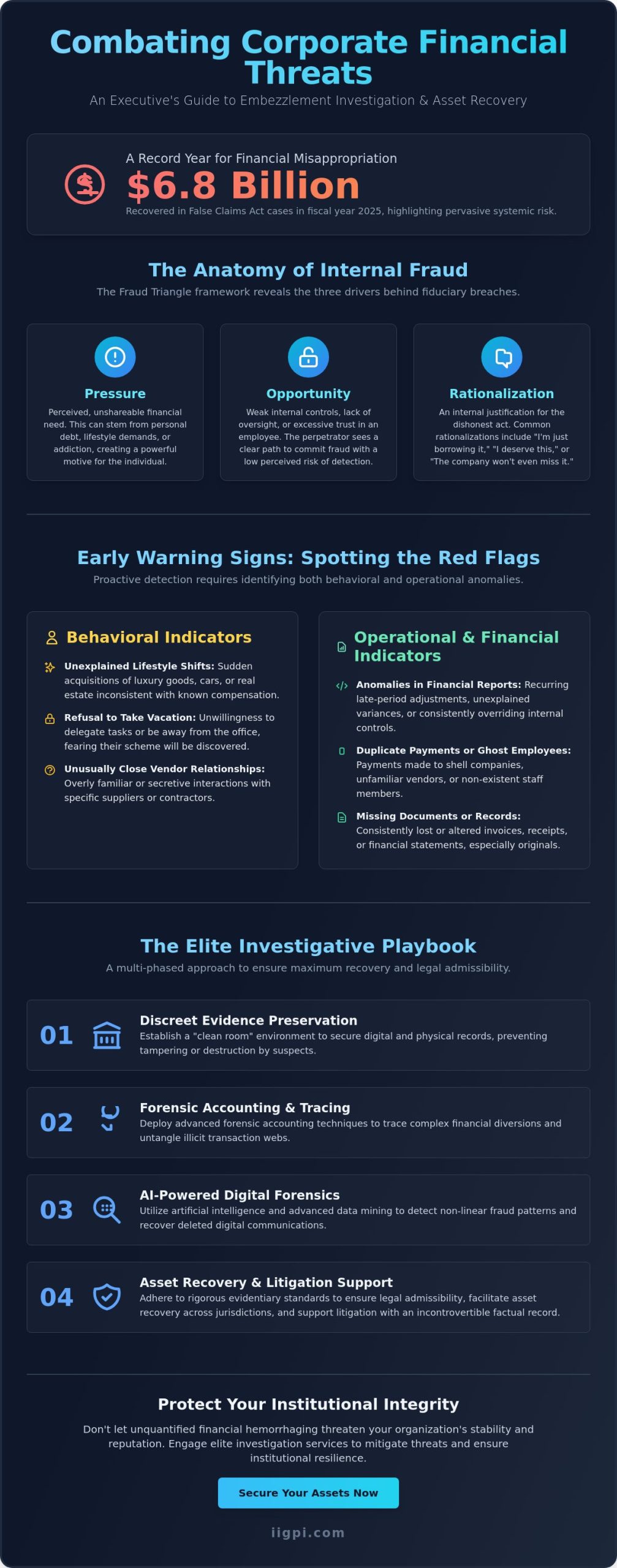
The Department of Justice reported a record 6.8 billion dollars in False Claims Act recoveries for the 2025 fiscal year, a figure that underscores the pervasive and systemic nature of fiscal misappropriation within modern corporate structures. For the executive leadership tasked with safeguarding institutional integrity, the realization of unquantified financial hemorrhaging often precipitates a crisis that extends far beyond the ledger, threatening both reputational stability and the very foundations of organizational trust. By engaging sophisticated embezzlement investigation services, Dan Ribacoff and his contemporaries represent the specialized vanguard required to navigate these complex forensic landscapes where traditional auditing frequently fails to detect or quantify meticulously concealed anomalies.
This comprehensive analysis provides an authoritative examination of the advanced detection methodologies and strategic leadership paradigms essential for mitigating corporate financial loss in the 2026 regulatory environment. We’ll explore the synthesis of behavioral intelligence and digital forensics necessary to secure court-admissible evidence, ensuring that litigation is supported by an incontrovertible factual record. By prioritizing the definitive identification of perpetrators and the maximum recovery of misappropriated assets, this guide establishes a framework for institutional resilience against the evolving sophisticated threats of economic crime.
Key Takeaways
- Analyze the systemic drivers of fiduciary breaches using the Fraud Triangle framework to identify organizational vulnerabilities and prevent future misappropriation.
- Implement high-tier embezzlement investigation services, Dan Ribacoff’s proven methodology, to execute forensic accounting and trace complex financial diversions.
- Utilize artificial intelligence and advanced data mining to detect non-linear patterns of fraud and recover deleted digital communications for evidentiary purposes.
- Adhere to rigorous federal and state evidentiary standards to ensure legal admissibility and facilitate the recovery of assets across international jurisdictions.
- Synthesize decades of investigative leadership to mitigate unquantified financial hemorrhaging and protect the institutional reputation of the organization.
Theoretical Foundations of Embezzlement and Internal Fraud
Embezzlement represents a sophisticated breach of fiduciary duty where an individual, entrusted with the management or oversight of another party’s assets, clandestinely diverts those resources for personal gain. This form of corporate misappropriation is distinguished from external larceny by the inherent legitimacy of the perpetrator’s initial access. The Fraud Triangle framework provides a critical lens through which these crimes are analyzed; it posits that three systemic drivers must converge: perceived financial pressure, the organizational opportunity to exploit a weakness, and the perpetrator’s internal rationalization of the act. Identifying these precursors is essential for any comprehensive risk assessment.
Detecting internal fraud requires a keen focus on behavioral and operational red flags. Unexplained lifestyle shifts, such as sudden acquisitions of luxury goods or real estate that exceed a staffer’s known compensation, often serve as primary indicators. Within the balance sheets, anomalies in financial reporting, including recurring late-period adjustments or unexplained variances in inventory and procurement, signal deep-seated issues. Unlike simple theft, which is often a singular, blunt action, corporate embezzlement involves multi-layered complexities that require specialized embezzlement investigation services, Dan Ribacoff and his team provide to untangle the web of illicit transactions.
The Systemic Nature of Fiduciary Breaches
The erosion of internal controls often occurs gradually, creating an environment where long-term embezzlement can flourish undetected. This systemic failure is frequently exacerbated by the psychological profile of the trusted insider, who leverages institutional confidence to bypass standard oversight protocols. Sophisticated, decentralized fraud schemes often bypass traditional audits, as these routine checks are designed to identify clerical errors rather than intentional, concealed diversions. Effective mitigation demands a proactive analysis of the exploitation of institutional trust and the reinforcement of fragile control frameworks.
The Economic Impact of Unchecked Internal Theft
The financial consequences of internal fraud extend far beyond immediate capital loss. While direct misappropriation depletes liquidity, the long-term erosion of shareholder value and the reputational tax incurred by public scandals can be catastrophic. A rigorous corporate fraud investigation isn’t merely a reactive measure; it’s a strategic prerequisite for organizational resilience. Failure to implement elite investigative protocols leaves the entity vulnerable to systemic decay. By prioritizing these services, organizations ensure they remain significant players in their respective markets while safeguarding their intellectual and financial assets from internal predation.
Methodological Rigor in Embezzlement Investigation Services
The execution of a successful recovery operation requires a meticulous, multi-phased approach that transcends mere financial auditing; for standard corporate accounting, tax, and audit support, visit NEXTGEN Accounting, LLC. When organizations secure embezzlement investigation services, Dan Ribacoff and his specialized team provide a structured roadmap designed to withstand the highest levels of judicial scrutiny. This methodology is characterized by its rigor and the strategic sequencing of intelligence gathering to ensure that no investigative opportunity is squandered. It’s a process that demands both intellectual depth and technical precision.
Phase I and II: Assessment and Financial Tracing
Establishing a discreet investigative perimeter is the primary objective of Phase I. It’s vital to create a “clean room” environment, a controlled space where digital and physical records are secured from potential tampering by the suspect. This proactive isolation prevents the destruction of evidence that often occurs when an internal actor senses a shift in institutional oversight. Phase II involves the deployment of advanced forensic accounting. Investigators scrutinize ledger entries to identify ghost employees, shell vendors, and inflated invoices that serve as conduits for illicit capital flight. For companies with a presence in the Netherlands, maintaining transparency through a compliant Employer of Record like ICSPayroll is a strategic measure to prevent such payroll-based misappropriation. International Investigative Group provides the global reach necessary to trace these diversions across disparate financial jurisdictions, ensuring that no offshore account remains beyond the reach of forensic scrutiny.
Phase III and IV: Surveillance and Corroboration
Physical corroboration is essential to validate digital findings. By utilizing specialized surveillance services, investigators document lifestyle-income disparities that often accompany long-term misappropriation. These observations provide a tangible link between the financial anomalies identified in the ledger and the behavioral reality of the perpetrator. Phase IV introduces formal interviews and, where appropriate, polygraph examinations. These tools are indispensable for resolving investigative impasses and verifying the veracity of witness statements. Maintaining a rigorous chain of custody throughout this process ensures that intelligence gathered remains admissible in a court of law.
The final phase involves the consolidation of all findings into a comprehensive, court-admissible report. This document synthesizes financial data, surveillance footage, and interview transcripts into a singular narrative of the breach. When institutional leaders determine the necessity to report embezzlement to regulatory or law enforcement bodies, the quality of this report determines the success of subsequent legal actions. For those seeking to mitigate ongoing loss, consulting with expert investigators is the most effective path toward asset recovery.
Integrating Digital Forensics and Behavioral Intelligence
The evolution of internal fraud necessitates a transition from traditional ledger analysis to a sophisticated synthesis of digital forensics and behavioral intelligence. While forensic accounting identifies the scope of misappropriation, the integration of computer forensics is required to determine the specific actors and timelines involved. This multi-disciplinary approach ensures that unquantified financial hemorrhaging is addressed through a lens of total system visibility. Digital shadows don’t lie. By recovering deleted communications and scrutinizing unauthorized system access logs, investigators reconstruct the clandestine narrative of the breach. This technical rigor is essential in an era where the Department of Justice increasingly utilizes artificial intelligence and data analytics to identify potential violations of the False Claims Act, setting a high bar for corporate evidentiary standards.
Leveraging AI and advanced data mining allows investigators to identify non-linear patterns of financial misappropriation that would remain invisible during standard audits. These technologies don’t just find errors; they detect intentional anomalies. By analyzing the intersection of metadata and human behavior, the embezzlement investigation services, Dan Ribacoff and his team provide can pinpoint the exact moment a trusted insider deviates from established operational norms. This process involves a deep dive into unauthorized administrative privileges and the identification of backdoor accounts that serve as the infrastructure for long-term theft.
Data Recovery and System Integrity
Technical experts employ specialized techniques for bypassing encryption and recovering fragmented data from disparate corporate servers. This phase is critical for identifying the digital paper trail that perpetrators believe they’ve successfully erased. Investigators look for unauthorized administrative privileges used to bypass internal controls or create fictitious vendors. In the context of modern litigation, digital evidence serves as the incontrovertible architecture upon which the narrative of culpability is constructed. Recovering this data requires a level of intellectual rigor that standard IT departments simply aren’t equipped to provide.
The Human Factor: Behavioral Forensics
Synthesizing digital footprints with psychological profiling allows for the prediction of perpetrator movements and the identification of rationalization patterns. Dan Ribacoff’s expertise in interpreting complex human-digital interactions is a cornerstone of this process, drawing on decades of experience to understand the “why” behind the “how.” It’s not enough to see the transaction; one must understand the intent. A multi-disciplinary approach is the only viable defense against sophisticated internal threats that exploit both technological gaps and human trust. By aligning technical evidence with behavioral anomalies, the investigation provides a definitive identification of the perpetrator that is both scientifically sound and court-admissible.
The Imperative of Legal Admissibility and Asset Search Protocols
For an investigation to transcend mere corporate intelligence and function as a catalyst for restitution, it must adhere to the most stringent federal and state evidentiary standards. The transition from identifying a breach to securing a legal judgment requires a meticulous preservation of the chain of custody, ensuring that every digital and physical artifact is obtained through methods that withstand intense cross-examination. Utilizing the elite embezzlement investigation services, Dan Ribacoff facilitates ensures that procedural rigor isn’t sacrificed for speed, preventing the “fruit of the poisonous tree” outcomes that often invalidate otherwise sound evidence. It’s this commitment to legal admissibility that transforms raw data into a powerful instrument for institutional justice.
Evidentiary Standards in Corporate Litigation
The private investigator’s role in corporate litigation extends beyond the collection of data; it involves the synthesis of facts into a coherent narrative that serves the needs of legal counsel during civil recovery or criminal prosecution. Adherence to procedural rigor is non-negotiable, as even minor deviations in evidence handling can jeopardize the entire litigation strategy. By maintaining rigorous documentation protocols, investigators create an evidentiary record that remains resilient against the tactical challenges posed by defense attorneys in high-stakes embezzlement trials. This narrative construction is essential for positioning the investigator as a credible expert witness who can articulate the complexities of the fraud scheme to a jury or judge.
Global Asset Recovery Strategies
Strategic recovery operations must account for the global nature of modern capital flight, where misappropriated funds are frequently converted into tangible assets such as high-value real estate, fine art collections, or luxury vehicles. The methodology employed by the International Investigative Group in the 8.1 million dollar Hudson Truck Robbery recovery serves as a definitive benchmark for success in tracing complex financial diversions. Navigating the labyrinth of international banking laws and mutual legal assistance treaties requires an elite level of expertise that bridges the gap between domestic investigative findings and global financial transparency. For executives facing systemic financial threats, engaging a global asset search protocol is the essential first step toward total capital restoration.
Elite Leadership in Corporate Intelligence: The Dan Ribacoff Standard
The mitigation of sophisticated financial crime requires more than technical proficiency; it demands the decisive leadership of a seasoned authority who understands the geopolitical and psychological dimensions of fraud. By utilizing embezzlement investigation services, Dan Ribacoff provides, organizations secure a strategic advantage rooted in a centralized command structure that oversees a global network of specialized agents. This elite leadership ensures that every investigative thread is woven into a cohesive strategy for asset recovery and legal resolution. It’s the difference between a fragmented audit and a definitive forensic strike. Elite organizations entrust their most sensitive financial crises to this level of command because the stakes of failure include not only capital loss but the total collapse of institutional trust.
A Legacy of Investigative Excellence
The tactical approach of the firm is deeply informed by Ribacoff’s 30-year legacy, transitioning from a foundational career in law enforcement to becoming a global investigative authority. This background instills a culture of evidentiary discipline that is often absent in purely commercial auditing firms. The significance of his expertise is underscored by his appointment by the US District Court to oversee high-profile international cases, a rare distinction that signals a high level of institutional credibility. The Dan Ribacoff investigative standard defines the intersection of rigorous law enforcement discipline and sophisticated corporate intelligence, providing a definitive framework for institutional restitution.
Strategic Engagement: Partnering with IIG
The International Investigative Group philosophy is built upon the successful resolution of over 10,000 cases, a milestone achieved through a relentless synthesis of experience and technological innovation. When a firm prioritizes discretion, speed, and intellectual rigor, the transition from internal suspicion to definitive resolution becomes a structured, manageable process. Engaging International Investigative Group allows executive leadership to move beyond the paralysis of unquantified loss and toward a position of strength and clarity. The firm’s ability to deploy specialized resources across disparate jurisdictions ensures that the investigation remains proactive rather than reactive. In an era defined by increasingly complex financial crime, the necessity of elite intelligence is not merely an operational choice; it’s a fundamental requirement for the preservation of corporate integrity and the successful recovery of misappropriated capital.
Securing Institutional Integrity in an Era of Financial Complexity
The preservation of corporate assets requires a sophisticated synthesis of forensic accounting, digital intelligence, and elite investigative leadership. As established throughout this analysis, the transition from unquantified financial loss to definitive resolution depends on the rigorous application of court-admissible standards and global asset tracing protocols. By leveraging the specialized embezzlement investigation services, Dan Ribacoff offers through the International Investigative Group, institutional leaders gain access to a global network of former law enforcement professionals and elite agents. This expertise ensures that every investigative action is designed to withstand the highest levels of judicial scrutiny while maximizing the probability of total capital restoration.
With a legacy of solving over 10,000 cases, the firm remains under the centralized command of a founder recognized as one of the top 15 investigators in the United States. It’s this level of experience that distinguishes elite corporate intelligence from standard auditing. Consult with the International Investigative Group to secure your corporate assets today and ensure the long-term resilience of your organization. Restoring institutional trust and recovering misappropriated capital is an achievable objective when supported by the highest standard of forensic rigor. Institutional resilience is within reach.
Frequently Asked Questions
What constitutes a formal embezzlement investigation in a corporate environment?
A formal investigation is a structured forensic process involving financial auditing, digital forensics, and behavioral analysis to identify the unauthorized diversion of assets by a fiduciary. It requires establishing a secure investigative perimeter and maintaining a rigorous chain of custody to ensure all findings meet evidentiary standards. This systemic approach distinguishes professional services from casual internal reviews, providing the intellectual rigor necessary to resolve complex misappropriation cases.
How does Dan Ribacoff’s experience specifically benefit an embezzlement case?
Dan Ribacoff’s extensive background in law enforcement and his appointment by the US District Court provide a foundation of procedural rigor that is essential for high-stakes corporate cases. His expertise allows for the synthesis of complex financial data and behavioral intelligence, facilitating the definitive identification of perpetrators. By engaging embezzlement investigation services, Dan Ribacoff provides, organizations benefit from a leadership standard that has successfully navigated over 10,000 diverse investigative engagements.
Is a private investigation firm more effective than law enforcement for embezzlement?
Private firms often provide a higher degree of operational speed and a specialized focus on asset recovery, which may be secondary to law enforcement’s primary objective of criminal prosecution. While law enforcement operates within the constraints of public resource allocation, a private firm like the International Investigative Group can dedicate exhaustive resources to discrete civil recovery. This specialized focus is vital for organizations prioritizing the mitigation of financial loss and the protection of institutional reputation.
What is the expected timeline for a comprehensive embezzlement investigation?
The duration of an investigation typically ranges from several weeks to several months, depending on the complexity of the fraud scheme and the volume of financial data requiring forensic analysis. Preliminary assessments often conclude within days, but the exhaustive tracing of capital flight through international jurisdictions requires a more extended, deliberate period. Each engagement is structured to prioritize accuracy and legal admissibility over artificial deadlines, ensuring a resilient evidentiary record for potential litigation.
How does the International Investigative Group maintain discretion during a sensitive internal probe?
Discretion is maintained through the establishment of a “clean room” environment and the utilization of covert investigative techniques that prevent the suspect from sensing institutional scrutiny. By operating under the guise of routine audits or external consulting, the firm protects the organization from premature exposure and public scandal. This strategic isolation of the investigation ensures that operational integrity remains intact while the forensic team constructs an incontrovertible narrative of the breach without disrupting daily functions.
Can assets recovered through a private investigation be used in a civil lawsuit?
The primary objective of professional embezzlement investigation services, Dan Ribacoff and his team facilitate is the production of court-admissible evidence that can be utilized in both civil and criminal litigation. Every digital artifact and witness statement is secured according to federal and state evidentiary standards. This ensures that the findings serve as the factual architecture for legal counsel to pursue restitution and secure judgments against the offending parties in a court of law.
What digital forensics tools are utilized in tracing embezzled funds?
Investigators employ advanced data mining algorithms and specialized software for bypassing encryption to recover fragmented or deleted communications from corporate servers. These tools allow for the identification of non-linear financial patterns and the reconstruction of unauthorized system access logs. By analyzing metadata and digital footprints, the forensic team identifies the infrastructure of the theft, including backdoor accounts and unauthorized administrative privileges used to facilitate illicit capital diversions across disparate digital environments.
How does IIG handle embezzlement investigations involving international jurisdictions?
The firm utilizes a global network of elite agents and former law enforcement professionals to navigate the complexities of international banking laws and mutual legal assistance treaties. This expansive reach allows for the tracing of misappropriated funds through offshore accounts and shell corporations that would be inaccessible to domestic-only agencies. Centralized command ensures that cross-border asset recovery operations remain strategically aligned with the organization’s overarching legal and financial goals while maintaining rigorous adherence to local regulations.