
Does your organization possess the forensic depth required to distinguish between a sanitized digital profile and the authentic professional history of a high-level executive candidate? The prevailing reliance on automated, high-volume screening protocols represents a critical vulnerability for institutions operating within the increasingly litigious and regulated environment of New York’s labor market. You likely recognize that the 2026 regulatory shift, characterized by the New York State credit history prohibition and the complexities of the NYC Fair Chance Act, has rendered traditional screening methods insufficient for identifying sophisticated executive misrepresentation or deep-seated financial fraud. It’s a systemic risk that requires moving beyond the superficiality of database scraping to maintain institutional integrity through a rigorous pre-employment background check nyc, specifically utilizing the specialized methodologies of Lance Ribacoff.
This analysis provides an authoritative examination of the IIGPI Forensic Standard, offering a necessary evolution from administrative checklists to sophisticated investigative frameworks. We will explore the intersection of the New York State Clean Slate Act, the forensic integrity required for elite-level intelligence, and the strategic preservation of institutional assets through a methodology designed for the highest levels of global corporate governance. By prioritizing forensic rigor over automated convenience, firms can mitigate the potential for litigation and ensure compliance with the most recent 2026 labor mandates.
Key Takeaways
- Identify the critical regulatory requirements of the 2026 NYC Fair Chance Act and the New York State Clean Slate Act to mitigate the risk of non-compliant hiring practices.
- Learn how a specialized pre-employment background check nyc utilizing the Lance Ribacoff forensic standard provides a superior defense against high-level executive misrepresentation.
- Analyze the strategic advantages of the Ribacoff Protocol, which synthesizes digital forensics with traditional investigative techniques to preserve institutional integrity.
- Adopt a multi-phase vetting framework that begins with defining the investigative scope and concludes with an exhaustive verification of professional credentials.
The Strategic Imperative of Pre-Employment Background Check NYC in the 2026 Financial Ecosystem
Institutional reputation is a fragile construct; it’s especially vulnerable within the high-velocity economic corridors of Manhattan. In this context, pre-employment intelligence serves as an essential mechanism for the preservation of corporate capital and public trust. A comprehensive background check is no longer merely a procedural formality. It’s a sophisticated investigative instrument designed to insulate an organization from the catastrophic repercussions of executive malfeasance. The unique corporate density of New York City, characterized by its concentration of global financial hubs and legal powerhouses, necessitates a specialized investigative approach that transcends standard administrative reviews. For firms seeking to mitigate systemic risk in 2026, the pre-employment background check nyc methodology pioneered by Lance Ribacoff represents the definitive standard for institutional safety.
Institutional Integrity and Risk Abatement
The presence of a single bad actor within a senior leadership tier can exert a corrosive influence on the entire organizational culture. This often leads to a degradation of ethical standards and institutional morale. Rigorous investigative due diligence acts as a primary barrier against internal theft and the misappropriation of intellectual property. It ensures that only those with demonstrated integrity gain access to sensitive assets. This is a proactive strategy for long-term asset protection. The pre-employment background check nyc constitutes a rigorous forensic prerequisite for all 2026 executive hires to ensure the absolute alignment of candidate history with institutional values.
The Limitations of Automated Screening Mills
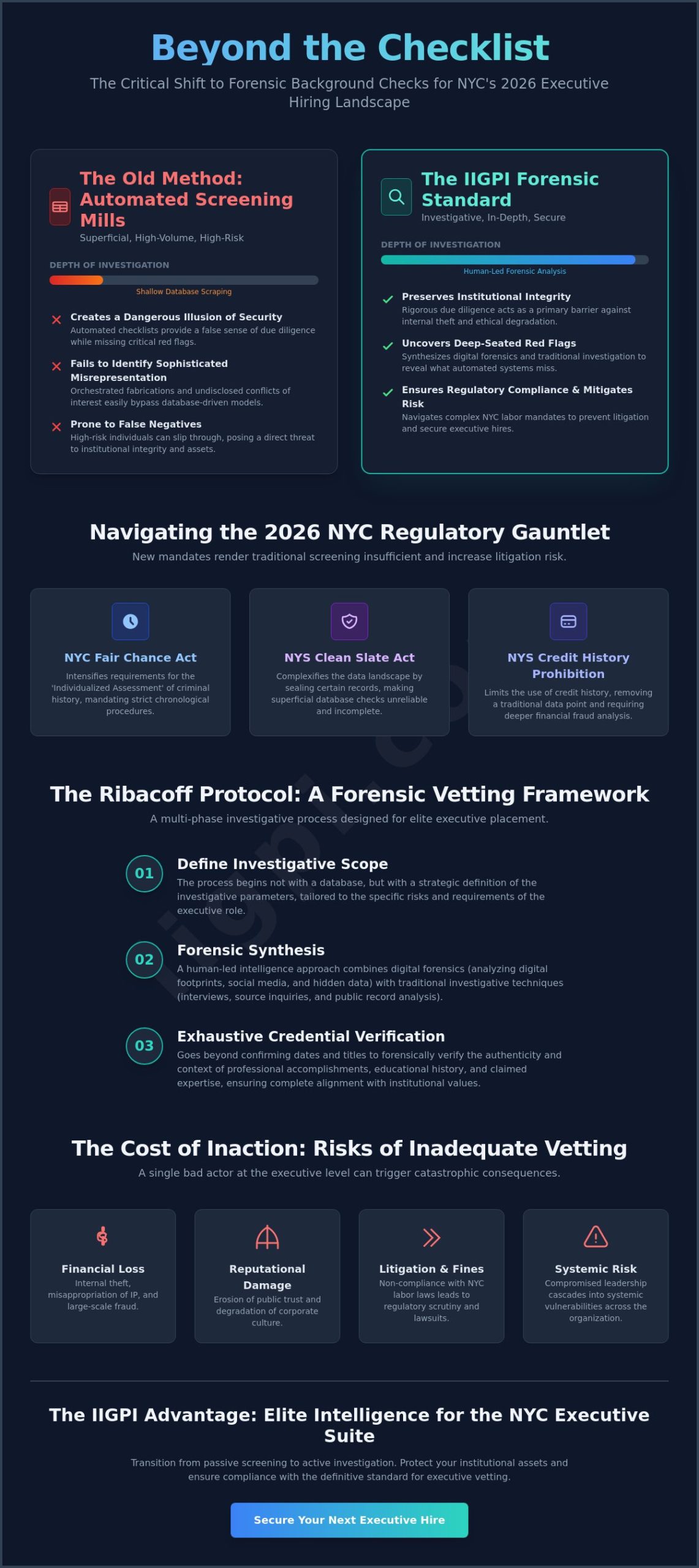
Standardized, database-driven screening models often fail to identify sophisticated misrepresentations that a dedicated investigator would uncover. These automated mills prioritize speed and volume over depth; they frequently result in false negatives that allow high-risk individuals to infiltrate sensitive financial placements. Relying on automated systems creates a dangerous illusion of security. Deep-seated red flags, such as undisclosed conflicts of interest or orchestrated professional fabrications, require a human-led intelligence approach. By transitioning from automated checklists to the high-level Background Investigations offered by IIGPI, organizations achieve a level of scrutiny that matches the gravity of their hiring decisions. This shift from passive screening to active investigation is the only viable path for maintaining security in an era of complex corporate fraud.
Navigating the NYC Regulatory Landscape: Compliance and the Fair Chance Act
The contemporary regulatory environment within the New York City jurisdiction is characterized by a dense architecture of labor protections that necessitate an intellectually rigorous approach to candidate vetting. Organizations must navigate a framework where the timing of inquiries is strictly mandated, ensuring that no criminal history is reviewed before a conditional offer of employment is extended. This legal sequencing is fundamental to the pre-employment background check nyc process. Failure to adhere to these chronological requirements often results in significant litigation risk, positioning the organization as a target for regulatory scrutiny. Institutions must move beyond basic compliance to understand the strategic importance of background checks as a tool for both safety and legal defense.
The 2026 Fair Chance Act Amendments
Recent amendments to the NYC Fair Chance Act have intensified the requirements for the ‘Individualized Assessment’ of criminal history. When an investigation reveals a relevant conviction, employers are legally obligated to analyze specific factors, such as the time elapsed since the offense and its direct relationship to the job’s duties. This analytical rigor is essential for maintaining a Corporate Fraud Investigation protocol that remains within legal boundaries. The 2026 standard demands that these assessments be documented with precision to withstand potential challenges from the NYC Commission on Human Rights. It’s no longer sufficient to have a general policy; institutions must demonstrate a nuanced, case-by-case evaluation of every candidate to ensure systemic fairness.
Beyond criminal records, the April 18, 2026, statewide prohibition on utilizing credit history for most employment decisions reinforces the need for alternative investigative methodologies. Lance Ribacoff and his team specialize in navigating these restrictions by focusing on forensic data that remains legally accessible while providing deep insight into a candidate’s professional integrity. This includes managing the legal boundaries of social media forensics, where investigators must avoid accessing protected class information while identifying behavioral red flags that indicate a risk to institutional assets. Balancing the right to privacy with the corporate necessity for security requires a level of expertise that automated systems simply cannot provide.
FCRA and NYC-Specific Disclosure Protocols
Mastering notification requirements for Manhattan-based employers involves more than just standard Fair Credit Reporting Act (FCRA) compliance. NYC-specific disclosure protocols require precise communication during the adverse action process, including providing the candidate with a written copy of the investigative findings and a minimum of five business days to respond. Managing these timelines is critical. Engaging with Background Investigations experts ensures that every step of the vetting process aligns with current municipal standards. Specialized counsel often plays a role in vetting these findings to ensure that the final decision is both ethically sound and legally defensible, protecting the organization from claims of discriminatory hiring practices while maintaining the highest standards of executive excellence.
The Ribacoff Protocol: Lance Ribacoff and the Forensic Synthesis of Background Intelligence
The Ribacoff Protocol represents a fundamental paradigm shift in the methodology of the pre-employment background check nyc. It integrates the intellectual rigor of traditional investigative techniques with the precision of modern forensic analysis. This framework, developed by Lance Ribacoff, moves beyond the superficial examination of public records to create a multi-dimensional profile of a candidate’s professional and ethical trajectory. By synthesizing disparate data points into actionable institutional intelligence, the protocol enables decision-makers to identify hidden liabilities that standard screening processes routinely overlook. It’s a system designed for an era where sophisticated misrepresentation has become a significant threat to corporate stability.
Lance Ribacoff and the Digital Intelligence Edge
The integration of computer forensics into the vetting process is a hallmark of the Ribacoff Methodology. Rather than treating a candidate’s digital footprint as a mere social media review, the protocol employs forensic principles to verify the authenticity of professional history and identify digital anomalies that may signal future fraudulent behavior. This technical depth is further elucidated in our Computer Forensics Guide, which outlines the systematic approach required for corporate and legal investigations. By analyzing metadata and digital trails, investigators can uncover inconsistencies in employment timelines or undisclosed affiliations that automated systems are incapable of detecting. This forensic scrutiny provides a layer of security that is essential for protecting sensitive intellectual property and financial assets.
Global Reach and Local NYC Expertise
The International Investigative Group leverages over 30 years of Manhattan investigative experience to navigate the specific complexities of the New York regulatory environment, including the nuanced requirements of the NYC Fair Chance Act. Given that the NYC executive suite often draws from a global talent pool, the IIGPI advantage lies in its extensive network of international agents who provide multi-jurisdictional verification. This ensures that a candidate’s history in London, Hong Kong, or Dubai is scrutinized with the same forensic intensity as their record in New York. Maintaining consistency across diverse regulatory environments is paramount for organizations with a global footprint, as it ensures that institutional standards for integrity are upheld regardless of geographic boundaries. This global perspective, combined with deep local knowledge, allows for a vetting process that is both exhaustive and legally compliant.
The architecture of discretion is fundamental to high-profile corporate vetting. High-net-worth individuals and elite institutions require an investigative partner who can operate with absolute confidentiality while delivering exhaustive results. This level of sophistication is what defines the Ribacoff standard. By combining global agent networks with localized expertise, the protocol ensures that every pre-employment background check nyc meets the highest evidentiary standards. This approach doesn’t just verify a resume; it validates the character and history of the individual who will be entrusted with the organization’s future.
Implementing a Comprehensive Vetting Framework: A Professional Protocol
The execution of an elite pre-employment background check nyc requires a structured, multi-dimensional methodology that moves beyond the linear checklists of standard human resources departments. The protocol developed by Lance Ribacoff is organized into five distinct phases to ensure the absolute integrity of the investigative process. Phase 1 involves defining the investigative scope based on the sensitivity of the role, as a Chief Financial Officer requires a different level of scrutiny than a mid-level director. Phase 2 focuses on executing a deep-dive into credential and professional history verification, looking for continuity and authentic progression. Phase 3 incorporates digital footprint analysis and forensic online reputation audits to identify behavioral patterns that might indicate future risk. Phase 4 involves synthesizing these findings into a formal, executive-ready intelligence report that provides more than raw data; it offers a narrative of the candidate’s professional character. Finally, Phase 5 provides post-investigation advisory and risk assessment to help institutional leaders interpret the findings within the context of their specific organizational needs.
Credential Verification and Academic Integrity
Sophisticated educational misrepresentation has become increasingly prevalent, necessitating techniques that go beyond checking a database. Direct verification with institutional registrars and the forensic analysis of physical diplomas are essential steps in uncovering fabricated degrees or altered transcripts. It’s not enough to rely on third-party aggregators who may possess outdated or incomplete information. The ‘credential gap’ in modern NYC hiring is the discrepancy between a candidate’s self-reported academic history and the verifiable reality of their institutional achievements. To bridge this gap, investigators must engage in a rigorous process of validation that leaves no room for ambiguity. This forensic approach ensures that the intellectual foundation of your leadership team is authentic and robust.
The Role of Professional Surveillance
There are specific instances where field investigations become a necessary component of the vetting process, particularly when a candidate’s reported lifestyle or affiliations don’t align with their stated history. When an organization is considering a high-stakes executive placement, Professional Surveillance Services offer a method for verifying a candidate’s real-world activities and associations. This is not about intrusion; it’s about the ethical and legal verification of facts that have a direct bearing on institutional security. These field operations are conducted within strict legal boundaries to ensure that all evidence gathered is admissible and ethically sourced. For organizations seeking to implement this level of forensic rigor, engaging with professional Background Investigations is the most effective way to ensure that your hiring process meets the highest global standards for integrity and safety. It’s a necessary step for any firm that prioritizes the long-term protection of its assets and reputation.
The IIGPI Advantage: Elite Intelligence for the NYC Executive Suite
The efficacy of an investigative framework is ultimately validated by the caliber of the institutions that rely upon its findings. For the preeminent law firms and multinational corporations anchored in Manhattan, the IIGPI standard represents the apex of evidentiary integrity and strategic foresight. These entities recognize that a standard pre-employment background check nyc is insufficient for the complexities of the 2026 financial ecosystem; they require a partner capable of synthesizing forensic data into a definitive risk assessment. By prioritizing intellectual rigor over administrative convenience, IIGPI has established itself as an indispensable asset for organizations where the margin for error in executive selection is non-existent. For those requiring a specialized pre-employment background check nyc, Lance Ribacoff provides the necessary forensic depth to ensure every hire is a secure investment.
A Legacy of Investigative Excellence
The institutional character of IIGPI is deeply rooted in the forensic pedigree of the Ribacoff family, whose investigative legacy spans decades of high-stakes inquiry. At the helm of this operation is Lance Ribacoff, whose background as a former law enforcement professional provides a unique vantage point on the mechanics of fraud and misrepresentation. This professional lineage isn’t merely a matter of historical record; it’s a living methodology informed by over 10,000 solved cases. These successful resolutions serve as the empirical foundation for current 2026 protocols, ensuring that every investigation is conducted with a sophistication that automated systems can’t replicate. The commitment to absolute discretion and institutional security remains the cornerstone of this legacy, providing clients with the assurance that their most sensitive vetting needs are handled with the highest degree of professional sobriety.
Engaging IIGPI for Your Vetting Needs
The process of engaging IIGPI begins with a comprehensive consultation designed to define the strategic requirements of the client. This initial phase ensures that the investigative scope is precisely aligned with the sensitivity of the role and the specific risk profile of the organization. Rather than operating as a siloed entity, IIGPI functions as a seamless extension of existing HR and legal departments, providing the forensic depth that internal teams often lack. This collaborative model allows for the real-time integration of intelligence into the hiring workflow, ensuring that decision-makers possess a complete understanding of a candidate’s history before a final commitment is made. Whether providing customized solutions for corporate, insurance, or personal clients, the objective remains the same: the preservation of institutional integrity through elite intelligence. To ensure your organization is protected by the highest standard of forensic vetting, you may secure your institutional integrity with IIGPI background investigations today.
Securing Institutional Resilience through Forensic Intelligence
The strategic landscape of 2026 necessitates a departure from the superficiality of automated database reviews in favor of a forensic standard that prioritizes institutional resilience. This analysis has underscored the critical importance of aligning hiring protocols with the evolving NYC Fair Chance Act while leveraging the digital intelligence required to uncover sophisticated professional fabrications. The adoption of a specialized pre-employment background check nyc framework, guided by the expertise of Lance Ribacoff, represents the definitive safeguard for organizations operating at the highest levels of global commerce. IIGPI offers over 30 years of NYC investigative experience and is led by former law enforcement professionals who command a global network of elite agents. It’s through this lens of intellectual and investigative rigor that your organization can effectively mitigate systemic risks and preserve its professional legacy. Securing elite talent is the most significant investment your firm will make. We invite you to Initiate a Strategic Background Investigation with IIGPI to ensure your executive suite remains a bastion of integrity and excellence.
Frequently Asked Questions
What are the legal requirements for a pre-employment background check in NYC in 2026?
The primary legal requirements for a pre-employment background check nyc in 2026 include strict adherence to the Fair Chance Act’s sequencing and the state-level prohibition on utilizing credit history. As of April 18, 2026, most employers are barred from requesting or using credit standing in hiring decisions. Additionally, the Clean Slate Act mandates the automatic sealing of specific misdemeanor and felony records after three and eight years respectively, necessitating that investigators utilize methodologies that respect these updated privacy boundaries.
How does the NYC Fair Chance Act affect executive-level hiring?
The NYC Fair Chance Act mandates that no inquiry into criminal history occur before a conditional offer of employment is extended, a requirement that remains absolute even for high-stakes executive roles. This necessitates that organizations delay the investigative process until the final stage of the recruitment cycle. Following a conditional offer, any discovered record must undergo an individualized assessment to determine its direct relevance to the executive functions, ensuring a legally defensible hiring process that avoids premature disqualification.
What is the difference between a standard background check and a forensic investigation?
A standard background check typically relies on automated database aggregation and superficial record scraping, whereas a forensic investigation involves the rigorous verification of primary source data and digital metadata. Forensic methodologies analyze the authenticity of credentials and identify sophisticated professional misrepresentations that automated systems routinely overlook. This distinction is critical for identifying high-level fraud or behavioral anomalies that could jeopardize institutional security, moving beyond administrative checklists to provide actionable intelligence for decision-makers.
Can an employer in NYC check an applicant’s social media and digital footprint?
Employers in New York City are permitted to analyze an applicant’s public digital footprint, provided they adhere to strict anti-discrimination laws and avoid accessing private or protected class information. The investigative process must focus exclusively on behavioral indicators that impact professional integrity or institutional safety. Utilizing forensic digital audits allows organizations to identify potential reputational risks while ensuring the methodology remains compliant with the evolving privacy standards maintained by the NYC Commission on Human Rights.
How long does a comprehensive NYC executive background check typically take?
A comprehensive executive-level investigation typically requires five to ten business days to complete, depending on the complexity of the candidate’s professional history and geographic footprint. This duration reflects the time necessary for direct verification of international credentials and the execution of the forensic Ribacoff Protocol. While automated screenings offer rapid results, the depth required for institutional asset protection necessitates a more deliberate and structured investigative timeline to ensure absolute evidentiary accuracy and compliance with municipal mandates.
Why is Lance Ribacoff’s forensic expertise important for background checks?
The forensic expertise of Lance Ribacoff is vital because it integrates law enforcement rigor with sophisticated computer forensics to identify risks that traditional vetting protocols fail to detect. His methodology is informed by over 10,000 solved cases, providing a deep understanding of the mechanisms utilized in professional misrepresentation and corporate fraud. This specialized perspective ensures that high-level placements are scrutinized through a lens of technical and behavioral integrity, safeguarding the organization’s future from internal threats.
What happens if a background check uncovers a criminal record in NYC?
If an investigation reveals a criminal record, NYC law requires the employer to provide the candidate with a written copy of the report and a formal analysis using the Fair Chance Act factors. The organization must allow the applicant at least five business days to respond or provide evidence of rehabilitation before any adverse action is finalized. This structured process ensures that hiring decisions are based on a nuanced evaluation of risk rather than an automatic disqualification, protecting the firm from litigation.
How does IIGPI ensure compliance with the FCRA and local NYC laws?
IIGPI ensures absolute compliance by integrating standardized disclosure protocols and individualized assessment frameworks into every investigative cycle. The organization adheres to the specific notification requirements of the FCRA and the unique municipal mandates of New York City, including the 2026 credit check prohibition. By utilizing forensic methodologies that respect legal boundaries, IIGPI provides institutional leaders with the intelligence necessary for secure hiring while mitigating the potential for regulatory litigation or claims of discriminatory hiring practices.