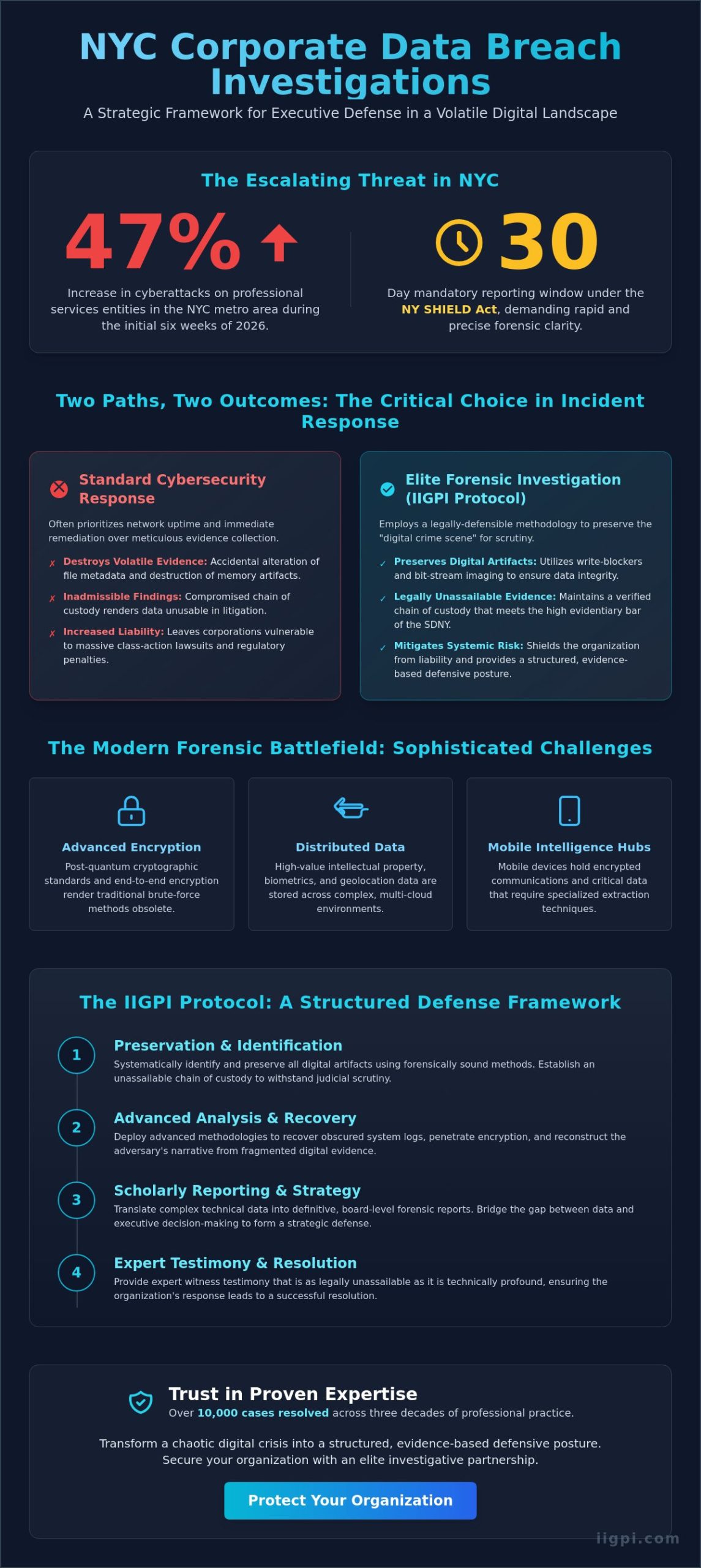
During the initial six weeks of 2026, cyberattacks targeting professional services entities within the New York metropolitan area escalated by a staggering 47 percent, a metric that underscores the profound volatility of the current digital threat landscape. For the modern executive, the realization that a corporate data breach investigation nyc has evolved into a critical instrument of risk mitigation is often accompanied by the daunting pressure of the NY SHIELD Act’s mandatory 30-day reporting window. This examination offers an authoritative analysis of the Ribacoff Protocol, an elite forensic methodology engineered to decipher the technical intricacies of contemporary encryption while shielding organizations from the specter of massive class-action liabilities.
You’ll gain a comprehensive understanding of the strategic frameworks necessary to identify sophisticated threat actors and generate definitive forensic reports suitable for rigorous board-level scrutiny. Our discourse previews the essential protocols for maintaining compliance with both state and federal evidentiary standards; this ensures that your organization’s response is as legally unassailable as it’s technically profound. By prioritizing intellectual rigor and forensic precision, we’ll explore how to transform a chaotic digital crisis into a structured, evidence-based defensive posture.
Key Takeaways
- Examine the paradigm shift in digital exfiltration and the deployment of the four-phase IIGPI Protocol as a structured framework for the mitigation of systemic corporate risk.
- Comprehend the complex jurisdictional requirements of a corporate data breach investigation nyc to ensure it’s unassailable under the rigorous New York rules of evidence.
- Discover advanced forensic methodologies designed for the recovery of obscured system logs and the penetration of end-to-end encryption within enterprise communications.
- Recognize how scholarly forensic reporting and expert witness testimony bridge the gap between technical data and executive-level strategic decision-making.
- Assess the institutional value of elite investigative partnerships by prioritizing firms that have successfully resolved over 10,000 cases during three decades of professional practice.
The Paradigm of Corporate Data Breach Investigation in the NYC Ecosystem
The nature of digital compromise has transitioned from rudimentary credential theft to sophisticated, multi-stage exfiltration campaigns that prioritize long-term persistence within a network. A formal data breach overview identifies these events as security incidents where sensitive or protected data is viewed, copied, or transmitted without authorization. In the context of a corporate data breach investigation nyc, this process is defined as the systematic identification and analysis of unauthorized network access. It’s an intellectual exercise in reconstructing an adversary’s narrative through the lens of digital artifacts. Every successful corporate data breach investigation nyc requires a synthesis of technical expertise and strategic legal foresight to withstand the scrutiny of the modern judicial system.
Within the Manhattan legal ecosystem, the intersection of digital forensics and corporate liability creates a high-stakes environment where technical findings must be beyond reproach. Standard cybersecurity firms frequently prioritize remediation and network uptime over forensic preservation. This tactical preference often leads to the accidental destruction of volatile memory or the alteration of file metadata. Such oversights render the resulting data inadmissible in formal litigation, leaving the corporation vulnerable to massive class-action liabilities. Forensic investigators, by contrast, utilize write-blockers and bit-stream imaging to ensure that the digital crime scene remains pristine for future testimony.
The NYC Legal and Regulatory Landscape
The NY SHIELD Act mandates that organizations identify breaches in the most expedient time possible, often requiring forensic clarity within 30 days of discovery. Within the Southern District of New York (SDNY), the evidentiary bar is exceptionally high. Digital evidence must be handled with a verified chain of custody to support potential criminal or civil actions. The May 2026 NYC Health + Hospitals breach, which impacted 1.8 million individuals, illustrates the catastrophic liability that follows when forensic discovery is delayed or when third-party vulnerabilities are not investigated with sufficient rigor. Regulatory compliance isn’t a passive state; it’s an active investigative requirement.
Digital Artifacts as Corporate Assets
Modern 2026 encryption standards have transformed digital artifacts into complex repositories of corporate intelligence that require specialized intervention to decrypt and analyze. High-value targets now include biometrics, granular geolocation data, and proprietary intellectual property stored across distributed cloud environments. Mobile devices have transitioned into comprehensive intelligence hubs. They hold encrypted communications that traditional tools often fail to extract. Professional computer forensics is essential to navigate these layers of security without compromising the integrity of the underlying data. By 2026, the proliferation of post-quantum cryptographic standards has made traditional brute-force methods obsolete, requiring investigators to rely on sophisticated memory forensics to retrieve plaintext data.
The IIGPI Investigative Framework: A Synthesis of Forensic Rigor and Strategic Oversight
The IIGPI Protocol represents an elite synthesis of forensic science and strategic intelligence, specifically designed to address the volatility inherent in a corporate data breach investigation nyc. Under the strategic leadership of Dan Ribacoff, the organization leverages decades of specialized law enforcement experience to navigate digital forensic challenges that typically baffle standard cybersecurity firms. This methodology isn’t merely a technical response; it’s a “Think Tank” operation where complex digital puzzles are analyzed through a lens of institutional expertise and historical precedence. By treating every breach as a unique geopolitical event, the protocol ensures that the investigation accounts for both technical anomalies and the human motivations driving the intrusion.
Lance Ribacoff further elevates this framework by integrating global agent networks, allowing for cross-jurisdictional data tracking that transcends geographical boundaries. This global perspective is essential when threat actors operate from decentralized nodes, necessitating a dynamic response that mirrors their complexity. While meeting NYS breach notification requirements remains a fundamental regulatory necessity, the IIGPI framework focuses on the private investigative protocols required to actually resolve the breach and identify the perpetrator. Organizations requiring this level of rigor often initiate corporate investigations to secure their digital perimeter and identify the provenance of an attack before liabilities escalate.
Phases of the IIGPI Protocol
Phase 1 focuses on immediate device isolation and the preservation of the digital state, ensuring that volatile data in RAM or temporary system files remains preserved for judicial review. Phase 2 involves advanced extraction methodologies, where investigators distinguish between logical data acquisition, which captures accessible files, and physical data acquisition, which retrieves raw data from the storage medium. Phase 3 enters the realm of deep-dive analysis, where experts decrypt obscured artifacts and identify ghost applications used for clandestine data exfiltration. This phase is critical for uncovering evidence that sophisticated actors believe they’ve successfully purged from the system.
The Ribacoff Methodology in Practice
The efficacy of this approach is rooted in 30 years of investigative tradecraft, which informs every aspect of modern computer forensics. It bridges the critical gap between raw data extraction and actionable corporate intelligence, providing board-level decision-makers with the clarity needed to manage reputational and legal risks. Strategic coordination between the NYC headquarters and global agents ensures that even the most fragmented digital trails are reconstructed into a cohesive narrative. This process transforms disparate logs into a definitive account of the breach, allowing corporations to move from a defensive posture to an informed, strategic response.
Navigating the Jurisdictional Imperative: Admissibility and the New York Rules of Evidence
The technical success of a corporate data breach investigation nyc is rendered inconsequential if the resulting evidence fails to meet the stringent admissibility requirements of the New York judicial system. In the high-stakes environment of Manhattan’s commercial divisions, the transition from a digital crime scene to a courtroom exhibit requires a meticulous adherence to the New York Rules of Evidence. Every byte of data retrieved must be accompanied by a comprehensive narrative that accounts for its origin, preservation, and analysis. Securing an elite private investigator nyc isn’t merely a tactical choice for discovery; it’s a strategic necessity to ensure that the evidentiary integrity of the investigation remains unassailable under judicial review.
New York courts historically rely on the Frye standard to determine the admissibility of scientific evidence, requiring that the methodologies employed are generally accepted within the relevant professional community. However, in cases involving federal jurisdictions like the Southern District of New York, the more expansive Daubert factors often apply, demanding a demonstration of peer-reviewed techniques and known error rates. A professional corporate data breach investigation nyc must therefore be conducted with a dual-track awareness of these standards. This ensures that the forensic findings can support a corporation’s defensive posture or facilitate the pursuit of damages against malicious actors without the risk of summary exclusion.
Unassailable Chain of Custody Protocols
Establishing an unassailable chain of custody requires a granular level of documentation for every physical and digital interaction with the evidence. Investigators utilize bit-stream forensic imaging and unique cryptographic hash values, such as SHA-256, to prove that the data remains identical to its original state at the moment of seizure. Any deviation in these protocols, however slight, provides opposing counsel with the leverage needed to argue for the suppression of critical evidence. Procedural errors in the NYC jurisdictional landscape are frequently the primary cause of failed litigation, making the rigorous standards of forensic preservation the foundation of any successful corporate defense.
The Forensic Report as a Legal Instrument
A scholarly forensic report serves as the primary bridge between complex binary data and the decision-makers within the legal system. It translates technical artifacts into a structured, authoritative narrative that judges, juries, and regulatory bodies can comprehend with clarity. The role of the expert witness extends beyond mere data presentation; it involves defending the investigative process against aggressive cross-examination through rigorous technical validation. Utilizing specialized computer forensics allows an organization to validate its cybersecurity safeguards while providing the definitive proof required to mitigate liability or identify internal threats with surgical precision.
Advanced Forensic Methodologies: Uncovering Exfiltrated Data and Obscured Artifacts
Sophisticated threat actors in 2026 don’t merely leave digital traces; they actively employ anti-forensic measures to obfuscate their presence. A robust corporate data breach investigation nyc must consequently move beyond surface-level log analysis to utilize data carving. This technique recovers fragmented artifacts from unallocated space on high-capacity enterprise servers. Such precision is essential when navigating end-to-end encryption in messaging platforms like Signal or WhatsApp, where ephemeral data is often leveraged to coordinate illicit exfiltration. Identifying “ghost” applications or hidden partitions requires a granular examination of system registries, ensuring that no clandestine communication channel remains unscrutinized.
The distinction between data discovery and strategic intelligence is profound. While finding a deleted file is a technical success, interpreting its role within a broader campaign of espionage provides the intellectual depth required for board-level review. This level of analysis allows investigators to reconstruct the adversary’s intent, distinguishing between random opportunistic probes and targeted intellectual property theft. It’s not enough to know that a breach occurred. One must understand the adversary’s narrative to prevent future recurrence.
Data Carving and Unallocated Space Analysis
Data carving bypasses the file system to identify file headers and footers directly within raw disk clusters, allowing for the reconstruction of fragmented documents that were intentionally purged. Establishing precise timelines of unauthorized exfiltration through metadata analysis often reveals that the breach originated through a third-party vendor’s compromised access point. Identifying these supply chain vulnerabilities is a core component of a modern corporate data breach investigation nyc. It requires a meticulous reconstruction of the file system’s state before the intrusion occurred.
Strategic Intelligence in Corporate Fraud
Many digital breaches serve as the primary mechanism for internal collusion or large-scale intellectual property theft. Applying the formal corporate fraud investigation framework ensures that digital forensics are integrated with traditional investigative tradecraft. This holistic approach is necessary to uncover the human elements of a breach while maintaining strict adherence to the legal permissions required for forensic network access. Organizations must prioritize these advanced methodologies to transform raw data into a strategic defensive asset.
Strategic Intelligence Partnerships: Why Global Corporations Mandate the IIGPI Protocol
Selecting a partner for a corporate data breach investigation nyc is a decision that fundamentally defines an organization’s long-term institutional stability and legal resilience. Global corporations and premier law firms prioritize the International Investigative Group because of its unmatched pedigree, having successfully resolved over 10,000 cases during more than 30 years of professional practice. This extensive case history provides a depth of experience that transcends theoretical cybersecurity models, offering instead a battle-tested approach to digital crisis management. The Ribacoff methodology is mandated because it doesn’t just identify technical vulnerabilities; it provides a comprehensive strategic framework that accounts for the geopolitical and socioeconomic factors influencing modern threat actors.
The institutional gravitas of the IIGPI Protocol is rooted in its dual-leadership model, which bridges the gap between traditional investigative tradecraft and sophisticated digital forensics. While many firms offer technical audits, few possess the intellectual depth required to present findings that withstand the scrutiny of Manhattan’s commercial divisions or international regulatory bodies. By maintaining a global network of agents, the firm ensures that a corporate data breach investigation nyc can follow fragmented digital trails across multiple jurisdictions without losing evidentiary integrity. This perspective is vital for organizations that operate at the highest levels of global commerce and require a partner capable of managing complex, multi-layered risks.
The Credibility of Law Enforcement Pedigree
Dan Ribacoff’s background in law enforcement provides a unique intellectual lens through which to analyze criminal digital behavior, allowing the firm to anticipate adversary movements before they escalate. This pedigree ensures that every investigation is conducted with a commitment to absolute transparency and professional conduct, mirroring the standards expected in elite governmental forums. The strategic advantage of this approach lies in the ability to synthesize binary details into a “big picture” narrative that informs executive-level decision-making. It’s this synthesis of technical precision and strategic oversight that defines the firm’s reputation as a leading authority in global investigative discourse.
Initiating the Consultation Process
The engagement begins with a rigorous assessment of the technical and legal feasibility of a forensic intervention, ensuring that the investigative goals align with the client’s specific risk profile. Every plan is customized to address the unique jurisdictional nuances of the NYC corporate landscape, providing a structured path from initial detection to final forensic reporting. This deliberate and measured rhythm ensures that all investigative actions are both purposeful and legally unassailable. For organizations facing a systemic digital crisis, the next step is to consult with International Investigative Group for an authoritative analysis of your corporate data security needs.
Strategic Resilience in the Era of Digital Volatility
The complexity of contemporary digital threats necessitates a transition from passive cybersecurity measures to active forensic rigor. A comprehensive corporate data breach investigation nyc must prioritize the preservation of digital artifacts while ensuring that every finding adheres to the stringent New York Rules of Evidence. By synthesizing advanced data carving with the strategic oversight of the IIGPI Protocol, organizations can transform a catastrophic security failure into a definitive legal and technical defense. This methodology ensures that exfiltrated intelligence is recovered and that the provenance of the attack is identified with surgical precision.
International Investigative Group offers a unique institutional pedigree, led by former law enforcement professional Dan Ribacoff and supported by over 30 years of elite investigative experience in New York City. With more than 10,000 cases successfully resolved through seamless global agent coordination, the firm provides a level of authoritative analysis that’s essential for high-level decision-makers. It’s imperative for corporations to proactively address these vulnerabilities before they manifest as systemic liabilities. You’re invited to Secure Your Corporate Intelligence with the IIGPI Protocol to fortify your organization’s digital perimeter. Achieving total operational integrity is possible when technical expertise meets strategic foresight.
Strategic Inquiries Regarding Digital Forensic Protocols
What is the primary difference between a logical and a physical extraction in cell phone forensics?
A logical extraction captures only the visible files and application data accessible through the device’s operating system API, whereas a physical extraction involves a bit-for-bit duplication of the entire flash memory. This distinction is critical for a corporate data breach investigation nyc because physical extraction allows for the recovery of deleted artifacts and hidden system data that logical methods cannot perceive. By analyzing the raw data on the storage medium, investigators can reconstruct a more comprehensive narrative of unauthorized access.
How does the NY SHIELD Act affect the timeline of a corporate data breach investigation?
The NY SHIELD Act mandates that organizations notify affected residents of a data breach no later than 30 days after the initial discovery of the incident. This regulatory constraint necessitates a compressed investigative timeline, forcing forensic teams to identify the scope of compromised data with extreme expediency to avoid significant civil penalties. Failure to provide timely notification can result in fines of up to $20 per failed instance, which underscores the importance of rapid forensic clarity.
Can deleted encrypted messages truly be recovered from a modern smartphone in 2026?
Recovery of deleted encrypted communications remains technically feasible through advanced memory forensics and the analysis of SQLite database fragments found in unallocated space. While end-to-end encryption secures data during transit, artifacts of the plaintext message often persist in the device’s volatile memory or within temporary system logs before they’re overwritten. Specialized forensic intervention is required to reconstruct these fragmented communications from high-security enterprise devices used in 2026.
Is forensic evidence gathered by a private investigator admissible in New York City courts?
Forensic evidence gathered by a licensed private investigator is fully admissible in New York City courts provided that the practitioner maintains a verified chain of custody. The methodology must meet the Frye or Daubert standards, which require a demonstration that the techniques used for data acquisition are generally accepted within the scientific community. Professional investigators ensure that the digital evidence is handled with the rigor necessary to withstand aggressive cross-examination during Manhattan legal proceedings.
What is the “Think Tank” approach used by Dan and Lance Ribacoff?
The “Think Tank” approach is a collaborative analytical framework where Dan and Lance Ribacoff synthesize traditional investigative tradecraft with high-level digital forensics to interpret the strategic motivations of threat actors. This model moves beyond simple data extraction to provide an intellectual analysis of complex digital puzzles, involving multiple experts in the reconstruction of the breach narrative. It ensures that board-level intelligence accounts for both technical anomalies and the human behaviors driving the intrusion.
How long does a comprehensive corporate data breach investigation typically take at IIGPI?
The duration of a corporate data breach investigation nyc varies depending on the complexity of the network architecture, but initial forensic clarity is often achieved within the 72-hour window required for certain regulatory reports. A full reconstruction of the event and the generation of a final scholarly report may extend over several weeks as investigators penetrate deep partitions and analyze global exfiltration trails. Each engagement is structured to meet the specific reporting deadlines mandated by New York state and federal authorities.
Who are Dan and Lance Ribacoff, and what is their role in the forensic process?
Dan Ribacoff is a former law enforcement professional who provides the strategic leadership and institutional pedigree required for high-stakes corporate investigations. Lance Ribacoff directs the technical integration of global agent networks, ensuring that digital tracking remains seamless across international jurisdictions. Their combined roles facilitate a synthesis of raw binary data into actionable intelligence, providing a unique dual-leadership model that addresses both technical and human elements of a breach.
Can IIGPI perform forensic analysis on encrypted messaging apps like Telegram or WhatsApp?
IIGPI performs sophisticated forensic analysis on encrypted messaging platforms by extracting data directly from the physical storage layer of the device, bypassing application-level encryption. This process involves analyzing database logs, media caches, and temporary system files where plaintext artifacts or metadata may reside even after a message is deleted. Such methodologies are essential for uncovering clandestine internal collusion or the unauthorized exfiltration of proprietary intellectual property.