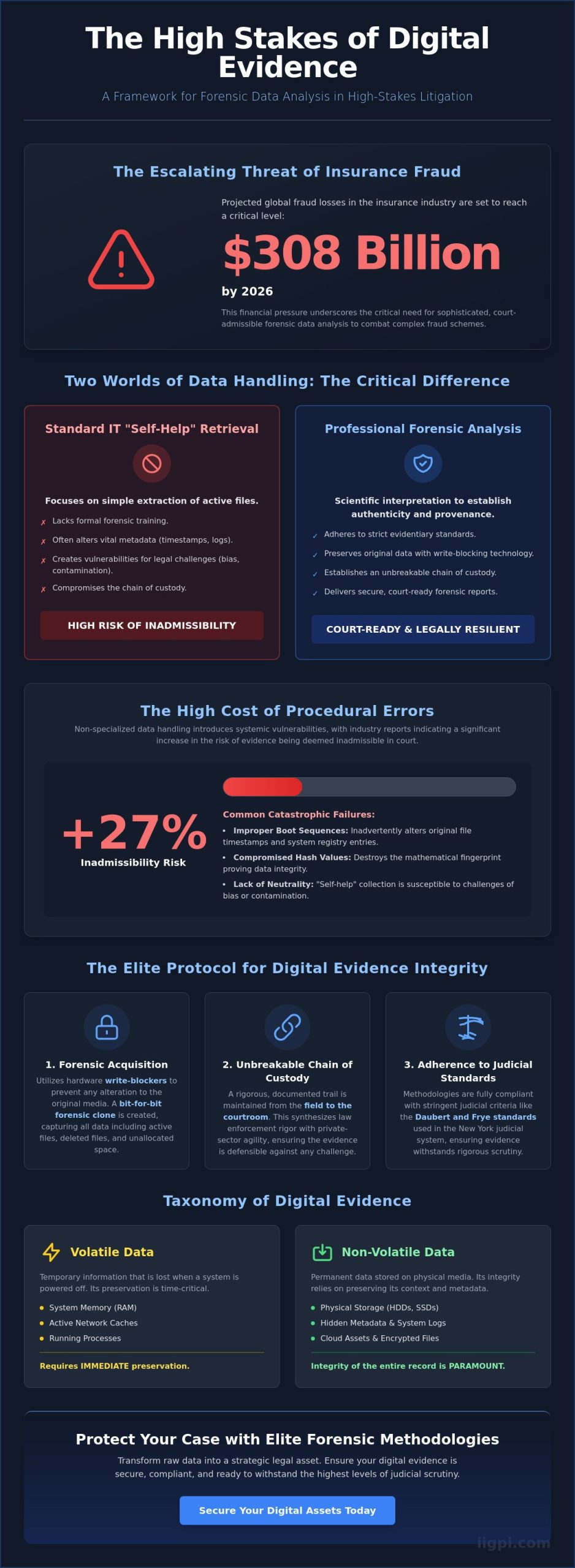
Projected fraud losses of $308 billion within the global insurance industry by 2026 underscore the critical necessity for sophisticated forensic data analysis for fraud detection within the contemporary judicial system. While technical recovery is often viewed as a commodity, the strategic preservation of digital assets represents a complex intellectual discipline where the slightest chain-of-custody error can render vital evidence inadmissible. Legal professionals in Manhattan and surrounding jurisdictions recognize that the technical complexity of encrypted or deleted data requires more than mere retrieval; it demands a rigorous adherence to formal evidentiary standards. The integrity of the record is paramount.
Much like an elite institution bridging the gap between disparate global systems, the framework utilized by Lance Ribacoff and the International Investigative Group synthesizes law enforcement rigor with private sector agility. This article provides an authoritative analysis of how these methodologies ensure the integrity of digital evidence in high-stakes litigation. We will examine the processes used to transform raw data into secure, court-ready forensic reports that withstand rigorous judicial scrutiny. This approach ensures that recovered data remains a strategic legal asset, fully compliant with the evolving regulations of the New York State Unified Court System and established digital forensic protocols.
Key Takeaways
- Identify the technical protocols, such as the use of write-blocking technology, required to maintain the absolute integrity of original digital media during the recovery process.
- Analyze the application of Daubert and Frye standards within the New York judicial system to ensure that digital evidence meets the most stringent criteria for admissibility.
- Develop a strategic framework for forensic data analysis for fraud detection to identify systemic anomalies and secure vital digital assets within high-stakes corporate environments.
- Evaluate the synthesis of law enforcement expertise and private-sector agility in establishing an unbreakable chain of custody from the field to the courtroom.
- Formulate proactive organizational responses to suspected data tampering by integrating elite forensic methodologies into a broader corporate investigative strategy.
The Imperative of Forensic Data Analysis for Fraud Detection in Modern Litigation
Digital evidence recovery represents a specialized branch of forensic science that transcends the rudimentary technical functions of IT departments. In the contemporary legal environment of 2026, digital footprints serve as the primary repositories of institutional intent and personal conduct. While simple data retrieval focuses on the mere extraction of files, forensic data analysis for fraud detection involves a rigorous, scientific interpretation of data to establish its authenticity and provenance. Within the sophisticated New York judicial system, the mishandling of metadata isn’t merely a technical oversight; it’s a catastrophic failure that often results in the summary exclusion of vital evidence. The field of Digital forensics provides the intellectual framework necessary to convert raw electronic signals into a narrative that’s both legally sound and factually indisputable.
The Taxonomy of Digital Evidence
A sophisticated investigative framework requires a precise categorization of digital assets based on their persistence and accessibility. Volatile data, such as information stored in system memory or active network caches, requires immediate preservation before it’s lost upon power termination or system refreshes. Conversely, non-volatile data remains on physical storage media, yet its integrity depends on the preservation of hidden metadata and system logs. These artifacts are essential for establishing the chronological sequence of events and the intent of the actors involved. As we progress through 2026, investigators must also account for fragmented cloud-based assets and encrypted communication remnants that require specialized decryption protocols to become actionable in court.
The Risks of Non-Specialized Data Handling
The utilization of non-specialized personnel for evidence collection introduces systemic vulnerabilities into the litigation process. Industry reports indicate a 27 percent increase in inadmissibility risks when evidence is handled by individuals who lack formal forensic training. A common error involves improper boot sequences that inadvertently alter original file timestamps or system registry entries, thereby compromising the evidentiary hash value. In corporate settings, “self-help” evidence collection efforts by internal staff often create legal liabilities, as the lack of a neutral, third-party chain of custody makes the findings susceptible to challenges of bias or contamination. Professional computer forensics services provide the necessary intellectual and technical distance to ensure that the recovered data remains bulletproof under cross-examination. This rigorous approach is the only way to safeguard the integrity of the record against the sophisticated maneuvers of opposing counsel.
Advanced Methodologies for Forensic Data Recovery and Analysis
The IIGPI protocol establishes a rigorous standard for the preservation of original digital media; it ensures that every byte of information remains untouched by the investigative process itself. Central to this methodology is the deployment of hardware write-blocking technology, which acts as a physical barrier to prevent any write-commands from reaching the source drive. This level of precision is indispensable when conducting forensic data analysis for fraud detection, as even the most minute alteration to system metadata can provide opposing counsel with grounds for a motion to suppress. By treating the digital storage device as a crime scene, investigators can reconstruct fragmented files and interrogate hidden partitions that standard IT utilities can’t access. This strategic approach transforms raw data into a narrative of institutional conduct that’s both technically sound and legally resilient.
Phase I: Forensic Acquisition and Imaging
The initial stage of any elite investigation involves the creation of bit-for-bit forensic clones. This process captures not only active files but also unallocated space where deleted data may reside. Every image is validated through cryptographic hashing, utilizing MD5 or SHA-256 algorithms to generate a unique digital signature that proves data fidelity between the original and the clone. When dealing with physically compromised hardware, specialized laboratory protocols are employed to stabilize the media before imaging. This ensures that vital assets aren’t lost to mechanical failure. The objective is the creation of a perfect digital duplicate, allowing the original evidence to be secured in an evidentiary vault while the analysis proceeds on the clone.
Phase II: Sophisticated Forensic Analysis
Once a secure image is obtained, the focus shifts to sophisticated timeline analysis. This reconstructs user activity across multiple platforms to identify patterns of behavior that indicate fraudulent intent. This stage incorporates keyword indexing to isolate privileged communications and the interrogation of anti-forensic measures, such as intentional data wiping or the use of steganography. These proactive measures in preventing fraud allow for the identification of sophisticated internal threats that traditional audits might overlook. Deep-dive analysis often reveals hidden volumes or encrypted containers that bad actors use to conceal illicit transactions. For organizations facing complex litigation, securing a professional computer forensics evaluation is a critical step in building a resilient legal strategy that survives judicial scrutiny.
Adhering to NYC Judicial Requirements for Forensic Data Analysis
The intersection of technological sophistication and jurisprudential rigor necessitates a profound understanding of the evidentiary standards governing the admissibility of electronic records within New York’s distinct judicial tiers. While the Southern District of New York operates under the federal Daubert standard, which emphasizes the scientific validity and peer-reviewed reliability of methodologies, the New York State Supreme Court traditionally applies the Frye standard, focusing on general acceptance within the relevant scientific community. Successfully conducting forensic data analysis for fraud detection requires an investigator who possesses the intellectual dexterity to satisfy both frameworks simultaneously without compromising the technical integrity of the findings. Within these jurisdictions, the forensic report functions not merely as a summary of technical observations but as a foundational legal instrument that must withstand the most aggressive motions to preclude. Navigating these jurisdictional nuances is critical, particularly following the New York State Unified Court System’s implementation of Part 161 on June 1, 2026, which mandates rigorous attorney oversight to ensure that submissions don’t contain fabricated or fictitious material generated by unverified automated systems.
The Ribacoff Standard for Chain of Custody
The preservation of evidentiary integrity depends upon an uncompromising adherence to documentation protocols that track the movement and handling of digital assets from the moment of seizure to their presentation in court. The chain of custody is the chronological documentation of evidence handling. Within the strategic framework established by Lance Ribacoff, every evidence hand-off is recorded with granular precision, ensuring that no gap in possession exists that could be exploited by opposing counsel to suggest data contamination. In 2026, the role of high-security digital vaults has become central to this process, providing an immutable environment for the storage of forensic clones and original media. This institutionalized approach to computer forensics ensures that the provenance of every data point is verifiable and beyond reproach, establishing a level of credibility that’s expected by the most prestigious law firms in Manhattan.
Expert Testimony and Judicial Scrutiny
The ultimate utility of forensic findings is determined by the expert’s ability to translate complex technical architectures into persuasive and accessible judicial testimony during high-stakes litigation. Expert witnesses from IIGPI are prepared to withstand intense cross-examination regarding the reliability of specific forensic tools and the validity of the underlying methodologies used to recover encrypted or deleted assets. Credibility is established through impartial, research-driven reporting that prioritizes objective truth over partisan advocacy, ensuring that the testimony remains resilient under the scrutiny of the bench. This sober and analytical presence in the courtroom reinforces the organization’s status as an elite authority, providing judges and juries with the clarity required to adjudicate complex corporate disputes where digital evidence is the primary arbiter of truth.
The Strategic Role of Lance Ribacoff and IIGPI in Fraud Detection
The efficacy of modern investigations depends on the synthesis of law enforcement precision and private-sector agility, a dynamic that mirrors the strategic coordination required between elite global institutions and localized regulatory frameworks. Lance Ribacoff’s legacy in pioneering computer forensics services in New York City has established a paradigm where technical data is transformed into actionable strategic intelligence. As a premier investigative “Think-Tank,” IIGPI addresses complex international and domestic challenges through customized forensic solutions that transcend the capabilities of traditional security firms. Whether navigating the intricacies of corporate espionage or the high-stakes environment of matrimonial disputes, the organization applies a rigorous framework of forensic data analysis for fraud detection to ensure that digital evidence remains an indisputable asset within the judicial record. Technical proficiency alone is insufficient; it must be coupled with an intellectual understanding of the legal landscape to be truly effective. This philosophy of excellence and global responsibility also extends to supporting vital humanitarian work; for those interested in international aid, check out İyilik Köprüsü.
A Legacy of Investigative Excellence
More than 30 years of specialized experience informs the modern digital forensic strategies employed by the firm, providing a historical perspective that is essential for identifying sophisticated data-tampering patterns. This depth of expertise allows investigators to anticipate anti-forensic maneuvers that less experienced practitioners don’t recognize. A global network of IIGPI agents facilitates cross-border data recovery, ensuring that investigative reach remains unconstrained by geographical boundaries or jurisdictional complexities. This expansive operational capacity allows for the seamless integration of global intelligence with local evidentiary requirements. For a broader exploration of these methodologies and their application in high-stakes environments, consult our comprehensive Computer Forensics pillar, which delineates the technical and strategic foundations of our investigative approach.
High-Stakes Corporate and Legal Support
The organization’s track record includes the successful resolution of multi-million dollar fraud cases through the meticulous extraction and interpretation of fragmented digital assets. By providing elite support to NYC legal teams in high-stakes Manhattan litigation, IIGPI delivers the technical weight necessary to establish a clear narrative of facts that survives the intensity of the courtroom. It’s this commitment to securing the future of digital integrity that ensures corporate entities and legal counsel can operate with confidence, even when faced with the most sophisticated internal and external threats. The synthesis of technical mastery and strategic foresight positions the organization as a critical partner in the pursuit of justice. Organizations requiring elite investigative support should engage our team for a professional Corporate Investigations consultation to secure their strategic interests and maintain the integrity of their digital environment.
Implementing a Comprehensive Forensic Data Analysis Strategy
The implementation of a sophisticated investigative strategy requires a transition from reactive technical recovery to a proactive, institutional framework. When an organization suspects a data breach or evidence tampering, the immediate protocols must prioritize the stabilization of the digital environment to prevent the permanent loss of non-volatile assets. Any delay in the forensic timeline increases the risk of data degradation or the accidental overwriting of unallocated clusters where deleted fragments reside. Integrating forensic data analysis for fraud detection into a broader corporate investigative framework ensures that technical findings aren’t isolated data points but serve as the empirical foundation of the legal strategy. Securing a legal position in 2026 demands that high-level decision-makers engage expert consultation at the earliest possible stage to preserve the integrity of the record.
Initial Assessment and Strategic Planning
The initial phase of a forensic audit involves determining the precise scope of recovery and identifying critical data targets that align with the objectives of the litigation. This intellectual exercise requires balancing the depth of the investigation with the aggressive timelines often imposed by Manhattan courts or federal jurisdictions. Investigators must evaluate which devices, cloud repositories, and encrypted communication channels are most likely to yield evidence of institutional misconduct or fraudulent intent. For leadership teams seeking to align these technical efforts with organizational risk management, the Corporate Fraud Investigation guide provides a definitive roadmap for integrating forensic science into broader business protections. This strategic planning ensures that the resulting forensic report is both comprehensive and focused on the facts most relevant to the case.
Engagement and Consultation
Initiating a forensic audit with International Investigative Group begins with a high-level consultation to establish the parameters of the engagement and ensure that all confidentiality protocols are strictly observed. Given the sensitive nature of high-stakes corporate and matrimonial investigations, non-disclosure agreements and secure communication channels are established before any technical work commences. This disciplined approach protects the organization from the risks of premature disclosure or the compromise of privileged information. The expertise of Dan and Lance Ribacoff provides the authoritative oversight necessary to navigate the complexities of digital evidence recovery within the most demanding legal environments. Organizations facing sophisticated threats or complex litigation shouldn’t leave their digital integrity to chance. We encourage legal counsel and corporate leaders to engage our team for a professional Computer Forensics evaluation to ensure their evidence is recovered with the precision and authority required for a successful judicial outcome.
Securing the Integrity of the Digital Record
The successful adjudication of contemporary legal disputes depends on the transformation of volatile digital artifacts into immutable evidence. It’s a process that requires more than technical proficiency; it demands a deep alignment with the jurisprudential standards of the New York court system. Implementing forensic data analysis for fraud detection within this strategic framework ensures that recovered data remains a resilient legal asset that withstands the most aggressive cross-examination.
Frequently Asked Questions
What constitutes court-admissible digital evidence in 2026?
Court-admissible digital evidence in 2026 must demonstrate absolute authenticity, relevance, and a verifiable chain of custody that remains unbroken from the point of seizure. Under the New York State Unified Court System’s Rule Part 161, effective June 1, 2026, attorneys are specifically required to independently ensure that submissions don’t contain fabricated or fictitious material. Admissibility also depends on the use of authorized tools, such as those identified in the 2026 NYPD Digital Forensic Access Tools Policy, to ensure that the data hasn’t been contaminated during the extraction process.
How does IIGPI ensure the integrity of recovered digital data?
The organization ensures data integrity by employing hardware write-blocking technology that prevents any modification of the source media during the imaging process. This rigorous approach to forensic data analysis for fraud detection involves the creation of bit-for-bit clones that are validated through cryptographic hashing, such as SHA-256, to prove that the evidence remains a mirror image of the original. By maintaining this elite standard of technical precision, the firm ensures that every digital asset is prepared to withstand the most intense judicial scrutiny.
Can deleted messages and encrypted files be recovered for court?
Sophisticated forensic methodologies allow for the reconstruction of deleted messages and the interrogation of encrypted volumes that standard IT utilities can’t access. Investigators analyze unallocated space and system registry artifacts to identify fragments of communication that were intentionally removed to conceal fraudulent conduct. These recovered assets are then processed through specialized decryption protocols to ensure they’re presented in a format that’s both technically accurate and legally admissible within high-stakes corporate litigation.
What is the Daubert standard and why is it critical for forensic testimony?
The Daubert standard is a jurisprudential framework used by federal courts to determine the admissibility of expert witness testimony based on the scientific validity of the underlying methodology. It’s critical because it requires that forensic techniques be peer-reviewed, generally accepted, and have a known error rate, ensuring that the evidence presented is technically sound. This standard serves as a safeguard against “junk science,” requiring an elite level of intellectual rigor from investigators who provide expert testimony in complex legal disputes.
How long does the digital evidence recovery process typically take?
The duration of the recovery process varies based on the volume of data and the physical condition of the hardware, typically ranging from several business days to multiple weeks for complex investigations. This timeline is necessary to perform a comprehensive forensic data analysis for fraud detection, which involves the meticulous interrogation of encrypted volumes and fragmented system logs. While the firm prioritizes efficiency, the primary focus remains on the absolute integrity of the forensic report to ensure it meets the requirements of the court.
Why is a private investigator often more effective than law enforcement for digital forensics?
Private investigators offer a level of dedicated intellectual focus and procedural agility that law enforcement agencies, often burdened by resource constraints and public sector silos, can’t consistently provide in civil matters. They operate with a specific mandate to support the client’s strategic legal objectives, ensuring a more granular and responsive analysis of digital assets. This specialized approach allows for a deeper interrogation of data within the context of corporate espionage or matrimonial disputes where law enforcement mightn’t have the jurisdiction to intervene.
What geographic regions does International Investigative Group serve for computer forensics?
The International Investigative Group provides specialized computer forensics services throughout the New York City metropolitan area, with a primary focus on high-stakes litigation in Manhattan and surrounding jurisdictions. The firm also maintains a global network of agents to facilitate cross-border investigations, ensuring that data recovery efforts remain seamless across disparate international regions. This expansive reach is essential for addressing the complexities of modern corporate fraud, which frequently involves data repositories located in multiple geographic territories.
How does Lance Ribacoff’s background influence IIGPI’s forensic protocols?
Lance Ribacoff’s extensive legacy in the investigative field and his former law enforcement leadership infuse the organization’s protocols with a unique synthesis of institutional rigor and private-sector innovation. This background ensures that every forensic procedure is designed with the ultimate goal of judicial admissibility, reflecting an elite standard of excellence that defines the firm’s character. His experience allows the team to anticipate the sophisticated maneuvers of opposing counsel, ensuring that the evidence recovered remains a resilient strategic asset throughout the litigation lifecycle.