
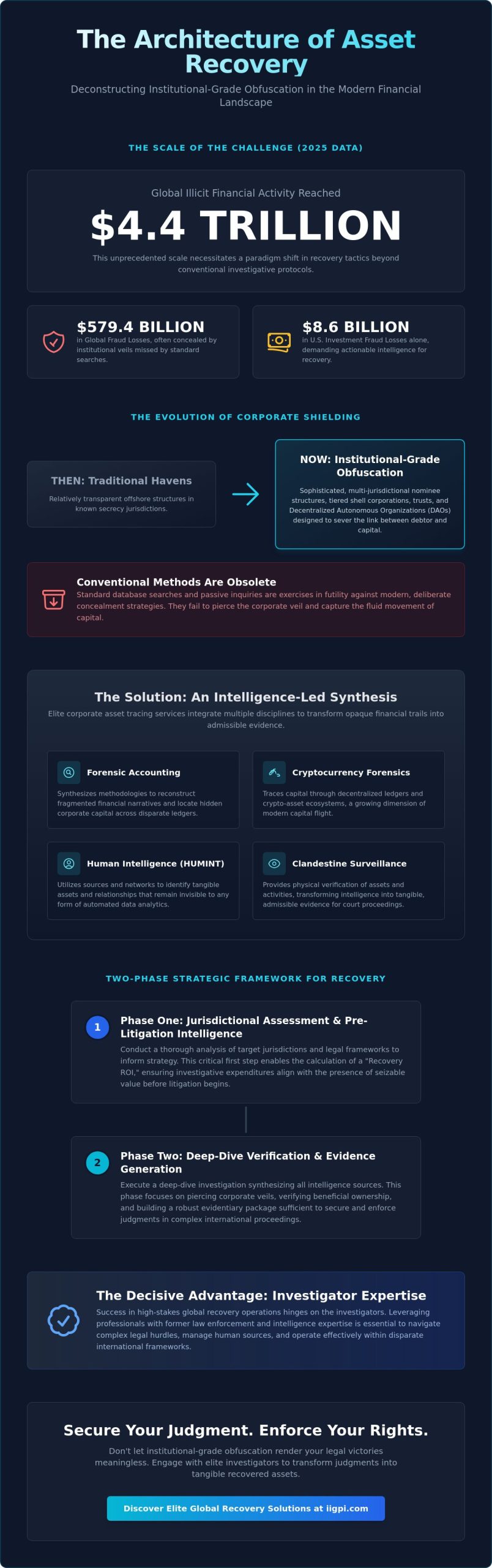
The scale of global illicit financial activity reached an unprecedented $4.4 trillion in 2025, a figure that underscores the profound systemic challenges inherent in modern capital recovery. It’s clear that conventional investigative protocols remain fundamentally inadequate when they’re confronted by the deliberate obfuscation of assets through multi-jurisdictional shell structures. This sophisticated analysis delineates the rigorous methodologies required to identify, verify, and recover obscured interests across disparate international legal frameworks. By engaging with elite corporate asset tracing services, organizations can transcend the limitations of standard database searches to secure tangible results in high-stakes litigation.
We’ll examine the synthesis of forensic accounting and human intelligence necessary to transform opaque financial trails into admissible evidence for global proceedings. This framework provides a strategic blueprint for judgment enforcement, ensuring that recovery targets aren’t merely identified but successfully liquidated within the evolving 2026 regulatory environment, including the nuanced reporting requirements for foreign entities under the Corporate Transparency Act. Through this lens, the recovery of capital becomes a disciplined exercise in institutional intelligence rather than a speculative legal pursuit.
Key Takeaways
- Analyze the evolution of institutional obfuscation from traditional havens to multi-jurisdictional nominee structures that demand a rigorous investigative response.
- Synthesize forensic accounting methodologies with cryptocurrency forensics to effectively reconstruct fragmented financial narratives and locate hidden corporate capital.
- Understand how elite corporate asset tracing services utilize clandestine surveillance and human intelligence to identify tangible assets that remain invisible to automated data analytics.
- Implement a strategic two-phase framework encompassing jurisdictional assessment and deep-dive verification to facilitate successful judgment enforcement in international proceedings.
- Evaluate the necessity of leveraging investigators with former law enforcement expertise to navigate the complexities of high-stakes global recovery operations.
The Evolution of Institutional Obfuscation and the Necessity of Tracing
Corporate asset tracing constitutes the systematic identification and verification of seizable value within increasingly intricate legal and financial frameworks. This discipline transcends mere record retrieval, functioning instead as a rigorous forensic synthesis designed to penetrate layers of intentional institutional shielding. With global illicit financial activity reaching $4.4 trillion in 2025, the scale of capital diversion has necessitated a paradigm shift in recovery tactics. We’ve witnessed a decisive shift from the relatively transparent offshore havens of the late twentieth century toward sophisticated, multi-jurisdictional nominee structures that exploit the inherent fragmentation of the global regulatory landscape. These elite corporate asset tracing services are now essential for identifying interests that are intentionally obscured through complex corporate veils.
Passive database inquiries remain fundamentally inadequate for addressing “institutional-grade obfuscation,” a term describing the deliberate use of professional intermediaries and layered entities to sever the visible nexus between a debtor and their capital. This level of concealment characterizes the majority of modern financial fraud and high-stakes commercial disputes. Standard database searches frequently miss the $579.4 billion in global fraud losses recorded in 2025 because they’re not designed to pierce institutional veils. Relying on standard electronic searches in 2026 is an exercise in futility for global recovery mandates, as these systems don’t capture the fluid movement of capital or the nuanced realities of beneficial ownership in jurisdictions that prioritize financial secrecy.
The Anatomy of Modern Corporate Shielding
Modern shielding strategies utilize tiered shell corporations and trust-based ownership models that effectively decouple legal title from beneficial control. The proliferation of decentralized autonomous organizations (DAOs) has introduced a new dimension of complexity, as these entities often lack a centralized physical presence or a traditional corporate registry. Sophisticated actors leverage these legal loopholes to construct barriers that appear non-immune to standard enforcement, requiring a sophisticated investigative approach to reveal the underlying economic reality. It’s no longer enough to identify a parent company; one must map the entire ecosystem of shadow entities that facilitate capital flight.
The Strategic Mandate for Asset Intelligence
The implementation of a strategic mandate for asset intelligence necessitates conducting pre-litigation asset searches to inform the broader legal strategy. This process enables decision-makers to calculate the “Recovery ROI,” ensuring that the expenditures associated with International asset recovery align with the presence of tangible, seizable value. In an era where investment fraud accounted for over $8.6 billion in losses in the U.S. alone during 2025, the transition from informational awareness to the generation of actionable legal evidence is paramount. Organizations seeking rigorous methodologies often turn to established institutions like IIG to facilitate this transition, ensuring that corporate asset tracing services deliver the evidentiary weight required for successful judgment enforcement in any sophisticated recovery operation.
Methodologies for Penetrating Complex Corporate Structures
The efficacy of corporate asset tracing services in 2026 depends on the investigator’s ability to deconstruct meticulously engineered financial facades. While traditional searches might identify registered property, they often fail to account for the sophisticated use of cross-border legal discovery mechanisms designed to compel institutional transparency. Effective recovery mandates require a shift from observing static records to utilizing dynamic investigative protocols that verify beneficial ownership far beyond surface-level filings, especially since a 2025 FinCEN rule exempted U.S. persons from certain reporting requirements. It’s insufficient to merely identify a legal titleholder when the true economic interest remains shielded by layers of nominee directors and discretionary trusts. Standard searches don’t account for these deep-seated layers, necessitating a more rigorous analytical framework.
Forensic Accounting and Financial Reconstruction
Digital Asset Forensics in the Corporate Sphere
As decentralized finance becomes a standard tool for institutional obfuscation, the integration of cryptocurrency forensics within traditional searches has become a non-negotiable requirement. Tracing blockchain-based transactions back to physical seizable entities requires a synthesis of distributed ledger analysis and traditional intelligence gathering. The role of computer forensics is particularly vital in this context, as it enables the recovery of deleted financial records and clandestine communications that reside within compromised hardware. Modern corporate asset tracing services must therefore account for the $20.9 billion lost to cybercrime in 2025, ensuring that digital evidence is extracted from encrypted environments to support recovery efforts. Organizations that require this level of technical sophistication often engage with IIG to ensure their investigative frameworks are robust enough to withstand the scrutiny of international legal proceedings.
The Intelligence-Led Synthesis: Human Intuition vs. Data Analytics
While the proliferation of algorithmic data processing has fundamentally altered the investigative landscape, it remains insufficient for interrogating the psychological nuances of intentional institutional fraud. Data analytics can identify anomalous patterns within vast datasets, but it’s incapable of interpreting the underlying intent or the “human element” that drives sophisticated capital diversion. In an era where 90% of financial professionals report an increase in AI-driven attacks as of 2026, the reliance on automated systems alone creates a dangerous vulnerability. Elite corporate asset tracing services recognize that high-level recovery requires a synthesis of “hard” digital evidence and “soft” human intelligence to construct a definitive recovery map. This approach ensures that investigative efforts aren’t merely reactive but are instead guided by an intellectual rigor that anticipates the debtor’s next move.
The strategic advantage of a former law enforcement perspective is particularly evident when anticipating reactionary maneuvers from sophisticated debtors during active litigation. These individuals don’t simply wait for a judgment; they actively engage in asset dissipation, often utilizing the same multi-jurisdictional structures discussed in previous sections to move capital beyond the reach of the courts. By integrating clandestine surveillance and direct source inquiries, investigators can identify tangible assets that exist outside the digital record. This synthesis allows for the transformation of abstract financial leads into admissible evidence that can withstand the scrutiny of international legal proceedings, bridging the gap between informational awareness and successful capital repatriation.
Leveraging Global Intelligence Networks
The utility of “boots-on-the-ground” agents in high-risk jurisdictions can’t be overstated when dealing with obscured corporate interests. Establishing the credibility of human sources in international corporate settings requires a level of professional discretion and regional expertise that automated tools simply don’t possess. By utilizing Professional Surveillance Services, organizations can verify the physical existence of assets and the actual activities of nominee directors. This human-centric intelligence provides the necessary context to interpret fragmented financial data, ensuring that the investigative narrative remains grounded in physical reality rather than digital obfuscation.
Anticipatory Intelligence in Asset Recovery
Anticipatory intelligence focuses on predicting asset dissipation patterns before they manifest as permanent losses. The “cat-and-mouse” dynamic between investigators and sophisticated debtors requires a proactive defense of investigative integrity. This includes the strategic use of electronic countermeasures and bug sweeps to ensure that sensitive recovery strategies remain confidential. In a landscape where global fraud losses reached $579.4 billion in 2025, protecting the secrecy of the investigative process is as critical as the tracing itself. By maintaining this high level of operational security, corporate asset tracing services can secure the element of surprise, which is often the deciding factor in successful judgment enforcement.
Strategic Protocols for Pre-Litigation and Judgment Enforcement
Successful capital recovery is predicated on a structured, multi-phased investigative protocol that begins long before a judicial filing occurs. This procedural rigor ensures that legal maneuvers aren’t merely symbolic but are directed toward verifiable, seizable interests. By utilizing professional corporate asset tracing services, organizations can ensure that their litigation strategy is grounded in the reality of seizable value. The following five phases constitute the elite framework for modern recovery:
- Phase I: Preliminary Asset Profiling and Jurisdictional Assessment to map the debtor’s global footprint and identify potential points of entry.
- Phase II: Deep-Dive Forensic Analysis and Source Verification to pierce the corporate veil and confirm beneficial ownership beyond nominee structures.
- Phase III: Evidentiary Compilation for Legal Mandates, transforming raw intelligence into court-admissible documentation and forensic reports.
- Phase IV: Strategic Coordination with Legal Counsel for Seizure, aligning investigative findings with jurisdictional enforcement mechanisms.
- Phase V: Post-Judgment Monitoring and Continuous Asset Tracing to identify newly acquired or previously undiscovered assets during the collection period.
Optimizing Pre-Litigation Due Diligence
The determination of seizable asset availability before initiating high-cost legal action is a fundamental requirement for maintaining a positive recovery ROI. This process involves a comprehensive evaluation of Asset Search and Recovery: Tracing Hidden Funds, focusing on jurisdictions that offer the greatest transparency and enforcement potential. New York City, as a global financial nexus, provides unique jurisdictional leverage; the presence of correspondent banking accounts often allows for the discovery of international transaction data that would otherwise remain shielded. Utilizing these financial hubs as investigative anchors enables corporate asset tracing services to compel a level of institutional transparency that decentralized havens cannot easily replicate.
The Mechanics of Judgment Enforcement
Identifying non-immune assets capable of satisfying complex financial judgments requires an analytical depth that transcends basic public records. Private investigators play a critical role in supporting writ of execution filings by providing the specific location and legal status of high-value interests, including real property, specialized equipment, and intellectual property rights. Judgment enforcement is the culmination of rigorous tracing, turning investigative findings into tangible financial recovery. Organizations facing complex recovery challenges should consult with our corporate investigations team to establish a definitive enforcement path. This coordination ensures that once a judgment is secured, the path to liquidation is already clearly mapped and legally substantiated.
The International Investigative Group: Elite Global Recovery Solutions
International Investigative Group (IIG) maintains an unparalleled position as a premier institution for capital recovery, underpinned by a thirty-year history of navigating the most complex financial disputes. This institutional pedigree is defined by a commitment to academic rigor and the presentation of objective, empirically verified evidence in every mandate we undertake. By leveraging corporate asset tracing services that are grounded in decades of specialized experience, IIG provides a strategic advantage that standard investigative firms can’t replicate. Our global network of agents operates within critical financial hubs to provide localized intelligence, ensuring that recovery efforts are informed by regional nuances and the latest shifts in international regulatory frameworks. We don’t just find data; we synthesize it into a definitive map for recovery.
The distinctive advantage of our organization lies in the integration of former law enforcement expertise into every high-stakes investigation. This background allows our team to anticipate the maneuvers of sophisticated debtors with a level of precision that only those who’ve operated at the highest levels of criminal justice can achieve. It’s not merely about following a paper trail. It’s about understanding the psychological and systemic mechanics of capital flight. This perspective ensures that every investigative step is taken with a view toward the ultimate goal of successful repatriation, transforming complex financial data into a coherent narrative of accountability. Our clients benefit from an elite level of intuition that’s been refined through decades of real-world application.
Unrivaled Expertise in Corporate Intelligence
Our history is marked by the successful resolution of multi-million dollar bank fraud and embezzlement cases, where the identification of seizable value required an exhaustive synthesis of diverse investigative disciplines. We integrate sophisticated polygraph testing and computer forensic services to ensure that no lead remains unexamined and no digital record remains obscured. This multi-faceted approach is detailed in The Definitive Guide to Corporate Investigations, which serves as a foundational resource for leaders facing institutional threats. By combining these technical capabilities with traditional intelligence gathering, we offer corporate asset tracing services that satisfy the most stringent evidentiary requirements of international legal proceedings, providing the intellectual depth necessary for high-stakes litigation.
Contacting the Authority in Global Asset Tracing
Engagement with an elite investigative entity must be characterized by immediate action to prevent the further dissipation of assets. As established in the strategic protocols discussed earlier, the speed at which capital can be moved across jurisdictions necessitates a proactive and confidential response. Organizations seeking to secure their financial interests should initiate your confidential corporate inquiry with International Investigative Group to establish a rigorous path toward recovery. Our team is prepared to conduct a comprehensive assessment of your specific mandate, ensuring that the transition from loss to liquidation is managed with the professional discretion and analytical precision that your case requires. Time is the ally of the debtor; decisive intelligence is the ally of the creditor.
Securing Capital in an Era of Institutional Obfuscation
The identification of seizable value in the 2026 regulatory landscape requires more than rudimentary database queries. Organizations must adopt a synthesized approach that merges forensic accounting with human intelligence to penetrate the sophisticated multi-jurisdictional veils that shield illicit capital. By establishing a rigorous evidentiary nexus through elite corporate asset tracing services, creditors can transform fragmented financial leads into actionable legal targets. This disciplined process ensures that recovery efforts aren’t merely reactive but are instead directed toward tangible assets that can satisfy a final judgment. It’s the difference between a symbolic victory and the actual repatriation of lost capital.
International Investigative Group offers a sophisticated framework for global recovery, drawing upon over 30 years of elite investigative experience. Founded by former law enforcement professionals, our institution leverages a global network of specialized agents to provide localized intelligence in the most critical financial hubs. This synthesis of institutional knowledge and technical expertise is essential for navigating the “cat-and-mouse” dynamics of modern asset dissipation. We encourage high-level decision-makers to secure your institutional assets with the expertise of International Investigative Group to ensure the integrity of their recovery mandates. Decisive action remains the most effective deterrent against the deliberate concealment of corporate capital.
Frequently Asked Questions
What is the primary difference between a basic asset search and corporate asset tracing?
Basic asset searches typically involve the retrieval of accessible public records, while corporate asset tracing services constitute a rigorous forensic synthesis designed to penetrate intentional institutional obfuscation. This process transcends simple data collection by identifying the underlying economic reality that’s frequently shielded by multi-layered shell structures and nominee directors. It’s a method of reverse-engineering financial narratives to reveal beneficial ownership that remains invisible to standard inquiries.
Can corporate asset tracing services identify assets hidden in offshore jurisdictions?
Professional tracing protocols are specifically designed to identify interests obscured within international financial havens. By utilizing global intelligence networks and localized source inquiries, investigators can reveal the nexus between a debtor and their capital in jurisdictions that prioritize financial secrecy. This often involves leveraging correspondent banking data and cross-border discovery mechanisms to compel a level of transparency that decentralized structures attempt to avoid.
How long does a comprehensive corporate asset tracing investigation typically take?
The duration of an investigation is contingent upon the complexity of the corporate shielding and the number of jurisdictions involved. While preliminary asset profiling may be completed within several weeks, a deep-dive forensic analysis often requires several months of sustained effort. This measured pace ensures that the resulting evidence is sufficiently robust to withstand the scrutiny of international legal proceedings and support judgment enforcement mandates.
Is the evidence gathered during asset tracing admissible in international courts?
Evidence gathered through professional tracing is admissible provided it’s collected in accordance with established forensic standards and jurisdictional legal requirements. Maintaining a definitive chain of custody and documenting the methodology used to reconstruct financial narratives is essential for transforming raw intelligence into court-ready evidence. This evidentiary rigor is what allows organizations to successfully secure writs of execution and other judicial enforcement tools.
What types of assets can be identified through professional corporate tracing?
Tracing identifies a broad spectrum of seizable interests, including real property, specialized equipment, intellectual property rights, and correspondent bank accounts. Investigators also focus on intangible interests and “lifestyle indicators” that serve as proxies for hidden corporate wealth. By mapping these diverse assets, corporate asset tracing services provide a comprehensive recovery map that accounts for both physical and digital capital across international borders.
How does cryptocurrency impact the modern corporate asset tracing process?
The rise of decentralized finance necessitates the integration of blockchain forensics to identify capital diverted through distributed ledgers. With cybercrime losses reaching $20.9 billion in 2025, de-anonymizing these transactions is a critical component of the modern recovery process. Investigators must bridge the gap between anonymous digital wallets and the physical entities that control them to ensure that digital assets can be successfully liquidated.
Why is a former law enforcement background critical for high-stakes asset recovery?
Professionals with a law enforcement background possess an investigative intuition that’s essential for anticipating the reactionary maneuvers of sophisticated debtors. This experience allows them to predict asset dissipation patterns and maintain operational security through electronic countermeasures. Their ability to interpret the psychological nuances of intentional fraud ensures that the investigative strategy remains proactive rather than merely reactive during high-stakes litigation.
What is the cost structure for elite corporate asset tracing services?
The financial commitment for elite investigative mandates is generally determined by the jurisdictional scope and the depth of forensic reconstruction required. Factors such as the complexity of the shell structures and the necessity for localized human intelligence agents influence the overall resource allocation. This tiered approach ensures that the expenditure remains aligned with the potential recovery ROI, focusing efforts on the most viable seizable targets.