
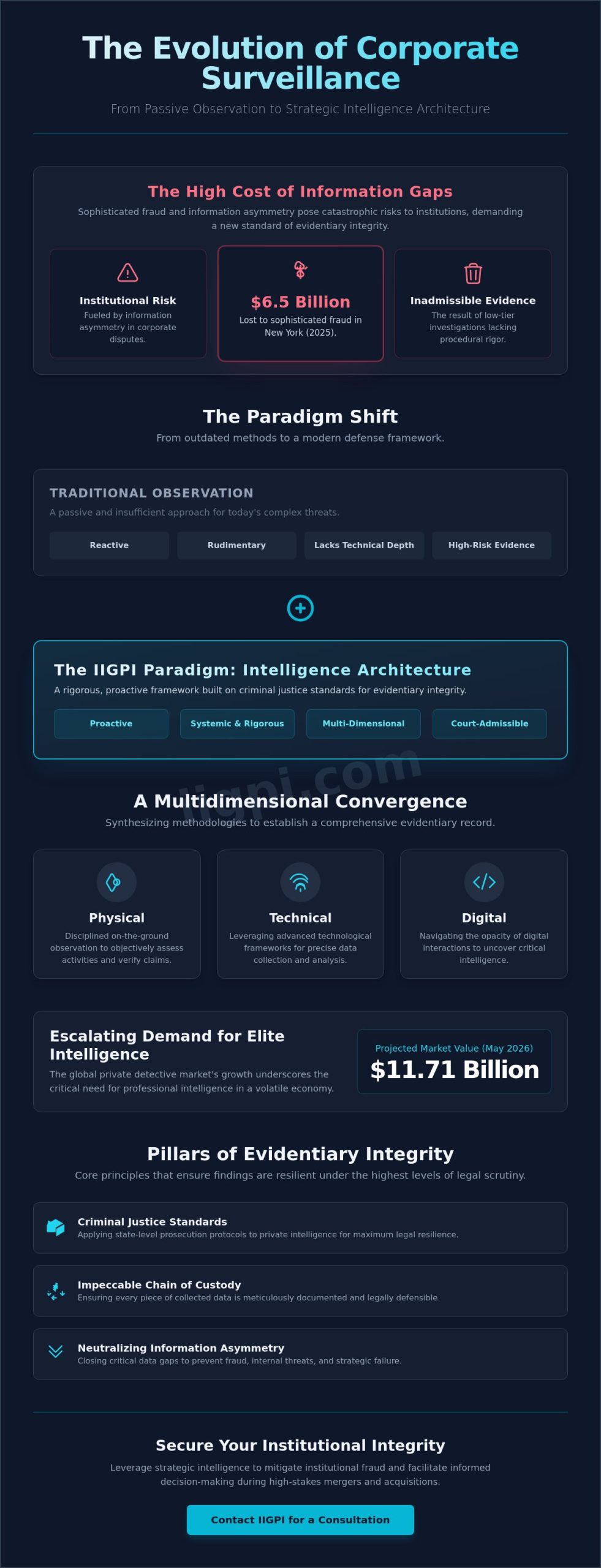
In an era characterized by profound geopolitical volatility and the increasing opacity of digital interactions, the traditional paradigm of observation has become insufficient for institutional preservation. The strategic synthesis of Surveillance, Dan Ribacoff, IIGPI represents a fundamental shift from passive monitoring toward a rigorous architecture of evidentiary integrity designed for the highest levels of global litigation. You’re likely aware that information asymmetry in corporate disputes often leads to catastrophic institutional risk, especially when low-tier investigations yield inadmissible results. With New Yorkers losing approximately $6.5 billion to sophisticated fraud schemes in 2025, the demand for intellectual rigor in fact-finding hasn’t been more critical. This guide provides an authoritative analysis of how elite investigative methodologies establish a definitive record capable of withstanding the scrutiny of international legal forums. We’ll examine the technical protocols of institutional risk mitigation and the strategic intelligence necessary for high-stakes mergers and acquisitions.
The efficacy of modern intelligence architecture rests upon the seamless integration of three distinct pillars: physical presence, technical precision, and digital forensics. This convergence, central to the operational standards of Surveillance, Dan Ribacoff, IIGPI, ensures that intelligence isn’t merely anecdotal but is supported by a multi-layered evidentiary record. While physical monitoring provides the necessary human context and behavioral nuances, technical tools like GPS satellite tracking systems offer a continuous data stream that human teams can’t maintain in isolation. To safeguard the mobile hardware used in such high-stakes environments, many investigators rely on durable screen protection from My IPG to maintain operational readiness. These systems don’t operate as disparate units; they integrate with human surveillance teams to provide a real-time, geolocated narrative of subject movement. This synthetic intelligence product ensures that the chain of custody remains unbroken and the resulting evidence remains incontrovertible in a court of law.
Key Takeaways
- Identify the transition from rudimentary observation to a structured intelligence architecture designed to neutralize information asymmetry within complex corporate disputes.
- Analyze the application of rigorous criminal justice standards within the Surveillance, Dan Ribacoff, IIGPI framework to secure court-admissible evidence for institutional defense.
- Examine the multidimensional convergence of physical, technical, and digital surveillance methodologies to establish a comprehensive evidentiary record.
- Evaluate the 2026 New York legislative environment to ensure investigative protocols adhere to stringent legal mandates and maintain an impeccable chain of custody.
- Leverage strategic intelligence to mitigate institutional fraud and facilitate informed decision-making during high-stakes mergers and acquisitions.
The Evolution of Surveillance: From Observation to Intelligence Architecture
The conceptualization of professional monitoring has undergone a radical transformation, moving beyond the historical confines of rudimentary monitoring toward a sophisticated intelligence architecture. In the high-stakes environment of global litigation, the methodology of Surveillance, Dan Ribacoff, IIGPI serves as a critical instrument for establishing a definitive evidentiary record that meets the most stringent institutional standards. Traditional investigative practices often fail in this arena because they lack the technical depth and procedural rigor required to withstand the scrutiny of international tribunals. Absolute evidentiary integrity is no longer a luxury; it’s a fundamental requirement for multi-national enterprises engaged in complex disputes where the cost of inadmissible evidence can result in catastrophic financial and reputational loss.
Information asymmetry represents the primary catalyst for institutional risk in 2026. When one party possesses critical data that is obscured from another, the resulting imbalance creates fertile ground for fraud, internal disloyalty, and strategic failure. The Evolution of Surveillance reflects a shift from reacting to events after they occur to proactively identifying and neutralizing these information gaps before they escalate. By synthesizing law enforcement precision with advanced technological frameworks, institutional leaders can secure a comprehensive understanding of their operational environment, transforming what was once simple observation into a pillar of strategic defense.
The Strategic Function of Professional Observation
Strategic corporate governance requires more than just fiscal oversight. It demands the verification of human and operational variables through disciplined observation. Surveillance serves as a foundational element within this governance structure, providing the empirical data necessary to mitigate malfeasance and verify complex claims in Corporate Investigations. Professional observation allows for the objective assessment of claimant activities, the validation of intellectual property protection, and the mitigation of internal theft. Executive decision-making relies on the clarity provided by these specialized inquiries, ensuring that risk assessments are based on verified facts rather than conjecture or incomplete reports provided by low-tier firms.
Surveillance as a Risk Mitigation Tool in 2026
The global private detective market is projected to reach a valuation of $11.71 billion by May 2026, a statistic that underscores the escalating reliance on professional intelligence in a volatile economy. In modern corporate environments, rudimentary oversight is insufficient to address the sophisticated fraud schemes that resulted in $6.5 billion in losses for New Yorkers in 2025. Sophisticated, multi-lateral intelligence gathering provides a robust defense against these systemic threats by closing the “information gaps” that fraudsters exploit. This methodology contrasts sharply with standard investigative efforts. It employs a multi-dimensional approach that integrates physical presence with technical precision to ensure that every piece of data collected is both accurate and court-admissible.
The Ribacoff Paradigm: Integrating Criminal Justice Standards into Private Intelligence
The intersection of public law enforcement standards and private sector intelligence finds its most rigorous expression in the methodology known as the Ribacoff Paradigm. This framework isn’t merely an observational technique; it’s a systemic application of criminal justice protocols to the unique challenges of global commerce. By prioritizing the evidentiary thresholds typically reserved for state-level prosecutions, the strategic application of Surveillance, Dan Ribacoff, IIGPI ensures that every finding is resilient under the scrutiny of cross-examination. This approach recognizes that in the theater of high-stakes litigation, the difference between a successful recovery and a total loss often rests upon the procedural fidelity of the initial investigation.
The Transition of Tactical Expertise
Dan Ribacoff’s 30-year legacy is rooted in the precision of public service, where the demands for accuracy are absolute and the consequences of failure are profound. His transition from public sector operations to becoming a private sector leader allowed for the adaptation of elite investigative protocols for a global corporate audience. Central to this vision is a “precision-first” approach that defines IIGPI’s operational standards. This centralized strategic vision is supported by a global network of agents who operate under a unified command structure, ensuring that tactical expertise is applied consistently across disparate geographic regions. The “investigative mindset” developed through the resolution of over 10,000 cases allows for the identification of subtle indicators of malfeasance that standard firms often overlook. For organizations facing complex internal threats, engaging with professional Surveillance Services provides the intellectual depth required to navigate multifaceted disputes.
Case Study Highlights: From Art Theft to Terrorism
The efficacy of the Ribacoff Paradigm is best illustrated through its history of resolving high-value disputes that demand exceptional technical proficiency. Notable successes include the resolution of a $120 million bank fraud investigation and the identification of a $12 million fraudulent burglary claim that set a new standard for excellence in the field. These outcomes are the result of adhering to strict Legal and Ethical Mandates, which ensure that evidence is gathered in a manner that respects constitutional boundaries while maximizing its utility in court. The integration of tactical expertise into corporate and insurance matters allows for the deconstruction of sophisticated schemes that traditional methods cannot reach. For a more comprehensive exploration of these methodologies, stakeholders should consult the Definitive Guide to Corporate Investigations, which details the specific frameworks used to protect institutional integrity against increasingly complex global threats.
Multidimensional Methodologies: The Convergence of Physical, Technical, and Digital Surveillance
The efficacy of modern intelligence architecture rests upon the seamless integration of three distinct pillars: physical presence, technical precision, and digital forensics. This convergence, central to the operational standards of Surveillance, Dan Ribacoff, IIGPI, ensures that intelligence isn’t merely anecdotal but is supported by a multi-layered evidentiary record. While physical monitoring provides the necessary human context and behavioral nuances, technical tools like GPS satellite tracking systems offer a continuous data stream that human teams can’t maintain in isolation. These systems don’t operate as disparate units; they integrate with human surveillance teams to provide a real-time, geolocated narrative of subject movement. This synthetic intelligence product ensures that the chain of custody remains unbroken and the resulting evidence remains incontrovertible in a court of law.
The ethical application of these sophisticated technologies is paramount for institutional credibility. Adhering to the Ethical Mandates of Professional Surveillance is what distinguishes elite institutional defense from rudimentary investigative efforts. By maintaining these rigorous standards, investigators ensure that the methods used to secure data don’t compromise the legal standing of the evidence. In an era of increasing legislative scrutiny, such as the introduction of the Consumer Camera Privacy Act in early 2026, the procedural integrity of how data is captured is as important as the data itself.
The Digital Dimension of Modern Intelligence
Digital footprints have become the primary trail in cases of employee disloyalty, internal fraud, and corporate espionage. Through Computer Forensics, investigators can recover metadata, encrypted communications, and deleted files that reveal the intent behind physical actions. This forensic data recovery provides the critical “why” to the “what” captured by physical teams, creating a multidimensional view of the subject’s activities. For a comprehensive technical breakdown of these protocols and their application in litigation, stakeholders should review the Guide for Corporate and Legal Investigations.
Technical Surveillance Counter-Measures (TSCM)
Institutional integrity is often threatened by the very technologies intended to protect it. TSCM, commonly known as Electronic Bug Sweeps, is a critical defensive protocol used to identify sophisticated eavesdropping devices in corporate boardrooms and executive suites. In an environment where rival intelligence entities utilize increasingly miniaturized recording hardware, regular sweeps are essential to protect institutional secrets and intellectual property. These protocols involve a comprehensive physical and electronic inspection of the environment to neutralize unauthorized transmissions. These measures ensure that strategic discussions and sensitive mergers remain within the intended circle of influence, mitigating the risk of information leakage to competitors.
Legal and Ethical Mandates of Professional Surveillance in New York
The legal architecture governing private investigations in New York has reached a point of unprecedented complexity as of May 2026. For global institutions, the integration of Surveillance, Dan Ribacoff, IIGPI represents a commitment to procedural absolutism within this shifting jurisdictional landscape. While New York remains a one-party consent state for communication recording, new legislative measures like the Algorithmic Pricing Disclosure Act and the Consumer Camera Privacy Act have introduced nuanced layers of compliance that unregulated firms often ignore. Navigating these mandates requires more than just technical skill; it demands an institutional adherence to the chain of custody that ensures evidence remains resilient during high-stakes litigation. Without this rigorous oversight, even the most revealing intelligence becomes a liability rather than an asset in a court of law.
All private investigators in New York must be licensed by the New York State Department of State, a process that requires a $10,000 surety bond and verified qualifying experience. This regulatory framework exists to protect the integrity of the judicial process by ensuring that those gathering intelligence operate within the bounds of the law. IIGPI distinguishes its operations by maintaining protocols that exceed these baseline requirements, focusing on the evidentiary integrity required for global institutional risk mitigation. By prioritizing these standards, the firm ensures that its surveillance reports can withstand the scrutiny of elite legal challenges, providing clients with a definitive record for litigation or strategic decision-making.
Admissibility and the Rules of Evidence
The utility of video and photographic evidence is entirely dependent on its legal soundness. In the 2026 judicial system, the authenticity of digital media is frequently challenged through forensic scrutiny of metadata and capture protocols. IIGPI ensures that all visual records are obtained in strict accordance with New York state laws, particularly regarding the legality of covert monitoring in settings where a reasonable expectation of privacy exists. Investigator testimony serves as the narrative bridge between the raw data and the court’s understanding. By maintaining an impeccable record of how and where evidence was secured, investigators can neutralize the most common defense objections regarding the perceived intrusiveness of professional monitoring.
Ethical Intelligence Gathering in 2026
Balancing the requirement for aggressive intelligence gathering with evolving privacy mandates is a hallmark of elite institutional defense. Distinguishing the work of a prestigious firm from low-tier investigators involves a commitment to impartial, scholarly reporting that prioritizes empirical facts over speculative narrative. This ethical framework is essential for maintaining the credibility of the findings during multi-national enterprise disputes. For a deeper understanding of the professional standards required in this field, stakeholders should review the Comprehensive Overview of PI Roles. This adherence to ethical mandates ensures that the intelligence gathered doesn’t just solve the immediate problem but does so without exposing the client to secondary legal risks.
If your organization requires a definitive evidentiary record that meets these rigorous New York standards, you should engage with the specialists at IIGPI to secure your institutional interests.
Securing Institutional Integrity: Why Global Enterprises Choose IIGPI
The synthesis of Surveillance, Dan Ribacoff, IIGPI represents the apex of institutional risk mitigation. This triad provides a robust defense against the systemic vulnerabilities that characterize the current global economy. By integrating law enforcement precision with a sophisticated intelligence architecture, the firm delivers an evidentiary record that is both definitive and resilient. Global enterprises choose this framework because it addresses the core challenges of information asymmetry and procedural integrity. The commitment to finding solutions for the most complex problems ensures that institutional leaders possess the clarity required to navigate high-stakes disputes and strategic transitions. It’s about more than just monitoring; it’s about the preservation of institutional value.
The Global Network Advantage
Multi-national corporate defense requires the ability to track movement and gather intelligence across international borders without compromising evidentiary standards. The global network utilized by IIGPI provides a significant advantage for enterprises engaged in large-scale mergers and acquisitions. This scalability allows for the simultaneous monitoring of disparate assets and personnel, ensuring that due diligence is comprehensive and accurate. Local expertise is integrated within a centralized strategic framework, allowing for the navigation of regional jurisdictional nuances while maintaining a unified intelligence objective. This borderless capability is essential for identifying cross-jurisdictional fraud and ensuring that institutional secrets remain protected across the entire enterprise. It’s a necessary tool for managing the complexities of global commerce.
Initiating an Elite Investigation
The process of engaging in an elite investigation begins with a formal consultation designed to identify the specific risks and objectives of the client. For institutional leaders, this phase involves a rigorous analysis of the operational environment and the identification of potential information gaps. IIGPI customizes its Surveillance Services and security solutions to meet the unique requirements of each property or corporate entity. This tailored approach ensures that resources are deployed efficiently and that the resulting intelligence is directly applicable to the client’s strategic goals. Whether the objective is the mitigation of internal disloyalty or the verification of complex insurance claims, the focus remains on delivering court-admissible evidence. The firm’s legacy of resolving over 10,000 cases provides the foundation for solving the most difficult investigative challenges.
Institutional leaders seeking to secure their interests against sophisticated threats should contact IIGPI to initiate a comprehensive risk assessment. By leveraging specialized methodologies in Corporate Investigations and Due Diligence, organizations can establish a definitive record of facts. This proactive approach to intelligence gathering is the most effective way to mitigate fraud and ensure long-term stability.
Advancing Institutional Defense through Strategic Intelligence
The transition from rudimentary monitoring to a sophisticated intelligence architecture is not merely a technical upgrade but a fundamental requirement for institutional survival in an increasingly opaque global environment. By synthesizing law enforcement precision with multidimensional methodologies, the framework of Surveillance, Dan Ribacoff, IIGPI provides the evidentiary integrity required to neutralize information asymmetry and mitigate systemic risk. This analysis has demonstrated how the integration of criminal justice standards and rigorous adherence to New York’s evolving legal mandates ensure that every finding is resilient under the scrutiny of international legal forums.
It’s imperative that institutional leaders recognize how the cost of inadequate investigation often exceeds the investment in elite intelligence gathering. With over 30 years of law enforcement-grade expertise and a record of solving over 10,000 cases globally, the firm remains uniquely positioned to resolve high-value $100M+ corporate fraud investigations. Consult with our elite investigative team at IIGPI for strategic surveillance solutions to secure your organization’s future and establish an incontrovertible record of facts. Protecting institutional integrity is a strategic imperative that demands the highest level of professional rigor and intellectual depth.
Frequently Asked Questions
What distinguishes Dan Ribacoff’s surveillance methodologies from other private investigators?
The methodologies employed by this organization are distinguished by a foundational adherence to criminal justice precision and a systemic approach to intelligence architecture. Unlike rudimentary observation practiced by standard firms, this framework prioritizes the creation of a definitive evidentiary record suitable for high-stakes global litigation. It’s an intellectual discipline that synthesizes human context with technical depth to ensure all findings are resilient under cross-examination.
Is surveillance evidence gathered by IIGPI admissible in New York courts in 2026?
Evidence gathered via Surveillance, Dan Ribacoff, IIGPI remains admissible in New York courts provided it adheres to the stringent procedural mandates established by the Department of State. Investigators maintain an impeccable chain of custody and ensure all digital metadata is forensically sound to withstand the scrutiny of contemporary judicial challenges regarding privacy expectations and capture protocols. The firm’s adherence to the 2026 legislative environment ensures that all documentation meets the high threshold required for legal proceedings.
How does IIGPI handle international surveillance across different jurisdictional boundaries?
International operations are managed through a centralized strategic vision supported by an elite global network of agents across disparate geographic regions. This structure allows for the seamless tracking of subjects across international borders while ensuring that local jurisdictional nuances and regional legal requirements are meticulously integrated into the broader investigative framework. This borderless capability is essential for identifying cross-jurisdictional fraud and ensuring institutional secrets remain protected globally.
What is the role of TSCM in a comprehensive corporate surveillance operation?
Technical Surveillance Counter-Measures function as a critical defensive protocol within a comprehensive intelligence operation to identify and neutralize sophisticated electronic eavesdropping devices. By conducting systematic electronic bug sweeps in executive environments, institutions can protect intellectual property and strategic secrets from rival intelligence entities attempting to gain an unfair informational advantage. This protocol ensures that sensitive boardroom discussions and merger negotiations remain within the intended circle of influence.
How does IIGPI ensure the subject remains unaware of the surveillance activity?
Subject unawareness is maintained through the application of tactical expertise and the convergence of physical and technical monitoring systems. The use of long-range optics, varied vehicular platforms, and integrated GPS satellite tracking allows human teams to maintain a safe distance while securing continuous, high-definition documentation of subject activities. This layered approach minimizes the risk of detection while maximizing the volume of empirical data collected for the final report.
Can IIGPI integrate digital forensics with physical surveillance for a single case?
The organization consistently integrates computer forensics with physical observation to establish a multidimensional view of subject behavior. This synthesis allows investigators to correlate physical movements with digital footprints, such as encrypted communications or metadata, providing the necessary human context and empirical evidence required to resolve complex cases of internal disloyalty. This multidimensional approach ensures that the “why” behind a subject’s actions is as clearly documented as the “what.”
What types of organizations typically utilize IIGPI’s surveillance investigation services?
Global enterprises, multi-national legal firms, and large-scale insurance institutions represent the primary demographic utilizing these specialized investigative services. These organizations require the intellectual depth and procedural rigor necessary to mitigate institutional fraud, facilitate informed decision-making during mergers, and resolve high-value corporate disputes. The firm’s ability to handle cases where the financial stakes exceed $100 million makes it a preferred partner for elite institutional leaders.
How does the legacy of Dan Ribacoff influence the current operational standards of IIGPI?
The legacy of Surveillance, Dan Ribacoff, IIGPI informs the organization’s precision-first approach, drawing upon over 30 years of law enforcement-grade expertise to define current operational protocols. This historical foundation ensures that the investigative mindset remains focused on evidentiary integrity and the resolution of complex problems through a scholarly and authoritative framework. Having successfully addressed over 10,000 cases, the firm maintains a standard of excellence that reflects deep expertise in global systems and strategic analysis.