
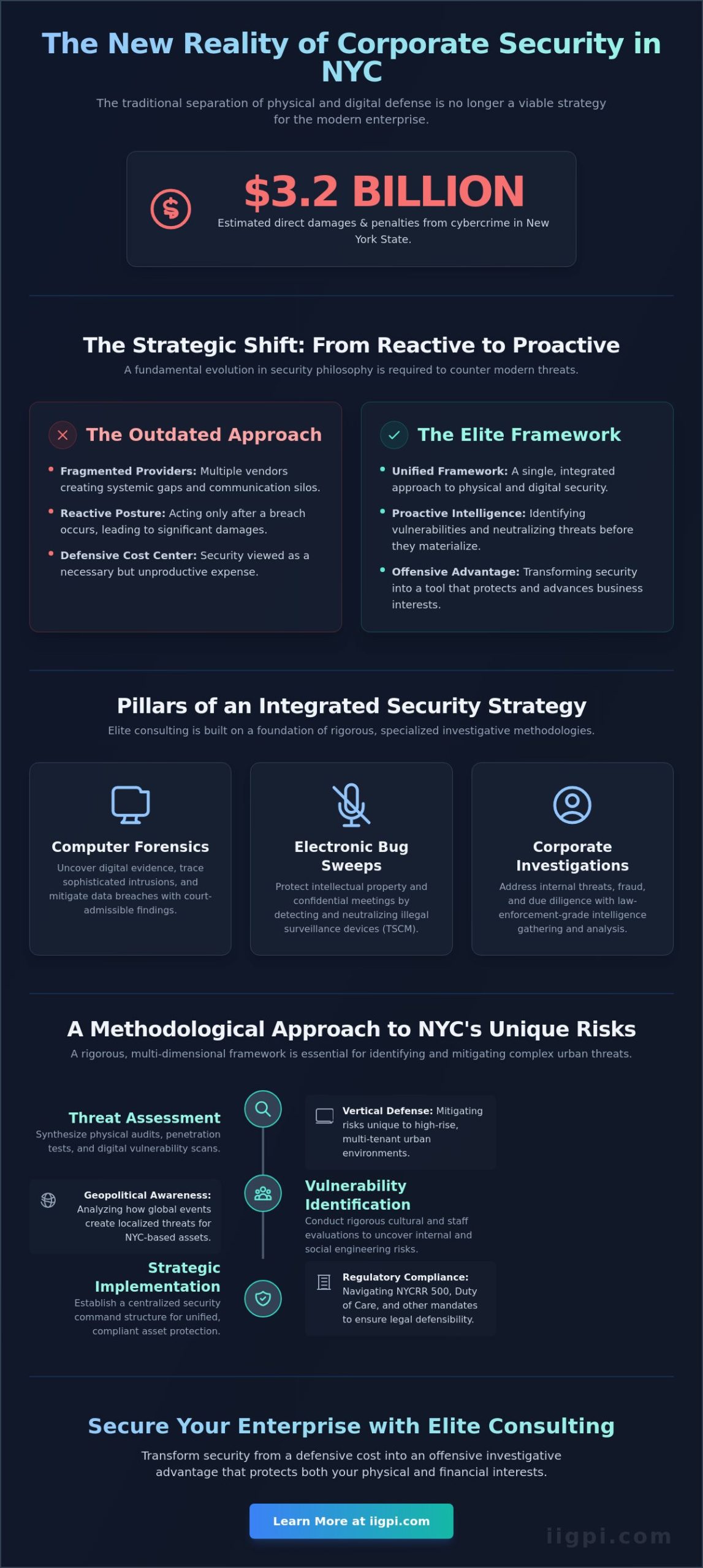
While the Manhattan skyline projects an image of impenetrable corporate power, the reality is that cybercrime alone accounted for an estimated $3.2 billion in direct damages and penalties across New York State in recent years. This staggering figure underscores a critical vulnerability where the traditional separation of physical and digital defense is no longer a viable strategy for the modern enterprise. Sophisticated organizations recognize that managing fragmented security providers while attempting to adhere to the rigorous demands of New York Department of Financial Services Cybersecurity Regulation 23 NYCRR 500 creates a precarious environment. Consequently, the necessity for elite corporate security consulting nyc has evolved from a peripheral concern to a central pillar of institutional stability.
Security consulting improves a firm’s insurance risk profile by providing empirical evidence of proactive risk mitigation and institutional hardening. Underwriters often view the implementation of professional investigative protocols and comprehensive vulnerability assessments as indicators of reduced liability. For companies managing complex logistics, these security standards are often a prerequisite for obtaining Commercial Trucking Insurance. This demonstrable commitment to security can lead to more favorable terms and lower premiums by aligning the firm’s operations with industry-standard risk management principles. It transforms security into a measurable financial advantage.
This analysis provides an authoritative exploration of how a unified framework can bridge systemic gaps by synthesizing elite investigative protocols with sophisticated risk mitigation strategies. We’ll examine the integration of computer forensics, electronic bug sweeps, and specialized corporate investigations to establish a robust posture against increasingly sophisticated espionage. By aligning law-enforcement-grade intelligence with strategic asset protection, decision-makers can transform security from a defensive cost into an offensive investigative advantage that secures both physical and financial interests.
Key Takeaways
- Analyzes the critical transition from traditional reactive protection to a proactive risk intelligence model tailored for the unique socioeconomic dynamics of the New York financial sector.
- Demonstrates why effective corporate security consulting nyc must integrate professional investigative methodologies, such as computer forensics and electronic bug sweeps, to mitigate sophisticated corporate espionage.
- Outlines a methodological approach to multi-dimensional threat assessments that identifies institutional vulnerabilities through a rigorous combination of physical audits and cultural staff evaluations.
- Provides a strategic framework for establishing centralized security command structures that ensure regulatory compliance and unified asset protection across diverse metropolitan locations.
- Evaluates the efficacy of employing law-enforcement-grade intelligence and sophisticated surveillance protocols to secure high-value corporate assets against multifaceted physical and financial risks.
The Evolving Landscape of Corporate Risk in the New York Metropolitan Area
The conceptualization of security within the New York metropolitan area has undergone a radical transformation, evolving from a peripheral administrative function into a core strategic imperative. Professional corporate security consulting nyc now operates at the intersection of global financial intelligence and localized tactical defense. By 2026, the traditional model of reactive posture has been largely superseded by proactive risk intelligence frameworks that prioritize the early detection of systemic vulnerabilities. These frameworks rely on established risk management principles to address a spectrum of threats that range from unauthorized physical intrusions to the sophisticated infiltration of corporate data through social engineering and technical surveillance. Manhattan’s verticality complicates defense. It’s no longer sufficient to secure the perimeter; consultants must now scrutinize internal workflows and digital footprints to identify indicators of corporate espionage that could compromise institutional integrity.
New York’s status as a premier global financial hub makes its corporate infrastructure a primary target for actors seeking to disrupt economic stability or misappropriate high-value intellectual property. Effective consulting must account for these NYC-specific threat vectors by implementing multi-layered investigative protocols. The shift toward proactive intelligence means that firms don’t wait for a breach to occur. Instead, they utilize specialized investigative expertise to map out potential points of failure within their organizational structure. This transition is driven by the realization that physical security and digital forensics are no longer separate domains but are deeply interconnected components of a unified institutional defense strategy.
Macro-Level Systemic Risks for NYC Enterprises
Enterprises headquartered in Manhattan face a unique intersection of global and local pressures. Geopolitical instability often manifests as localized threats to high-profile corporate assets, requiring a nuanced understanding of how international events influence metropolitan safety trends. The integration of public safety trends with private security requirements creates a symbiotic relationship where corporate entities must actively participate in the broader metropolitan safety ecosystem. Navigating the complexities of high-rise security in dense urban environments requires vertical protocols that address multi-tenant access risks and sophisticated surveillance gaps. Standard security providers often lack the investigative depth needed to manage these high-density urban challenges effectively.
Regulatory Mandates and Institutional Responsibility
The legal framework governing corporate operations in New York imposes significant institutional responsibilities on executives. The “Duty of Care” doctrine requires a demonstrable commitment to identifying and mitigating foreseeable risks to personnel and assets. Compliance with the New York State Security Guard Act and the stringent requirements for investigative licensing ensures that security measures are not only effective but also legally defensible. Insurance underwriters increasingly dictate the depth of consulting services, often mandating rigorous audits and the implementation of specialized protocols as a prerequisite for coverage. Institutional responsibility doesn’t end at the lobby; it extends to the rigorous vetting of all personnel and the continuous monitoring of high-value internal assets.
The Investigative Foundations of Sophisticated Security Consulting
The efficacy of modern corporate security consulting nyc depends entirely on its foundation in rigorous investigative methodologies. While many providers focus on visible deterrents, an elite framework treats security as an empirical discipline. It requires a synthesis of physical protection and deep-level intelligence. This approach ensures that vulnerabilities are not merely managed but systematically eradicated through forensic insight. By treating every security audit as an investigative inquiry, consultants can uncover hidden risks that traditional checklists often overlook. This methodology is particularly vital in the New York market, where the density of high-value assets demands a precision-based approach to risk mitigation.
Effective strategies recognize the inherent synergy between corporate fraud investigation and physical security posture. Fraudulent activities often serve as precursors to broader security breaches. By analyzing financial anomalies and procedural lapses, consultants can identify the human elements that threaten institutional stability. Surveillance acts as a diagnostic instrument in this context. It’s not just about monitoring exits. It’s about identifying behavioral patterns that suggest internal leaks or unauthorized information sharing. These observations allow for a more nuanced understanding of how information flows through an organization and where it’s most vulnerable to misappropriation.
Intelligence-Led Risk Mitigation
The “Investigative-Security Nexus” represents the point where intelligence informs action. Modern enterprises must look beyond the perimeter. Background investigations are no longer just hiring formalities; they’re essential tools for informing access control and internal security hierarchies. When evaluating third-party security vendors, the application of due diligence is paramount. It ensures that every link in the supply chain adheres to the same rigorous standards as the primary organization. This alignment often mirrors the CISA risk management framework, which emphasizes the need for a holistic view of institutional resilience. By prioritizing intelligence, firms can preempt threats before they manifest into physical or financial crises.
Forensic Analysis as a Consultative Tool
Sophisticated consulting utilizes computer forensics to identify internal vulnerabilities that traditional audits miss. Within the scope of corporate security consulting nyc, tracing the origin of intellectual property theft back to its origin point requires specialized digital audits. This forensic depth is critical in the high-stakes environment of Manhattan’s financial and legal sectors. For sensitive internal security evaluations, polygraph testing remains a definitive tool for verifying personnel integrity. These methods provide the empirical data required for high-level decision-making. Organizations seeking to fortify their assets should consider how specialized investigative services can provide the intelligence needed to preempt systemic threats.
Assessing Institutional Vulnerabilities: A Methodological Approach
The identification of institutional vulnerabilities within the New York metropolitan area requires a departure from standard security checklists in favor of a multi-dimensional analytical framework. Effective corporate security consulting nyc necessitates a systematic deconstruction of an organization’s operational architecture to identify points of systemic fragility. This methodological approach prioritizes the identification of both overt and latent risks by synthesizing physical site evaluations with a rigorous analysis of an entity’s digital footprint. It’s a process that views security not as a static state but as a dynamic equilibrium that must be constantly reassessed against the backdrop of an evolving threat landscape. By employing professional investigative methodologies, consultants can uncover vulnerabilities that remain invisible to conventional audit processes, ensuring that high-value assets are protected by more than just superficial barriers.
A critical, yet often overlooked, component of this assessment involves the execution of staff interviews and cultural audits. These qualitative inquiries are essential for identifying security gaps that originate within the human element of an organization. By evaluating the internal security culture, consultants can determine whether employees adhere to established protocols or if “shadow procedures” have emerged that compromise institutional integrity. This human-centric data is then integrated with a technical evaluation of security systems, including CCTV coverage, biometric access controls, and the robustness of encrypted communication channels. The goal is to ensure that technical solutions are not undermined by procedural lapses. This comprehensive synthesis allows for the development of a security posture that is both technically sophisticated and culturally reinforced.
The Physical Security Audit Protocol
The Physical Security Audit Protocol focuses on assessing perimeter integrity within the unique constraints of New York’s public-private interface. It’s insufficient to secure a lobby without considering the complexities of multi-tenant high-rise environments and the shared infrastructure of Manhattan’s commercial districts. This protocol establishes rigorous standard operating procedures for executive protection and secure transport, ensuring that leadership remains insulated from external threats. Vulnerability testing plays a central role here; by simulating both technical intrusions and internal breach scenarios, consultants can provide empirical data on the efficacy of existing countermeasures. These simulations allow firms to refine their defensive strategies based on observed performance rather than theoretical assumptions.
Crisis Management and Disaster Recovery Planning
Institutional resilience depends on the ability to maintain operations during high-stakes urban disruptions. Crisis management planning involves developing contingency frameworks that account for the specific logistical and regulatory dynamics of the NYC market. Consultants serve a vital function in training internal crisis management teams, ensuring that personnel can execute recovery protocols under extreme pressure. This planning must integrate local emergency response dynamics to ensure that private security efforts are aligned with metropolitan public safety initiatives. By establishing these recovery protocols in advance, organizations can mitigate the impact of systemic failures and ensure the continuity of their mission-critical functions.
Strategic Implementation of Integrated Security Protocols
The operationalization of security mandates within a multi-location metropolitan enterprise requires a departure from decentralized, site-specific management. Effective corporate security consulting nyc facilitates the establishment of a centralized security command structure. This ensures that institutional policies are applied with absolute consistency across disparate Manhattan and Brooklyn facilities. The transition from diagnostic audit findings to implementable institutional policy is a complex process. It demands a rigorous translation of technical vulnerabilities into actionable governance frameworks. Organizations that fail to centralize oversight often find their security posture compromised by fragmented execution and inconsistent protocol adherence. By establishing a unified command, leadership can ensure that every asset, regardless of its physical location, remains under the protection of a singular, high-level defensive strategy.
Ongoing validation of these implemented protocols is achieved through professional surveillance services, which serve as an empirical check on procedural compliance. These services provide the data necessary to verify that theoretical policies are being executed effectively in the field. Measuring the efficacy of security investments is no longer an abstract exercise; it’s conducted through KPI-driven audits that evaluate response times, breach prevention rates, and the robustness of internal reporting mechanisms. This data-driven approach allows for the continuous refinement of security measures, ensuring that resources are allocated to the areas of highest risk. It’s through this rigorous implementation that security evolves from a static deterrent into a dynamic institutional capability.
Phase-Based Protocol Deployment
The deployment of integrated security protocols follows a structured, three-phase methodology. The initial phase establishes an intelligence baseline through deep-dive investigations into existing operational vulnerabilities. The second phase focuses on hardening physical and digital assets based on the forensic data gathered during the investigative stage. The final phase involves training and institutionalizing a security-conscious corporate culture. This ensures that the human element of the organization acts as an active participant in the defensive framework. It’s this phase-based approach that allows for the seamless integration of sophisticated security measures into the daily workflows of a high-performance NYC firm.
Technological Integration and Oversight
Modern security implementation relies on the selection and deployment of advanced electronic countermeasures, including Technical Surveillance Counter-Measures (TSCM). These bug sweeps are essential for maintaining the confidentiality of sensitive executive communications. In 2026, the role of AI and automated monitoring has become central to corporate security, providing real-time threat detection capabilities that far exceed human observation. However, the integration of these technologies must be managed with a focus on the legal admissibility of evidence. Ensuring a proper chain of custody for data gathered through security systems is vital for any subsequent corporate investigations. For organizations ready to transition to a high-level security framework, engaging with specialized security management professionals is the definitive step toward institutional resilience.
International Investigative Group: Elite Consulting for Global Enterprises
International Investigative Group (IIG) provides a definitive model for corporate security consulting nyc by leveraging over 30 years of specialized investigative expertise within the New York metropolitan market. This institutional longevity allows for a nuanced understanding of the region’s unique risk profile, from the complexities of high-rise asset protection to the intricacies of localized regulatory compliance. IIG’s leadership consists of former law enforcement professionals; this provides a perspective that is rooted in rigorous evidentiary standards and tactical precision. This background ensures that every consultative engagement is conducted with a level of intellectual rigor and operational depth that generic security providers cannot replicate. By prioritizing an investigative-first philosophy, IIG transforms security from a passive administrative function into an active strategic asset.
The organization’s influence extends beyond the five boroughs through a global network of elite agents who provide localized intelligence for NYC-headquartered firms with international interests. This macro-level perspective is essential for identifying systemic risks that may originate in emerging markets but threaten the stability of domestic headquarters. In one notable strategic intervention, IIG identified a sophisticated corporate fraud scheme by synthesizing digital forensics with physical surveillance, ultimately securing high-value assets that had been compromised by internal actors. This case study illustrates the necessity of a unified framework that addresses both physical and financial vulnerabilities through a singular, authoritative command. It’s this integration of intelligence and action that defines the modern standard for institutional defense.
The IIG Advantage: Beyond Traditional Security
IIG distinguishes itself by synthesizing elite surveillance services with strategic consulting to create a bespoke defensive posture. Clients receive direct access to senior partners whose extensive law enforcement backgrounds inform every aspect of the risk mitigation strategy. This exclusive model prioritizes investigative depth over generic staffing, ensuring that security protocols are based on empirical data rather than industry averages. It’s a research-driven approach that appeals to high-level decision-makers who require more than just a visible presence; they require institutional resilience. By avoiding the limitations of fragmented providers, IIG offers a unified solution that addresses the totality of the threat landscape.
Engaging Our Consultative Services
The engagement process begins with an initial consultation designed to define institutional objectives and identify critical vulnerabilities within the existing infrastructure. This diagnostic phase leads to the development of customized reporting and long-term security roadmaps that align with the organization’s broader strategic goals. These roadmaps provide a clear trajectory for institutional hardening and continuous protocol validation. Organizations seeking a definitive solution to complex risk environments should contact the International Investigative Group for a confidential assessment to begin the process of fortifying their global corporate interests.
Advancing Institutional Resilience in the Metropolitan Global Hub
The complexity of the 2026 threat landscape demands that modern enterprises move beyond traditional, fragmented defense models. Effective corporate security consulting nyc now requires a rigorous synthesis of physical protection and forensic intelligence to address the sophisticated nature of systemic risk. By prioritizing a methodological approach to vulnerability assessment and centralized protocol implementation, organizations can establish a posture that is both proactive and legally defensible. It’s no longer sufficient to maintain a static defensive perimeter; success depends on the ability to integrate law-enforcement-grade intelligence into every facet of institutional operations.
International Investigative Group remains at the forefront of this evolution, offering over 30 years of specialized experience in the New York market. The organization’s leadership by former law enforcement professionals ensures that security strategies are rooted in investigative depth and empirical precision. By leveraging a global network of agents, IIG provides the localized intelligence necessary for NYC-headquartered firms to navigate international challenges with confidence. Secure your organization’s future with elite corporate security consulting from International Investigative Group. Establishing a robust security framework today ensures the long-term stability and integrity of your most critical corporate assets.
Frequently Asked Questions
What is the difference between a security guard company and a security consulting firm?
A security guard company primarily provides personnel for physical presence, whereas a security consulting firm offers strategic analysis and investigative oversight. Consulting involves the development of institutional frameworks and the identification of systemic vulnerabilities. It focuses on high-level risk mitigation and the integration of diverse security protocols rather than merely providing staffing solutions for building entrances. This strategic depth allows for a more comprehensive approach to protecting corporate assets.
How does corporate security consulting in NYC differ from other major metropolitan areas?
Corporate security consulting nyc is distinguished by the city’s high-density urban environment and its status as a global financial epicenter. Consultants must navigate unique challenges such as multi-tenant high-rise security and stringent local regulations like NYC Local Law 61 of 2026. The concentration of high-value targets in a compact geographic area requires a more sophisticated investigative approach than is typically found in less dense metropolitan centers.
Can a security consultant assist with internal financial fraud investigations?
Yes, specialized consultants utilize corporate investigations and polygraph testing to identify the origins of internal financial fraud. By synthesizing forensic accounting data with behavioral analysis, they can uncover unauthorized asset diversions and procedural lapses. This investigative depth is essential for protecting an organization’s financial integrity and identifying actors who exploit internal vulnerabilities for personal gain. It’s a proactive measure that secures the firm’s fiscal health.
What role does digital forensics play in a physical security audit?
Computer forensics serves as a critical diagnostic tool by identifying how digital vulnerabilities can facilitate physical breaches. During a comprehensive audit, consultants analyze access logs and encrypted communication channels to detect unauthorized entries or data leaks. This integration ensures that the physical security posture isn’t undermined by technical weaknesses in the organization’s underlying digital infrastructure. It creates a unified defensive framework that addresses both physical and digital threats.
How often should an NYC-based corporation undergo a comprehensive security re-evaluation?
Corporations should initiate a comprehensive re-evaluation annually or immediately following significant operational shifts or regulatory changes. Given the rapid evolution of threat vectors in 2026, a static security posture is insufficient for maintaining institutional resilience. Regular assessments ensure that protocols remain aligned with current metropolitan safety trends and that any emerging vulnerabilities are addressed through updated risk mitigation strategies. This frequency ensures that defensive measures remain effective.
Is it necessary to hire a consultant with a law enforcement background for corporate security?
While not a legal requirement, hiring a consultant with a former law enforcement background provides a significant advantage in terms of investigative rigor and tactical expertise. These professionals possess a deep understanding of evidentiary standards and the methodologies required to manage complex criminal threats. Their experience allows for a more authoritative analysis of institutional risks and the implementation of law-enforcement-grade intelligence protocols. It enhances the overall credibility of the security strategy.
What are the primary legal boundaries for private surveillance in an NYC corporate setting?
Private surveillance must adhere to New York State privacy laws, which generally prohibit monitoring in areas where individuals have a reasonable expectation of privacy, such as restrooms. Surveillance services must also comply with the SHIELD Act regarding the protection of personal data gathered during monitoring. It’s essential that all investigative activities are conducted within these legal parameters to ensure the admissibility of evidence in future proceedings. Compliance protects the firm from legal repercussions.
How can security consulting improve a firm’s insurance risk profile?
Security consulting improves a firm’s insurance risk profile by providing empirical evidence of proactive risk mitigation and institutional hardening. Underwriters often view the implementation of professional investigative protocols and comprehensive vulnerability assessments as indicators of reduced liability. This demonstrable commitment to security can lead to more favorable terms and lower premiums by aligning the firm’s operations with industry-standard risk management principles. It transforms security into a measurable financial advantage.