
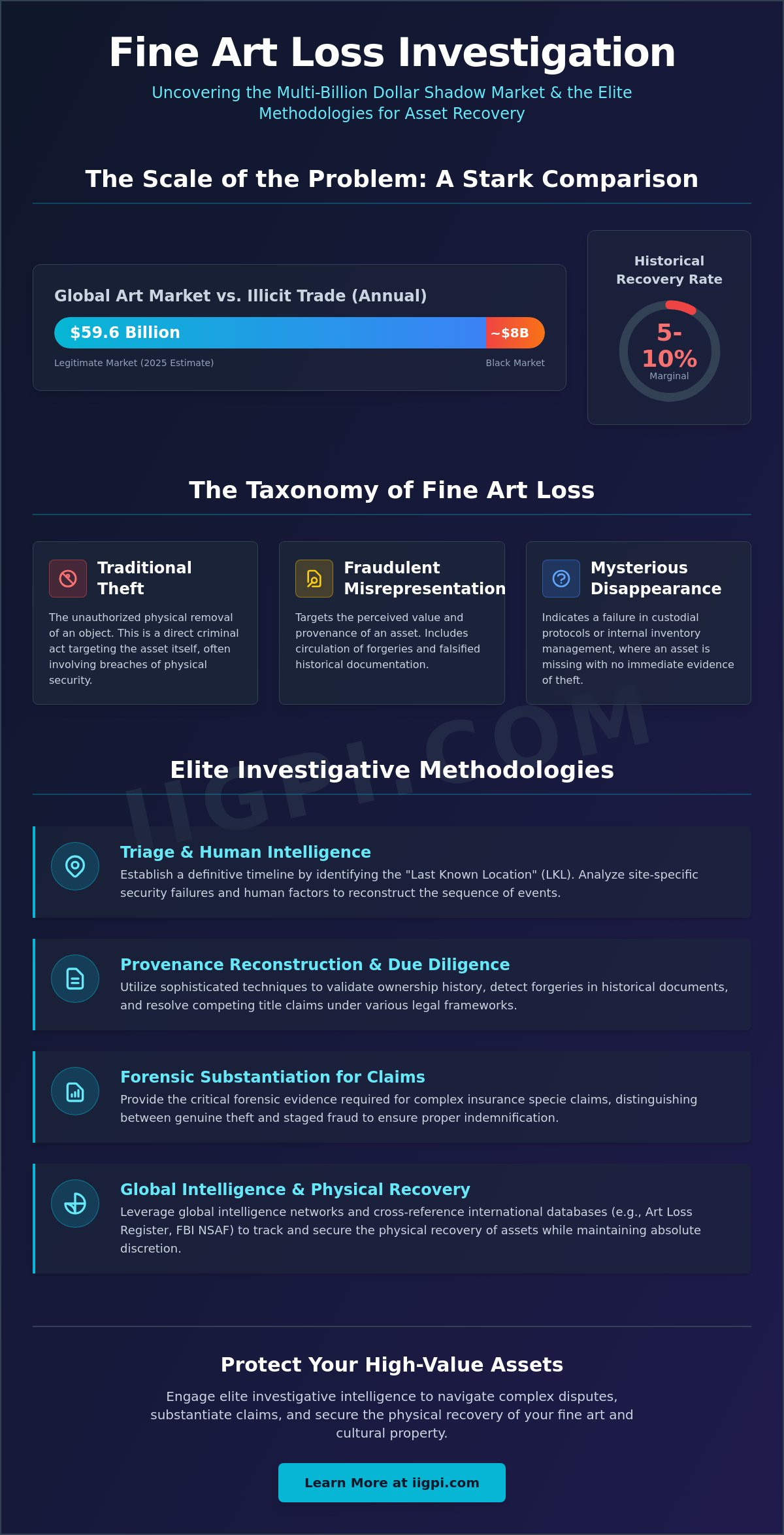
While the global art market reached an estimated $59.6 billion in 2025, the illicit trade in cultural property continues to operate as a multibillion-dollar shadow economy, with the black market for stolen art valued at nearly $8 billion annually. This profound discrepancy highlights the systemic risks faced by collectors and institutions, where the historical recovery rate for stolen assets remains a marginal 5% to 10%. A sophisticated fine art loss investigation serves as the critical intersection between forensic methodology and legal substantiation, addressing the inherent vulnerabilities of high-value asset management in an increasingly volatile global environment.
The challenges of navigating cross-border trafficking and the rigorous evidentiary demands of insurance specie claims often create significant barriers to asset restoration. This article offers a comprehensive analysis of the elite methodologies employed in the investigation of fine art loss, provenance disputes, and the substantiation of complex claims. We’ll examine the reconstruction of ownership histories through the lens of the 2026 HEAR Act, the impact of emerging regulatory frameworks like the Art Market Integrity Act, and the strategic frameworks necessary for the physical recovery of displaced assets.
Key Takeaways
- Distinguish between diverse loss modalities, including fraudulent misrepresentation and mysterious disappearance, to establish a precise investigative framework for recovery.
- It’s critical to implement rigorous triage and human intelligence protocols within a professional fine art loss investigation to identify the last known location of high-value assets.
- Utilize sophisticated due diligence and provenance reconstruction to detect forgeries in historical documentation and validate competing title claims.
- Facilitate the substantiation of complex insurance specie claims by providing the forensic evidence required to distinguish genuine theft from staged fraud.
- Leverage global intelligence networks while maintaining absolute discretion to resolve high-profile disputes and secure the physical recovery of assets.
The Taxonomy of Fine Art Loss: Defining the Investigative Scope
The conceptualization of loss within the high-value asset sector requires a rigorous analytical framework that extends beyond the simplistic binary of theft and possession. A comprehensive The Taxonomy of Fine Art Loss must account for diverse modalities, including illicit trafficking, the circulation of contemporary forgeries, and the historical complexities of looted antiquities. While traditional theft involves the unauthorized physical removal of an object, fraudulent misrepresentation targets the perceived value and provenance of the asset. Mysterious disappearance, by contrast, frequently indicates a failure in custodial protocols or internal inventory management. It’s essential to recognize that these distinctions are not merely academic; they dictate the investigative strategy and the likelihood of successful recovery in a global market where the black market for stolen art is estimated to reach $8 billion annually.
Private investigative entities serve as a critical bridge between the jurisdictional limitations of law enforcement and the civil imperatives of asset recovery. While public agencies focus on criminal prosecution, a professional fine art loss investigation prioritizes the physical restoration of the asset and the resolution of title disputes. This specialized field requires a deep understanding of the systemic impact art loss has on both global cultural heritage and private equity portfolios. By integrating surveillance and due diligence, investigators provide the evidentiary foundation necessary for insurance claims and legal proceedings.
The Legal and Theoretical Framework of Art Loss
Within the specialized lexicon of insurance and risk mitigation, ‘specie’ refers to high-value, portable assets such as bullion or precious stones, while ‘fine art’ is defined by its unique cultural, historical, or aesthetic significance. The resolution of ownership often hinges on the principle of ‘good faith’ acquisition, a legal concept that varies significantly across international borders and can either facilitate or hinder the recovery of looted works. Fine art loss investigation is a specialized subset of forensic asset recovery that integrates provenance research with field intelligence to resolve complex title and physical loss claims.
Global Dynamics of the Illicit Art Market
The movement of stolen assets across international jurisdictions often mirrors the sophisticated routes utilized by organized crime for money laundering and other illicit activities. Digital sales platforms have introduced new avenues for the rapid, anonymous transfer of high-value items, complicating the efforts of traditional recovery teams. Geopolitical instability significantly accelerates the frequency of cultural property loss, as weakened state institutions fail to protect archaeological sites and museum collections from systematic looting. These displaced assets often enter the legitimate market through laundered provenances, requiring investigators to trace financial trails and digital footprints across multiple continents to establish the true history of an object.
Sophisticated Methodologies in Art Loss Investigation
The transition from the identification of a loss to the execution of a professional fine art loss investigation requires a rigorous adherence to established forensic protocols. Initial efforts focus on the “Last Known Location” (LKL) to establish a definitive timeline of disappearance, as temporal accuracy is paramount, and it’s the foundation for reconstructing the sequence of events. This phase involves a forensic analysis of site-specific security failures, ranging from mechanical breaches to the circumvention of electronic monitoring systems. By identifying these vulnerabilities, investigators can better understand the level of sophistication involved in the removal of the asset.
Investigators must cross-reference missing assets against specialized international databases to mitigate the risk of illicit re-entry into the legitimate market. While the Art Loss Register provides a comprehensive private database for the global art trade, the FBI’s National Stolen Art File (NSAF) serves as a critical public resource. Engaging Elite Investigative Intelligence through these channels ensures that stolen works are flagged during auction house due diligence or museum acquisitions. Strategic coordination with INTERPOL further facilitates the tracking of assets across borders, leveraging the Stolen Works of Art Database to alert international customs and border protection agencies. This multi-layered approach ensures that the visibility of a stolen object is maximized across the global supply chain, rendering it toxic to reputable collectors.
Advanced Surveillance and Intelligence Gathering
Tactical operations in art recovery often necessitate the deployment of Professional Surveillance Services to monitor suspects and identify illicit secondary markets. Human intelligence remains a cornerstone of this effort. Undercover operatives don’t merely observe; they actively infiltrate networks where stolen assets are held as collateral. These operations are conducted with extreme discretion to prevent suspects from concealing the asset further.
Digital Forensics and the Paper Trail
Modern recovery efforts rely on Computer Forensics in Legal Investigations to analyze encrypted communications and financial transactions related to the loss. Tracing the digital provenance of an artwork involves scrutinizing blockchain records or examining digital archives for anomalies in ownership history. This digital paper trail is vital for substantiating insurance claims. For institutions facing high-stakes losses, initiating a targeted theft investigation is the first step toward reclaiming physical control of the asset.
Provenance Reconstruction and Due Diligence Protocols
Provenance isn’t merely a chronological list of owners; it’s a forensic narrative that serves as the definitive arbiter of legitimacy in any fine art loss investigation. Rigorous research is required to validate or challenge ownership claims, particularly when an asset reappears after decades of obscurity. Investigators must scrutinize historical documentation with the same intensity applied to the artwork itself, as sophisticated forgeries often extend to the certificates of authenticity and sales receipts that underpin a work’s history. These archival fabrications are designed to bypass standard scrutiny, requiring a multi-disciplinary approach to detect inconsistencies in paper age, ink composition, or historical context.
The complexity of this task is amplified when dealing with works whose ownership history is fragmented or entirely unknown. The U.S. Copyright Office Report on Orphan Works highlights the significant legal and practical challenges associated with assets where the rightful owner can’t be identified. In the context of loss recovery, these “orphan” status items often signal a deeper systemic issue, such as illicit removal during periods of conflict or the intentional obfuscation of title to facilitate a sale. Establishing a clear chain of title isn’t just about historical accuracy; it’s a critical risk mitigation strategy for collectors and institutions alike.
Analysing the Chain of Title
Uncovering the “Lacuna,” or gaps in ownership history, is the primary objective of provenance reconstruction. These silences in the record often mask periods of illicit trafficking or unauthorized transfers. Investigators must apply the legal doctrine of Nemo dat quod non habet—no one can give what they don’t have—to every link in the chain. If a single transfer was illegitimate, subsequent owners, regardless of their good faith, may find their title voided. This reality makes the investigation of found artworks in private collections a high-stakes exercise in legal and historical verification.
Pre-Acquisition Intelligence and Risk Mitigation
Institutional and private collectors must adopt a standard of care that exceeds basic market assumptions to avoid the “Red Flag” threshold of negligence. Implementing Elite Corporate Due Diligence Protocols is essential before any high-value acquisition. This involves conducting comprehensive background checks on galleries, dealers, and private sellers to identify patterns of ethical or legal non-compliance. When combined with forensic science, such as pigment analysis to detect anachronistic materials or carbon dating for organic substrates, this intelligence-led approach ensures that loss verification is grounded in empirical truth rather than anecdotal history.
The Nexus of Insurance, Specie Loss, and Private Investigation
The intersection of risk transfer and forensic verification represents a critical juncture in the management of high-value collections, especially as the global art insurance market reached an estimated $6.46 billion in 2026. Substantiating a “Proof of Loss” for complex insurance claims requires more than a mere declaration of absence; it demands a rigorous reconstruction of the circumstances surrounding the disappearance. Despite the “soft market” conditions observed in early 2026, which have led to more flexible terms and higher coverage limits, the evidentiary requirements for claim substantiation remain stringent. Private investigators operate in tandem with adjusters and underwriters to provide the empirical data necessary to trigger policy coverage while navigating the nuances of “Mysterious Disappearance” clauses. These clauses often serve as a point of contention, as they may exclude losses where no evidence of a fortuitous event exists, placing the burden of proof on the claimant to demonstrate that the loss was indeed accidental or criminal in nature. The resolution of a fine art loss investigation often depends on the investigator’s ability to distinguish between genuine criminal activity and opportunistic fraud within this specialized insurance framework.
Mitigating Fraudulent Art Insurance Claims
Identifying discrepancies between reported events and physical evidence is a primary function of Insurance Fraud Investigation Services. Staged burglaries and inflated valuations represent significant threats to the integrity of the specie market, necessitating a professional fine art loss investigation to validate the legitimacy of a claim. Investigators frequently utilize polygraph testing to verify claimant statements and identify potential inconsistencies in the narrative of the loss. This objective assessment of credibility is essential when the financial stakes involve multi-million dollar payouts, ensuring that insurers don’t honor illegitimate obligations.
Specie Loss and High-Value Logistics
The global supply chain for fine art introduces unique vulnerabilities during transit, whether by air, sea, or specialized art couriers, particularly as auction houses see increased sales of portable luxury goods. Investigating specie loss in these environments requires an assessment of custodial liability within professional storage facilities and museum settings. Recovery strategies for assets that are “lost” but not “stolen” focus on tracing logistical failures and identifying the exact point of failure in the chain of custody. If you require expert assistance in substantiating a high-value claim, consider engaging specialized specie loss investigations to secure your financial interests and ensure a comprehensive recovery effort.
Engaging Elite Investigative Intelligence for Art Recovery
The successful restoration of a high-value asset depends on the seamless integration of global intelligence and local jurisdictional knowledge. Because the illicit art trade operates across porous borders, a decentralized investigative network is essential for tracking assets as they move through international transit hubs. A professional fine art loss investigation doesn’t conclude with the mere identification of the asset; it requires a strategic transition toward legal resolution and physical repatriation. This process is often complicated by competing claims of good faith acquisition and the historical opacity of the market. Maintaining strict confidentiality and discretion is vital in high-profile art disputes to protect the reputation of the involved parties and the market value of the work itself. Discretion is paramount. Expertise matters.
The transition from the field to the courtroom requires a synthesis of forensic evidence and strategic negotiation. Investigators must account for the systemic complexities of the global market, where a single work may be subject to multiple liens or historical claims. By providing a clear, evidence-based narrative of the loss and subsequent movement of the work, investigators enable legal teams to navigate the procedural hurdles that often delay recovery. This multi-disciplinary approach ensures that the recovery effort is both legally sound and operationally effective.
Strategic Resolution of Title Disputes
Facilitating negotiations between multiple claimants requires a sophisticated understanding of international cultural property law and the specific provisions of the 2026 HEAR Act. Investigators serve a dual role; they provide the forensic evidence needed for physical recovery and act as expert witnesses during complex art litigation. This expertise ensures that the repatriation of looted assets or cultural property follows established ethical and legal protocols. It’s about more than just finding the work. It’s about securing a definitive title.
The IIG Advantage: 30 Years of Investigative Excellence
International Investigative Group leverages over 30 years of experience to provide unparalleled expertise in the field of fine art loss investigation. Our team draws upon a background in elite law enforcement to conduct private investigations that meet the highest standards of intellectual and operational rigor. With a history spanning more than 10,000 cases in corporate and high-value asset recovery, we offer a strategic advantage that public agencies often can’t match. If you’re navigating a complex title dispute or seeking the recovery of a stolen asset, consult with our elite investigative team regarding your fine art loss to initiate a professional and discreet recovery protocol.
Advancing Strategic Resilience in High-Value Asset Management
The restoration of displaced cultural property and high-value specie requires an uncompromising commitment to forensic rigor and global strategic coordination. By establishing a definitive timeline of loss and reconstructing fragmented ownership histories, a professional fine art loss investigation provides the empirical foundation necessary to navigate the complexities of the international art market. Success in this exclusive sphere isn’t merely a matter of chance; it’s the result of deploying sophisticated intelligence networks that operate beyond the jurisdictional limitations of traditional agencies. The integration of digital forensics and archival research remains the only viable mechanism for challenging fraudulent title and securing physical recovery.
International Investigative Group brings over 30 years of asset recovery expertise and a global agent network to every engagement, ensuring that high-profile disputes are resolved with absolute discretion. Under the direction of former law enforcement leadership, our methodologies bridge the gap between initial loss and final repatriation. We invite you to secure specialized investigative intelligence for your high-value art loss and ensure the integrity of your collection remains uncompromised. Your commitment to excellence deserves an investigative partner of equal stature.
Frequently Asked Questions
What are the first steps to take immediately following the discovery of a fine art loss?
The immediate containment of the physical site and the preservation of all forensic evidence are the primary imperatives following the identification of a loss. Owners must document the last known state of the asset and notify their insurance underwriters to initiate the formal claim process while simultaneously flagging the object in international databases. Engaging a professional entity to launch a fine art loss investigation ensures that the timeline of disappearance is established before evidence is degraded by environmental factors or human interference.
How does a private investigator differ from the FBI Art Crime Team in recovery operations?
Private investigators prioritize the civil recovery of the asset and the substantiation of insurance claims, whereas the FBI Art Crime Team focuses on the criminal prosecution of offenders and federal law violations. While federal agencies operate within the constraints of public resource allocation and criminal procedure, private firms offer a dedicated, client-centric framework that focuses on the physical restoration of property. This distinction is critical for collectors who require a focus on asset restoration rather than purely punitive outcomes.
Can a fine art loss investigation resolve a title dispute without litigation?
Structured negotiation and the presentation of undeniable provenance research frequently facilitate the resolution of title disputes without the necessity of formal litigation. By providing an empirical ownership narrative that challenges the legitimacy of a current possessor’s title, investigators create the leverage required for mediated settlements. This approach minimizes the public exposure and financial exhaustion associated with prolonged court proceedings while achieving a definitive restoration of ownership rights for the rightful claimant.
What is the significance of the Art Loss Register in a professional investigation?
The Art Loss Register serves as the definitive private global database for the registration of stolen and missing works of art, acting as a critical barrier against illicit market re-entry. Professional investigators utilize this resource to ensure that stolen assets are flagged during the due diligence processes conducted by major auction houses and galleries. This systemic visibility renders the asset toxic to legitimate market participants, significantly increasing the pressure on illicit holders to negotiate for the work’s return.
How do investigators verify the authenticity of provenance documentation?
Verification is achieved through a multi-disciplinary approach that integrates archival cross-referencing with material science and forensic analysis. Investigators scrutinize historical sales records and exhibition catalogues while utilizing chemical tests to identify anachronistic pigments or paper compositions that contradict the claimed era of the documentation. This rigorous scrutiny is essential because sophisticated forgeries often extend beyond the artwork itself to include the very documents intended to prove its legitimacy.
Is it possible to recover art that has been missing for several decades?
The recovery of assets missing for extended periods is increasingly viable due to the extension of the HEAR Act in 2026, which reduces procedural defenses related to statutes of limitations. Modern investigative methodologies utilize digital archives and global intelligence networks to trace assets that have been held in private collections for generations. As these works eventually resurface at auction or during estate liquidations, a comprehensive fine art loss investigation can establish the historical theft and facilitate repatriation.
What role does digital forensics play in tracing stolen or fraudulent art?
Digital forensics provides the technical framework for analyzing encrypted communications and tracing the financial trails associated with the illicit transfer of assets. Investigators examine metadata from digital sales platforms and monitor blockchain ledgers to identify the movement of high-value items through the shadow economy. This technological integration is indispensable for identifying the digital footprints left by criminal organizations that utilize the relative anonymity of the internet to facilitate cross-border trafficking.
How are investigation costs structured for high-value fine art recovery?
The financial structure of an investigation typically involves a combination of initial retainer fees and performance-based incentives that are aligned with the successful recovery of the asset. These arrangements reflect the complexity of the task and the level of specialized expertise required to navigate international jurisdictions and multi-party disputes. Clients should expect a transparent fee structure that accounts for field operations, archival research, and the deployment of technological resources, ensuring that the investigative effort is adequately capitalized.