
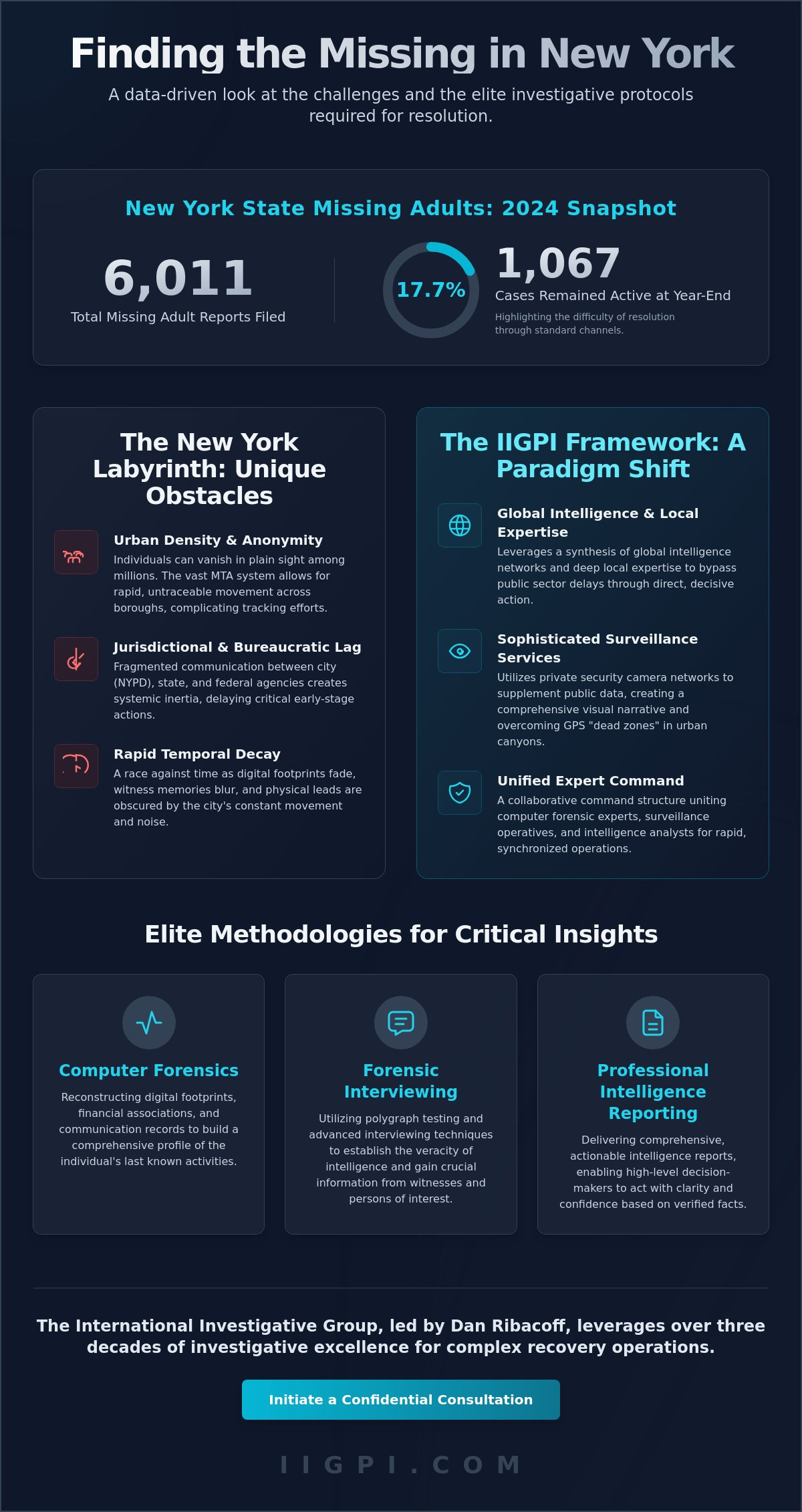
In 2024, New York State cataloged 6,011 missing adult reports, a statistic that illustrates the structural magnitude of human disappearance within the jurisdiction. Despite the interventions of public institutions, 1,067 cases remained active as the year concluded; this reflects the inherent difficulties in achieving resolution through standard bureaucratic channels. It’s often the case that those facing the agonizing uncertainty of a missing person encounter systemic inertia or jurisdictional constraints that impede rapid progress. The rigorous operational framework for finding a missing person in New York, Dan Ribacoff, IIGPI represents a departure from standard procedures, prioritizing deep intelligence and specialized surveillance services.
This article provides an authoritative analysis of the sophisticated protocols and investigative rigor that define the International Investigative Group’s approach to complex recovery operations. You’ll gain insight into how elite methodologies facilitate the rapid and discreet location of individuals while producing a professional intelligence report for high level decision makers. We’ll examine the strategic framework and expert guidance provided by Dan Ribacoff to demonstrate how private sector expertise addresses the unique challenges of the New York landscape.
Key Takeaways
- Analyze the multifaceted challenges presented by the urban density of the New York metropolitan area and the necessity of employing sophisticated surveillance services to mitigate the phenomenon of individuals disappearing within high-traffic sectors.
- Evaluate the specialized protocols for finding a missing person in New York, Dan Ribacoff, IIGPI, which utilize a synthesis of global intelligence networks and localized expertise to achieve rapid resolution.
- It’s essential to recognize the utility of forensic interviewing and polygraph testing as primary instruments for establishing the veracity of intelligence within complex personal investigations.
- Gain insight into the procedural importance of computer forensics for the reconstruction of digital footprints and financial associations during the critical initial phases of a recovery operation.
The Jurisdictional and Geographic Complexities of Missing Person Recoveries in New York
The quest for locating a missing person within the New York metropolitan area is fundamentally complicated by the region’s unmatched structural density and human velocity. New York City functions as a high-traffic urban environment where individuals can effectively vanish in plain sight among millions of residents and commuters. This phenomenon necessitates the deployment of specialized surveillance services that transcend the capabilities of standard investigative frameworks. The analytical approach to finding a missing person in New York, Dan Ribacoff, IIGPI involves navigating a labyrinth of jurisdictional hurdles that often impede public sector efforts. These challenges include fragmented communication between local NYPD precincts, state authorities, and federal entities, which can create a bureaucratic lag that private sector specialists are uniquely positioned to bypass through direct action.
Every recovery operation is essentially a race against the temporal degradation of evidence. As hours pass, digital footprints fade, witnesses’ recollections blur, and physical leads are obscured by the city’s constant movement. Professional investigators view this as a systemic challenge where the objective is to freeze and analyze data before it’s lost to the noise of the metropolis. It’s a high-stakes environment where the speed of intelligence gathering determines the success of the outcome, making the immediate deployment of sophisticated resources a logistical necessity rather than a luxury.
The Urban Maze: NYC Geographic Obstacles
The Metropolitan Transportation Authority (MTA) provides a network of rapid transit that allows a subject to traverse boroughs in minutes, complicating the tracking of physical movements across the five boroughs. Urban canyons created by high-rise structures often render standard GPS tracking ineffective; this creates “dead zones” where digital signals fail to provide precise coordinates. To counter these limitations, the protocol involves utilizing private security camera networks to supplement public surveillance data. This creates a comprehensive visual narrative that public agencies might lack the resources to compile with the same level of granular detail, especially when time is the primary constraint for recovery.
Socioeconomic Dynamics and Disappearance
New York’s diverse socioeconomic landscape demands a search strategy that’s tailored to specific neighborhood enclaves and cultural contexts. The protocols required for high-profile individuals differ significantly from those applied to runaways or vulnerable adults. While high-profile cases might involve complex digital obfuscation, locating individuals in tight-knit ethnic or economic communities requires deep local intelligence and the ability to navigate social barriers. By understanding these regional dynamics, expert investigators can deploy resources more effectively across the diverse landscape of the metropolitan area, ensuring no lead is ignored due to cultural or geographic isolation.
The IIGPI Investigative Framework: A Synthesis of Global Intelligence and Local Expertise
The IIGPI protocol represents a methodological paradigm shift from traditional private inquiry to a sophisticated intelligence operation. By synthesizing over 34 years of investigative experience into a structured recovery protocol, the organization addresses the systemic failures often encountered in public missing person cases. The process of finding a missing person in New York, Dan Ribacoff, IIGPI relies on a multidisciplinary architecture where computer forensic experts, surveillance operatives, and intelligence analysts collaborate within a unified command structure. This framework extends beyond domestic borders; it utilizes a global network of agents to track individuals who have fled the local jurisdiction to avoid detection or legal obligations.
While the New York State Missing Persons Clearinghouse serves as a vital public resource for alert activation, the IIGPI framework provides an intensive, private intelligence pipeline for families and legal representatives. This ensures that information isn’t merely collected but analyzed for strategic utility. For those requiring the highest level of rigor in personal investigations, the integration of local expertise with global reach becomes the decisive factor in case resolution. The organization functions as a research-driven entity, prioritizing intellectual rigor over standard observational techniques.
Phase I: Intelligence Gathering and Data Aggregation
The initial phase focuses on establishing an evidentiary baseline through comprehensive background checks and deep-web social media activity analysis. Financial transaction monitoring serves as a primary tool for locating active fugitives or debtors, as economic movement often precedes physical discovery. By synthesizing these disparate data points into a coherent lead-generation framework, investigators identify patterns that are invisible to less specialized entities. This phase is characterized by a high degree of technical sophistication, where data points are aggregated to predict future movements and associations.
Phase II: Tactical Field Operations and Surveillance
Once intelligence suggests a high probability of location, the operation transitions to tactical field deployment. This involves deploying covert surveillance in public spaces and likely frequentation points identified during the data aggregation phase. Operatives may utilize specialized informants within specific industries or locales to gain proximity without alerting the subject. Throughout these activities, the organization maintains strict adherence to the legal boundaries of private surveillance operations; this ensures that all gathered intelligence remains admissible for legal proceedings or official reporting.
The Influence of Dan Ribacoff’s Law Enforcement Pedigree on Modern Recovery Methodologies
The evolution of recovery protocols within the International Investigative Group is rooted in a foundational law enforcement pedigree that prioritizes systemic analysis over anecdotal evidence. This transition from public service to the helm of a premier private firm has enabled the institutionalization of investigative techniques that are typically reserved for high-level criminal prosecutions. The methodology for finding a missing person in New York, Dan Ribacoff, IIGPI is defined by what’s termed the “Ribacoff Signature,” a commitment to exhaustive evidence collection and intellectual rigor. It’s this rigor that ensures the transition from public to private inquiry doesn’t result in a loss of investigative integrity but rather an enhancement of focused resources. By applying the same standards of proof required in state-level investigations, the firm provides a level of certainty that’s often absent in standard private inquiry.
The application of these rigorous standards is most visible in how multidisciplinary teams handle complex data. Investigators don’t simply look for a person; they reconstruct a life to identify the exact moment of deviation from normal patterns. This process requires a deep understanding of criminal justice frameworks and the technical ability to execute polygraph testing or computer forensics with precision. It’s a synthesis of traditional detective work and modern technological intervention, ensuring that every lead is vetted through an authoritative lens before field assets are deployed.
Forensic Interviewing and the Human Element
Elite recovery operations rely heavily on the extraction of actionable intelligence from human sources through advanced forensic interviewing. By applying the principles of polygraphy and psychological profiling, investigators can predict the future movements of missing persons based on historical behavioral patterns. It’s not merely about asking questions. It’s about identifying cognitive dissonance in the testimony of associates to uncover hidden agendas. These specialized techniques allow the firm to verify the veracity of statements in real time. This ensures that tactical resources aren’t diverted by deceptive or erroneous information provided by reluctant witnesses or person-of-interest associates.
Bridging the Gap Between Private and Public Sectors
A significant advantage of a law enforcement background is the ability to navigate the complex relationship between private entities and the NYPD or state authorities. Professional reputation facilitates better cooperation and can expedite the sharing of critical information that’s often delayed by bureaucratic inertia. Every piece of evidence is gathered with the understanding that it must remain admissible in a court of law. This strict adherence to legal standards ensures that the findings from personal investigations or background investigations remain viable for subsequent litigation or official law enforcement action. It creates a seamless intelligence loop that benefits the client while respecting the boundaries of the judicial system.
Strategic Protocols for Initiating an Elite Missing Person Investigation in New York City
The initiation of a high-stakes recovery operation requires an immediate transition from passive concern to active intelligence gathering. Statistical data suggests that the first 48 hours are the most critical window for finding a missing person in New York, Dan Ribacoff, IIGPI protocols emphasize this temporal urgency. During this period, the probability of recovering volatile digital data and securing witness testimony remains at its peak before the natural entropy of urban life obscures the trail. An elite investigation doesn’t wait for the expiration of standard waiting periods often associated with public agencies; instead, it immediately establishes an evidentiary baseline through the aggregation of digital footprints and financial records. This proactive stance is essential for maintaining the momentum of a case before leads begin to suffer from temporal degradation.
Defining the scope of the investigation is a strategic decision that must be made at the outset to allocate resources effectively. Whether the search is confined to a local neighborhood enclave or necessitates an international recovery, the methodology remains rooted in rigorous data analysis. Establishing clear communication channels between the client and the investigative lead ensures that intelligence is shared in real time, allowing for rapid adjustments to the field strategy. For those facing the uncertainty of a disappearance, securing personal investigations through a proven authority provides the structural support and intellectual rigor necessary for a successful resolution.
The Digital Audit: Preparing for Computer Forensics
The modern subject leaves a trail of digital breadcrumbs that often provides the most accurate roadmap for recovery. Identifying key devices and cloud accounts that may contain geolocation data is a priority for the investigative team. The role of computer forensics in uncovering these breadcrumbs cannot be overstated; it allows for the reconstruction of recent associations and travel intentions. Preserving data integrity is essential to prevent the accidental deletion of vital evidence, requiring a professional hand to ensure that all digital artifacts remain admissible and informative for the intelligence report.
Legal and Ethical Considerations in NYC
Operating within a dense urban landscape requires a nuanced understanding of the legal boundaries of private surveillance in New York. While investigative reach must be maximized, it’s mandatory to ensure compliance with privacy laws to protect the viability of the case. The ethical responsibility of the investigator is dual-natured; it requires a commitment to the client’s objective while maintaining the dignity and safety of the subject. This balance is a hallmark of an elite firm that operates at the highest levels of global influence and legal scrutiny, ensuring that all gathered intelligence is both actionable and ethically sound.
International Investigative Group: Leveraging Three Decades of Investigative Excellence for Recovery
The institutional legacy of the International Investigative Group is defined by more than 34 years of operational success within high-stakes environments. While the firm has earned a prestigious reputation for its contributions to corporate fraud investigations, this same level of systemic analysis is applied to the recovery of individuals. The methodology for finding a missing person in New York, Dan Ribacoff, IIGPI protocols ensures that every case is managed with the intellectual rigor of a global intelligence mission. Discretion remains the cornerstone of these operations; it protects the client’s interests while ensuring that sensitive data is managed within a secure, professional framework. This commitment to confidentiality is a primary driver for high-level decision makers who require absolute certainty and elite guidance in their personal investigations.
IIGPI offers a comprehensive suite of services that extends from initial background investigations to intensive surveillance services. By maintaining a research-driven approach, the organization avoids the pitfalls of standard investigative firms that lack a law enforcement pedigree. The synthesis of traditional detective work and modern technological intervention allows for a level of evidence collection that’s both exhaustive and admissible. It’s this commitment to excellence that has positioned the firm as a leading authority in the field, capable of resolving cases that have stalled within the public sector’s bureaucratic framework.
The Global Reach of IIGPI
Although the organization is headquartered in the metropolitan region, its operational efficacy isn’t limited by geography. A New York-based firm can execute international missing person recoveries by coordinating with a vetted network of global agents across disparate time zones. This capability is essential when subjects cross borders to exploit jurisdictional gaps or social anonymity. Success stories in fugitive recovery and cross-border investigations demonstrate the firm’s ability to maintain a continuous intelligence loop. It’s a macro-level perspective that ensures the search continues wherever the evidence leads, bridging the gap between local disappearances and international resolutions through a synthesized global network.
The Definitive Path to Resolution
The transition from the intelligence-gathering phase to the recovery and reunification phase is a structured process that prioritizes the subject’s safety and the client’s strategic objectives. By utilizing personal detective protocols, investigators provide a comprehensive suite of services that includes post-investigation support and the deployment of security and armed guards if the situation demands protective intervention. This holistic approach ensures that resolution isn’t merely the discovery of a location but the successful conclusion of a complex human challenge. For those who require the highest level of expertise to resolve a disappearance, the definitive path to resolution begins with a formal consultation to establish a strategic recovery framework.
Securing Resolution Through Sophisticated Intelligence and Strategic Recovery
The resolution of disappearances within the New York metropolitan area requires a departure from standard investigative tropes in favor of a synthesized, research-driven framework. We’ve analyzed how the intersection of urban density and jurisdictional fragmentation necessitates the application of elite surveillance and forensic protocols. The methodology for finding a missing person in New York, Dan Ribacoff, IIGPI addresses these systemic challenges by leveraging a global network of agents and a law enforcement pedigree that ensures evidentiary integrity. It’s this synthesis of local expertise and macro-level intelligence that allows for the successful navigation of the city’s unique geographic obstacles.
With a historical record of over 10,000 successfully resolved cases and more than 30 years of private intelligence expertise, the International Investigative Group provides the intellectual rigor required for complex recovery operations. The integration of computer forensics and specialized interviewing techniques transforms a passive search into an active intelligence mission. To secure the professional guidance necessary for a definitive outcome, you’re invited to Consult with the Experts at International Investigative Group. Professional intervention remains the most reliable pathway to achieving clarity and reunification in high-stakes personal investigations.
Frequently Asked Questions
How long does it typically take for a private investigator to find a missing person in New York?
The duration of an inquiry is contingent upon the complexity of the subject’s obfuscation and the temporal proximity of the report to the disappearance. While 2024 statistics indicate a median of three days between the reporting and cancellation of state level cases, professional recoveries often require extended periods for deep intelligence gathering. Success in finding a missing person in New York, Dan Ribacoff, IIGPI involves a rigorous analysis of variables that dictate the speed of resolution.
Can Dan Ribacoff and IIGPI help if the person has left the United States?
The International Investigative Group utilizes an expansive global network of agents to facilitate recoveries that extend beyond domestic borders. This international reach allows the firm to track individuals who’ve fled the jurisdiction to avoid legal or domestic obligations in other continents. By coordinating with localized assets, the organization ensures that the search isn’t limited by geographic boundaries or the constraints of domestic law enforcement.
What is the difference between a police missing person report and a private IIGPI investigation?
Public sector inquiries are often constrained by bureaucratic inertia and limited resource allocation, whereas a private investigation offers a concentrated application of specialized surveillance services. While police reports are essential for alert activation, the IIGPI protocol provides an exhaustive intelligence pipeline that prioritizes the specific objectives of the client. This distinction is critical for high-stakes cases where jurisdictional limitations might otherwise impede the rapid recovery of a subject.
Is it legal for a private investigator to track a missing person’s cell phone or bank records?
Investigative activities must strictly adhere to the legal frameworks governing privacy and data access within the state of New York. While private entities don’t possess the same statutory powers as state agencies, they utilize sophisticated computer forensics to analyze accessible digital footprints and financial associations. It’s imperative that all gathered data remains admissible for legal proceedings, requiring a professional adherence to ethical and legal standards.
What information should I have ready before contacting IIGPI for a missing person case?
Clients should prepare a comprehensive dossier including the subject’s recent associations, digital account credentials, and known financial institutions. This evidentiary baseline allows investigators to initiate Phase I of the intelligence gathering protocol without delay. Providing detailed information regarding the subject’s behavioral patterns and recent stressors enables the team to construct a psychological profile that informs the search strategy.
Does IIGPI handle cold cases of missing persons in the New York area?
The firm applies retrospective analysis to cold cases by re-evaluating historical evidence through the lens of modern forensics. These investigations often uncover previously ignored leads by utilizing advanced polygraph testing or updated background investigations of original associates. This methodological rigor allows for the identification of new lead-generation frameworks that weren’t available at the time of the initial disappearance.
How much does it cost to hire an elite firm for a missing person search?
The financial commitment required for an elite recovery operation is determined by the scope of the investigation and the volume of specialized resources deployed. Factors such as the necessity for international agent coordination or the duration of surveillance services influence the overall resource allocation. Interested parties should check specific engagement terms through a formal consultation to ensure the proposed strategy aligns with the complexity of the case.
Can IIGPI assist with parental abduction or international child custody cases?
IIGPI provides specialized child custody investigations to address the complexities of parental abduction and unauthorized relocation. These cases often require a synthesis of matrimonial investigations and tactical recovery protocols to ensure the safety of the minor within legal boundaries. The firm’s global network is particularly effective in resolving international disputes where domestic authorities may face jurisdictional hurdles.