
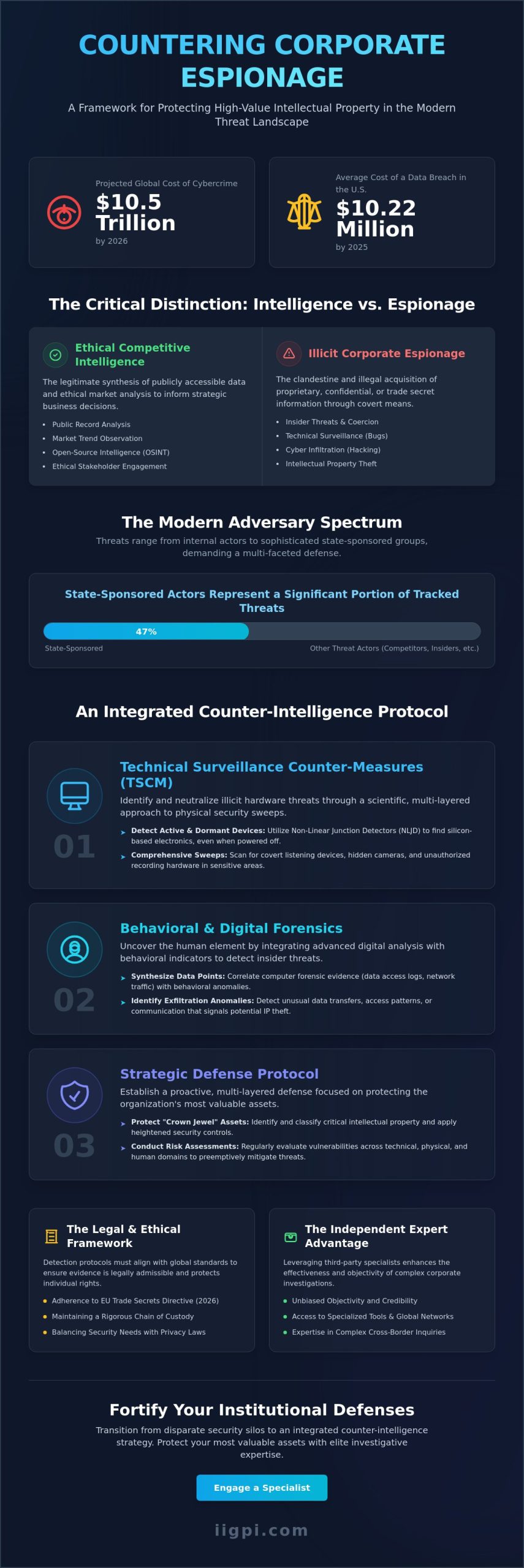
With the projected global cost of cybercrime exceeding $10.5 trillion in 2026, the demarcation between ethical competitive intelligence and illicit intellectual property theft represents the most critical challenge for the modern enterprise. You’ve likely recognized that the persistent threat of institutional paranoia regarding insider activities is often a rational response to the rising average cost of data breaches, which reached $10.22 million in the United States by 2025. Definitively confirming the presence of intrusive surveillance requires a transition from disparate security silos toward integrated corporate espionage detection methods that utilize both technical and behavioral indicators. This evolution is essential for survival.
This analysis provides an authoritative framework for implementing counter-intelligence methodologies designed to identify and neutralize illicit intellectual property theft. We’ll examine a rigorous investigative architecture that synthesizes technical hardware sweeps with behavioral forensics and advanced digital analysis. By integrating the latest forensic standards and adhering to evolving regulations like the EU Trade Secrets Directive, your organization can establish a secure environment where evidence isn’t just identified but is legally admissible. We’ll explore how to bridge the gap between technical detection and strategic institutional defense to ensure global operational integrity through a sophisticated, research-driven approach.
Key Takeaways
- Distinguish legitimate competitive intelligence from illicit clandestine activities by applying a rigorous conceptual framework aligned with modern global socioeconomic dynamics.
- Identify active and dormant surveillance hardware through sophisticated corporate espionage detection methods including Technical Surveillance Counter-Measures and Non-Linear Junction Detectors.
- Mitigate insider vulnerabilities by synthesizing computer forensics with behavioral analysis; it’s the most effective way to detect exfiltration anomalies.
- Prioritize the protection of high-value crown jewel assets through a multi-layered counter-intelligence protocol and comprehensive institutional risk assessments.
- Enhance investigative objectivity and reach by leveraging independent third-party expertise and global networks for complex cross-border inquiries.
The Evolution of Intellectual Property Theft in Global Markets
The conceptualization of corporate espionage has transitioned from localized industrial theft to a sophisticated instrument of geopolitical and economic warfare. While the history of industrial espionage reveals a long-standing pattern of technological poaching, the contemporary environment is defined by a convergence of state-sponsored interests and aggressive commercial competition. In 2025, state-sponsored actors represented 47% of tracked threat actors, illustrating that the preservation of intellectual property is no longer merely a corporate concern but a matter of national economic security. The systemic impact of data exfiltration is profound. With the average cost of a data breach in the United States reaching $10.22 million in 2025, the resulting erosion of institutional valuation can be catastrophic. Effective corporate espionage detection methods must therefore account for a spectrum of adversaries, ranging from disgruntled internal personnel to foreign intelligence services targeting emerging market sectors.
Distinguishing between ethical competitive intelligence and illicit clandestine activities requires a rigorous understanding of legal boundaries. Competitive intelligence relies upon the synthesis of publicly accessible data and ethical market analysis. In contrast, espionage involves the clandestine acquisition of proprietary information through illicit means. This distinction has become increasingly blurred as digital boundaries dissolve. Organizations seeking to fortify their defenses often turn to specialized Corporate Investigations to conduct deep-dive audits of their internal security posture and identify latent vulnerabilities before they’re exploited by aggressive competitors.
The Taxonomy of Modern Espionage Threats
The distinction between economic espionage and traditional industrial spying resides primarily in the involvement of foreign powers. While industrial spying focuses on gaining a competitive advantage over a specific rival, economic espionage involves state-orchestrated efforts to bolster national industries. Emerging technologies, including AI-powered data harvesting, have facilitated exfiltration at a scale previously inconceivable. Regional dynamics play a pivotal role. The April 2025 Department of Justice rule restricting data transactions with specific countries of concern highlights the necessity for corporate espionage detection methods that monitor high-value data flows across sensitive geographic borders.
The Legal and Ethical Framework of Detection
Implementing investigative protocols requires a meticulous balance between institutional security and the privacy rights of the individual. As organizations deploy detection protocols, they must align their activities with international standards such as the European Council’s Trade Secrets Directive, approved in May 2026. Maintaining a rigorous chain of custody is paramount. If evidence of theft is detected, it must be gathered through methods that ensure legal admissibility in various jurisdictions. This necessitates a structured approach to internal inquiries that respects both domestic privacy laws and global compliance mandates. It’s a complex environment where technical precision and legal adherence are equally vital.
Technical Surveillance Counter-Measures (TSCM): Identifying Illicit Hardware
The identification of illicit hardware requires a scientific methodology that transcends basic electronic scanning. Technical Surveillance Counter-Measures (TSCM) represent a sophisticated subset of corporate espionage detection methods, focused on the neutralization of covert listening and recording devices. Unlike rudimentary sweeps, professional TSCM utilizes Non-Linear Junction Detectors (NLJD) to identify the presence of silicon-based semiconductors. This allows investigators to locate dormant or inactive electronics concealed within furniture or structural elements. This capability is essential because sophisticated actors often deploy devices that remain in a sleep state to evade traditional radio frequency (RF) detection. It’s a precise discipline that demands both high-level instrumentation and an analytical mindset.
Complementing NLJD technology, Radio Frequency spectrum analysis provides a comprehensive overview of the electromagnetic environment. This process involves the systematic identification of unauthorized transmissions that may indicate data exfiltration. By establishing a baseline of legitimate signals, investigators can isolate anomalies that correlate with the FBI’s counter-espionage strategy for protecting high-value national interests. Physical inspection remains a cornerstone of this framework; it’s the only way to confirm the absence of passive recording devices or optical surveillance in secure boardroom environments. A thorough physical audit ensures that no hardware has been surreptitiously integrated into the executive workspace.
Advanced Signal Analysis and Thermal Imaging
Modern threats utilize “burst” transmissions, where data is compressed and sent in high-speed intervals to minimize the window of detection. Sophisticated corporate espionage detection methods now incorporate real-time signal analysis to capture these ephemeral events. Additionally, thermal imaging has become a vital diagnostic tool. It allows for the detection of subtle heat signatures generated by hidden power sources or miniature circuitry embedded within walls. Integrated building management systems (BMS) are frequently overlooked as potential vectors for surveillance, requiring rigorous audits to ensure that environmental controls haven’t been compromised to facilitate monitoring.
Securing the Physical Perimeter
Maintaining the integrity of executive suites requires a combination of scheduled and emergency Electronic Bug Sweeps to deter persistent threats. Physical breaches often manifest as “dead drops” or the installation of hardware within infrastructure, such as electrical outlets or telecommunications cabling. A multi-layered strategy ensures that any physical access breach is identified before it results in a significant loss of competitive advantage. This proactive stance is critical for institutional stability. It’s not just about the technology; it’s about the rigorous application of inspection protocols to ensure every physical vulnerability is mitigated effectively.
Behavioral and Digital Forensics: Uncovering the Human Element
The identification of hardware through TSCM, while foundational, addresses only the physical manifestations of a breach; the human element necessitates a more nuanced investigative paradigm. Behavioral forensics provides the analytical lens through which institutional actors can identify insider threat indicators before they culminate in catastrophic intellectual property theft. By integrating Computer Forensics with physical surveillance, investigators can construct a comprehensive evidentiary chain that links digital anomalies to specific human actions. This synthesis is critical because the human factor accounted for a significant portion of the $4.88 million average global data breach cost projected for 2026. It’s insufficient to rely solely on reactive measures; instead, a proactive analysis of communication patterns for signs of social engineering or coercion must be woven into the organization’s broader corporate espionage detection methods to ensure institutional resilience.
Identifying Clandestine Data Exfiltration
Modern exfiltration strategies often utilize “low and slow” patterns, where minute increments of data are transferred over extended periods to bypass automated software thresholds. Forensic analysis of removable media and unauthorized cloud transfers requires sophisticated tools like OpenText EnCase Forensic CE 25.1 to reconstruct file fragments and trace exfiltration paths. These corporate espionage detection methods are essential for identifying the use of encrypted communication channels by internal actors who seek to circumvent institutional oversight. Tracing these digital footprints requires a meticulous examination of system logs and metadata, often adhering to NIST Special Publication 800-70r5 guidelines to ensure the technical integrity of the investigative instruments used. This granular digital reconstruction ensures that clandestine activities, which standard security protocols might overlook, are brought to light.
Psychological Profiling and Behavioral Analysis
The motivation for clandestine activity is frequently categorized through the “MICE” framework, which examines Money, Ideology, Coercion, and Ego as primary drivers for espionage. Identifying shifts in employee behavior, such as unexplained affluence or unusual access requests during non-operational hours, is a core component of behavioral analysis. In high-stakes environments, the application of Polygraph Testing serves as a rigorous vetting mechanism to verify the integrity of personnel with access to “crown jewel” assets. This psychological profiling, when combined with digital evidence, allows for the early detection of recruitment by foreign entities or aggressive competitors, effectively neutralizing the threat at its inception. It’s this combination of behavioral observation and technical verification that distinguishes an elite investigative framework from a purely defensive security posture.
Establishing a Strategic Counter-Intelligence Protocol
The establishment of a counter-intelligence protocol requires more than a reactive posture; it necessitates a systemic integration of Human Resources, Information Technology, and specialized external investigators to create a defensive architecture that identifies vulnerabilities before they’re exploited. This multi-layered strategy begins with comprehensive risk assessments designed to categorize and isolate “crown jewel” assets, ensuring that institutional resources are prioritized where the potential for loss is greatest. By implementing rigorous access controls and “need-to-know” protocols, organizations can effectively limit the exposure of sensitive data to only those personnel whose operational functions require it. These corporate espionage detection methods are most effective when they’re supported by a confidential reporting mechanism that empowers employees to disclose suspected intelligence breaches without fear of institutional reprisal.
Maintaining the integrity of this protocol demands an ongoing schedule of technical and digital audits. Given that corporations budgeting for proactive TSCM coverage at their headquarters in 2026 can expect to allocate between $15,000 and $30,000 per quarter, these investments must be viewed as essential operational expenditures rather than discretionary costs. Regular audits ensure that the defensive perimeter evolves in tandem with the sophisticated tactics utilized by state-sponsored actors and aggressive competitors. It’s through this deliberate, measured approach that an organization can transition from a state of vulnerability to one of informed resilience, bridging the gap between technical detection and strategic institutional defense.
The Critical Response Framework
Immediate action upon the discovery of a suspected surveillance device is a pivot point that determines the success of the entire counter-intelligence effort. Rather than impulsively removing the hardware, which alerts the adversary and destroys potential behavioral evidence, the framework prioritizes non-disruptive monitoring to identify the controlling party. This phase often involves formalizing the relationship with an elite corporate private investigator NYC to manage the transition from detection to active investigation. By maintaining the status quo while under professional observation, institutions can often trace the data exfiltration path back to its origin, whether it’s an internal actor or a remote external entity.
Evidence Preservation and Legal Standing
The transition from detection to litigation requires a meticulous adherence to evidentiary standards to ensure that all findings remain admissible in a court of law. This involves documenting the exact physical and digital context of the discovery, utilizing specialized Computer Forensics to capture volatile data before it’s lost or overwritten. Coordinating with legal counsel early in the process is paramount to prepare for potential litigation or law enforcement referral under evolving regulations like the Trade Secrets Directive. Every step taken must be measured against its impact on the chain of custody, ensuring that the integrity of the evidence is beyond reproach. If you suspect your proprietary environment has been compromised, engaging professional Corporate Investigations is the most effective way to secure your assets while maintaining full legal standing.
Engaging Elite Investigative Expertise for Risk Mitigation
The transition from identifying a breach to mitigating systemic risk requires an external perspective that internal departments, often constrained by institutional biases or resource limitations, cannot provide. The necessity of engaging independent, third-party investigative firms is predicated on the requirement for absolute objectivity in the face of sensitive internal breaches. While internal security teams are essential for daily operations, they often suffer from institutional blindness or conflicts of interest that can obscure the presence of sophisticated actors. Leveraging a global network of agents for cross-border espionage investigations ensures that the reach of the defense matches the international scale of the threat. The role of professional surveillance services is particularly critical in identifying external spy actors who operate outside the digital perimeter, providing the physical intelligence necessary to complement technical findings. Transitioning from detection to a long-term posture of strategic intelligence resilience represents the final stage of institutional maturation. It’s a shift from a defensive crouch to a state of informed vigilance where corporate espionage detection methods are woven into the very fabric of the organization’s governance.
The International Investigative Group Advantage
With over 30 years of experience in resolving complex corporate investigations, the International Investigative Group offers a level of expertise that is unavailable to most internal security departments. The team is led by former law enforcement professionals who bring a disciplined, forensic approach to every engagement, ensuring that all corporate espionage detection methods adhere to the highest standards of legal admissibility. The firm’s comprehensive solutions span the entire investigative spectrum, from high-level computer forensics to the deployment of armed security for high-value assets. This integrated approach ensures that no gap is left unaddressed in the enterprise’s defensive architecture. It’s this synthesis of experience and technical capability that defines the firm’s elite status.
Securing the Future of the Enterprise
In a hyper-competitive market defined by geopolitical volatility, a proactive investigative posture is the only viable strategy for long-term survival. Organizations must customize their security solutions to reflect the unique vulnerabilities of their corporate properties and high-profile events. This customization requires a deep understanding of both local dynamics and global threat patterns. By establishing a direct engagement with an elite firm, decision-makers can ensure their institutional integrity is preserved against even the most sophisticated clandestine efforts. For those seeking to fortify their environment, a confidential consultation is available at iigpi.com to begin the process of identifying and neutralizing potential threats. Proactivity isn’t just a preference. It’s an institutional imperative.
Forging Institutional Resilience in a Volatile Global Market
The preservation of intellectual property in 2026 requires a departure from antiquated, siloed security models toward a unified investigative paradigm. By synthesizing technical hardware sweeps with rigorous behavioral and digital analysis, organizations move beyond mere detection to a state of comprehensive strategic resilience. It’s clear that the efficacy of modern corporate espionage detection methods depends upon the seamless integration of technical precision and legal admissibility; this ensures that any identified breach leads not just to discovery, but to definitive institutional recovery. Establishing this level of defense necessitates the involvement of a partner with proven global influence and specialized expertise.
The International Investigative Group, led by former law enforcement professionals, has successfully resolved over 10,000 cases globally and remains specialized in multi-million dollar fraud and espionage recovery. Securing the future of your enterprise requires the same level of intellectual rigor and operational depth that clandestine actors utilize to target your proprietary data. Consult with our elite corporate investigative team to secure your assets. You don’t have to navigate these systemic challenges alone; a more secure and resilient corporate environment is entirely achievable through professional collaboration.
Frequently Asked Questions
What are the primary indicators that a corporation is under surveillance?
Indicators of surveillance include subtle physical discrepancies within executive environments, such as unexplained debris or displaced structural elements, which frequently signal the installation of clandestine hardware. Organizations might also experience recurring electronic interference during sensitive communications or find that competitors demonstrate an improbable awareness of proprietary strategic initiatives. These anomalies often suggest that corporate espionage detection methods should be deployed immediately to verify the integrity of the workspace.
How frequently should a professional TSCM bug sweep be conducted?
Professional Technical Surveillance Counter-Measures (TSCM) should ideally be conducted on a quarterly basis for corporate headquarters, particularly given that proactive coverage budgets in 2026 typically range between $15,000 and $30,000 per quarter. Frequency should increase surrounding high-stakes events, such as mergers or product launches, to ensure that institutional defenses remain effective against persistent threats. Regularity is the most critical factor in identifying hardware that may have been installed during recent security lapses.
Is corporate espionage a criminal offense under federal law?
Corporate espionage is a criminal offense under federal law, primarily prosecuted through the Economic Espionage Act of 1996. This legislation distinguishes between theft for the benefit of a foreign power and theft for commercial advantage, with both categories carrying severe penalties including significant fines and lengthy periods of incarceration. Legal frameworks continue to evolve, with new Department of Justice rules in 2025 further restricting data transactions with countries of concern to protect national interests.
What is the difference between a cyberattack and corporate espionage?
A cyberattack refers to the specific digital vector used to disrupt or access systems, while corporate espionage is the broader strategic objective of illicitly acquiring intellectual property. Espionage often utilizes a multi-dimensional approach that incorporates both cyber-based exfiltration and physical surveillance hardware to achieve its goals. While a cyberattack might be a one-time event, espionage is typically a persistent, long-term effort to gain a competitive advantage through the theft of trade secrets.
Can an investigation be conducted without alerting the suspected insider?
Investigations are systematically designed to proceed without alerting a suspected insider, utilizing non-disruptive monitoring and after-hours digital audits to preserve the element of surprise. This clandestine approach is vital for identifying the full scope of the breach and the controlling external entities while ensuring that the perpetrator doesn’t destroy critical evidence. Maintaining operational secrecy allows investigators to map the entire exfiltration network before taking decisive action.
What equipment is used in professional electronic bug detection?
Professional electronic bug detection utilizes sophisticated instrumentation such as Non-Linear Junction Detectors (NLJD) to find semiconductors and Radio Frequency (RF) spectrum analyzers to isolate unauthorized transmissions. These corporate espionage detection methods are often supplemented by thermal imaging cameras that detect the minute heat signatures produced by hidden electronics within building infrastructure. The use of advanced software, such as the 2025 release of EnCase Forensic CE 25.1, ensures that digital footprints are also meticulously recovered.
How does a private investigator ensure evidence is admissible in court?
Admissibility is ensured through the rigorous maintenance of the chain of custody and the use of forensically sound imaging techniques that adhere to standards like NIST Special Publication 800-70r5. Professional investigators document every phase of the discovery process to ensure that evidence meets the stringent requirements of both domestic and international legal frameworks. This meticulous documentation is essential for supporting litigation or referring the case to federal authorities for criminal prosecution.
What industries are currently most vulnerable to intelligence theft in 2026?
Industries categorized as critical infrastructure and those within high-value emerging markets are currently most vulnerable, with 64% of organizations factoring geopolitically motivated attacks into their 2026 risk strategies. The rapid evolution of AI-powered technologies has also made the semiconductor and biotechnology sectors primary targets for state-sponsored and competitive intelligence theft. As global volatility increases, any sector involved in the development of proprietary technology or sensitive data remains at heightened risk for sophisticated espionage.