
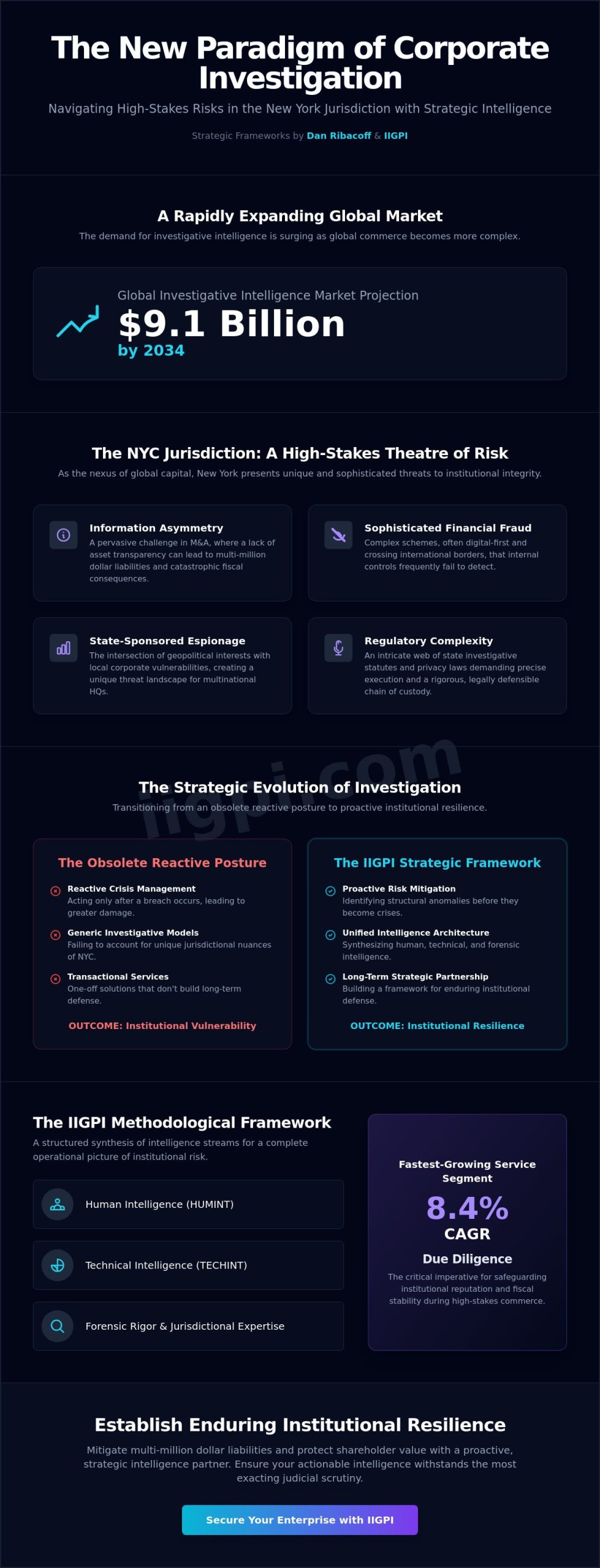
In an era where the global market for investigative intelligence is projected to reach $9.1 billion by 2034, the traditional reactive posture toward internal breaches has become an obsolete relic of institutional vulnerability. You’re likely aware that within the high-stakes jurisdiction of the New York metropolitan area, information asymmetry during acquisitions isn’t merely a logistical hurdle; it’s a profound structural risk that can precipitate multi-million dollar liabilities. This institutional analysis provides a rigorous examination of the methodologies governing elite corporate investigation services nyc, specifically evaluating the strategic frameworks associated with Dan Ribacoff and IIGPI to ensure your actionable intelligence withstands the most exacting judicial scrutiny. We’ll explore the synthesis of jurisdictional expertise and forensic rigor required to achieve complete asset transparency and mitigate the sophisticated financial fraud that characterizes modern global commerce. By deconstructing the imperatives of due diligence, which remains the fastest-growing service segment with an 8.4% CAGR, we’ll demonstrate how proactive intelligence serves as the ultimate safeguard for institutional reputation and long-term fiscal stability.
Key Takeaways
- Examine the unique geopolitical and financial complexities inherent to the New York jurisdiction to identify how these variables facilitate sophisticated institutional fraud and state-sponsored economic espionage.
- Synthesize human and technical intelligence through elite corporate investigation services nyc, specifically the frameworks pioneered by Dan Ribacoff and IIGPI, to transition from reactive crisis management toward proactive risk mitigation.
- Identify the rigorous protocols required for tracing hidden assets across disparate international jurisdictions to preserve shareholder value and ensure comprehensive fiscal recovery.
- Evaluate the strategic evolution of investigative standards from traditional law enforcement models toward unified global command structures that effectively address modern corporate vulnerabilities.
- It’s essential to distinguish between transactional investigative services and long-term strategic partnerships—such as the organizational methodology implementation provided by Intergroup Consulting—to establish a framework for enduring institutional resilience and the mitigation of multi-million dollar liabilities.
The Evolving Landscape of Corporate Risk in the New York Jurisdiction
New York City functions as the primary nexus of global capital, a status that inadvertently renders it a central theatre for sophisticated corporate crime and institutional malfeasance. The density of multinational headquarters in the Manhattan sector creates a unique environment where state-sponsored economic espionage intersects with local corporate vulnerabilities. Within this high-stakes jurisdiction, corporate investigation services nyc act as a critical mechanism for maintaining jurisdictional compliance and institutional integrity. Firms like IIGPI, under the strategic direction of Dan Ribacoff, provide the localized intelligence necessary to decode these multifaceted risks. Reliance on generic investigative models often fails to account for the specific jurisdictional nuances of New York corporate law, necessitating a more rigorous, institutional approach that synthesizes forensic expertise with local regulatory knowledge.
Macro-Economic Drivers of Institutional Vulnerability
The shift toward digital-first financial crimes has profoundly altered the risk profile of the Manhattan business sector. Information asymmetry remains a pervasive challenge during high-stakes mergers and acquisitions, where the lack of complete asset transparency can lead to catastrophic fiscal consequences. These systemic weaknesses aren’t merely incidental; they’re structural realities of a globalized financial hub that demands constant vigilance. Investigative intervention becomes essential when internal controls prove insufficient to detect complex fraud schemes that cross international borders. Proactive intelligence gathering is the only viable method for bridging the gap between perceived and actual institutional health, ensuring that decision-makers aren’t operating within a vacuum of misinformation.
The Legal and Regulatory Imperatives for NYC Firms
NYC firms must navigate an intricate web of New York state investigative statutes and privacy laws that demand precise execution. Maintaining a rigorous “chain of custody” for all gathered intelligence is mandatory for any findings intended for judicial review. This level of forensic discipline ensures that actionable intelligence isn’t only accurate but legally defensible in the most demanding courtrooms. Investigative rigor serves as a cornerstone for corporate fiduciary responsibility, protecting shareholders from the fallout of internal breaches and reputational damage. As the global market for these services expands, the distinction between transactional providers and strategic entities like IIGPI becomes increasingly apparent. Elite organizations recognize that localized expertise is the prerequisite for global strategic success, as it allows for the mitigation of multi-million dollar liabilities before they crystallize into public crises.
The IIGPI Methodological Framework for Strategic Intelligence
The efficacy of elite corporate investigation services nyc is predicated on a structured synthesis of intelligence streams that exceeds traditional investigative boundaries. Within the IIGPI paradigm, the methodology transitions from disparate data collection to a unified intelligence architecture. Precision matters. This framework integrates human intelligence (HUMINT) with technical intelligence (TECHINT) to construct a comprehensive operational picture of institutional risk. While the NYC Department of Investigation establishes the standards for public sector integrity, private firms require a parallel level of forensic rigor to safeguard their interests. Rigorous discipline is mandatory. By prioritizing proactive risk mitigation over reactive crisis management, organizations can identify structural anomalies before they manifest as catastrophic financial losses. Multidisciplinary teams, often led by Dan Ribacoff, are essential for resolving multi-million dollar financial discrepancies. These units incorporate computer forensics into the broader investigative architecture to ensure that digital artifacts are preserved with the same precision as physical evidence.
The Integration of Advanced Surveillance Systems
Establishing empirical baselines in complex fraud cases requires the deployment of elite surveillance services. The modern investigative landscape has evolved from simple physical observation to sophisticated digital monitoring, allowing for a persistent presence without compromising operational security. This evolution is not merely technological but strategic, enabling the collection of metadata that contextualizes physical movements. Evidence must be untainted. Maintaining a delicate balance between comprehensive intelligence gathering and ethical boundaries is paramount. This discipline ensures that the results of any surveillance operation remain beyond reproach during judicial scrutiny.
Forensic Financial Analysis and Digital Discovery
Forensic financial analysis serves as the primary tool for deconstructing sophisticated embezzlement and money laundering schemes. Complexity requires specialized expertise. By leveraging forensic accounting, investigators can peel back layers of complex transactions to identify the ultimate beneficiaries of illicit activity. Digital forensics further enhances this capability by pinpointing the origins of internal data breaches and intellectual property theft at the source. The success of this approach is best illustrated by the resolution of a $120 million bank fraud investigation, which stands as a benchmark for methodological precision. It’s often prudent for leadership to consult with senior investigative strategists to evaluate existing vulnerabilities before they are exploited by external actors.
The Influence of Dan Ribacoff on Modern Investigative Standards
The institutionalization of law enforcement rigor within the private sector represents a fundamental shift in how corporate intelligence is gathered and verified. When evaluating corporate investigation services nyc, Dan Ribacoff, IIGPI represents the synthesis of jurisdictional authority and private sector agility. This transition from public service leadership to the helm of a premier private investigator firm has established a global network of agents operating under a unified command structure. Such a framework is essential in high-stakes environments where the complexity of cases requires a centralized strategic vision. Ribacoff’s legacy is defined by this structural discipline, ensuring that every inquiry adheres to the highest evidentiary standards. It provides clients with the assurance that findings will remain robust under intense judicial scrutiny, effectively bridging the gap between raw data and actionable intelligence.
Establishing Professional Credibility in High-Stakes Environments
Professional credibility in the investigative field is built upon a foundation of proven results in high-stakes environments. Ribacoff’s reputation as one of the elite investigators in the United States is grounded in his participation in precedent-setting cases. His involvement in the investigation of the African Embassy bombings and the Revere Armored Truck loss demonstrates a capacity to operate within sensitive geopolitical zones and high-value recovery operations. This background informs the firm’s ability to handle complex institutional crises that demand absolute discretion and forensic precision. A founder’s reputation acts as a force multiplier. It grants the organization access to intelligence networks and resources that remain unavailable to less established entities, particularly when navigating the intricate regulatory landscape of the New York metropolitan area.
The Evolution of Polygraph and Credibility Assessment
The strategic application of polygraph testing has evolved into a cornerstone of internal corporate theft prevention and security clearances. Ribacoff’s specialized expertise in polygraphy and human behavior informs modern corporate interview protocols, moving beyond simple interrogation toward a scientific assessment of credibility. By advancing the science of credibility assessment within the IIGPI service suite, the firm can identify deceptive patterns that traditional methods might overlook. This methodology synthesizes traditional techniques with modern psychological analysis to provide a more nuanced understanding of subject behavior. It provides a structured approach to identifying internal threats. Institutional resilience is maintained through rigorous personnel vetting and behavioral analysis, allowing corporations to mitigate risks before they escalate into significant liabilities.
Strategic Implementation: Executing Due Diligence and Asset Recovery
Execution of strategic mandates requires a shift from passive observation to the active preservation of shareholder value through rigorous forensic intervention. Within the high-pressure environment of the Manhattan financial sector, corporate fraud investigation serves as a fundamental fiduciary imperative rather than a mere restorative measure. IIGPI utilizes a proprietary methodology that transcends the limitations of localized agencies by leveraging a global network of operatives capable of operating across disparate legal systems. This expansive reach is critical when tracing misappropriated funds that have been dispersed through complex offshore structures. By employing corporate investigation services nyc that prioritize global forensic rigor, institutions can effectively bypass the jurisdictional barriers that often stymie less sophisticated firms. The objective is the crystallization of evidence that identifies the ultimate beneficial owners of illicitly obtained assets, ensuring that recovery efforts are directed toward tangible targets.
The Multi-Phased Approach to Asset Tracing
The process of asset recovery is structured into three distinct phases to ensure maximum forensic integrity. During Phase I, investigators identify the nexus of financial movement by deconstructing shell entity structures and identifying hidden linkages between disparate accounts. Phase II involves the application of digital forensics to track cryptocurrency transactions and complex offshore transfers that are designed to obfuscate the paper trail. Finally, Phase III focuses on the preparation of comprehensive intelligence dossiers. These documents allow clients to coordinate with their legal counsel for the formal seizure and recovery of misappropriated funds. This structured approach ensures that every step of the recovery process is documented and remains resistant to challenges during subsequent judicial proceedings.
Due Diligence as a Competitive Advantage
Modern due diligence has evolved beyond basic background checks into deep-dive reputational and financial audits that provide a definitive intelligence basis for decision-making. It’s no longer sufficient to verify credentials; boards must understand the underlying ethical and fiscal history of potential merger partners or executive hires. Identifying “red flag” indicators, such as undisclosed litigation or patterns of financial instability, allows for the quantification of risk before capital is committed. This level of scrutiny transforms due diligence from a compliance checkbox into a strategic competitive advantage. It provides leadership with the clarity required to navigate high-stakes acquisitions without exposure to unforeseen liabilities. Organizations seeking to fortify their pre-transactional protocols should engage with IIGPI to establish a comprehensive risk profile for all prospective institutional partners.
Establishing Institutional Resilience with International Investigative Group
The culmination of institutional resilience depends on the transition from transactional investigative services to long-term strategic partnerships. For entities seeking corporate investigation services nyc, Dan Ribacoff, IIGPI represents the logical conclusion of a search for elite intelligence that synthesizes jurisdictional knowledge with global reach. Three decades of institutional memory allow the firm to navigate the New York business environment with a level of precision that newer entrants cannot replicate. This historical depth ensures every operation is contextualized within the broader socioeconomic and geographic dynamics of the region. Aligning global capabilities with specific strategic objectives allows corporations to maintain a proactive stance against emerging threats. It’s this alignment that transforms raw data into a shield for shareholder value, particularly when dealing with the high-velocity capital movements characteristic of the Manhattan sector.
The Scalability of IIGPI Global Operations
Maintaining a global network of elite agents from an NYC-based headquarters requires a sophisticated centralized command structure. This model provides consistent investigative quality across disparate geographic regions; it ensures that a case initiated in Manhattan receives the same forensic rigor when it extends into emerging markets or European financial centers. The scalability of these operations is a direct result of the firm’s ability to bridge gaps between regional dynamics and international standards. Multi-jurisdictional corporate cases demand this level of coordination to prevent information fragmentation that often plagues decentralized agencies. By centralizing oversight, the organization ensures the strategic vision remains unified, regardless of the physical location of the investigative theater. This institutional coherence is essential for managing the multi-million dollar liabilities that define modern corporate risk.
Securing the Future: A Commitment to Confidentiality and Results
Protecting sensitive corporate data during the course of an investigation is a non-negotiable protocol within the IIGPI framework. The firm’s history of successfully resolving 10,000+ cases serves as the ultimate empirical proof of efficacy and institutional reliability. This track record isn’t merely a statistic. It’s a testament to a methodology that prioritizes results while maintaining absolute discretion. High-level decision-makers require the assurance that their internal vulnerabilities will remain confidential throughout the investigative lifecycle. Engaging in a formal consultation process allows leadership to evaluate their risk profile in a secure environment. This commitment to confidentiality and forensic excellence ensures the partnership remains a cornerstone of long-term institutional resilience. Ultimately, the synthesis of law enforcement rigor and private sector agility provides the definitive answer to the challenges of global financial complexity.
Fortifying Institutional Integrity Through Strategic Intelligence
The transition from institutional vulnerability to strategic resilience requires a paradigm shift in how global organizations perceive risk within the New York jurisdiction. Elite investigative intervention is no longer a peripheral function; it’s a core strategic imperative that preserves shareholder value and mitigates multi-million dollar liabilities. Success in this complex landscape depends on the synthesis of human intelligence and technical forensics, ensuring that every finding withstands the most rigorous judicial scrutiny. The deployment of corporate investigation services nyc, Dan Ribacoff, IIGPI provides the intellectual and operational framework necessary to navigate these challenges with absolute precision.
With thirty years of specialized experience in the NYC jurisdictional landscape, the organization brings a level of institutional memory that is unparalleled in the private sector. This legacy is supported by a track record of over 10,000 cases successfully resolved and founding leadership recognized among the top 15 investigators in the United States. It’s essential to secure your organization’s future with a partner that understands the intersection of local dynamics and global mandates. Engage the expertise of International Investigative Group for your corporate investigative requirements. We look forward to fortifying your strategic objectives.
Frequently Asked Questions
What specific methodologies define elite corporate investigation services in NYC?
Elite corporate investigation services nyc are defined by a methodological synthesis of human intelligence and advanced technical forensics that exceeds traditional investigative boundaries. This approach ensures that every inquiry adheres to the specific jurisdictional nuances of New York corporate law while maintaining a global operational perspective. By prioritizing proactive risk mitigation over reactive crisis management, firms can identify structural anomalies before they manifest as significant fiscal liabilities.
How does Dan Ribacoff’s background in law enforcement influence IIGPI’s operational protocols?
The operational protocols at IIGPI are deeply informed by Dan Ribacoff and his extensive background in law enforcement leadership. This influence manifests in the institutionalization of rigorous evidentiary standards and a centralized command structure that governs every investigation. His specialized expertise in polygraphy and human behavior further informs the firm’s interview protocols, ensuring that credibility assessments are grounded in scientific assessment rather than subjective observation.
Can IIGPI conduct asset searches across international jurisdictions for NYC-based firms?
The firm maintains the capacity to conduct comprehensive asset searches across disparate international jurisdictions for entities based in the New York metropolitan area. This global reach allows the organization to deconstruct shell entity structures and identify hidden linkages that localized agencies frequently overlook. By leveraging a network of elite agents, the organization can trace misappropriated funds through complex offshore transfers to identify ultimate beneficial owners.
What is the strategic importance of computer forensics in a modern corporate fraud investigation?
Computer forensics serves as a foundational pillar of modern fraud investigations by allowing for the preservation and analysis of untainted digital artifacts. This capability is essential for identifying the origins of internal data breaches and tracking the movement of capital through cryptocurrency or digital offshore transfers. Integrating these forensic findings into the broader investigative architecture provides a definitive intelligence basis for subsequent judicial review or internal disciplinary actions.
How does IIGPI ensure the admissibility of evidence in complex corporate litigation?
Admissibility is ensured through a rigorous adherence to the chain of custody and New York state investigative statutes. Every piece of intelligence is gathered with the explicit intent of withstanding intense judicial scrutiny in the most demanding courtrooms. This forensic discipline guarantees that actionable intelligence isn’t only accurate but legally defensible, protecting the institution from the fallout of procedural errors that could compromise a legal victory.
What differentiates IIGPI from standard private detective agencies in the New York area?
The primary differentiator is the firm’s transition from transactional investigative tasks to a long-term strategic partnership model. Unlike standard agencies, the organization offers thirty years of specialized institutional memory and a global infrastructure that supports multi-jurisdictional cases. This elite positioning is reinforced by leadership recognized among the top fifteen investigators in the United States, providing a level of authority that is unmatched in the region.
In what scenarios should a corporation engage IIGPI for due diligence rather than a traditional audit firm?
Corporations should engage specialized investigative firms when due diligence requires a deep-dive reputational audit rather than a simple financial review. While audit firms focus on balance sheets, investigative entities identify red flag indicators such as undisclosed litigation or ethical history that could compromise a merger. This level of scrutiny provides boards with the clarity required to navigate high-stakes acquisitions without exposure to unforeseen liabilities or reputational damage.
How does the firm handle high-stakes surveillance without compromising corporate ethics?
High-stakes surveillance is executed through a combination of physical observation and sophisticated digital monitoring that remains within strict ethical and legal boundaries. This discipline ensures the collection of empirical metadata that contextualizes subject behavior without compromising operational security. By maintaining this balance, the firm provides untainted evidence that establishes an empirical baseline for fraud cases while preserving the client’s institutional reputation and adherence to privacy mandates.