
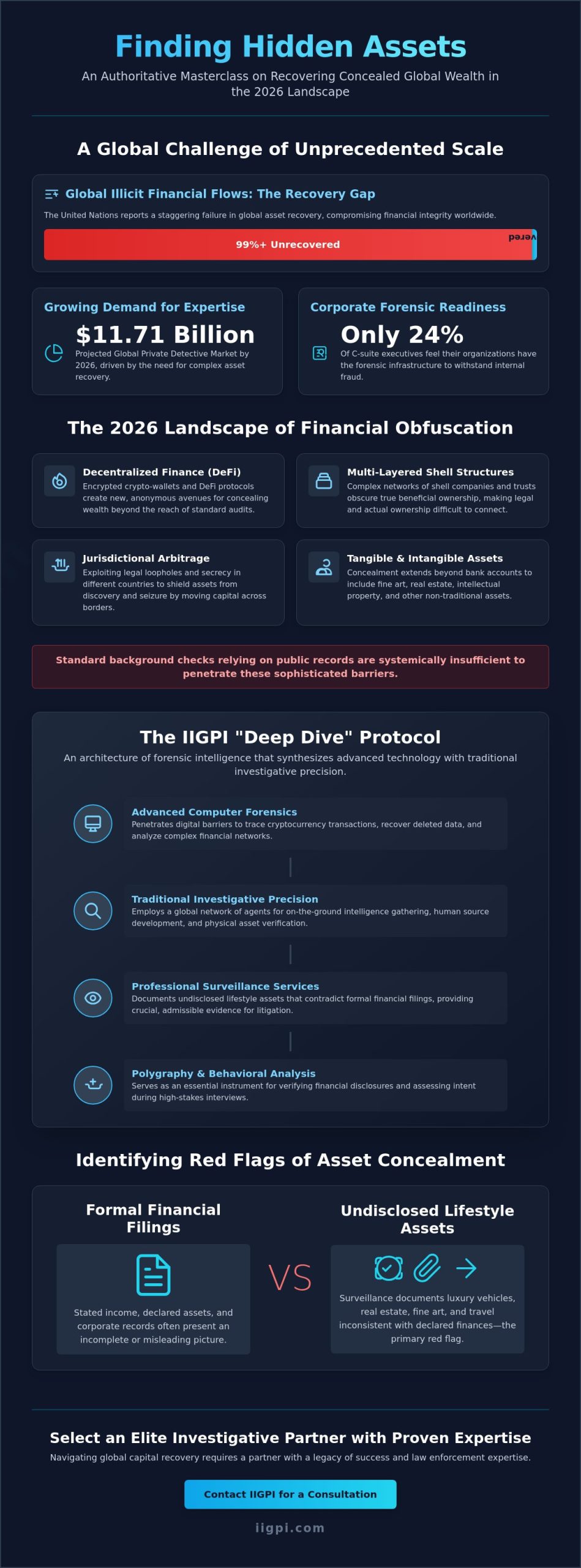
While the global private detective market is projected to reach a valuation of $11.71 billion by 2026, the United Nations Office on Drugs and Crime estimates that less than one percent of global illicit financial flows are intercepted and recovered. You likely recognize that information asymmetry remains a primary obstacle in high-stakes legal proceedings, especially when standard background checks fail to identify offshore holdings or navigate the complexity of multi-jurisdictional asset concealment. This article provides an authoritative masterclass in how to find hidden assets, Dan Ribacoff, IIGPI, and the elite forensic protocols required to recover concealed global wealth within the current geopolitical landscape.
By examining the architectural discipline of intelligence gathering, you will gain a definitive understanding of the IIGPI investigative framework, an approach that has earned the institute its reputation as the G20 of think tanks in the forensic sector. We will preview how to secure admissible evidence for litigation under the 2026 regulatory standards, including the strategic implications of the New York AVOID Act and the European Union’s MiCA regulation on digital asset recovery. Through this analysis, we facilitate a deeper comprehension of the specialized methodology required to penetrate complex shell structures and reclaim hidden capital.
Key Takeaways
- Analyze the 2026 landscape of financial obfuscation, emphasizing the systemic challenges posed by decentralized finance and multi-layered global shell structures.
- Master the “Deep Dive” protocol to understand how to find hidden assets, Dan Ribacoff, IIGPI, and their synthesis of advanced computer forensics with traditional investigative precision.
- Evaluate the application of polygraphy and behavioral analysis as essential instruments for verifying financial disclosures and maintaining institutional investigative standards.
- Identify the primary red flags of asset concealment and utilize professional surveillance services to document undisclosed lifestyle assets that contradict formal financial filings.
- Establish rigorous criteria for selecting an elite investigative partner with the 30-year legacy and law enforcement expertise required for global capital recovery.
The Strategic Imperative of Identifying Hidden Assets in 2026
The identification of concealed capital represents a critical frontier in global governance and private wealth management. Hidden assets are defined as financial instruments or property deliberately obscured through complex legal and digital structures to circumvent transparency requirements. The 2026 landscape of financial obfuscation has evolved into a multi-layered ecosystem involving decentralized finance (DeFi) protocols and sophisticated shell companies. While the global private detective market is projected to reach $11.71 billion by 2026, the success rate for recovery remains remarkably low. Standard background checks frequently fail because they rely on public records that are easily manipulated by elite actors. Dan Ribacoff and the International Investigative Group (IIGPI) have redefined this field by treating asset recovery not as a mere search, but as a strategic intellectual discipline. This shift is essential for bridging the gap between the Global North and Global South in matters of financial integrity.
The Taxonomy of Concealed Wealth
Wealth concealment strategies differentiate between tangible assets, such as real estate or fine art, and intangible holdings like intellectual property and encrypted crypto-wallets. The fundamental challenge lies in the divergence between beneficial ownership and legal ownership within complex trust structures. Elite concealment strategies utilize jurisdictional arbitrage to shield assets from standard due diligence. Conventional methods are often insufficient to penetrate these barriers. The methodology regarding how to find hidden assets, Dan Ribacoff, IIGPI, and the associated elite protocols are now essential for multi-jurisdictional litigation. The integration of digital and physical intelligence isn’t optional; it’s a prerequisite for identifying red flags in corporate and personal settings where assets are hidden behind layers of nominal owners.
The Economic Impact of Information Asymmetry
Information asymmetry creates significant economic distortions that undermine the stability of multilateral markets. The United Nations Office on Drugs and Crime reports that less than one percent of global illicit financial flows are intercepted and recovered. This failure compromises the integrity of corporate governance and matrimonial settlements alike. A 2026 survey indicated that only 24% of C-suite executives believe their organizations possess the forensic infrastructure to withstand internal fraud. The Asset recovery process is the systematic restoration of financial transparency through forensic rigor. By deconstructing the mechanisms of concealment, investigators facilitate the return of capital to its rightful place within the global economy. This systematic approach ensures that litigation is supported by admissible evidence rather than mere suspicion. It’s the only way to ensure accountability in an era of increasingly sophisticated financial evasion.
The IIGPI Methodology: The Architecture of Forensic Intelligence
The IIGPI “Deep Dive” protocol functions as the definitive antithesis of the relic-era background check, which frequently relies on fragmented public records that are easily obfuscated by sophisticated actors. This methodology represents an advanced architecture of forensic intelligence that synthesizes traditional investigative precision with high-level computer forensics to eliminate critical information gaps. Dan Ribacoff established this rigorous standard of investigative discretion to ensure that every inquiry maintains intellectual depth while remaining resilient against the scrutiny of international legal bodies. Tracing transnational capital in 2026 requires more than localized efforts; it necessitates a global network of agents capable of navigating diverse regulatory environments and geopolitical sensitivities. Mastering how to find hidden assets, Dan Ribacoff, IIGPI, and the associated strategic framework allows organizations to move beyond superficial suspicion toward actionable financial intelligence that facilitates the restoration of capital.
Phase I: The Preliminary Intelligence Audit
The investigative process commences with a rigorous mapping of a subject’s lifestyle-to-income ratio to isolate statistical anomalies that suggest undisclosed wealth. This audit utilizes proprietary databases and non-indexed digital footprints that remain invisible to standard search engines or commercial software. By analyzing behavioral patterns and consumption habits, investigators identify “proxies” and “nominee owners” within the subject’s inner circle who may be holding assets in their name. These individuals often serve as the legal facade for beneficial interests, a common tactic in elite concealment designed to frustrate standard due diligence. This phase establishes the critical foundation for deeper forensic inquiry by identifying the most likely vectors of asset diversion and establishing the subject’s true financial baseline.
Phase II: Cross-Border Financial Forensics
Tracing funds through offshore jurisdictions and tax havens demands a high degree of technical expertise and a thorough understanding of the role of a forensic accountant in deconstructing complex ledger entries. This stage often intersects with corporate fraud investigation protocols to identify diverted revenue streams and illicit transfers between seemingly unrelated shell entities. Navigating the legal complexities of international asset recovery in 2026 requires a nuanced understanding of multilateral treaties and local reporting requirements that vary significantly between the Global North and Global South. IIGPI facilitates this transition from raw data to admissible evidence by maintaining a focus on forensic integrity and structural transparency. For those facing complex financial concealment, initiating a comprehensive intelligence audit is the first step toward the systematic restoration of capital.
Dan Ribacoff and the Science of Truth in Asset Recovery
The application of behavioral analysis and polygraphy serves as a critical mechanism for dismantling the information asymmetry inherent in high-stakes financial disputes. Dan Ribacoff’s legacy in law enforcement, characterized by his tenure as an auxiliary officer for the NYPD, provides the foundational rigor for the firm’s institutional investigative standards. This background allows the firm to approach capital recovery with the precision of a state-sanctioned inquiry rather than a cursory data search. By positioning the private investigator as an essential arbiter of truth, the IIGPI methodology transforms subjective claims into objective, admissible findings. This approach is fundamental to understanding how to find hidden assets, Dan Ribacoff, IIGPI, and the strategic deconstruction of financial obfuscation in an increasingly opaque global market.
The Interrogation of Financial Disclosures
Behavioral analysis reveals “omission fraud” by identifying psychological indicators that often accompany incomplete or falsified sworn financial statements. Unlike traditional auditing, which focuses purely on the paper trail, this method scrutinizes the individual’s behavioral baseline to detect inconsistencies in their financial narrative. The strategic use of polygraph testing in high-stakes corporate and matrimonial cases provides an additional layer of verification that standard document reviews simply cannot achieve. Ribacoff’s methodology represents the convergence of traditional tradecraft and modern psychological forensic analysis. This dual approach aligns with the official guide to identifying hidden assets, which emphasizes the necessity of looking beyond public records to uncover professional-grade concealment.
Institutional Governance and the IIGPI Standard
The IIGPI framework operates as the “G20 of Think Tanks” within the private investigation sector, providing a centralized hub for global financial intelligence and policy-driven inquiry. Elite law firms in NYC frequently rely on this framework for cross-border litigation because it provides a structured, repeatable methodology that withstands intense judicial scrutiny. The firm’s investigative capacity is exemplified by its successful navigation of a $120 million bank fraud case, which remains a benchmark for its ability to handle large-scale financial deceptions. This level of forensic depth ensures that financial transparency is restored through a deliberate and measured process that respects international legal standards. By adhering to these institutional standards, the firm facilitates the identification of actionable intelligence in the most complex multi-jurisdictional environments, ultimately bridging the gap between suspicion and recovery.
Protocols for Identifying Red Flags of Asset Concealment
Identifying indicators of financial obfuscation requires a sophisticated understanding of behavioral anomalies and structural inconsistencies. While previous sections detailed the architectural discipline of intelligence gathering, the practical application of these principles relies on recognizing specific red flags that signal the presence of concealed capital. Professional surveillance services play a critical role in this process by documenting lifestyle assets that contradict formal financial disclosures. This physical intelligence is synthesized with social media intelligence (SOCMINT) to identify discrepancies in a subject’s digital footprint. Mobile devices now serve as a critical source of evidence in 66% of contemporary legal cases, providing the digital footprints necessary to confirm physical surveillance findings. The ultimate objective is to convert these investigative findings into admissible evidence that meets the rigorous standards of international litigation.
Corporate Red Flags: Diverted Revenue and Ghost Employees
Analyzing suspicious patterns in accounts payable often reveals vendor relationships that lack commercial substance. In an environment where 42% of global organizations report a heightened emphasis on security, recognizing these red flags is a strategic necessity for maintaining corporate governance. These entities frequently serve as conduits for diverting revenue or facilitating “specie loss” through fraudulent insurance claims. Investigators look for specific markers of internal fraud, including:
- Payments to vendors with registration addresses matching the subject’s private residence or known associates.
- Sequential invoice numbers from supposedly different service providers, suggesting a single source of fabrication.
- Sudden, significant increases in “consulting fees” or “professional services” without documented deliverables.
- The presence of ghost employees on payroll records used to siphon corporate funds into private accounts.
The methodology regarding how to find hidden assets, Dan Ribacoff, IIGPI, and the associated forensic standards ensures that every corporate anomaly is investigated with intellectual depth. This approach is particularly effective for uncovering “lifestyle-funding” where corporate expense accounts are utilized to maintain an extravagant standard of living that exceeds the individual’s reported compensation. By deconstructing these financial narratives, investigators provide the transparency required for effective risk management and recovery.
Domestic Red Flags: The Matrimonial Context
In the matrimonial context, “divorce planning” often manifests as sudden, unexplained decreases in reported income or significant cash withdrawals preceding legal filings. These actions are designed to minimize the marital estate and create an illusion of financial hardship. Engaging personal detective services is essential for uncovering hidden domestic accounts or undisclosed real estate transactions that standard searches overlook. Significant “gifts” to associates or family members often serve as a mechanism for temporary asset parking. These indicators, when identified early, allow for the implementation of protective measures to preserve the integrity of the asset pool. If you suspect the deliberate concealment of marital wealth, initiating comprehensive surveillance and digital forensics is the most effective way to secure a fair and transparent resolution.
Selecting an Elite Investigative Partner: The IIGPI Advantage
Selecting an elite investigative partner involves evaluating a firm’s capacity for high-level financial intelligence and its ability to withstand the scrutiny of contemporary legal proceedings. The International Investigative Group brings a 30-year legacy of excellence, rooted in former law enforcement leadership, to the complex challenge of capital recovery. This institutional pedigree is essential when determining how to find hidden assets, Dan Ribacoff, IIGPI, and the strategic framework necessary to penetrate the most sophisticated concealment efforts. While many localized agencies struggle with multi-jurisdictional complexities, an elite partner utilizes a global network of agents to track capital that flows through domestic and international channels alike.
The distinction between a localized agency and a firm with a global network of agents is critical in an era where capital moves with frictionless speed. Small-scale firms often lack the forensic infrastructure to follow funds beyond their immediate geographic area, leading to fragmented results that fail to meet judicial standards. In contrast, an institution with a global reach facilitates a seamless flow of intelligence, ensuring that no jurisdictional boundary halts the progress of an investigation. This capability is vital for deconstructing the nominee ownership structures and shell entities previously discussed, providing a comprehensive solution for capital restoration.
Global Reach and NYC Pedigree
NYC-based firms like IIGPI are uniquely positioned at the center of the world’s financial markets, providing a strategic advantage when navigating complex asset structures. This NYC pedigree ensures a nuanced understanding of domestic regulations and the institutional depth required for high-stakes litigation across the United States. The firm’s services extend from Manhattan to major financial hubs across the country, offering a level of forensic precision that smaller agencies simply can’t match. It’s this commitment to intellectual rigor that allows the institute to find a way forward in cases where others see only dead ends.
Contacting the International Investigative Group
For those requiring a confidential assessment of their investigative needs, the official IIGPI portal serves as the primary gateway for high-stakes consultation. Every engagement is managed through a formal Architecture of Discretion, ensuring that sensitive financial data remains protected throughout the inquiry. The IIGPI promise is to deliver institutional-grade intelligence with surgical precision, facilitating the systematic restoration of capital for its clients. By choosing a partner with a proven history of success, you gain access to the forensic infrastructure needed to resolve even the most difficult financial deceptions.
Advancing Financial Integrity Through Forensic Rigor
The evolution of financial obfuscation in 2026 demands a transition from passive observation to the active deconstruction of complex concealment structures. By leveraging the synthesis of behavioral analysis and advanced computer forensics, organizations can effectively address the information asymmetry that historically impeded capital restoration. This authoritative framework defines the standard for how to find hidden assets, Dan Ribacoff, IIGPI, and the associated protocols that ensure every finding is resilient against international judicial scrutiny. The restoration of transparency is not merely a technical objective but a strategic imperative that supports the integrity of global governance and private wealth management. With a 30-year legacy of investigative excellence and a foundation in former law enforcement leadership, the International Investigative Group has successfully resolved over 10,000 cases globally. This institutional-grade expertise provides the necessary infrastructure to navigate the most intricate multi-jurisdictional challenges with surgical precision. To secure your financial interests and reclaim obscured capital, we invite you to Consult with Dan Ribacoff and the IIGPI Elite Investigative Team. The path toward financial clarity and the systematic recovery of wealth begins with the application of elite forensic intelligence.
Frequently Asked Questions
How does Dan Ribacoff find assets hidden in offshore accounts?
Dan Ribacoff identifies assets in offshore accounts by deconstructing jurisdictional arbitrage and utilizing a global network of agents to penetrate tax havens. This methodology moves beyond public records to analyze beneficial ownership through multilateral cooperation. By tracing funds through complex offshore structures, the institute facilitates financial transparency in regions where local reporting requirements are historically opaque. This approach bridges the gap between the Global North and Global South in high-stakes capital recovery.
Can IIGPI recover assets concealed in cryptocurrency wallets?
IIGPI utilizes advanced computer forensics and blockchain analysis to identify capital concealed within cryptocurrency wallets and decentralized finance protocols. Under the 2026 Markets in Crypto-Assets (MiCA) regulation, the firm navigates the evolving legal landscape to trace tokenized assets across international borders. This forensic rigor ensures that digital footprints are converted into actionable intelligence. The institute maintains the technical infrastructure necessary to penetrate encrypted environments that standard investigative agencies cannot access.
Is an asset search conducted by IIGPI admissible in NYC courts?
Asset searches conducted by the firm are designed to meet the rigorous evidentiary standards required for admissibility in New York State courts. Every inquiry adheres to the procedural mandates of the New York AVOID Act, ensuring that findings regarding how to find hidden assets, Dan Ribacoff, IIGPI, are legally resilient. By maintaining a chain of custody and documenting findings through formal forensic protocols, the institute provides the intellectual rigor necessary for high-stakes litigation.
What is the difference between a standard background check and the IIGPI methodology?
The IIGPI methodology functions as a strategic intellectual discipline, whereas standard background checks typically rely on fragmented public records and commercial databases. This “Deep Dive” protocol incorporates behavioral analysis and proprietary intelligence to identify anomalies in a subject’s lifestyle-to-income ratio. While a standard check might verify a subject’s employment, the IIGPI framework deconstructs their entire financial architecture to uncover undisclosed holdings. This structural approach is what distinguishes the institute as the G20 of think tanks.
How long does a comprehensive asset investigation typically take?
The duration of a comprehensive investigation depends on the complexity of the concealment strategies and the number of jurisdictions involved in the search. A preliminary intelligence audit often establishes a baseline within a defined timeframe, while cross-border financial forensics may require more extensive multilateral cooperation. Each case follows a deliberate and measured rhythm to ensure that no forensic detail is overlooked. The objective is always to deliver institutional-grade intelligence without sacrificing the surgical precision required for recovery.
What information does Dan Ribacoff need to begin an asset search?
To initiate a successful asset search, Dan Ribacoff requires the subject’s primary identifiers, known financial baselines, and a list of suspected proxies or nominee owners. This foundational data allows the institute to map the subject’s domestic and international footprint effectively. Providing existing financial disclosures or known business affiliations facilitates a more efficient preliminary audit. This initial information is the catalyst for the deeper forensic inquiry required to penetrate professional-grade concealment strategies.
Can IIGPI find assets hidden within complex corporate shell structures?
The institute specializes in deconstructing multi-layered corporate shell structures to identify diverted revenue streams and illicit transfers between seemingly unrelated entities. By analyzing accounts payable and vendor relationships, investigators uncover the mechanisms used for wealth obfuscation. This process often identifies ghost employees or fraudulent consulting fees used to siphon capital into private accounts. Such forensic depth is essential for maintaining corporate governance and resolving significant internal fraud within global organizations.
Why is Dan Ribacoff considered the elite standard for NYC investigations?
Dan Ribacoff is recognized as the elite standard for NYC investigations due to his 30-year legacy and his foundational experience in law enforcement as an NYPD auxiliary officer. This pedigree informs the institute’s institutional standards and its commitment to intellectual rigor in every engagement. His status as a leading authority in polygraphy and behavioral analysis provides a unique mechanism for verifying truth in financial disputes. This combination of tradecraft and forensic depth makes the firm a premier partner for NYC’s elite law firms.