
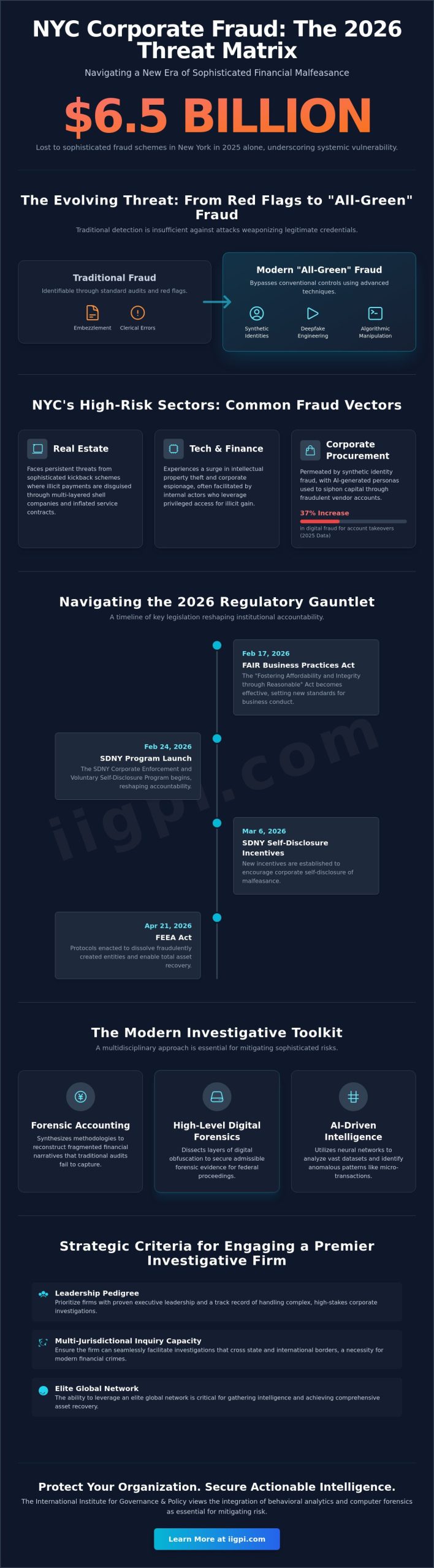
New Yorkers lost approximately $6.5 billion to sophisticated fraud schemes in 2025, a figure that underscores the systemic vulnerability of the world’s premier financial hub. As the SDNY Corporate Enforcement and Voluntary Self-Disclosure Program, launched on February 24, 2026, reshapes institutional accountability, the demand for elite corporate fraud investigation services nyc has transitioned from a reactive necessity to a cornerstone of strategic governance. You likely recognize that traditional red-flag detection is increasingly insufficient against “all-green” fraud where legitimate credentials are weaponized by synthetic identities or deepfake social engineering.
This analysis provides a sophisticated framework for navigating the Fostering Affordability and Integrity through Reasonable (FAIR) Business Practices Act, effective February 17, 2026, ensuring your organization maintains regulatory clearance while securing actionable intelligence for litigation. We’ll examine how the International Institute for Governance & Policy, the “G20 of Think Tanks,” views the integration of behavioral analytics and computer forensics as essential for mitigating the $400 hourly cost of specialized financial risk. This discourse previews the protocols required to dissolve fraudulently created entities under the April 21, 2026, FEEA Act while achieving total asset recovery and the mitigation of future multi-stage fraud schemes.
Key Takeaways
- Analyze the contemporary paradigm of corporate malfeasance within Manhattan’s financial sector to understand how 2026’s sophisticated instruments necessitate a multidisciplinary approach to risk mitigation.
- Synthesize forensic accounting methodologies with high-level digital forensics to detect and analyze anomalous financial patterns through AI-driven intelligence.
- Master the jurisdictional complexities inherent in the NYC regulatory environment, specifically regarding the collaboration between corporate fraud investigation services nyc and the Southern District of New York (SDNY).
- Adopt rigorous selection criteria for private investigative firms by prioritizing leadership pedigree and the capacity to facilitate multi-jurisdictional inquiries through an elite global network.
The Paradigm of Corporate Malfeasance in New York City’s Financial Landscape
Manhattan’s high-density corporate sector remains the global epicenter for white-collar malfeasance, where the convergence of massive capital flows and complex regulatory structures creates a fertile environment for illicit activity. In 2026, corporate fraud has evolved beyond simple embezzlement into a sophisticated paradigm of corporate malfeasance involving algorithmic manipulation, synthetic identities, and decentralized financial instruments that bypass traditional oversight. These developments necessitate the deployment of specialized corporate fraud investigation services nyc to dissect layers of obfuscation that traditional compliance frameworks are ill-equipped to penetrate. It’s essential to recognize that as financial instruments become more abstract, the methods used to exploit them grow increasingly opaque.
Standard internal audits are frequently neutralized by high-level executive malfeasance because these protocols are designed to identify clerical errors rather than deliberate, technologically-enabled deception orchestrated by those with administrative override capabilities. When leadership figures engage in collusion, the resulting data siloing prevents internal controllers from perceiving the holistic scope of the threat. Utilizing professional corporate fraud investigation services nyc ensures that forensic evidence remains admissible during federal proceedings while providing the intellectual rigor needed to identify and neutralize threats before they metastasize into terminal institutional failures. Corporate fraud investigation is a strategic prophylactic against systemic organizational collapse.
Common Vectors of Financial Fraud in NYC
The New York real estate sector faces persistent challenges from sophisticated kickback schemes where illicit payments are disguised through multi-layered shell companies and inflated service contracts. Simultaneously, the tech and finance corridors of Manhattan experience a surge in intellectual property theft and corporate espionage, often facilitated by internal actors leveraging privileged access. Synthetic identity fraud has also permeated corporate procurement processes, with 2025 data from TransUnion indicating a 37% increase in digital fraud rates for account takeovers, often involving AI-generated personas used to siphon capital through fraudulent vendor accounts.
The Economic Impact of Unresolved Internal Threats
Direct financial hemorrhaging represents only the initial layer of damage, as the long-term erosion of shareholder confidence often leads to a precipitous decline in market valuation that far exceeds the original loss. In the global media capital, the “silent cost” of reputational damage can permanently impair a firm’s ability to secure capital or attract elite talent. For a deeper analysis of these risks, leaders should consult the Corporate Fraud Investigation: A Definitive Guide for Business Leaders to establish robust defense protocols that align with the March 6, 2026, SDNY self-disclosure incentives.
Advanced Methodologies in Forensic Accounting and Digital Intelligence
The synthesis of forensic accounting and high-velocity technological inquiry represents the contemporary frontier of institutional protection. Advanced Methodologies in Forensic Accounting now rely on the integration of digital forensics to reconstruct fragmented financial narratives that traditional audits fail to capture. By 2026, AI-driven data analysis has become an essential instrument for identifying anomalous financial patterns, such as micro-transactions designed to evade standard velocity triggers. These corporate fraud investigation services nyc utilize neural networks to analyze vast datasets, cross-referencing internal procurement logs with deep-web intelligence to trace misappropriated corporate assets through obfuscated cryptocurrency mixers. To ensure judicial efficacy, digital evidence must be harvested using write-blocked imaging and cryptographic hashing to maintain a pristine chain of custody that adheres to the stringent 2026 evidentiary standards required by the Southern District of New York.
Computer Forensics as a Strategic Investigative Tool
Modern inquiries frequently depend on the recovery of deleted files and the decryption of ephemeral communications. Analyzing metadata provides the chronological framework necessary to establish intent, proving that a transaction wasn’t a clerical error but a deliberate strategic bypass. For a technical deep-dive, organizations should reference Computer Forensics: A Guide for Corporate and Legal Investigations. These techniques allow corporate fraud investigation services nyc to pierce the veil of the “all-green” fraud discussed in previous sections. Organizations seeking to fortify their internal defenses can consult with a specialist to implement proactive monitoring protocols.
Surveillance Protocols in Corporate Environments
While digital footprints are essential, high-definition physical surveillance verifies the human element of malfeasance, such as unauthorized access to secure server rooms or covert meetings with competitors. In the high-stakes environment of Manhattan, the legality of these operations is governed by nuanced privacy laws that distinguish between public corridors and private executive suites. Adhering to these ethical boundaries is critical for ensuring that findings remain actionable in civil litigation. Comprehensive insights into these methodologies are available in Professional Surveillance Services: A Comprehensive Guide for 2026.
Navigating the Jurisdictional Complexities of the NYC Regulatory Environment
The regulatory environment of New York City is characterized by a high-stakes symbiosis between federal enforcement and state-level mandates. Utilizing corporate fraud investigation services nyc is no longer a discretionary expense; it’s a strategic necessity for entities operating within the jurisdiction of the Southern District of New York (SDNY). The launch of the SDNY Corporate Enforcement and Voluntary Self-Disclosure Program on February 24, 2026, establishes a new benchmark for corporate accountability, offering declinations of prosecution for firms that promptly disclose financial crimes. This federal shift coincides with the implementation of the FAIR Business Practices Act on February 17, 2026, which significantly empowers the New York Attorney General to prosecute “unfair” or “abusive” practices under the federal UDAAP standard. NYC mandates are absolute.
Investigative protocols must function on a parallel track to active litigation, providing a continuous stream of actionable intelligence without compromising the integrity of judicial proceedings. The FAIR Business Practices Act’s adoption of the UDAAP standard means that business practices can be deemed unlawful even if they lack explicit deceptive intent. This necessitates a proactive investigative stance that transcends traditional compliance checklists. Parallel-track investigations allow a corporation to pursue internal recovery and remediation while simultaneously cooperating with federal authorities, a balance that is essential for securing the declinations promised by the February 2026 program. All findings must adhere to the evidentiary standards of the New York courts, particularly as the Fraudulent Entities Elimination Act (FEEA Act) of April 21, 2026, introduces new mechanisms for dissolving entities compromised by identity theft.
White-Collar Criminal Defense and Investigative Support
Professional investigative firms act as essential conduits for legal counsel, translating complex financial anomalies into coherent narratives for both defense and prosecution. Expert witness testimony has become increasingly vital in trials involving sophisticated algorithmic fraud, where the investigator’s ability to deconstruct synthetic identity schemes determines the outcome. NYC serves as the primary hub for navigating the “Grey Market” of international asset recovery. This requires agents to manage multi-jurisdictional challenges while maintaining compliance with local discovery rules. Investigators must also account for the rise in money mule activity, which increased globally throughout 2025, by tracing the flow of capital through domestic and international nodes.
Regulatory Compliance and Anti-Money Laundering (AML)
Implementing frameworks that satisfy federal Anti-Money Laundering (AML) requirements is critical for avoiding the 4,235 complaints filed with the AG’s office in 2025 regarding banking and mortgage fraud. Due diligence serves as a primary defense against the inadvertent regulatory violations that often accompany the formation of foreign LLCs under the January 1, 2026, NYCTA reporting mandates. Compliance is the only path. A detailed analysis of these professional responsibilities is provided in The Role and Function of a Private Investigator: A Comprehensive Overview.
Strategic Criteria for Engaging a Premier Private Investigative Firm
Selecting an institution for corporate fraud investigation services nyc requires a rigorous evaluation of intellectual capital and operational pedigree. While academic credentials provide a necessary theoretical foundation for policy analysis, the volatility of the 2026 financial landscape demands leadership with a deep-rooted history in high-stakes field operations. A firm’s ability to synthesize macro-level geopolitical insights with localized tactical maneuvers in Manhattan’s five boroughs distinguishes elite institutions from generic service providers. It’s not enough to understand the theory of malfeasance; the firm must possess the cognitive flexibility to anticipate the next iteration of synthetic identity fraud before it compromises the organizational core.
The integration of a global network of agents is indispensable for addressing multi-jurisdictional fraud cases that frequently originate in the NYC hub but terminate in offshore tax havens. When assessing a firm’s technological stack, stakeholders must verify the use of 2026-standard forensic tools capable of real-time behavioral analytics and blockchain-based asset tracing. Transparency in reporting has also evolved, moving beyond the simplistic summaries of the past toward comprehensive intelligence dossiers that provide actionable data for both litigation and long-term risk mitigation. These dossiers serve as the definitive record of an organization’s commitment to regulatory clearance and asset recovery.
Experience and Case History as Key Performance Indicators
A track record encompassing 10,000+ successfully resolved cases is a non-negotiable prerequisite for establishing corporate trust in a high-density financial sector. Analyzing specific case studies involving high-value bank fraud and complex insurance claims reveals whether a firm possesses the requisite institutional memory to identify recurring patterns of deception. The “former law enforcement” perspective is particularly valuable in this context, as it brings a nuanced understanding of the evidentiary standards required by the SDNY that purely academic firms often lack. This experience ensures that investigative findings aren’t just informative but are legally resilient.
Discretion and the “G20 of Think Tanks” Approach
Maintaining a “silent partner” status during sensitive executive investigations is critical for ensuring that institutional stability isn’t compromised by premature disclosure or internal panic. This approach mirrors the intellectual rigor and exclusivity of the “G20 of Think Tanks,” where tactical field operations are guided by sophisticated policy analysis and a global perspective. Establishing protocols for secure, end-to-end encrypted communication between the firm and the client is mandatory for protecting the integrity of the inquiry. Organizations requiring this level of elite sophistication should secure a professional investigative consultation to fortify their systemic risk framework.
International Investigative Group: Three Decades of Excellence in NYC
The International Investigative Group occupies a singular echelon within the ecosystem of corporate fraud investigation services nyc, serving as the definitive authority for organizations navigating the complexities of the 2026 regulatory environment. With an institutional history spanning three decades, our firm synthesizes tactical field experience with the intellectual rigor characteristic of the “G20 of Think Tanks.” This legacy isn’t merely a chronological marker; it’s a strategic advantage that allows for the identification of systemic risks before they manifest as terminal financial failures. Elite NYC corporations prioritize our services because we provide a seamless transition from intelligence gathering to actionable litigation support, ensuring that every finding adheres to the highest evidentiary standards of the New York courts.
Former law enforcement expertise serves as the cornerstone of our investigative framework, offering a perspective that purely academic entities can’t replicate. This background ensures that our agents possess the cognitive flexibility required to deconstruct sophisticated malfeasance while maintaining the “silent partner” status essential for sensitive executive inquiries. By integrating macro-level policy insights with localized operational precision, we facilitate the regulatory clearance and asset recovery necessary to sustain institutional integrity in a volatile global market. Our methodology remains focused on providing the gravitas and intellectual depth required by global leaders who manage New York’s most influential financial instruments.
A Multidisciplinary Approach to Corporate Intelligence
Our successes include the resolution of a $120 million bank fraud scheme and the mitigation of $12 million in fraudulent insurance claims, demonstrating a capacity for handling high-stakes malfeasance with absolute precision. We offer a unified framework that convenes armed security, surveillance, and computer forensics under one elite umbrella, eliminating the data siloing that often hampers fragmented investigative efforts. This multidisciplinary strategy ensures that no anomalous pattern remains unexamined. For a detailed analysis of our specialized protocols, stakeholders should examine our Insurance Fraud Investigation Services: An Elite Framework for Risk Mitigation in 2026.
Initiating a High-Level Consultative Partnership
The transition from initial suspicion to a comprehensive investigative roadmap requires a deliberate and structured approach. We invite policymakers and industry leaders to engage our NYC-based experts for an immediate, confidential briefing to discuss the specific parameters of their risk environment. This consultative partnership ensures that every inquiry is tailored to the unique jurisdictional challenges of Manhattan and the broader global financial corridors. To protect your organization’s future and secure your assets, engage the elite investigative services of International Investigative Group today.
Fortifying Institutional Integrity in an Era of Algorithmic Deception
It’s essential to recognize that the transition toward a more transparent and accountable corporate ecosystem in New York City requires a departure from obsolete internal controls toward a multidisciplinary framework of forensic intelligence. As federal authorities increasingly prioritize self-disclosure and behavioral analytics, the role of corporate fraud investigation services nyc has become the primary mechanism for maintaining institutional stability and shareholder confidence. Organizations that successfully navigate the jurisdictional nuances of the SDNY and the FAIR Business Practices Act will emerge with enhanced resilience. Integrity is the only path.
International Investigative Group leverages over 30 years of elite investigative experience to resolve the most complex instances of corporate malfeasance. Founded by former law enforcement professionals, our institution hasn’t just analyzed financial anomalies; it’s facilitated the successful recovery in $120 million fraud cases by synthesizing tactical field operations with sophisticated digital forensics. We invite you to secure your corporate assets with a confidential consultation from International Investigative Group to ensure your firm remains a champion of governance and intellectual rigor. Protecting your institutional legacy is a mission-critical objective that demands the premier authority in global risk mitigation.
Frequently Asked Questions
What are the primary indicators of corporate fraud in a large NYC-based organization?
Primary indicators include anomalous micro-transaction velocity and unauthorized administrative credential overrides that bypass standard internal controls. The Federal Trade Commission reported 59,017 instances of identity theft in New York through the first three quarters of 2025; this reflects a rate of approximately 216 new victims daily. These indicators often coincide with unexplained lifestyle shifts in executive leadership or the sudden siloing of procurement data that prevents holistic oversight.
How does a private corporate fraud investigation differ from a law enforcement inquiry?
Private corporate fraud investigation services nyc differ from law enforcement inquiries by prioritizing institutional continuity and asset recovery over purely punitive outcomes. While federal programs incentivize self-reporting, private investigations allow a firm to gather intelligence discreetly before engaging the Southern District of New York. This provides the client with a strategic advantage in managing reputational risk while ensuring that all findings remain actionable for future civil litigation.
Are the findings of a private investigator admissible in New York State courts?
Findings are fully admissible provided they adhere to the stringent chain of custody requirements established for 2026 legal standards. By utilizing write-blocked imaging and cryptographic hashing, investigators ensure that digital evidence remains untainted for New York State court proceedings. These protocols are essential for meeting the evidentiary thresholds required under the FAIR Business Practices Act and ensuring that recovered data can withstand rigorous cross-examination during trial.
What is the typical duration of a comprehensive corporate financial investigation?
A comprehensive financial investigation typically spans three to six months depending on the complexity of the obfuscation layers involved. While preliminary findings from computer forensics can often be delivered within 14 business days, tracing misappropriated assets through international cryptocurrency mixers requires a more deliberate chronological framework. Complexity dictates the timeline; however, our multidisciplinary approach ensures that critical intelligence is disseminated to leadership as it’s verified.
How does International Investigative Group ensure absolute confidentiality during an audit?
Absolute confidentiality is maintained through end-to-end encrypted communication channels and a “silent partner” operational protocol that limits internal exposure. This approach ensures that the inquiry doesn’t trigger institutional panic or compromise the firm’s market valuation during the sensitive investigative phase. Every agent operates under strict non-disclosure mandates to protect the firm’s elite intellectual capital and maintain the integrity of the ongoing inquiry.
Can digital forensics recover data from encrypted or “wiped” corporate devices?
Digital forensics can recover fragmented data from encrypted or wiped devices through advanced forensic imaging and chip-off techniques that access raw data storage. Since the suspected digital fraud rate for account takeovers escalated significantly throughout 2025, the ability to reconstruct deleted ephemeral communications has become a prerequisite for identifying criminal intent. Our technological stack is specifically calibrated to pierce 2026-standard encryption layers while maintaining evidentiary integrity.
What jurisdictional reach does IIG have for international asset tracing?
International Investigative Group maintains a sophisticated global network of agents capable of facilitating multi-jurisdictional asset tracing from our primary NYC hub. This reach allows for the identification of capital flows through emerging economies while adhering to local discovery rules and international compliance standards. We provide the macro-level perspective required for tracing assets that have been dispersed across international boundaries to evade domestic recovery efforts.
What is the initial process for engaging IIG for a corporate fraud matter in NYC?
The process begins with a high-level confidential briefing to establish the specific parameters of the suspected malfeasance and the organization’s risk profile. Following this initial consult, our experts develop a comprehensive investigative roadmap that outlines the technical and tactical requirements for the inquiry. This structured approach ensures that the organization remains aligned with federal self-disclosure incentives while pursuing a strategy of total asset recovery.