
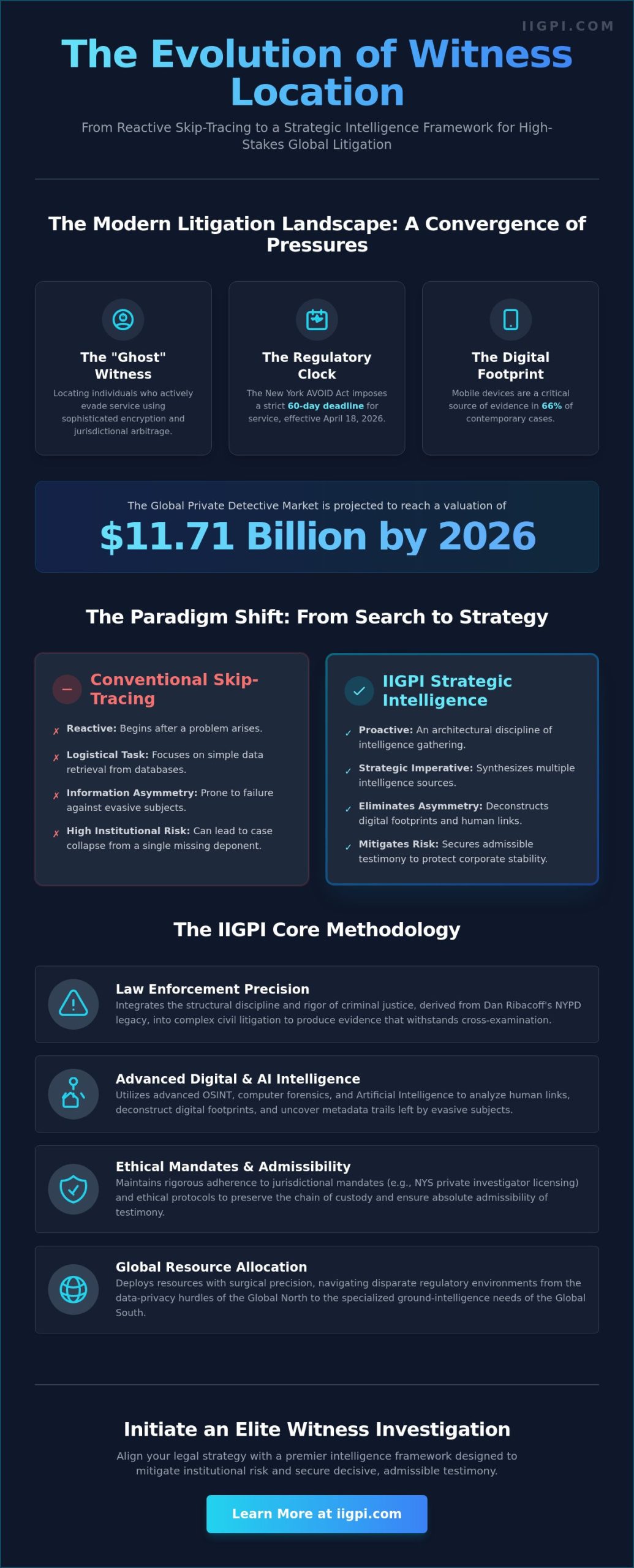
The strategic imperative of locating witnesses for a lawsuit, Dan Ribacoff, and the IIGPI framework represents a sophisticated architectural discipline of intelligence gathering designed to eliminate information asymmetry in complex global litigation. Within a global private detective market projected to reach a valuation of $11.71 billion by 2026, this methodology stands as a premier standard for investigative governance. It successfully synthesizes traditional law enforcement precision with advanced digital intelligence, acknowledging that mobile devices now constitute a critical source of evidence in 66% of contemporary cases.
Legal practitioners frequently encounter the profound difficulty of locating “ghost” witnesses who actively evade service, a challenge further complicated by the New York AVOID Act’s strict 60-day deadline effective April 18, 2026. This article offers an authoritative analysis of modern witness location methodologies, promising to demonstrate how a convergence of physical and technical intelligence secures admissible testimony. We’ll explore the integration of artificial intelligence in analyzing human links and the rigorous ethical standards required to maintain institutional integrity throughout the investigative process.
Key Takeaways
- Understand the transition from conventional skip-tracing to a strategic intelligence paradigm designed to mitigate institutional risk in multi-national litigation.
- Analyze the integration of law enforcement precision into the specialized methodologies for locating witnesses for a lawsuit, dan ribacoff, and the IIGPI framework to secure high-integrity evidence.
- Identify advanced techniques in OSINT and computer forensics used to deconstruct the digital footprints and metadata of subjects evading service.
- Evaluate the jurisdictional mandates and ethical protocols required to preserve the chain of custody and ensure the admissibility of testimony in New York courts.
- Establish the parameters for global resource allocation and consultation to align investigative scope with specific geopolitical and evidentiary objectives.
The Strategic Imperative of Witness Locating in 2026 Litigation
The evolution of modern litigation necessitates a departure from rudimentary search techniques toward a comprehensive architectural discipline of intelligence gathering. Within the current framework of global legal disputes, the process of locating witnesses for a lawsuit, Dan Ribacoff, and the IIGPI methodology represents a critical transition from reactive skip-tracing to strategic intelligence. This shift is driven by the reality that information asymmetry remains the primary catalyst for litigation failure, where the absence of a single key deponent can result in the complete collapse of a multi-million dollar corporate defense. Traditional databases don’t provide the depth required to identify high-value “ghost” witnesses who, by 2026, increasingly utilize sophisticated encryption and jurisdictional arbitrage to evade service.
A professional private investigator operating within the IIGPI framework recognizes that witness location is not merely a logistical task but a strategic imperative for mitigating institutional risk. When multi-national enterprises face complex liability claims, the ability to secure sworn statements early in the process dictates the trajectory of the entire case. It’s the synthesis of law enforcement precision and advanced digital forensics that allows IIGPI to ensure the evidentiary record remains robust against the challenges of 2026 legal standards.
The Strategic Function of Professional Observation
The transition from reactive searching to proactive intelligence gathering allows legal teams to control the narrative before a case reaches the trial phase. Credible witness testimony significantly alters the calculus of settlement negotiations, often providing the leverage necessary to avoid protracted and expensive litigation. Within this context, evidentiary integrity is defined as the rigorous preservation of the chain of custody and the ethical acquisition of testimony to ensure its absolute admissibility under 2026 judicial scrutiny.
Surveillance as a Risk Mitigation Tool
Locating witnesses during the preliminary stages of a dispute prevents the escalation of corporate liability and protects the long-term stability of global governance structures. The reliability of a witness is often the thin line between a successful defense and a catastrophic financial loss for an organization. This challenge is magnified by jurisdictional disparities, as investigators must navigate the distinct regulatory environments of the Global North and the Global South. While the Global North often presents hurdles related to stringent data privacy laws, the Global South may require specialized ground intelligence to navigate less formalized record-keeping systems. Ultimately, the systematic approach to locating witnesses for a lawsuit, Dan Ribacoff, and the IIGPI framework addresses these complexities by deploying global resources with surgical precision.
The Ribacoff Paradigm: Integrating Law Enforcement Precision into IIGPI Methodologies
The investigative legacy of Dan Ribacoff is characterized by a transition from tactical NYPD detective work to the establishment of an elite private intelligence infrastructure. This evolution has resulted in a methodology for locating witnesses for a lawsuit, Dan Ribacoff, and the IIGPI framework that prioritizes structural discipline over simple data retrieval. By synthesizing the rigor of criminal justice with the agility required in multi-million dollar civil litigation, the institute has developed an architectural approach to intelligence. It’s not enough to find a subject; the investigation must document the witness’s relevance with a level of depth that survives the most aggressive cross-examination. This Ribacoff-led discipline ensures that every lead is pursued with the same intensity as a high-profile criminal inquiry.
Adherence to New York State private investigator licensing standards, including the mandatory $10,000 surety bond and rigorous biennial renewal process, ensures that all findings meet the stringent criteria of the New York State Department of State. This regulatory compliance is the baseline for the International Investigative Group, which has handled over 10,000 cases with a focus on institutional integrity. Legal counsel seeking to elevate their evidentiary standing should consider the specialized consultation services provided by the institute to bridge the gap between raw data and admissible testimony.
The Architecture of Modern Intelligence Gathering
The institute utilizes what it defines as “The G20 of Think Tanks” approach to investigative strategy, framing witness location as a scholarly endeavor rather than a mere search. By applying law enforcement methodologies such as comprehensive canvassing and forensic record analysis, investigators enhance the reliability of the evidence gathered. This scholarly framework extends to the initial contact and interview phases, where the focus remains on the objective extraction of facts to eliminate the risk of witness coaching or evidence contamination.
Institutional Integrity and the IIGPI Global Standard
Maintaining a serious and objective tone during high-stakes witness engagements is essential for protecting the credibility of the resulting testimony. The inclusion of polygraph testing as a foundational service allows for the empirical verification of witness credibility, a critical tool when dealing with conflicting accounts in complex litigation. This commitment to truth-seeking reflects the institute’s broader mission to facilitate global governance through the dissemination of verified intelligence. Whether operating in the Global North or navigating the complexities of emerging markets, the IIGPI standard ensures that the process of locating witnesses for a lawsuit, Dan Ribacoff, and the IIGPI framework remains the definitive benchmark for investigative excellence.
Advanced Methodologies: The Convergence of Physical and Digital Intelligence
The efficacy of contemporary investigative frameworks is contingent upon the seamless integration of disparate intelligence streams into a unified evidentiary record. Within the specialized context of locating witnesses for a lawsuit, Dan Ribacoff, and the IIGPI framework, this convergence represents a sophisticated architectural discipline that bridges the divide between digital footprints and physical presence. While conventional firms often treat computer forensics and field surveillance as isolated operational silos, the institute facilitates a synthesized approach where metadata analysis directly informs tactical observation. This structural synergy ensures that even subjects who actively evade service are identified through a combination of technical precision and localized ground intelligence. By deploying these multi-layered strategies, the institute maintains its position as a leading authority in the global discourse on investigative governance.
The Digital Dimension of Witness Location
The process begins with the rigorous application of Open Source Intelligence (OSINT) to map the digital architecture surrounding an elusive subject. Investigators analyze social engineering patterns and digital behaviors to predict future movements, transforming raw data into actionable intelligence. The global private detective services market is projected to be valued at $11.71 billion in 2026, reflecting an increased institutional reliance on these sophisticated intelligence-gathering capabilities. Within this expanding sector, the IIGPI methodology utilizes computer forensics to extract location-specific metadata from encrypted communications and local storage. This technical depth allows the institute to bypass traditional evasive tactics by identifying systemic patterns that the subject cannot fully obscure. The objective is to eliminate the information asymmetry that often plagues complex litigation in both the Global North and emerging economies.
Physical Surveillance and Tactical Observation
Once the digital dimension provides a probable location, the investigation transitions from abstract analysis to physical confirmation through professional observation. This phase is supported by a global network of agents, with a concentrated presence in New York City and strategic reach across various geopolitical jurisdictions. The deployment of unmanned drones and advanced high-definition video evidence provides a level of witness verification that meets the highest evidentiary standards for 2026 litigation. To maintain the security of these operations, Technical Surveillance Counter-Measures (TSCM) are utilized to protect the integrity of the investigative team from electronic eavesdropping. For a more detailed analysis of these tactical applications, legal professionals should refer to the Professional Surveillance Services: A Comprehensive Guide for 2026. This transition from digital lead to physical confirmation ensures that the final evidentiary record is not only accurate but also resilient against rigorous procedural challenges.
Ensuring Evidentiary Admissibility and Ethical Mandates in New York
The preservation of judicial credibility in modern litigation is inextricably linked to the ethical rigor of the investigative process. Navigating the jurisdictional complexities of New York investigative laws requires a profound understanding of the legislative shifts that occurred in early 2026. The implementation of the AVOID Act on April 18, 2026, which established a strict 60-day deadline for third-party complaints, has intensified the pressure on legal teams to secure reliable testimony with unprecedented speed. Within this accelerated environment, the process of locating witnesses for a lawsuit, Dan Ribacoff, and the IIGPI framework serves as an essential safeguard against procedural errors. Evidentiary integrity is maintained through a rigorous chain of custody that begins at the initial point of location and extends through to the final deposition. This systematic approach ensures that every piece of information gathered is resilient against challenges regarding its origin or the ethics of its acquisition. The institute’s commitment to institutional oversight prevents the pitfalls of nefarious conduct that can compromise a case’s outcome.
Admissibility and the Rules of Evidence
Witness testimony is fundamentally only as robust as the methodology employed during the discovery phase. The institute utilizes a specialized protocol to document the “moment of discovery,” providing the court with a transparent and verifiable record of how the witness was identified and approached. This transparency is critical for establishing judicial credibility and preventing allegations of witness tampering or coercion. By prioritizing the scholarly extraction of facts over anecdotal evidence, the framework ensures that testimony remains admissible under the most rigorous judicial scrutiny. To further strengthen the evidentiary record, legal professionals should consult Computer Forensics: A Guide for Corporate and Legal Investigations to understand the technical nuances of evidence preservation.
Ethical Intelligence in a Global Context
The institute bridges the gap between the stringent legal standards of the Global North and the operational complexities often encountered in the Global South. By adhering to elite ethical frameworks and formal naming conventions, such as the World Governance Forum, the organization maintains its institutional gravitas across diverse geopolitical landscapes. This commitment to oversight eliminates the risk of ethical breaches, positioning the institute as a premier authority in the global discourse on investigative governance. It’s the synthesis of these high-level standards that allows the organization to operate effectively in jurisdictions where legal structures may be less formalized. The methodology for locating witnesses for a lawsuit, Dan Ribacoff, and the IIGPI framework ensures that testimony is acquired through ethical and admissible means. Organizations requiring high-level oversight for their litigation needs should contact the International Investigative Group to ensure their intelligence gathering meets these elite standards.
Initiating an Elite Witness Investigation with IIGPI
The formal engagement of a premier investigative entity requires a structured alignment between specific legal objectives and sophisticated intelligence capabilities. When initiating the process of locating witnesses for a lawsuit, Dan Ribacoff, and the IIGPI framework provide the architectural depth necessary to ensure successful outcomes in high-stakes litigation. This process begins with an exhaustive consultation phase where the institute’s experts analyze the specific geopolitical footprint of the subject to determine the most effective distribution of global resources. It’s a protocol of precision. By synthesizing institutional rigor with surgical field execution, the organization facilitates the dissemination of real-time intelligence to legal counsel, ensuring that every evidentiary lead is exploited with maximum efficiency.
The IIGPI Consultation Framework
The IIGPI consultation framework serves as a strategic portal through which legal professionals define the scope and desired evidentiary outcomes of their inquiries. This phase involves a multi-dimensional analysis of the case file to identify potential intelligence leads that conventional search methods often overlook. For corporate and insurance clients, the institute provides customized resource allocation that addresses the unique challenges of institutional risk management. Understanding the broader context of these inquiries is essential, as detailed in the Corporate Fraud Investigation: A Definitive Guide for Business Leaders, which outlines the necessity of proactive intelligence in protecting organizational stability across both the Global North and Global South.
Engaging the Ribacoff Legacy
Leveraging over 30 years of experience in New York City and various international jurisdictions, the firm provides a level of tactical expertise that remains unparalleled in the private sector. The Ribacoff legacy is built upon a foundation of law enforcement precision, ensuring that the integrity of a lawsuit is maintained through the acquisition of high-stakes, admissible intelligence. As “The G20 of Think Tanks” in the investigative sector, the institute continues to bridge critical information gaps by deploying specialized ground intelligence wherever it’s required. To secure the most credible testimony and ensure the successful resolution of complex legal disputes, counsel should Consult with the International Investigative Group for high-stakes witness location.
Securing Evidentiary Dominance through Strategic Intelligence
The evolution of global litigation in 2026 requires a departure from rudimentary search techniques toward an architectural discipline of intelligence gathering that eliminates information asymmetry. By integrating law enforcement precision with advanced digital forensics, the methodology for locating witnesses for a lawsuit, dan ribacoff, IIGPI ensures that testimony is discovered and preserved with absolute integrity. This synthesized approach allows legal teams to navigate the complexities of the New York AVOID Act effective April 18, 2026, while maintaining the highest standards of judicial credibility. It’s the difference between a collapsed defense and a successful resolution in high-stakes corporate disputes.
With over 30 years of specialized expertise and a global network of agents across the Global North and South, the institute provides the structural depth required for multi-million dollar corporate and insurance litigation. The organization’s proven track record of handling over 10,000 cases reflects a commitment to institutional oversight and elite ethical standards. Counsel seeking to fortify their evidentiary record should Engage the International Investigative Group for Elite Witness Location Services to secure the definitive results necessary for modern legal success. Establishing the truth remains the most powerful instrument for global governance.
Frequently Asked Questions
How does a private investigator locate a witness who is actively evading service?
A professional private investigator utilizes a convergence of digital intelligence and physical observation to identify the location of subjects who intentionally evade service. By analyzing mobile device data, which appears as a critical evidentiary source in 66% of contemporary cases, investigators deconstruct the digital architecture of a witness’s movement. This methodology bypasses traditional evasive tactics through the scholarly application of OSINT and metadata analysis.
Is information gathered by IIGPI investigators admissible in New York courts?
Evidence gathered through the specialized methodology of locating witnesses for a lawsuit, dan ribacoff, IIGPI is designed to meet the most rigorous admissibility standards of New York courts. Investigators adhere to the New York State Department of State licensing requirements, including the maintenance of a $10,000 surety bond, to ensure judicial credibility. This adherence is vital under the AVOID Act effective April 18, 2026, which imposes strict timelines for third-party complaints.
What is the role of Dan Ribacoff in supervising witness location operations?
Dan Ribacoff serves as the strategic architect of the institute’s investigative operations, ensuring that law enforcement precision is integrated into every phase of the intelligence-gathering process. Drawing upon over 30 years of tactical experience, he supervises the “Standard of Excellence” that governs witness location and initial contact. His leadership facilitates a scholarly framework that prioritizes institutional integrity and the objective extraction of facts.
How long does it typically take to locate a witness for a high-stakes lawsuit?
The duration of an investigation is dictated by the complexity of the subject’s geopolitical footprint and the legal deadlines established by the New York AVOID Act of April 18, 2026. While elite investigations are conducted with surgical speed, the process requires a deliberate and measured flow of information to ensure evidentiary resilience. Most high-stakes litigation requires the secure location of deponents within the strict 60-day window following the service of an answer.
Can IIGPI locate witnesses in international jurisdictions outside of the United States?
The institute facilitates witness location across diverse international jurisdictions by leveraging a global network of specialized agents positioned in both the Global North and Global South. This international reach allows for the navigation of disparate regulatory environments and the acquisition of ground intelligence in emerging economies. By maintaining a macro-level perspective, the organization addresses systemic challenges in global litigation without the need for fixed international branch offices.
What ethical standards does IIGPI follow during the witness locating process?
Ethical standards are maintained through rigorous institutional oversight and a complete adherence to the mandates set by the New York State Department of State Division of Licensing Services. This includes the biennial renewal of licenses and the strict preservation of the chain of custody from the moment of discovery. Such protocols eliminate the risk of nefarious conduct and ensure that all intelligence remains resilient against aggressive cross-examination.
How does digital forensics assist in the location of elusive witnesses?
Digital forensics assists in identifying elusive witnesses by extracting location-specific metadata from cloud-based and local storage sources, which are present in 46% of modern investigations. Investigators analyze encrypted communications and messaging apps, a task cited as a primary challenge by 54% of professionals in 2026, to predict future movements. This technical depth transforms abstract digital patterns into actionable physical leads for field observation.
What distinguishes IIGPI from a standard detective agency in witness location?
What distinguishes the organization is “The G20 of Think Tanks” approach, which frames the process of locating witnesses for a lawsuit, dan ribacoff, IIGPI as a scholarly architectural discipline. Unlike standard agencies that treat surveillance and forensics as silos, the institute synthesizes physical and technical intelligence into a unified record. This authoritative methodology ensures that evidentiary outcomes are aligned with the strategic objectives of global policy and corporate governance.