
While over 40 United States jurisdictions now mandate formal licensure for investigative practitioners, the strategic integration of a professional private investigator for family law cases has evolved into a critical component of sophisticated matrimonial governance. You likely recognize that the success of complex litigation hinges on the conversion of opaque suspicion into high fidelity, admissible evidence; it’s clear that the profound anxiety associated with asset concealment or child safety reflects the objective reality that the integrity of the family estate requires specialized intelligence. This analysis provides an authoritative framework for utilizing sophisticated surveillance and digital forensics to secure definitive proof of parental unfitness and financial transparency. We shall examine the 2026 protocols for evidence collection, including the implications of the May 1, 2026, California mandate for written service contracts and the shifting economics of child custody investigations that currently range from $1,500 to $10,000. Through this scholarly lens, we evaluate how empirical data facilitates a strategic advantage in settlement negotiations and ensures equitable outcomes within the global discourse of domestic policy.
Key Takeaways
- Practitioners facilitate the essential transition from anecdotal suspicion to judicially admissible evidence, providing the objective intelligence required for complex matrimonial litigation.
- The strategic deployment of a private investigator for family law cases ensures that surveillance and computer forensics are conducted within strict ethical boundaries to document cohabitation or hidden assets.
- Readers will examine the critical legal frameworks, including the Fourth Amendment and privacy regulations, that distinguish professional investigative protocols from high-risk, unlicensed activities.
- The article delineates a five-step strategic integration process that aligns investigative goals with the broader legal governance of a case through multilateral information sharing with counsel.
- Stakeholders gain insights into leveraging sophisticated domestic intelligence to secure definitive proof of parental unfitness and a strategic advantage in settlement negotiations.
Defining the Scope: The Function of a Private Investigator for Family Law Cases
The resolution of complex family law disputes necessitates a transition from the subjective volatility of emotional grievances to the objective rigor of empirical data. A Private investigator operating within this specialized framework functions as an essential conduit for intelligence, transforming anecdotal suspicion into judicially admissible evidence. This professional intervention facilitates the broader global policy of equitable distribution and legal governance by ensuring that the adjudication of the family estate is predicated on verified facts rather than rhetorical assertions. Primary catalysts for such engagement typically involve high-stakes matrimonial disputes, contentious custody battles, and the critical requirement for comprehensive asset verification. Engaging a private investigator for family law cases provides a strategic advantage that neutralizes the inherent bias of litigants, allowing legal counsel to present a case built on evidentiary certainty rather than speculative claims.
Domestic Intelligence vs. Casual Surveillance
The distinction between rudimentary observation and the sophisticated protocols of domestic intelligence is defined by the intellectual rigor and technical precision characteristic of the G20 of Think Tanks in the investigative sector. Unlike casual surveillance, professional domestic intelligence requires a foundation in elite law enforcement methodology and strict adherence to state licensing mandates to ensure the credibility and admissibility of all gathered findings. A Family Law Investigation is a formal evidence-gathering protocol for civil litigation that utilizes specialized intelligence to inform judicial determinations. By maintaining these rigorous standards, practitioners at the International Investigative Group provide the intellectual depth necessary to navigate the complexities of modern matrimonial governance. This level of professionalization ensures that every piece of intelligence is gathered through legal channels, protecting the integrity of the client’s legal position.
Primary Legal Contexts for Investigation
Matrimonial intelligence serves a dual function in divorce proceedings, influencing both the determination of fault where applicable and the strategic division of the marital estate. While simple surveillance might document an isolated incident, a professional private investigator for family law cases establishes a pattern of behavior that withstands cross-examination during trial. In the context of child custody and protection, the objective is the documentation of neglect, substance abuse, or lifestyle inconsistencies that directly impact the safety and welfare of minors. Financial transparency remains a cornerstone of these investigations; practitioners focus on uncovering the Global South of hidden matrimonial assets, which often includes complex offshore accounts or undervalued business interests. This systematic approach ensures that settlement negotiations are conducted with a full understanding of the multilateral financial realities at play, preventing the inequitable distribution of wealth. By facilitating a transparent analysis of the family’s geopolitical financial footprint, investigators enable a more sustainable and just resolution to the litigation.
Core Methodologies: From Physical Surveillance to Digital Forensics
The efficacy of modern matrimonial intelligence rests upon a multilateral approach that synthesizes traditional observation with advanced technological analysis. While many practitioners prioritize a singular investigative dimension, the strategic deployment of a private investigator for family law cases requires a simultaneous examination of physical behaviors and digital signatures to construct an unassailable evidentiary record. This synergy allows for the identification of systemic patterns that wouldn’t be visible through isolated data points, ensuring that the judicial review of a litigant’s conduct is based on a comprehensive intelligence profile. By bridging the gap between physical reality and virtual footprints, investigators facilitate the objective governance of the family estate.
Sophisticated Surveillance Operations
The documentation of cohabitation and lifestyle choices within a legal framework demands a rigorous adherence to established Professional Surveillance Services. Practitioners utilize high-definition video assets and GPS tracking, where legally permissible, to document “Lifestyle Inconsistency,” a phenomenon where a party’s visible standard of living contradicts their reported financial affidavits in alimony or support proceedings. It’s through this meticulous observation that investigators provide the empirical basis for challenging fraudulent financial disclosures, facilitating a more equitable distribution of marital resources. These operations are conducted with a level of technical precision that ensures all captured media meets the stringent requirements for judicial admissibility.
The Digital Frontier: Computer Forensics in the Home
As personal interactions increasingly migrate to encrypted platforms, the application of sophisticated Computer Forensics has become indispensable for recovering deleted communications and tracing clandestine financial trails. The role of a private investigator for family law cases includes the forensic analysis of digital footprints to identify hidden offshore accounts or undisclosed business interests that represent a significant portion of the marital estate. Courts in 2026 increasingly rely on social media scrapes and the associated metadata to verify the chronological accuracy of testimony, making the technical integrity of these digital acquisitions a primary concern for legal counsel. This level of digital scrutiny ensures that the “Global South” of hidden data is brought into the light of the legal process.
Beyond these core technical methodologies, the vetting of third-party caregivers or new romantic partners through comprehensive background investigations provides a necessary layer of security in child custody disputes. Voluntary polygraph testing serves as a supplemental tool for resolving domestic impasses, particularly when parties seek a non-judicial path toward verifying specific factual claims. For those navigating high-stakes matrimonial disputes, establishing a partnership with the International Investigative Group ensures that all intelligence gathering is conducted with the intellectual rigor and professional authority required for elite legal governance.
Navigating the Legal Framework: Admissibility and Ethical Boundaries
The transition from investigative intelligence to judicial evidence requires a rigorous adherence to the constitutional and statutory frameworks governing privacy and due process. While a private investigator for family law cases operates as a private actor, any deviation from established legal protocols can trigger the exclusion of evidence under state-specific privacy laws or common law torts such as intrusion upon seclusion. The integrity of the legal strategy depends on the investigator’s ability to navigate the Fourth Amendment’s shadows, ensuring that surveillance and data acquisition don’t cross into the territory of illegal wiretapping or trespassing. Professional conduct is the primary safeguard against “stalking” or “harassment” designations, which can arise if an investigation isn’t conducted with the sobriety and intellectual rigor expected of elite practitioners.
Utilizing an unlicensed “private eye” introduces systemic risk to matrimonial litigation, as evidence gathered through unauthorized means is frequently deemed inadmissible, potentially jeopardizing the entire case. Since more than 40 states now require formal licensure, and California mandated signed written contracts as of May 1, 2026, the era of informal, “handshake” investigative work has ended. The professional investigator serves as an expert witness, bridging the gap between raw field intelligence and the witness stand through the dissemination of structured, objective reports. This expert testimony facilitates the court’s understanding of complex behavioral patterns or financial discrepancies, positioning the investigator as a neutral arbiter of fact within the adversarial system.
Ensuring Judicial Admissibility
The preservation of the chain of custody for both physical media and digital artifacts is foundational to evidentiary governance. Practitioners must account for the “Fruit of the Poisonous Tree” doctrine; while traditionally a criminal law concept, civil courts increasingly apply similar logic to exclude evidence obtained through egregious violations of privacy or statutory law. Professional investigators serve as a vital safeguard against procedural errors that could result in the judicial exclusion of critical evidence or civil liability for the client. By maintaining a meticulous chronological record of evidence acquisition, they ensure that the intelligence gathered remains a viable asset throughout the multilateral stages of litigation.
Cross-Jurisdictional Challenges
Matrimonial disputes frequently transcend state lines, requiring a sophisticated understanding of varying jurisdictional mandates regarding recording consent and surveillance. When a spouse relocates or attempts to obscure assets in different domestic or international territories, the investigator must leverage a global network to maintain continuity of intelligence. This process mirrors the complexities found in a Corporate Fraud Investigation, where tracing assets requires a geopolitical perspective and a multilateral approach to information sharing. Navigating these cross-jurisdictional hurdles ensures that the family estate’s governance isn’t compromised by the geographic dispersion of assets or parties, maintaining a consistent standard of truth across all borders.
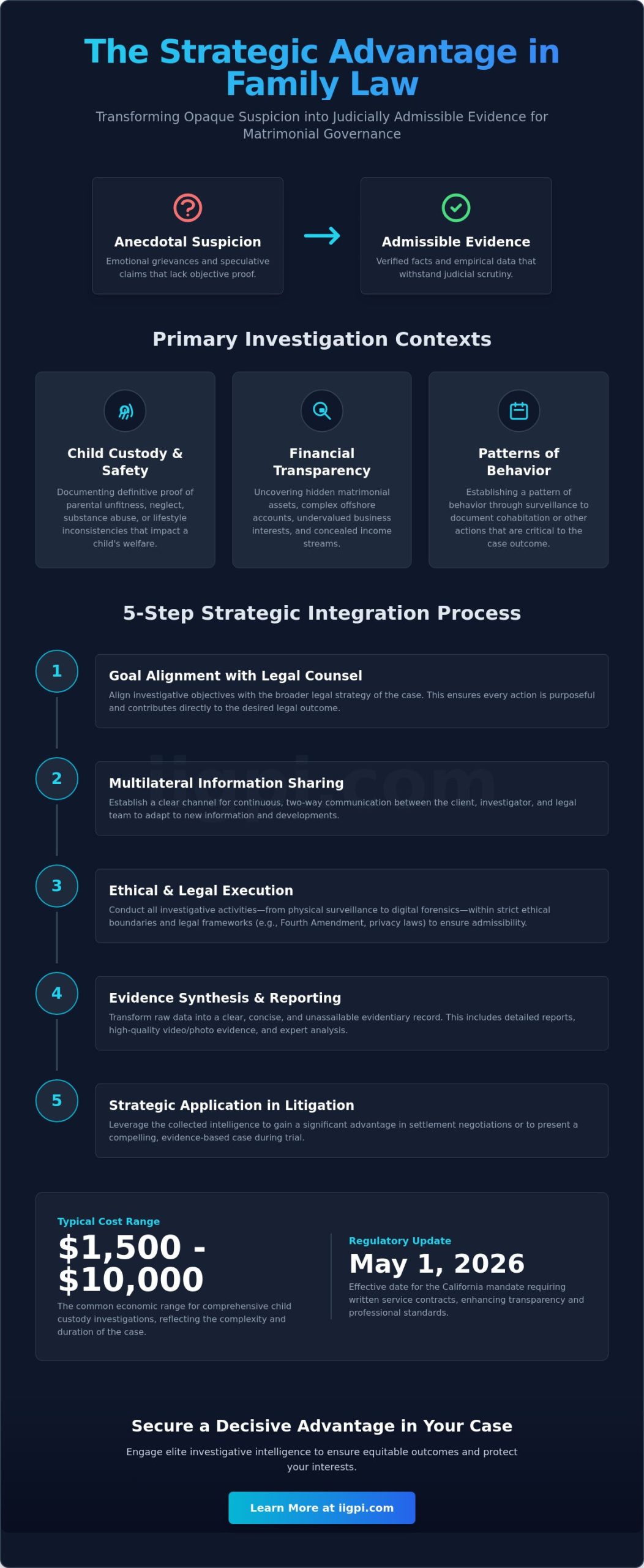
Strategic Integration: 5 Steps to Working with an Investigator and Legal Counsel
The successful resolution of high-stakes matrimonial litigation depends on the seamless integration of investigative intelligence into the broader legal strategy. Utilizing a private investigator for family law cases isn’t merely an ancillary tactic; it’s a strategic necessity that requires a structured, five-step protocol to ensure maximum efficacy and judicial impact.
- Consultation: Stakeholders must first align investigative goals with the legal governance of the case, identifying specific outcomes that will influence judicial determinations.
- Information Sharing: Counsel provides the investigator with multilateral access to all known facts, enabling a more targeted and efficient inquiry into suspected misconduct or hidden assets.
- Surveillance and Execution: Field operations are deployed in a measured, discreet manner to document real-time behaviors that contradict previous testimonies or financial affidavits.
- Reporting: Raw field data is synthesized into a formal, think-tank-style intelligence report that provides a clear, objective narrative for legal review.
- Testimony: The investigator’s authority is leveraged in the courtroom, where they present findings with the sobriety and precision required of an expert witness.
The Tripartite Relationship
A critical component of this protocol is the establishment of a tripartite relationship between the client, the attorney, and the investigative team. It’s a fundamental principle that the Work Product Doctrine often extends attorney-client privilege to the investigator’s findings, provided the engagement is facilitated through legal counsel. This protection allows for the candid dissemination of sensitive intelligence without the fear of premature discovery by the opposing party. By setting ROI-driven objectives, such as the quantification of undisclosed marital assets or the documentation of specific safety concerns, the investigative effort remains focused on delivering tangible legal value. We invite you to visit iigpi.com to understand our engagement protocols and how we facilitate these elite partnerships.
Analyzing Investigative Reports
The transition from raw field data to actionable legal strategy requires a sophisticated analysis of the final investigative report. Professional reports distinguish between “Intelligence,” which informs internal strategic decisions, and “Evidence,” which is structured for immediate judicial admissibility. When counsel utilizes these findings to confront an opposing party with definitive proof of cohabitation or financial concealment, it often forces a favorable settlement, bypassing the need for prolonged and costly litigation. Periodic strategic reviews are essential during long-term surveillance to ensure that field tactics remain responsive to the shifting dynamics of the family estate. For those seeking to secure an authoritative advantage in matrimonial matters, it’s advisable to consult with our senior investigators to align your case with these professional standards.
International Investigative Group: Elite Intelligence for Matrimonial Matters
The resolution of high-net-worth matrimonial disputes requires a level of intellectual rigor that transcends the capabilities of conventional investigative firms. By leveraging a legacy of 30 years of elite law enforcement experience, the International Investigative Group (IIG) functions as the “G20 of Think Tanks” within the private intelligence sector. This institutional depth is essential when navigating the multilateral complexities of modern family estates, where assets and interests often span diverse geopolitical jurisdictions. While localized firms focus on rudimentary observation, our methodology treats each engagement as a strategic exercise in domestic intelligence governance. This commitment to professional authority ensures that every private investigator for family law cases deployed by our firm operates with the sobriety and precision required to influence significant judicial outcomes.
Our operational reach extends from the concentrated financial hubs of New York City and Nassau County to a robust global network capable of tracing assets across international borders. This expansive perspective allows for a comprehensive analysis of the family’s total economic footprint, ensuring that no stone is left unturned in the pursuit of transparency. We prioritize a culture of discretion and objective analysis, positioning our findings as definitive legal assets rather than mere anecdotal reports. It’s this dedication to excellence that has established our firm as a leading authority in the global discourse on investigative policy and matrimonial security.
The IIG Advantage: Experience and Global Network
The superior quality of our domestic intelligence is a direct result of our recruitment protocols, which favor professionals with extensive backgrounds in formal law enforcement. These practitioners bring a sophisticated understanding of evidentiary standards and procedural integrity that is rarely found in the broader market. With a documented track record of successfully resolving over 10,000 cases, our firm excels in bridging the gap between the “Global North” of visible wealth and the “Global South” of obscured matrimonial assets. We invite you to examine The Modern Personal Detective to understand the advanced protocols we utilize for private and domestic intelligence. This global-minded approach ensures that our clients maintain a strategic advantage, regardless of where the opposition attempts to conceal relevant information.
Commitment to Professional Excellence
Our internal “Think Tank” culture dictates that every investigative report is drafted with the intellectual depth and structural clarity required for high-stakes litigation. We don’t just provide data; we facilitate the dissemination of structured intelligence that empowers legal counsel to negotiate from a position of absolute certainty. This authoritative framework is designed to withstand the most intense judicial scrutiny, securing your legal standing through empirical proof. To ensure the integrity of your family’s future governance, you should Consult with an IIG Specialist Today. Securing elite investigative intelligence is the first step toward a sustainable and equitable resolution in complex matrimonial matters.
Securing Matrimonial Governance Through Professional Intelligence
The evolution of domestic litigation in 2026 demands a rigorous shift from speculative claims to the deployment of empirical evidence. We’ve examined how the strategic integration of a private investigator for family law cases transforms the adversarial landscape, replacing subjective volatility with judicially admissible intelligence. By synthesizing physical surveillance with sophisticated computer forensics, practitioners ensure that the governance of the family estate remains rooted in transparency and objective truth. This transition from raw field data to a structured legal asset is the hallmark of elite investigative protocol.
Securing an equitable outcome requires a partner with the intellectual depth and technical precision to navigate complex geopolitical financial trails. The International Investigative Group offers over 30 years of elite experience and was founded by former law enforcement professionals to provide definitive clarity in high-stakes disputes. Our global network facilitates cross-border asset tracing, ensuring that no facet of the marital estate remains obscured from judicial review. We invite you to Contact International Investigative Group for a Confidential Consultation to secure your strategic advantage. Your pursuit of truth and judicial integrity is supported by our unwavering commitment to professional excellence.
Frequently Asked Questions
Is it legal to hire a private investigator for a family law case in New York?
It’s entirely legal to hire a professional for domestic intelligence in New York, provided the practitioner is licensed by the New York Department of State and adheres to regulatory mandates. This legal standing is contingent upon the investigator’s strict adherence to statutory privacy protections and the avoidance of prohibited activities such as trespassing or unauthorized wiretapping. By operating within these parameters, the practitioner ensures that the intelligence gathered remains a viable asset for judicial review.
Can a private investigator’s report be used as evidence in family court?
A professionally drafted report is admissible in family court provided the investigator followed all legal protocols and maintained a strict chain of custody during the evidence acquisition process. The court typically requires the practitioner to appear as an expert witness to verify the authenticity of surveillance media and the technical integrity of the data collected. This formal testimony bridges the gap between raw field intelligence and the judicial requirements of the adversarial legal system.
How much does a private investigator for family law cases typically cost?
Standard hourly rates for a private investigator for family law cases currently range from $75 to $250, with specialized forensic services often exceeding $400 per hour. National averages as of May 1, 2026, remain at approximately $110 per hour, reflecting the sophisticated nature of modern evidence collection. Comprehensive child custody investigations typically necessitate a budget between $1,500 and $10,000 to ensure the acquisition of high-fidelity, admissible evidence through sustained surveillance and expert reporting.
What can a private investigator legally do during a child custody investigation?
Practitioners are legally permitted to conduct surveillance in public areas and perform detailed background checks on caregivers to document lifestyle inconsistencies or safety concerns during child custody disputes. They’re strictly prohibited from accessing private records without authorization or misrepresenting themselves as law enforcement officers, as such actions would invalidate the evidentiary value of the investigation. Professional investigators focus on gathering empirical data that facilitates the court’s understanding of the child’s best interests within a formal legal framework.
Will my spouse know if I have hired a private investigator?
Discretion is a foundational requirement of professional domestic intelligence, and practitioners utilize specialized tactics to ensure the target remains oblivious to the observation throughout the operation. It’s common for these engagements to be managed directly through legal counsel, which invokes the Work Product Doctrine to maintain the absolute confidentiality of the investigative strategy. This tripartite relationship ensures that the findings remain protected from discovery until they’re strategically introduced during settlement negotiations or trial.
How long does a typical domestic surveillance operation take?
The duration of a domestic surveillance operation is determined by the complexity of the multilateral objectives established during the consultation and the specific behaviors being documented. Establishing a judicially verifiable pattern of conduct often requires several days or weeks of intermittent observation to ensure the evidence isn’t dismissed as an isolated incident. The chronological scope of the effort is adjusted based on real-time intelligence and the shifting dynamics of the family estate’s governance.
Can an investigator help if my spouse is hiding assets in offshore accounts?
Specialized firms facilitate the identification of assets hidden in offshore accounts by leveraging international networks and sophisticated computer forensics to trace clandestine financial trails. This multilateral approach ensures that the total family estate is transparently accounted for during the division of marital property, preventing the inequitable distribution of resources. By uncovering undisclosed business interests and foreign holdings, investigators provide the empirical basis for a more sustainable and just resolution to complex financial disputes.
What is the difference between a private investigator and a detective agency in family law?
While the terms are often conflated in common parlance, a detective agency represents a formal institution with a broader infrastructure of specialized practitioners and global resources. Choosing a private investigator for family law cases through a structured agency provides access to a wider array of technical assets, including digital forensics and multilateral asset tracing capabilities. This institutional depth is essential for high-stakes matrimonial matters that require a sophisticated, think-tank approach to intelligence gathering and reporting.