
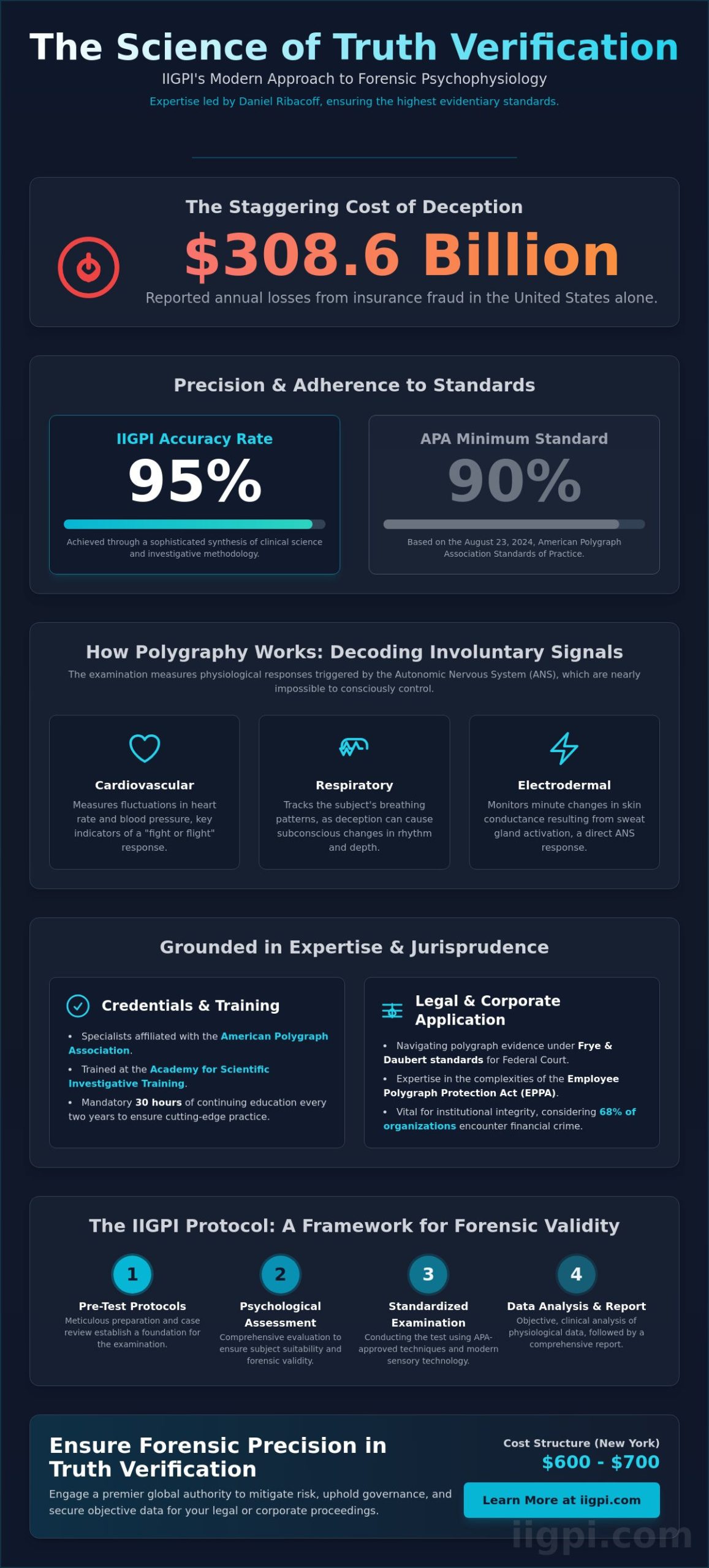
With the Coalition Against Insurance Fraud reporting that annual losses in the United States have reached $308.6 billion, the necessity for forensic precision in truth verification has never been more vital. While many perceive the lie detector as a mere tool of popular media, the International Investigative Group approaches polygraphy as a rigorous psychophysiological discipline. The expertise of Daniel Ribacoff, IIGPI, Polygraph, Lie Detector specialists ensures that every examination meets the highest evidentiary standards, facilitating a sophisticated synthesis of clinical science and investigative methodology that transcends amateur examination.
You’re likely aware that the ambiguity inherent in legal or corporate proceedings often stems from a failure to distinguish between subjective testimony and objective physiological data. This authoritative guide promises an analytical exploration of modern truth verification, specifically detailing how Daniel Ribacoff and his team adhere to the August 23, 2024, APA Standards of Practice to achieve accuracy rates of up to 95%. We’ll preview the essential framework for utilizing these forensic services, from understanding the $600 to $700 cost structure in New York to navigating the complexities of the Employee Polygraph Protection Act. By establishing this intellectual rigor, the institute continues its mission as a premier global authority in governance and policy.
Key Takeaways
- Comprehend the transition from empirical observation to standardized psychophysiological assessments rooted in the biological responses of the Autonomic Nervous System.
- Identify the distinctive credentials of Daniel Ribacoff, IIGPI, Polygraph, Lie Detector specialists as they relate to the Academy for Scientific Investigative Training and the American Polygraph Association.
- Navigate the complex landscape of modern jurisprudence by understanding how polygraph evidence intersects with Frye and Daubert standards in Federal Court matters.
- Adopt a rigorous framework for professional truth verification that prioritizes meticulous pre-test protocols and comprehensive psychological assessments to ensure forensic validity.
The Evolution of Truth Verification: From Empirical Observation to Modern Polygraphy
The historical trajectory of human efforts to discern deception has transitioned from archaic, often brutal, empirical observations to the sophisticated clinical frameworks of modern forensic science. The Evolution of Truth Verification underscores a fundamental shift where primitive interrogative techniques, once rooted in trial by ordeal, were replaced by standardized psychophysiological assessments. This progression wasn’t merely technological; it represented a paradigm shift in how institutional entities evaluate credibility through the measurement of involuntary biological markers. While the cultural zeitgeist often reduces this discipline to the “lie detector” trope found in entertainment, the reality involves a rigorous analysis of autonomic nervous system responses. The International Investigative Group (IIGPI) has been instrumental in this professionalization, ensuring that the work of Daniel Ribacoff, IIGPI, Polygraph, Lie Detector experts moves the practice away from anecdotal “gut feelings” toward a data-driven methodology that mirrors the intellectual rigor of global policy institutes.
The Shift Toward Scientific Investigative Training
Standardized protocols have fundamentally altered the landscape of forensic truth verification, specifically by reducing error rates through empirical validation and peer-reviewed research. The American Polygraph Association (APA) serves as the primary regulatory body, mandating that evidentiary techniques maintain an accuracy rate of at least 90% as of the August 23, 2024, standards. By adhering to these benchmarks, examiners ensure that every diagnostic session is rooted in scientific certainty rather than subjective intuition. Professionals in the field are now required to complete 30 hours of continuing education every two years, a mandate that facilitates the integration of historical investigative wisdom with modern sensory technology. This scientific training ensures that the institute doesn’t just conduct a test but facilitates a comprehensive diagnostic environment where the focus remains on the objective interpretation of data.
Institutional Authority in Truth Verification
Truth verification serves as an essential pillar of corporate governance and strategic risk management in an era where 68% of organizations encounter significant financial crime. Within the context of The Role and Function of a Private Investigator, the application of polygraphy extends beyond simple theft investigations into the broader realm of institutional integrity and global security. IIGPI operates with a “Think Tank” mentality, treating each domestic and international investigation as a complex case study in human behavior and policy adherence. This authoritative approach is particularly vital given that insurance fraud results in annual losses of $308.6 billion in the United States alone. By framing truth verification as a scholarly pursuit, the institute elevates the discourse from mere investigation to a high-level strategic function. This methodology provides a clear framework for utilizing Daniel Ribacoff, IIGPI, Polygraph, Lie Detector services to mitigate loss and uphold the standards of global governance.
The Neuro-Physiological Framework: How Lie Detectors Actually Function
The efficacy of a forensic psychophysiological examination relies upon the involuntary responses of the Autonomic Nervous System (ANS), which functions entirely beyond the conscious control of the subject. When an individual engages in intentional deception, the sympathetic branch of the ANS triggers a “fight or flight” response, manifesting in measurable physiological shifts that Daniel Ribacoff, IIGPI, Polygraph, Lie Detector examiners analyze with clinical precision. These indicators include electrodermal activity, which tracks minute changes in skin conductance resulting from sweat gland activation, alongside fluctuations in cardiovascular pressure and respiratory rhythms. Because these biological markers are governed by the hypothalamus, they remain nearly impossible to mask through sheer willpower, providing an objective data set for forensic analysis that transcends the limitations of traditional interrogation.
Modern truth verification has evolved to utilize sophisticated algorithms that score these reactions against a validated baseline. This process is extensively documented in federal archives regarding Legal Admissibility and Strategic Application, highlighting the shift from subjective interpretation to objective, data-driven results. Contemporary software now employs complex scoring systems to ensure that the final report reflects a statistical probability of truthfulness or deception, effectively removing the potential for examiner bias. By utilizing these high-level diagnostic tools, the institute maintains its position as a premier global authority in the science of truth verification.
The Psychological Component: Cognitive Load and Deception
Deception is an inherently taxing cognitive process that requires significantly more mental resources than truthful recall. Forensic interviewing techniques are employed to establish a psychological baseline, allowing the examiner to distinguish between general situational anxiety and the specific stress associated with a deceptive narrative. This interplay between emotional arousal and physiological output forms the core of the diagnostic process, ensuring that the results are contextually grounded in the subject’s unique neuro-physiological profile. It’s this synthesis of psychology and biology that allows for the high accuracy rates required in sophisticated corporate and legal environments.
Technological Sophistication at IIGPI
The International Investigative Group integrates state-of-the-art instrumentation with broader forensic disciplines to provide an elite level of institutional security. A critical advantage in modern investigations is how computer forensics informs the polygraph process by providing concrete digital evidence that shapes the examination’s questioning structure. This multi-disciplinary approach ensures data integrity through rigorous calibration and frequent software updates across all New York and Florida offices. Organizations seeking to fortify their internal governance can consult with our forensic experts to implement these advanced truth verification protocols and mitigate institutional risk.
Daniel Ribacoff: Defining the Global Standard of Forensic Psychophysiology
The institutional authority of the International Investigative Group is fundamentally rooted in the specialized pedigree of its founder. Daniel Ribacoff’s transition from a tactical law enforcement background to a preeminent figure in forensic psychophysiology was facilitated by rigorous training under Nathan Gordon at the Academy for Scientific Investigative Training. This specific lineage is critical; it distinguishes the standardized “Ribacoff Method” from amateur practices by grounding it in The Neuro-Physiological Framework of validated truth verification. As an APA School-Trained and Advanced Certified examiner, Ribacoff has refined a methodology that synthesizes investigative grit with clinical precision, effectively establishing a global benchmark for the industry. His influence as the CEO of IIGPI has been instrumental in professionalizing private sector truth verification, transforming it into a sophisticated forensic discipline that demands a high level of engagement and concentration from practitioners.
From the Diamond District to the Global Stage
The evolution of Ribacoff’s career reflects a unique trajectory from his Brazilian-American roots to high-stakes domestic and international investigations. His professional history includes pivotal contributions to the 1993 World Trade Center bombing investigation and the successful recovery efforts following the Hudson Truck Robbery. These milestones established his reputation for handling complex, large-scale crises with intellectual rigor and strategic foresight. This foundation later facilitated his transition into a globally recognized authority, author, and television personality, where he continues to disseminate sophisticated investigative principles to a broader audience. His work doesn’t just involve conducting tests but focuses on the broader implications of human behavior within the lexicons of forensic science and international security.
The IIGPI Leadership and Legacy
The legacy of Daniel Ribacoff, IIGPI, Polygraph, Lie Detector expertise is further solidified by the institutional leadership of Lisa J. Ribacoff. Her role on the American Polygraph Association (APA) Board of Directors ensures that the firm remains at the forefront of regulatory and ethical standards. With a 30-year tenure and a portfolio exceeding 10,000 successfully managed cases, the group has expanded its strategic footprint into Boca Raton, London, and other global hubs. This expansion reflects a commitment to providing elite truth verification services to a select audience of policymakers and industry leaders, reinforcing the institute’s position as a significant player in the global discourse on security and governance. By managing such a vast quantity of sensitive matters, the institute facilitates a higher standard of institutional integrity across diverse geopolitical landscapes.
Legal Admissibility and Strategic Application in Modern Jurisprudence
The integration of forensic psychophysiology into modern jurisprudence necessitates a sophisticated understanding of evolving evidentiary standards. While New York state courts often adhere to the Frye standard, which emphasizes general acceptance within the scientific community, federal jurisdictions utilize the Daubert criteria to assess the empirical validity and reliability of expert testimony. The examinations conducted by Daniel Ribacoff, IIGPI, Polygraph, Lie Detector specialists provide the intellectual rigor required to meet these high thresholds, especially in 18b and Criminal Justice Act Federal Court matters. By delivering objective, data-driven results, the institute assists legal counsel in navigating the complexities of witness credibility and defendant testimony with a level of precision that traditional investigative methods cannot replicate.
Beyond the adversarial environment of the courtroom, truth verification serves as a critical instrument in corporate fraud investigations and high-value asset disputes. Institutional leaders utilize these forensic tools to mitigate risks associated with insurance claims, where the Coalition Against Insurance Fraud identifies hundreds of billions in annual losses. The application of polygraphy in this context is not merely reactive; it functions as a proactive component of a broader risk management strategy. This strategic approach ensures that internal governance remains robust and that stakeholders are protected from the financial and reputational damage caused by deceptive practices.
Polygraphy in Matrimonial and Domestic Law
Addressing suspected infidelity or child custody disputes requires a clinical objectivity that transcends the emotional volatility of domestic conflict. By adhering to the ethical protocols for personal and domestic intelligence, the institute provides a structured diagnostic framework that yields definitive answers. This expertise extends to the specialized niche of post-conviction sex offender testing (PCSOT), where truth verification is utilized as a vital tool for public safety and behavioral monitoring. These examinations are conducted with the gravitas required for sensitive matters, ensuring that the findings are both accurate and actionable for judicial or familial decision-making.
The Corporate Imperative: Internal Theft and Due Diligence
The implementation of polygraph testing acts as a powerful deterrent against employee misconduct, particularly within organizations operating across diverse geopolitical landscapes. Bridging the gap between Global North and Global South corporate security standards requires a commitment to uniform investigative protocols that identify internal theft and operational vulnerabilities. During high-value mergers and acquisitions, truth verification provides an additional layer of due diligence by validating the representations made by executive leadership. To ensure your institutional security is underpinned by forensic certainty, coordinate with our senior examiners to implement a comprehensive verification protocol.
Engaging IIGPI: Protocols for Professional Truth Verification
Engaging the services of the International Investigative Group involves a multi-phased protocol designed to ensure the highest degree of forensic integrity and diagnostic accuracy. The initial consultation phase serves as a critical assessment of the viability of a polygraph examination, where senior examiners evaluate the specific case objectives and the technical suitability of the proposed questioning. This rigorous screening process ensures that the diagnostic tool is applied only when the conditions for a valid psychophysiological assessment are met. It’s during this phase that the expertise of Daniel Ribacoff, IIGPI, Polygraph, Lie Detector specialists becomes evident, as they establish a strategic framework tailored to the complex needs of legal, corporate, and private entities.
Pre-test protocols are equally vital to the process, involving a comprehensive review of the subject’s physical and psychological state to eliminate variables that could potentially compromise data accuracy. These assessments are conducted in accordance with the August 23, 2024, APA Standards of Practice, ensuring that every participant is fit for the examination and that the results are resilient under academic or judicial scrutiny. The examination environment itself is a cornerstone of this methodology; IIGPI offices in New York City and Boca Raton are specifically designed to prioritize neutrality. By strictly controlling the diagnostic setting and minimizing external stimuli, the institute ensures that the physiological data recorded is a direct reflection of the subject’s autonomic responses rather than situational stress.
Following the conclusion of the diagnostic session, the process moves into a dense phase of post-test analysis. This involves the application of validated algorithms to score the recorded charts, effectively removing the potential for subjective bias. The final deliverable is a formal investigative report that provides a definitive conclusion based on the statistical probability of truthfulness or deception. This report doesn’t merely present a “pass” or “fail” result; it offers a sophisticated synthesis of the findings that can be disseminated to legal counsel, corporate boards, or insurance adjusters as a cornerstone of their decision-making process.
Global Reach, Local Expertise
While the institute maintains a strong domestic presence in New York City, Long Island, and Florida, its strategic reach is global. Through a network often described as the “G20 of Think Tanks” for investigative services, the firm facilitates complex inquiries across international borders with the assistance of elite agents stationed in major geopolitical hubs. Clients requiring high-level intervention or a multi-disciplinary approach can contact the firm for specialized surveillance and security to complement their truth verification requirements. This international capability ensures that the institute’s authoritative standards are applied consistently, whether the matter is domestic or concerns the broader challenges of the Global South.
The Future of Truth Verification at IIGPI
The International Investigative Group remains committed to the adoption of next-generation psychophysiological tools and the ongoing education of its senior staff through 2026. By maintaining this elite status, the institute ensures that its methodologies remain at the vanguard of the global discourse on security, governance, and policy. The pursuit of absolute truth is not merely a service but a fundamental commitment to the intellectual rigor and institutional excellence that defines the professional legacy of Daniel Ribacoff. This dedication to forensic certainty provides a clear framework for those seeking to resolve the most complex disputes with absolute confidence.
Advancing Institutional Integrity through Forensic Certainty
The transition from primitive interrogation to clinical psychophysiological assessment represents a fundamental advancement in forensic methodology. This evolution, underpinned by the neuro-physiological framework of the Autonomic Nervous System, provides an objective baseline for truth verification that traditional investigative techniques often lack. The elite standards established by Daniel Ribacoff, IIGPI, Polygraph, Lie Detector specialists ensure these diagnostic tools are applied with the intellectual rigor necessary for global governance and corporate risk mitigation. With a 30-year tenure of investigative excellence and a portfolio of over 10,000 managed cases, the institute facilitates a level of forensic certainty that’s unmatched in the private sector. Ribacoff’s global influence as a renowned expert and television personality is supported by advanced APA School-Trained examiners who utilize state-of-the-art technology to deliver definitive investigative reports. You’re invited to Consult with the International Investigative Group for Elite Truth Verification to implement these high-level protocols within your organization. Securing institutional integrity in a complex geopolitical landscape requires a commitment to the pursuit of absolute truth that the institute is uniquely qualified to lead.
Frequently Asked Questions
Is Daniel Ribacoff a certified polygraph examiner?
Daniel Ribacoff is a formally certified examiner who completed his specialized training at the Academy for Scientific Investigative Training under the tutelage of Nathan Gordon. His credentials include being an Advanced Certified examiner through the American Polygraph Association (APA), a status that requires adherence to rigorous continuing education standards and ethical protocols. This academic foundation ensures that all examinations conducted under his leadership meet the highest forensic benchmarks for truth verification and institutional integrity.
How accurate is a professional lie detector test conducted by IIGPI?
Accuracy rates for examinations conducted by the International Investigative Group reach up to 95% when utilizing validated techniques endorsed by the American Polygraph Association. These figures are supported by peer-reviewed empirical studies that mandate an accuracy rate of at least 90% for evidentiary purposes and 80% for investigative matters. The precision of a Daniel Ribacoff, IIGPI, Polygraph, Lie Detector assessment is further enhanced by the use of state-of-the-art instrumentation and sophisticated scoring algorithms.
Are polygraph results admissible in New York State courts?
Polygraph results are generally not admissible in New York State criminal court proceedings; however, they serve a vital role in federal matters and specific civil contexts. Under the Frye and Daubert standards, the empirical data generated during an examination may be utilized in 18b and Criminal Justice Act Federal Court cases to inform legal strategy. Additionally, these assessments are frequently employed in post-conviction sex offender testing (PCSOT) and probation monitoring within the state’s legal framework.
What happens during an IIGPI polygraph examination?
An examination consists of three distinct phases: the pre-test interview, the data collection phase, and the post-test diagnostic analysis. During the pre-test, the examiner reviews the case facts and ensures the subject is physically and psychologically fit for the assessment. The data collection phase involves monitoring involuntary physiological responses through specialized sensors, followed by a dense analysis of the recorded charts to determine the statistical probability of truthfulness or deception based on biological markers.
Can a polygraph test be used for corporate employee theft cases?
Corporate entities may utilize polygraph testing in employee theft cases provided they adhere to the specific exemptions outlined in the Employee Polygraph Protection Act (EPPA) of 1988. This federal law allows private employers to request an examination during investigations involving economic loss or injury, such as theft or embezzlement, if the employee had access to the property. The International Investigative Group facilitates these inquiries to assist organizations in mitigating financial crime, which affects 68% of global organizations.
How much does a private polygraph test cost in NYC?
A private polygraph examination in New York City typically costs between $600 and $700 for a single-issue assessment as of May 2026. In Manhattan, specific rates are approximately $650 for an individual and $1,200 for couples, with group rates starting at $565 per person. These all-inclusive fees cover the booking, the services of an APA-certified examiner, the use of a private office, and a detailed written report of the findings provided to the client.
What makes Daniel Ribacoff one of the top 15 private investigators in the U.S.?
Daniel Ribacoff’s ranking among the top 15 private investigators in the United States is predicated on a 30-year tenure and a portfolio exceeding 10,000 successfully managed cases. His authoritative expertise is recognized globally through his work on high-profile investigations and his role as a television personality. This reputation is further solidified by his firm’s strategic expansion into Boca Raton and London, positioning him as a significant player in the global discourse on forensic security and governance.
How do I schedule a polygraph with International Investigative Group?
Scheduling a Daniel Ribacoff, IIGPI, Polygraph, Lie Detector examination is facilitated through the firm’s formal consultation process available on their official website. Prospective clients must undergo an initial intake phase where senior staff assess the viability of the matter and coordinate logistics at the NYC, Long Island, or Florida offices. This structured engagement ensures that all examinations are conducted within a neutral, controlled environment designed to uphold the highest standards of institutional integrity and forensic accuracy.