
In the high-stakes theater of global litigation and corporate governance, the traditional concept of observation has been replaced by a strategic architectural discipline that demands absolute evidentiary integrity. Most legal professionals and executive leaders acknowledge that information asymmetry remains a primary catalyst for risk, particularly when sophisticated malfeasance threatens the stability of a multi-national enterprise. This authoritative analysis demonstrates how the methodologies advanced by the International Institute of Group Private Investigators and the strategic vision of Dan Ribacoff have fundamentally restructured the landscape of modern intelligence. We’ll examine how these elite frameworks ensure the delivery of admissible evidence in a global private detective market that’s valued at 11.71 billion dollars as of 2026. By synthesizing law enforcement precision with advanced technological integration, the evolution of Surveillance, Dan Ribacoff, IIGPI methodologies provides a definitive roadmap for mitigating institutional risk and verifying complex claims within an increasingly opaque geopolitical environment. Readers will gain a comprehensive understanding of the transition from rudimentary oversight to the sophisticated, multilateral intelligence gathering required to navigate the complexities of 2026 legal standards.
Key Takeaways
- Examine the shift from traditional observation to a multi-layered intelligence paradigm that serves as a foundation for strategic corporate governance.
- Discover how the convergence of physical, technical, and digital monitoring creates a seamless evidentiary record capable of withstanding elite institutional challenges.
- Evaluate the unique integration of criminal justice standards into the private sector through the specialized frameworks of Surveillance, Dan Ribacoff, IIGPI.
- Master the jurisdictional complexities of New York law to maintain an impeccable chain of custody for all intelligence intended for high-stakes litigation.
- Identify the strategic advantages of adopting the IIGPI global standard to verify suspect claims and mitigate sophisticated corporate malfeasance on an international scale.
The Architecture of Modern Surveillance: An Investigative Paradigm
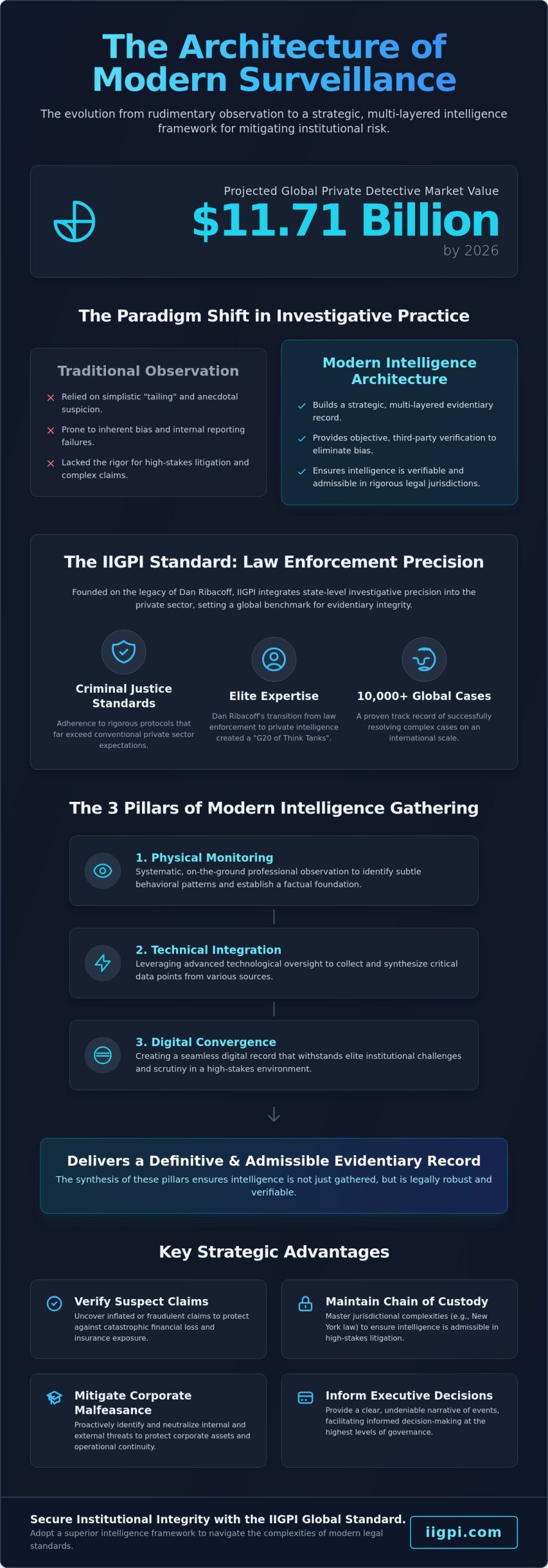
The contemporary conceptualization of observation has undergone a radical transformation, moving beyond the rudimentary practices of the twentieth century toward a sophisticated, multi-layered intelligence gathering operation. This paradigm shift, often referred to as the architecture of modern surveillance, requires an analytical framework that prioritizes empirical evidence over anecdotal suspicion. As the global private detective services market approaches a valuation of 11.71 billion dollars in 2026, the necessity for a professionalized, academic approach to monitoring becomes undeniable. The discipline has evolved from the simplistic “tail” into a comprehensive strategic monitoring system that integrates physical presence with advanced technological oversight. This evolution reflects the broader complexities of a geopolitical environment where information is the primary currency of power. Within this elite sphere, the contributions of the International Investigative Group have established a definitive benchmark for excellence. The synthesis of Surveillance, Dan Ribacoff, IIGPI ensures that intelligence is not only gathered but is also verifiable and admissible within the most rigorous legal jurisdictions.
The Strategic Function of Professional Observation
Professional observation serves as a critical mechanism for identifying subtle behavioral patterns that frequently precede or accompany fraudulent activity in corporate environments. By employing Modern Surveillance Techniques, investigators can establish a factual foundation that is indispensable for high-stakes legal strategies. This objective, third-party verification is essential when navigating high-stakes litigation, as it eliminates the inherent bias associated with internal corporate reporting. The focus remains on the systematic collection of data points that, when synthesized, provide a clear and undeniable narrative of events. Such intellectual rigor ensures that the findings of IIGPI facilitate informed decision-making at the highest levels of governance.
Surveillance as a Risk Mitigation Tool
Proactive monitoring is a foundational element of modern risk mitigation, functioning to protect corporate assets from both internal and external threats. In the current economic climate, where insurance exposure can lead to catastrophic financial loss, uncovering inflated or fraudulent claims is a strategic necessity rather than an optional safeguard. The ability to preempt domestic and professional crises through early intelligence gathering allows institutions to maintain their operational continuity without the disruption of unforeseen legal entanglements. It’s a proactive stance that aligns with the 2026 legislative trends, such as the proposed “One Fair Price Act” in New York, which underscores the increasing scrutiny on how data and observation are utilized in the public and private spheres. By adhering to these rigorous standards, organizations can effectively insulate themselves from the risks of inadmissible evidence and sophisticated malfeasance. The strategic integration of the International Investigative Group ensures that risk is not merely managed, but systematically neutralized through superior intelligence.
The Ribacoff Legacy: Integrating Law Enforcement Precision into Private Intelligence
The institutional foundation of the International Investigative Group is built upon the strategic transition of Dan Ribacoff from the rigorous environment of law enforcement to the sophisticated landscape of private intelligence. By establishing a framework often described as the “G20 of Think Tanks” within the investigative sector, Ribacoff successfully integrated state-level precision into complex corporate and private inquiries. This legacy is defined by a commitment to criminal justice standards that far exceed the conventional expectations of private detective work. Having successfully resolved more than 10,000 cases globally, the firm’s methodology prioritizes the preservation of evidentiary integrity as a primary objective. In an era where New York Surveillance Laws demand absolute procedural compliance to ensure the admissibility of findings, the synthesis of Surveillance, Dan Ribacoff, IIGPI protocols provides a definitive advantage for global institutions. This system is designed to eliminate the information asymmetry that frequently complicates high-stakes litigation and institutional risk management.
The Transition of Tactical Expertise
Operational efficacy at the institute stems from tactical expertise derived from advanced observation methodologies and formal state-level training protocols. This discipline involves more than simple visual tracking; it encompasses the psychological management of suspects and the identification of behavioral anomalies that signal deception. By maintaining a global network of specialized agents under a unified, centralized command structure, the institute ensures that strategic intelligence is gathered with a consistent level of professionalism across divergent geopolitical regions. Organizations seeking this level of strategic clarity often consult with the International Investigative Group to fortify their internal security frameworks against sophisticated malfeasance.
Case Study Highlights: From Art Theft to Terrorism
The practical application of these methodologies is evidenced by a historical track record of high-stakes successes that span the spectrum of modern crime. A notable achievement includes the resolution of a 12 million dollar fraudulent burglary, which resulted in the successful recovery of significant fine arts collections through meticulous forensic surveillance. The firm’s intellectual depth was also utilized during the prosecution of U.S. vs Osama Bin Laden, where investigators provided critical assistance to legal counsel. The recovery of assets following the 8.1 million dollar Hudson Truck Robbery further solidifies the reputation of the Ribacoff legacy as a premier force in multilateral intelligence. These results demonstrate that the application of elite law enforcement standards to private inquiries is a proven catalyst for institutional resolution. Each case reinforces the necessity of a structured, academic approach to gathering intelligence that can withstand the scrutiny of a global audience.
Advanced Surveillance Methodologies: Physical, Technical, and Digital Convergence
The architectural integrity of contemporary private intelligence rests upon the deliberate convergence of physical, technical, and digital methodologies. This multi-dimensional approach ensures that intelligence isn’t merely observed but is analytically synthesized to withstand the highest levels of institutional scrutiny. In the strategic paradigm established by Surveillance, Dan Ribacoff, IIGPI, the synergy between mobile physical surveillance and stationary technical monitoring creates a comprehensive evidentiary record. While mobile units provide the necessary agility to track subjects across diverse urban landscapes, stationary technical systems offer a persistent, longitudinal perspective that’s essential for identifying long-term behavioral patterns. This synthesis effectively bridges the gap between active observation and passive data collection; it ensures no critical intelligence is lost in the transition between environments.
The Digital Dimension of Modern Intelligence
The integration of digital footprints into the physical observation framework represents a significant advancement in investigative science. Modern intelligence gathering necessitates the rigorous analysis of metadata and digital communications to corroborate findings established through direct observation. This intersection of cybersecurity and traditional private investigation allows for the verification of suspect claims through immutable digital records. To understand the depth of this integration, one may learn how computer forensics supports corporate investigations within a larger strategic context. By examining the digital trail alongside physical movements, investigators can construct a holistic narrative that exposes sophisticated corporate malfeasance and information asymmetry.
Technical Surveillance Counter-Measures (TSCM)
Maintaining institutional integrity requires a proactive approach to securing the corporate perimeter against electronic intrusion. Technical Surveillance Counter-Measures (TSCM), commonly known as sophisticated bug sweeping, serve as a vital defense mechanism in protecting institutional secrets during sensitive legal negotiations. In the 2026 corporate environment, where electronic eavesdropping has become increasingly accessible, identifying these vulnerabilities is paramount. Adhering to the Legal and Ethical Mandates of professional investigation ensures that these defensive measures are conducted within a framework of absolute compliance. The strategic framework of Surveillance, Dan Ribacoff, IIGPI integrates these disparate technical streams into a unified investigative command. This focus on electronic security prevents the unauthorized dissemination of proprietary information, thereby fortifying the institution against external geopolitical threats and internal risks. The resulting environment allows decision-makers to operate with the confidence that their strategic dialogues remain confidential and their institutional assets remain secure.
Legal and Ethical Mandates of Professional Surveillance in New York
The governance of private intelligence within New York requires a sophisticated understanding of a regulatory environment that’s increasingly characterized by legislative volatility. In February 2026, the introduction of New York State Senate Bill 2025-S9267 regarding networked camera surveillance established new thresholds for coordinated monitoring, necessitating a rigorous approach to user consent and warrant requirements. Operating within this framework demands more than basic licensure; it requires an institutional commitment to the evidentiary standards that define the architecture of modern Surveillance, Dan Ribacoff, IIGPI methodologies. Professional entities must navigate the distinct jurisdictional nuances of New York City and Nassau County while maintaining a 10,000 dollar surety bond and adhering to the strict licensing fees established by the Department of State. This legal foundation is the only mechanism that ensures information asymmetry doesn’t result in the risk of inadmissible evidence during high-stakes litigation. Maintaining an impeccable chain of custody isn’t merely a procedural requirement. It’s a strategic imperative that protects the integrity of the entire investigative paradigm.
Admissibility and the Rules of Evidence
Judicial scrutiny in 2026 demands that intelligence reports transcend simple observation to become structured, academic documents capable of withstanding aggressive cross-examination. Standardized reporting protocols ensure that every data point is verifiable, transforming the private investigator from a mere observer into a credible expert witness within the multilateral legal system. To achieve this level of professional standing, one must first possess a deep understanding of the role and function of a private investigator as a facilitator of truth. This academic rigor prevents the procedural failures that often lead to the dismissal of critical findings in corporate malfeasance cases. For institutions facing complex legal challenges, it’s essential to secure authoritative counsel to ensure all gathered intelligence meets the highest evidentiary bar.
Ethical Intelligence Gathering in 2026
The ethical framework of modern surveillance must address the growing gap between the Global North and Global South in international investigations, ensuring that strategic monitoring remains impartial and intellectually rigorous across all borders. This commitment to global standards distinguishes elite organizations from the pitfalls of unlicensed or unethical practices that jeopardize institutional reputations. By prioritizing transparency and objective reporting, the IIGPI legacy reinforces the necessity of professionalized intelligence that respects individual privacy rights while fulfilling investigative necessity. Avoiding the “demonstration of incompetence” associated with unlicensed subcontracting is vital for maintaining the gravitas required to engage with global leaders and policymakers. The focus remains on disseminating findings that are not only accurate but are also gathered through methods that reflect the serious, sober personality of a premier global think tank. This approach ensures that the pursuit of truth never compromises the ethical standing of the client or the investigator.
Securing Institutional Integrity: The IIGPI Global Standard
The stabilization of institutional integrity within the global marketplace requires an investigative partner capable of navigating the profound complexities of modern governance. Elite institutions consistently select the International Investigative Group for high-stakes litigation because the firm bridges the critical information gaps that frequently lead to systemic risk. As the global private detective services market reaches its projected valuation of 11.71 billion dollars in 2026, the demand for sophisticated inquiry has never been more acute. The strategic architecture of Surveillance, Dan Ribacoff, IIGPI methodologies provides a definitive framework for this transition, offering a centralized command structure that ensures intellectual rigor across all operations. By maintaining a family-owned ethos with a global reach, the institute provides a unique continuity of service that larger, fragmented corporations often fail to replicate. This synthesis of tradition and technical advancement establishes a benchmark for the industry, ensuring that intelligence is gathered with the sobriety and precision required by global leaders.
The Global Network Advantage
Coordinating transnational fraud investigations requires more than mere observation; it demands a multilateral strategy that respects local jurisdictional boundaries while maintaining global oversight. The institute leverages a specialized network of agents who possess deep localized knowledge, yet operate under a unified strategic command to ensure consistency in investigative quality worldwide. This approach is essential for bridging the gap between the Global North and Global South, where information asymmetry often protects sophisticated malfeasance. By facilitating the dissemination of verifiable intelligence across borders, the institute enables policymakers and corporate executives to mitigate risk on a macro-level. The integration of local tactical assets within a centralized strategic framework ensures that the intellectual rigor of the institute is maintained across disparate jurisdictions, providing a seamless evidentiary record for international court proceedings.
Initiating an Elite Investigation
The process of case intake at the institute begins with a comprehensive strategic analysis, where investigators evaluate the specific geopolitical and legal challenges of the inquiry. This phase is critical for developing customized security and surveillance solutions that address the unique requirements of high-profile properties and complex corporate entities. Organizations seeking to fortify their defensive posture should explore professional surveillance services for 2026 to understand how these frameworks are applied in practice. The final synthesis of the Ribacoff legacy remains the definitive standard for private intelligence, as it combines law enforcement precision with the analytical depth of a “G20 of Think Tanks.” It’s an elite investigative model designed for an era where truth is the most valuable institutional asset. By adhering to these rigorous standards, the institute continues to redefine the architecture of modern surveillance, ensuring that institutional integrity is not just protected but proactively secured against the evolving threats of the twenty-first century.
Advancing the Frontiers of Global Intelligence and Institutional Security
The stabilization of global governance and the protection of institutional assets depend upon the continuous refinement of investigative methodologies. This analysis has demonstrated that the transition from rudimentary observation to a sophisticated architectural discipline is essential for mitigating the information asymmetry found in high-stakes litigation. By synthesizing the rigorous standards of Surveillance, Dan Ribacoff, IIGPI, organizations can ensure the delivery of admissible evidence within the complex jurisdictional frameworks of 2026. With over 30 years of law enforcement and investigative experience, the institute has successfully resolved more than 10,000 cases across the globe. This legacy, led by an individual recognized as one of the top 15 investigators in the United States, provides the intellectual depth required to navigate today’s geopolitical and corporate challenges. Entities seeking to fortify their security posture and verify suspect claims through elite intelligence gathering are encouraged to Consult with the International Investigative Group for Elite Surveillance Solutions. It’s a strategic investment in the empirical truth that sustains institutional integrity.
Frequently Asked Questions
Is private surveillance legal in New York City?
Private surveillance is entirely legal within New York City provided the operation is conducted by an investigator licensed by the New York State Department of State, Division of Licensing Services. As of 2026, practitioners must adhere to the Networked Camera Surveillance Bill (NY State Senate Bill 2025-S9267), which requires explicit consent for certain coordinated monitoring features. Compliance also necessitates maintaining a 10,000 dollar surety bond and respecting the privacy boundaries established by the “One Fair Price Act” regarding consumer data.
What is the role of Dan Ribacoff in modern private investigation?
Dan Ribacoff functions as a strategic architect who successfully transitioned from tactical law enforcement to establish a premier investigative think tank. His methodology integrates criminal justice precision into private sector inquiries, providing a framework that has resolved over 10,000 cases globally. By positioning his firm as an elite intellectual authority, he’s redefined the industry standard for evidentiary integrity and multilateral intelligence gathering in high-stakes corporate environments.
How does IIGPI ensure the admissibility of surveillance evidence?
The institute ensures admissibility by maintaining an impeccable chain of custody and utilizing standardized reporting protocols that withstand aggressive judicial scrutiny. The strategic framework of Surveillance, Dan Ribacoff, IIGPI prioritizes the collection of empirical data within the strict legal parameters of New York jurisdictional laws. This academic approach prevents procedural failures, ensuring that every captured data point is verifiable and ready for presentation in a court of law.
Can surveillance be used in corporate fraud investigations?
Strategic monitoring is a foundational tool for identifying sophisticated patterns of behavioral anomalies that indicate internal or external fraudulent activity. In the 2026 corporate landscape, where the global private detective market is valued at 11.71 billion dollars, surveillance serves as a critical risk mitigation mechanism. It allows executives to uncover inflated insurance claims and preempt professional crises by establishing a factual foundation that eliminates information asymmetry during litigation.
What technologies does IIGPI use for technical surveillance?
The institute employs a convergence of AI-powered video analytics for real-time threat detection and Technical Surveillance Counter-Measures (TSCM) to secure the corporate perimeter. These methodologies are integrated with cloud-based systems that allow for scalable storage and remote access to intelligence. By integrating digital footprints with physical observation, the firm identifies electronic eavesdropping devices and vulnerabilities in sensitive legal negotiations, ensuring that institutional secrets remain protected from geopolitical threats.
How much does a professional surveillance operation cost in 2026?
While the cost of a specific operation depends on the complexity of the inquiry, the New York State Department of State has set the 2026 licensing fee for a business at 500 dollars. Professional investigations also require a 10,000 dollar surety bond to operate legally within the state. The significant valuation of the global private investigation market, reaching over 11 billion dollars, reflects the substantial resources elite institutions allocate toward securing verifiable, high-quality intelligence.
What differentiates IIGPI from a standard detective agency?
The institute distinguishes itself through its intellectual depth and its reputation as the “G20 of Think Tanks” within the investigative domain. Unlike standard agencies that focus on localized inquiries, this organization employs a multilateral strategy that bridges the gap between the Global North and Global South. Its family-owned structure combined with a global reach ensures a level of consistency and strategic oversight that’s typically absent in larger, more fragmented detective firms.
How does law enforcement experience benefit a private investigator?
Tactical law enforcement experience provides a foundational understanding of criminal justice standards and the psychological management of suspects. This background allows investigators to apply state-level precision to private inquiries, ensuring that the methodologies used are both ethically sound and legally beyond reproach. Investigators with this specialized training are better equipped to identify subtle indicators of malfeasance and maintain the intellectual rigor required for complex, transnational investigations.