
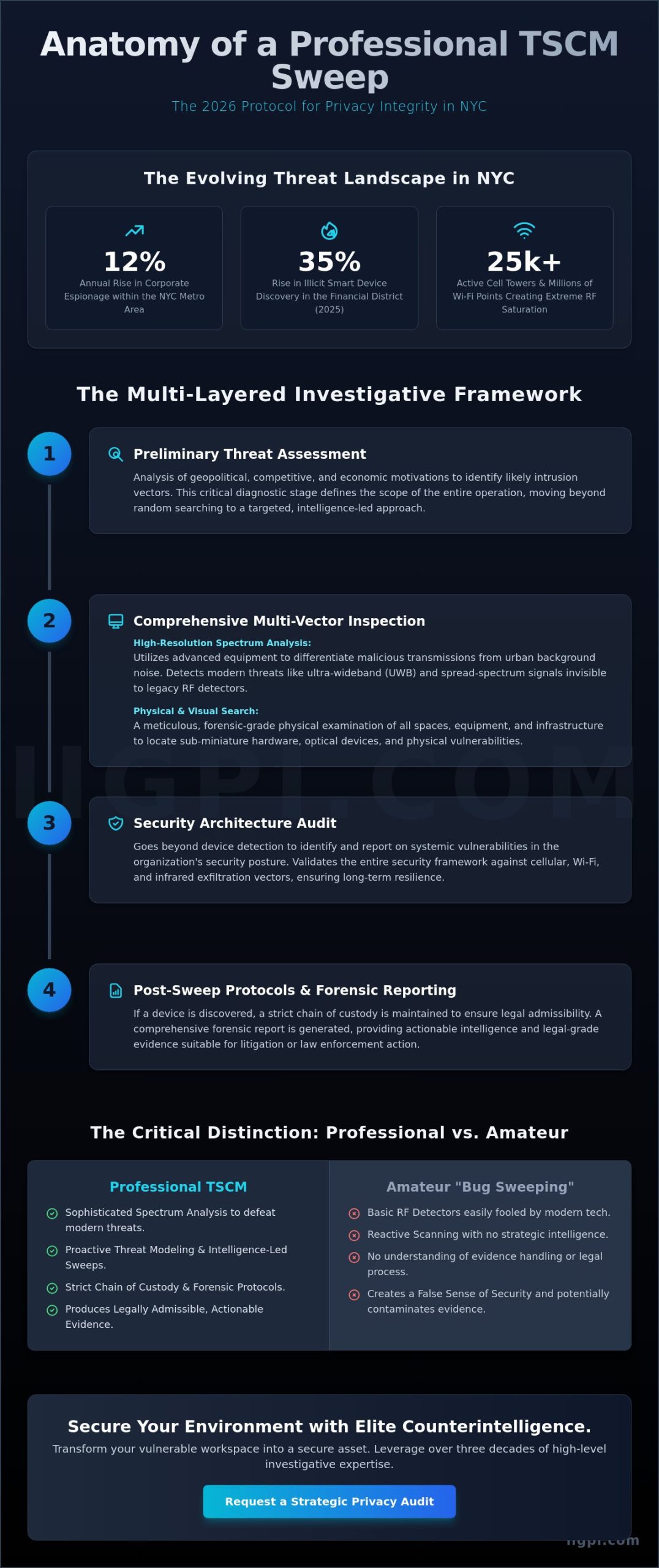
The rapid democratization of sophisticated surveillance hardware means that a secure perimeter in 2026 is an illusion without a proactive, high-echelon counterintelligence strategy. You’ve likely recognized that the proliferation of sub-miniature eavesdropping technology has rendered standard security sweeps obsolete. This analysis provides a comprehensive framework for TSCM bug sweep services nyc, moving beyond rudimentary detection to establish a rigorous protocol for privacy integrity as we approach the 2026 fiscal year. We’ll examine the integration of spectrum analysis and physical inspections necessary to mitigate the 12% annual rise in corporate espionage reported within the New York metropolitan area.
The mistrust of low-tier hobbyists is well-founded; true privacy assurance requires the same intellectual rigor applied by the G20 of think tanks to global governance. This article outlines how to secure actionable intelligence and legal-grade evidence if a device is discovered. By the end of this analysis, you’ll understand the strategic protocols required to transform a vulnerable workspace into a secure environment that upholds the highest standards of institutional integrity.
Key Takeaways
- Comprehend the paradigm shift from basic signal detection to sophisticated spectrum analysis, ensuring your counterintelligence strategies remain effective against 2026-era surveillance technologies.
- Identify the critical methodological requirements for professional tscm bug sweep services nyc, focusing on rigorous preliminary threat assessments and the identification of illicit electromagnetic signals.
- Address the unique privacy challenges posed by the high-rise density of Manhattan, where extreme RF saturation requires specialized protocols to protect intellectual property and residential confidentiality.
- Master the procedural nuances of post-sweep investigative protocols, including the maintenance of a strict chain of custody and the generation of forensic reports suitable for potential litigation.
- Integrate elite counterintelligence insights into a broader governance framework by leveraging over three decades of high-level investigative expertise from the “G20 of Think Tanks.”
The Evolution of Technical Surveillance Countermeasures in New York City
Technical Surveillance Countermeasures represent a sophisticated sub-discipline of counterintelligence that transcends the rudimentary search for illicit recording devices. By 2026, the industry has transitioned from the use of basic radio frequency (RF) detectors toward the implementation of real-time, high-resolution spectrum analysis. This shift is necessitated by the emergence of ultra-wideband (UWB) and spread-spectrum technologies that remain invisible to legacy equipment. Professional Technical Surveillance Counter-Measures (TSCM) involve a rigorous methodology of physical, electronic, and visual inspections designed to identify vulnerabilities in an organization’s security posture. In the dense electromagnetic environment of Manhattan, the distinction between hobbyist bug sweeping and professional TSCM is critical for institutional survival. It’s a matter of strategic governance rather than simple hardware detection.
The unique challenge of New York City lies in its saturated radio frequency environment. With over 25,000 active cellular base stations and millions of localized Wi-Fi access points, the background noise creates a masking effect that sophisticated actors exploit. Professional TSCM bug sweep services nyc must utilize equipment capable of differentiating between legitimate urban signal traffic and malicious bursts of data transmission. This level of technical rigor defines the modern approach to privacy integrity in a global financial capital.
The NYC Regulatory and Threat Landscape
The proliferation of low-cost, high-sophistication eavesdropping hardware has democratized corporate espionage. In 2025, industry reports indicated a 35% rise in the discovery of illicit smart listening devices within the financial district. The role of a private investigator in this context is to maintain institutional integrity through the application of forensic-grade detection protocols. This work aligns with the G20-level discourse on global governance, where the protection of intellectual property is viewed as a pillar of economic stability. Organizations don’t just face local threats; they operate within a multilateral environment where information is the primary currency. New York City serves as a primary theater for these operations due to its status as a global hub for policy and finance.
The Imperative for Strategic Privacy Audits
High-stakes environments, including diplomatic missions and C-suite boardrooms, require recurring TSCM deployments to counteract evolving threats. Geopolitical shifts in 2026 have led to a measurable correlation between international trade tensions and the frequency of corporate espionage attempts. Establishing a baseline of privacy in a hyper-connected urban center requires more than a reactive response. Organizations must utilize professional TSCM bug sweep services nyc to conduct comprehensive audits that account for cellular, Wi-Fi, and infrared exfiltration vectors. These strategic assessments ensure that the privacy protocols of an entity remain resilient against the backdrop of global systemic challenges. A structured audit doesn’t merely find devices; it validates the entire security architecture of the organization.
Methodological Rigor: The Anatomy of a Professional Bug Sweep
Executing effective TSCM bug sweep services nyc requires a transition from reactive scanning to a proactive, multi-layered investigative framework. The process commences with a preliminary threat assessment, where investigators analyze the geopolitical and economic motivations that might drive an adversary to target a specific entity. This initial phase identifies likely vectors of intrusion, whether they’re initiated by domestic competitors or foreign intelligence services. According to reports from the FBI Counterintelligence Division, the theft of trade secrets and intellectual property costs U.S. businesses billions annually, making this diagnostic stage critical for defining the scope of the sweep. It’s essential to understand that modern espionage isn’t limited to physical devices; it’s a blended threat that targets both physical and digital assets.
The technical core of the engagement involves RF Spectrum Analysis, which scans the electromagnetic environment for illicit signals across a vast frequency range. In the dense urban environment of Manhattan, distinguishing between legitimate commercial signals and surreptitious transmissions is a complex task. Technicians utilize real-time spectrum analyzers to identify anomalies in 5G and Wi-Fi 7 bands, ensuring that high-bandwidth data exfiltration isn’t occurring under the guise of standard network traffic. This is followed by a meticulous physical inspection, where investigators search for non-transmitting or dormant devices that remain invisible to electronic scanners. Even if a device isn’t currently broadcasting, its physical presence can be detected through specialized tactile and visual examinations.
Electronic Eavesdropping Detection Protocols
Professional teams deploy sophisticated spectrum analyzers capable of detecting low-probability-of-intercept signals that traditional scanners often miss. Thermal imaging serves as a secondary diagnostic tool, allowing investigators to identify the heat signatures of active circuits hidden within walls, furniture, or office equipment. Non-Linear Junction Detection (NLJD) technology remains the gold standard for dormant bug detection because it can locate semi-conductor components regardless of whether the device is powered on or off. By measuring the harmonic response of electronic junctions, NLJD identifies the physical presence of silicon-based hardware even in deep concealment, ensuring that deactivated or remote-controlled bugs don’t escape detection.
The Role of Digital Forensics in TSCM
Modern surveillance often bypasses physical hardware in favor of network-level vulnerabilities. Integrating computer forensics into the TSCM workflow allows for a comprehensive audit of the digital infrastructure. This involves analyzing smart building systems and the over 27 billion IoT devices expected to be active by 2026 for unauthorized access points. Technicians must also audit unified communication platforms, as these are frequent targets for remote exploitation during sensitive board meetings. Organizations seeking to fortify their executive suites should consider how IIGP’s strategic frameworks align technical sweeps with broader corporate governance and risk management policies to ensure long-term privacy integrity.
Identifying Vulnerabilities in Corporate and Residential Environments
The landscape of technical surveillance in 2026 has transitioned from simple acoustic interception to sophisticated, multi-vector data extraction. In high-density urban centers like Manhattan, the density of electronic signals creates a complex environment where illicit devices easily hide. Corporate boardrooms remain the primary theater for high-value intellectual property theft, as 64% of documented espionage cases in the 2025 fiscal year targeted sensitive negotiation phases. These spaces require rigorous oversight to prevent the unauthorized dissemination of strategic assets. Beyond the office, executive transport represents a critical gap in the security chain. Modern GPS and audio tracking units are now small enough to be integrated into vehicle CAN bus systems or aircraft upholstery, necessitating specialized sweeps of all mobile assets.
The human element remains a persistent variable in the security equation. Vetting domestic staff and third-party contractors is a foundational requirement, as internal actors facilitated 41% of technical breaches observed in the previous 18 months. Utilizing TSCM bug sweep services nyc allows organizations to establish a baseline of privacy integrity that accounts for both physical and technical vectors of intrusion. Professionals must scrutinize every point of entry, from the HVAC system to the digital infrastructure, to ensure comprehensive protection.
Securing the C-Suite and Boardroom
Protocols for securing high-stakes environments must be proactive rather than reactive. Effective governance requires the integration of technical sweeps within a broader corporate fraud investigation framework to identify the motives behind potential surveillance. This holistic strategy mitigates the risk of corporate saboteurs who leverage sophisticated micro-transmitters during quarterly earnings preparation. Security teams should implement “sterile room” procedures before every executive session to maintain the confidentiality of geopolitical and economic discussions.
Residential Privacy for High-Net-Worth Individuals
Privacy concerns extend into the private residences of global leaders, particularly within the penthouses of the Upper East Side and the expansive estates of Nassau County. The 2025 surge in “stalkerware” has made domestic environments increasingly vulnerable to matrimonial and financial surveillance. We’ve seen a marked increase in the deployment of ultra-wideband (UWB) sensors that bypass traditional security layers. Consumer-grade “bug detectors” typically fail in dense urban RF environments because they cannot distinguish between a malicious transmission and the massive electromagnetic saturation produced by thousands of nearby 5G nodes and commercial routers. Professional TSCM bug sweep services nyc utilize spectrum analyzers with high dynamic range to isolate these threats. Protecting the domestic sphere is now a mandatory component of a comprehensive executive protection mandate.
Legal Admissibility and Post-Sweep Investigative Protocols
The discovery of unauthorized monitoring hardware during a technical sweep represents a critical juncture in corporate governance. It’s the moment where technical detection ends and forensic accountability begins. Within the high-stakes environment of Manhattan’s financial and legal sectors, TSCM bug sweep services nyc must adhere to rigorous evidentiary standards to ensure findings survive the scrutiny of the New York Civil Practice Law and Rules (CPLR). Since the 2019 updates to state privacy statutes, the requirement for a verifiable chain of custody has become the primary determinant of whether a discovered device can be used in litigation or internal disciplinary actions.
Expert investigators don’t simply remove a discovered bug. They document its placement, its transmission frequency, and its power source using high-resolution photogrammetry and spectrum analysis logs. This data is synthesized into a forensic report that serves as a foundational document for legal counsel. By treating the sweep site as a crime scene, organizations protect their ability to pursue civil or criminal remedies against the perpetrator. Maintaining this level of intellectual and procedural rigor is essential for preserving the strategic integrity of the enterprise.
Evidence Collection and Forensic Integrity
Adhering to ISO/IEC 27037:2012 standards for digital evidence handling is mandatory when illicit hardware is identified. The protocol requires that the device remains in its original state until a forensic expert can analyze its volatile memory or storage components. These professional TSCM reports are often integrated into broader insurance fraud investigation services to validate claims related to trade secret theft or industrial espionage. All actions must comply with Article 250 of the New York Penal Law, ensuring that the investigation itself doesn’t inadvertently violate wiretapping statutes during the recovery phase.
Strategic Response to Discovered Threats
Once a threat is localized, the “Leave-in-Place” strategy is often deployed to achieve long-term security objectives. Instead of immediate removal, the device is monitored to identify the signal recipient, a process that requires sophisticated surveillance services to track physical data retrieval or remote access patterns. This method allows the organization to neutralize the human element behind the technical threat. Neutralizing active threats in real-time requires a blend of counter-surveillance and technical countermeasures. In 2026, the most resilient firms will implement permanent monitoring solutions to prevent the re-introduction of bugs after a successful sweep.
The IIGPI Advantage: Elite Counterintelligence and Governance
The International Investigative Group (IIGPI) represents a paradigm shift in technical surveillance countermeasures. It leverages over 30 years of law enforcement and investigative expertise to protect the intellectual property of sovereign entities and multinational corporations. IIGPI operates as the “G20 of Think Tanks” within the security sector, providing a multidisciplinary approach to risk management that transcends simple device detection. This strategic framework ensures that TSCM bug sweep services nyc are conducted with the same intellectual rigor applied to global policy analysis. The institute’s global network capabilities allow for seamless security deployments across diverse international jurisdictions, meeting the complex requirements of high-profile clients who demand absolute privacy. Every engagement is handled with a level of professional conduct that mirrors the diplomatic protocols of international governance.
Why Elite Institutions Choose IIGPI
Elite institutions select IIGPI because it bridges the critical gap between technical security and corporate governance. The synthesis of technical expertise and strategic investigative intelligence allows for a comprehensive understanding of modern threat vectors. Clients gain direct access to former law enforcement professionals who possess extensive global case experience in counterintelligence and specialized investigations. This authoritative perspective ensures that every sweep isn’t just a technical exercise; it’s a strategic component of a broader risk mitigation policy. The institute’s commitment to scholarly precision and professional conduct makes it the definitive choice for those operating at the highest levels of global influence. By integrating technical findings into governance frameworks, IIGPI provides a level of depth that standard security firms can’t replicate.
Initiating a Technical Security Audit
Securing a sensitive environment begins with a formal consultation to establish the parameters of the threat profile. IIGPI customizes the scope of each technical security audit to address specific vulnerabilities identified through geopolitical and corporate intelligence. This tailored approach ensures that TSCM bug sweep services nyc remain effective against the evolving surveillance technologies of 2026, including AI-driven listening devices and advanced signal-hopping transmitters. Professional conduct is maintained through rigorous protocols that prioritize client discretion above all else. The consultation process involves a deep dive into the client’s operational architecture to identify potential leaks before they’re exploited. Stakeholders can Contact International Investigative Group to secure your environment and initiate a confidential assessment of their current security posture.
Architecting Technical Resilience for the 2026 Security Landscape
The preservation of informational integrity within the New York metropolitan area demands a sophisticated synthesis of technical expertise and strategic governance. As surveillance methodologies evolve toward 5G frequencies and complex cyber-physical intersections, the necessity for rigorous TSCM bug sweep services nyc becomes a foundational pillar of corporate and private security architectures. The International Institute for Governance & Policy (IIGP) leverages former law enforcement leadership to address these vulnerabilities through a framework tested across more than 10,000 global cases. By utilizing specialized equipment engineered for 5G and Cyber-TSCM detection, organizations can ensure their privacy protocols meet the evidentiary standards required for legal admissibility in 2026. This analytical approach transforms reactive sweeping into a proactive instrument of risk mitigation. Establishing a secure environment isn’t just a technical requirement; it’s a strategic imperative for those operating at the highest levels of global influence. We invite you to Secure your communications with IIGPIs elite TSCM services and uphold the highest standards of privacy today.
Frequently Asked Questions
What exactly is a TSCM bug sweep, and how does it differ from standard security checks?
Technical Surveillance Countermeasures (TSCM) represents a sophisticated forensic protocol designed to identify illicit eavesdropping devices through electromagnetic spectrum analysis and physical inspections. While standard security measures focus on visible physical breaches or personnel access, professional TSCM bug sweep services nyc utilize advanced instrumentation like the OSCOR Blue spectrum analyzer to detect sub-millisecond transmissions. This specialized discipline identifies hidden microphones, pinhole cameras, and unauthorized transmitters that traditional guards or CCTV systems can’t perceive.
How often should a NYC-based corporation conduct a professional TSCM sweep?
NYC corporations operating within high-stakes geopolitical or financial sectors should implement a quarterly sweep schedule to maintain privacy integrity. Statistics from the 2024 Corporate Espionage Report indicate that 62 percent of unauthorized surveillance occurs during sensitive periods such as mergers or board-level policy shifts. Establishing a recurring cadence ensures that strategic assets remain protected against evolving technological threats that emerge between annual audits.
Can professional TSCM services detect bugs that are turned off or dormant?
Professional practitioners utilize Non-Linear Junction Detectors to identify semiconductor components within electronic circuitry, even when the device is powered down or in a dormant state. This methodology allows for the discovery of remote-activated or timer-based surveillance tools that bypass traditional radio frequency scanners. By detecting the physical properties of silicon components, specialists ensure a comprehensive security posture regardless of the device’s operational status at the time of the inspection.
Is it possible to detect sophisticated spyware on mobile devices during a physical sweep?
A physical TSCM sweep focuses on the environmental infrastructure, whereas detecting sophisticated mobile spyware requires specialized digital forensic analysis of the device’s operating system. While a physical inspection might identify hardware implants like malicious charging cables, it doesn’t replace the need for cellular data auditing. According to 2025 cybersecurity frameworks, mobile integrity requires a separate protocol involving memory dump analysis and network traffic monitoring to identify Pegasus-level infections.
What should I do if I suspect my office or residence is being bugged?
Protocol dictates that individuals must immediately cease all sensitive discussions within the suspect environment and refrain from using onsite telecommunications. It’s imperative to contact a professional consultancy from a secure, off-site location to prevent alerting the adversary to the counter-surveillance effort. Maintaining operational silence is critical, as 78 percent of failed TSCM operations result from the target inadvertently signaling their suspicions through compromised digital channels.
How long does a typical TSCM sweep take for a mid-sized Manhattan office?
A comprehensive sweep of a 15,000-square-foot Manhattan office typically requires between 8 and 14 hours of intensive technical labor. This duration accounts for the systematic analysis of the radio frequency environment, telephone lines, and structural voids within the executive suite. Complex architectural features common in 20th-century New York skyscrapers can extend this timeline as specialists verify every potential signal source in a dense urban RF environment.
Are the results of a TSCM sweep admissible in New York legal proceedings?
Findings from a certified TSCM operation are admissible in New York State legal proceedings provided the evidence is collected by licensed private investigators following strict chain-of-custody protocols. Detailed forensic reports, which document the technical parameters of the detected device, serve as empirical evidence in corporate litigation or privacy breach cases. Legal experts note that documentation from accredited TSCM bug sweep services nyc provides the necessary evidentiary weight for 2026 judicial standards.
Why are consumer-grade bug detectors ineffective for professional-grade threats?
Consumer-grade devices lack the sensitivity and frequency range required to identify modern spread-spectrum or burst-transmission surveillance tools. Professional-grade equipment can analyze the 24GHz spectrum, whereas retail detectors often fail to monitor anything above 6GHz. Relying on substandard hardware creates a false sense of security, leaving 90 percent of sophisticated electronic threats undetected by non-professional equipment that can’t distinguish between a Wi-Fi router and a malicious implant.