
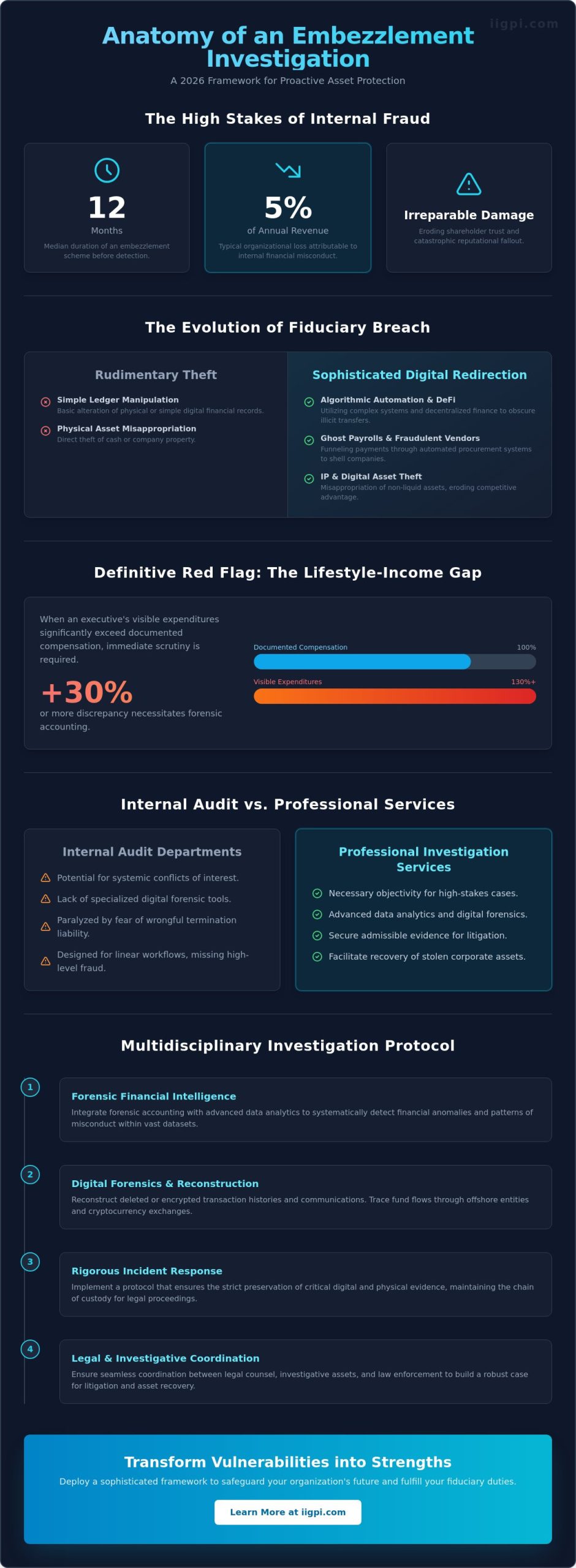
Does your board of directors possess the forensic infrastructure necessary to withstand a 5% reduction in annual revenue attributable to internal financial misconduct? According to the 2024 ACFE Report to the Nations, the median duration of an embezzlement scheme before detection is 12 months; during which time complex digital trails and eroding shareholder trust can cause irreparable institutional damage. We understand that the fear of legal liability for wrongful termination or the potential for catastrophic reputational fallout often paralyzes decisive executive action. This guide serves as the definitive framework for deploying sophisticated embezzlement investigation services in 2026, ensuring that your organization moves beyond reactionary measures toward a paradigm of proactive asset protection.
While investigative services are critical for recovery, long-term security is built upon the quality and integrity of your senior staff. If you are seeking to recruit top-tier talent through a specialized financial services executive search firm, click here.
You’ll gain access to specialized protocols designed to secure admissible evidence for litigation while facilitating the recovery of stolen assets. As the G20 of Think Tanks, the International Institute for Governance & Policy (IIGP) provides the methodology required to transform institutional vulnerabilities into strengthened internal controls that safeguard your organization’s future. By analyzing the intersection of forensic accounting and corporate governance, we present a structured approach to mitigating financial misconduct within the highest levels of global enterprise.
Key Takeaways
- Analyze the evolution of fiduciary breaches from rudimentary theft to the sophisticated digital redirection of capital within modern, complex corporate architectures.
- Master the integration of forensic financial intelligence and advanced data analytics to systematically detect anomalies and reconstruct encrypted transaction histories.
- Identify why engaging professional embezzlement investigation services provides the necessary objectivity to navigate high-stakes executive misconduct cases where internal audits may face systemic conflicts.
- Implement a rigorous multidisciplinary protocol for incident response that ensures the preservation of critical evidence and the seamless coordination of legal and investigative assets.
- Leverage global investigative frameworks and law enforcement-derived methodologies to protect corporate assets against increasingly intricate international financial threats.
The Complexity of Embezzlement within Contemporary Corporate Structures
Embezzlement represents a sophisticated criminal breach of trust where individuals lawfully granted access to corporate assets divert those resources for personal enrichment. In the 2026 fiscal environment, this misconduct has evolved beyond simple ledger manipulation into a complex architecture of digital redirection. Modern embezzlement investigation services now address schemes that utilize algorithmic automation and decentralized finance to obscure illicit transfers. This Embezzlement Overview clarifies that the crime’s core remains the violation of a fiduciary relationship, yet its execution has become increasingly opaque. Traditional internal controls, designed for linear workflows, often fail to detect high-level executive fraud because these individuals possess the authority to override systemic safeguards. The economic consequences are severe; the Association of Certified Fraud Examiners (ACFE) has historically noted that organizations lose approximately 5% of annual revenue to fraud, a figure that remains a critical benchmark for global enterprises facing reputational ruin.
Common Modalities of Modern Embezzlement
Decentralized organizational structures have facilitated the rise of ghost payroll schemes and the creation of fraudulent vendor profiles. It’s common for perpetrators to exploit automated procurement systems to funnel payments to shell companies they control. Beyond liquid capital, the misappropriation of intellectual property and digital assets has emerged as a primary threat to competitive advantage. Forensic auditors frequently identify the “lifestyle-income gap” as a definitive red flag. When an executive’s visible expenditures exceed their documented compensation by 30% or more, it necessitates immediate scrutiny through embezzlement investigation services to mitigate systemic risk. These investigations focus on forensic accounting to bridge the gap between reported earnings and actual consumption patterns.
The Role of Fiduciary Responsibility
Officers and directors hold a legal mandate to exercise due diligence in protecting shareholder interests. This obligation isn’t merely ethical; it’s a statutory requirement that forms the basis for civil and criminal liability. Effective embezzlement investigations are essential components that support broader Corporate Fraud Investigation objectives by establishing a clear chain of evidence. By rigorously analyzing financial flows and governance protocols, institutions can fulfill their oversight duties. It’s vital for leadership to recognize that failing to investigate suspected misconduct can be viewed as a secondary breach of fiduciary duty, exposing the entire board to litigation and regulatory sanctions. Embezzlement constitutes a sophisticated criminal breach of trust where an individual lawfully entrusted with assets misappropriates them for unauthorized personal gain.
Methodologies of Forensic Financial Intelligence and Digital Forensics
The evolution of embezzlement investigation services requires a sophisticated synthesis of forensic accounting and high-velocity data analytics to address the complexities of modern corporate malfeasance. This integration allows for the identification of anomalies within vast datasets that traditional oversight mechanisms often fail to capture. Through the application of Computer Forensics, investigators reconstruct deleted transactions and decrypt communications that perpetrators believe are permanently erased. These non-linear investigative techniques are foundational in uncovering hidden accounts, particularly when tracing the flow of funds through opaque offshore entities and decentralized cryptocurrency exchanges. By 2026, the reliance on automated ledger analysis has become a strategic necessity for maintaining institutional integrity.
Digital Evidence Acquisition Protocols
Establishing a rigorous chain of custody for digital devices and cloud-based accounting software is the primary requirement for any successful prosecution. Investigators utilize AI-driven tools to identify patterns of systemic fraud, often detecting irregularities that human auditors might miss in high-volume environments. Analyzing metadata provides a critical layer of intelligence, as it helps establish the specific intent and premeditation behind financial crimes by documenting when and how specific records were altered. This level of technical scrutiny ensures that the evidence remains admissible in international legal forums. Organizations seeking to strengthen their internal controls can benefit from the governance frameworks developed to mitigate these sophisticated internal threats.
Forensic Accounting vs. Standard Auditing
A fundamental distinction exists between standard auditing and forensic financial intelligence. While a standard audit is designed for regulatory compliance and the verification of financial statements, it’s not a tool for active fraud detection. Forensic investigators employ an investigative mindset that requires looking behind the ledger to understand the underlying reality of transactions. This process involves a deep dive into the legal definitions provided by the DOJ on Embezzlement
Comparative Analysis: Private Investigative Firms vs. Internal Audit Departments
The structural integrity of a corporate entity relies upon its ability to execute impartial inquiries into financial malfeasance. Internal audit departments, while proficient in routine compliance, frequently encounter systemic barriers when addressing executive-level fraud. Research from the Association of Certified Fraud Examiners (ACFE) 2024 Report to the Nations indicates that internal audits detected only 14% of fraud cases, whereas tip-offs and external reviews yielded significantly higher success rates. This disparity stems from the inherent conflict of interest that governs internal hierarchies; auditors often find themselves investigating the very executives who authorize their budgets or oversee their career trajectories.
Engaging external embezzlement investigation services provides a necessary firewall between the investigator and the institutional power structures. External firms facilitate the maintenance of Attorney-Client privilege through the Work Product Doctrine, a critical safeguard during the discovery phase of litigation. When a corporation utilizes internal staff, the resulting documentation is often discoverable in civil court, potentially exposing the firm to secondary liabilities. Specialized external agencies leverage global intelligence networks, providing a depth of resource that internal departments, constrained by regional operational silos, cannot replicate. It’s a strategic imperative to ensure that the investigation remains insulated from the internal chain of command.
The Limitations of Internal Oversight
Internal oversight mechanisms often suffer from a cognitive bias known as the “trust paradox,” where long-term employees escape scrutiny due to established social capital. This proximity increases the risk of inadvertent disclosure, where internal inquiries tip off suspects before evidence is secured. A private investigator serves as an objective third party, ensuring that the investigation remains discrete and insulated from corporate politics. This separation is vital for maintaining the evidentiary chain of custody required for criminal prosecution. It doesn’t matter how robust an internal policy is if the investigator is susceptible to peer pressure or professional retaliation.
Strategic Field Intelligence
The technical sophistication of modern financial crime necessitates advanced tactical responses. Professional Surveillance Services play a decisive role in documenting lifestyle inconsistencies that suggest illicit wealth accumulation. Beyond digital forensics, external firms deploy undercover operatives to identify systemic vulnerabilities within the supply chain or procurement departments. These specialists employ structured interview techniques designed to elicit admissions of guilt while adhering strictly to the Fair Labor Standards Act and relevant international labor regulations, ensuring that all gathered intelligence remains admissible in a court of law. By 2026, the integration of field intelligence with digital forensics will be the standard for any comprehensive embezzlement investigation services framework.
Strategic Protocols for Incident Response and Evidence Preservation
The detection of fiscal irregularities necessitates an immediate, structured response to mitigate further capital erosion. Organizations must activate a multidisciplinary task force comprising legal counsel, forensic accountants, and human resources specialists within 24 hours of the initial red flag. This group secures digital environments and physical ledgers before the perpetrator can execute data wiping protocols. Maintaining operational security is paramount; premature disclosure often triggers the destruction of evidence or the rapid dissipation of illicitly obtained funds. Professional embezzlement investigation services provide the framework required to transition from internal suspicion to formal legal action without compromising the integrity of the chain of custody.
Establishing a critical path from discovery to filing relies on a chronological reconstruction of events that links specific actors to unauthorized transactions. This process identifies systemic vulnerabilities while building a robust case for civil or criminal prosecution. It’s essential to isolate the suspected individual’s access to financial systems immediately, yet this must be done under the guise of routine maintenance or system upgrades to avoid alerting the target. High-stakes environments require a silent, surgical approach to evidence gathering that prioritizes the preservation of metadata and original source documents.
Strategic response protocols must account for the psychological profile of the insider threat. Many perpetrators of corporate theft are high-performing individuals who understand the organization’s surveillance gaps. By the time a discrepancy is noted, the financial damage often exceeds $150,000, according to 2024 industry benchmarks. Professional embezzlement investigation services are indispensable for identifying these sophisticated patterns while maintaining the intellectual rigor that matches the complexity of the crime. This involves the deployment of advanced data analytics to map behavioral anomalies against transactional history, ensuring that the investigation remains objective and authoritative throughout its duration.
Establishing Admissibility in Court
In New York, evidence must strictly adhere to CPLR standards to prevent suppression. Lead investigators provide vital expert testimony, translating complex financial data for the court. A 2023 ACFE report found that 42% of cases are compromised by early procedural errors. Maintaining a pristine chain of custody ensures that findings remain influential during criminal or civil filings.
Asset Search and Recovery Strategies
Freezing assets via Mareva injunctions is a critical first step to prevent capital dissipation. Coordination with legal counsel facilitates turnover orders that secure funds before they move through offshore shell companies. The International Institute for Governance & Policy, the G20 of Think Tanks, leverages global networks to track assets across the Global South, where 35% of 2025’s diverted corporate funds were localized.
Discover how our intellectual and organizational functions can fortify your corporate defenses by exploring our comprehensive governance frameworks.
International Investigative Group: Elite Solutions for Global Embezzlement Mitigation
International Investigative Group (IIG) represents the pinnacle of specialized intelligence, leveraging over 30 years of law enforcement-derived expertise to dismantle sophisticated financial crimes. Based in New York City, our headquarters functions as a strategic epicenter for global financial investigations, facilitating the seamless exchange of intelligence across international borders. We approach corporate security through what we define as the “G20 of Think Tanks” methodology, where elite investigative protocols meet academic rigor. This institutional framework ensures that our embezzlement investigation services aren’t merely reactive but serve as a robust pillar of institutional governance and geopolitical risk management.
Our efficacy is evidenced by a landmark May 2024 operation where tactical intelligence uncovered a $120 million bank fraud. By analyzing fragmented data sets across three continents, our team identified a network of shell companies used to siphon institutional capital through complex wire transfers. This case highlights our ability to translate abstract data into actionable legal evidence. It’s this level of precision that distinguishes our firm from standard private investigators. We don’t just find the missing capital; we identify the systemic vulnerabilities that allowed the breach to occur.
Why Choose IIG for Embezzlement Matters?
Clients choose IIG because we provide an unparalleled global network of agents, ensuring that multi-jurisdictional cases receive local expertise and global oversight. Our technical suite includes advanced computer forensics and comprehensive electronic counter-surveillance to secure internal communications. Our embezzlement investigation services integrate these high-tech tools with traditional boots-on-the-ground intelligence. We maintain a steadfast commitment to discretion and professionalism, delivering results that withstand the scrutiny of both boardrooms and courtrooms. Our approach is defined by:
- Access to a multilateral network of former federal agents and intelligence officers.
- Sophisticated digital forensics capable of recovering encrypted or deleted financial records.
- A reputation for absolute confidentiality in high-stakes corporate environments.
Contacting Our New York Private Investigation Service
The engagement process begins with a formal consultation designed to define specific objectives and the technical scope of the inquiry. Every initial inquiry is protected by rigorous confidentiality protocols to ensure the integrity of the enterprise remains uncompromised during the preliminary assessment phase. We focus on establishing a clear roadmap for recovery and prosecution. Secure your enterprise assets by contacting International Investigative Group today.
Fortifying Institutional Governance through Advanced Forensic Oversight
The landscape of corporate malfeasance in 2026 demands a shift from traditional auditing toward sophisticated forensic financial intelligence and rigorous digital forensics. Organizations that integrate specialized embezzlement investigation services into their strategic frameworks effectively mitigate the risks inherent in complex, multilateral corporate structures. International Investigative Group provides the intellectual rigor and technical precision necessary for high-level asset protection, drawing upon a global network of investigative agents and over 30 years of established experience. It’s essential for leadership to recognize that internal audit departments often lack the objective distance and specialized protocols required for comprehensive evidence preservation in high-stakes environments. Founded by former law enforcement professionals, our firm facilitates the transition from vulnerability to institutional resilience through proven, elite methodologies. By prioritizing these strategic protocols, global entities ensure their governance remains robust against evolving internal threats and geopolitical shifts. Consult with our elite corporate investigators for a confidential evaluation of your case. This proactive commitment to integrity secures the organization’s future in an increasingly volatile global economy.
Frequently Asked Questions
What is the primary difference between an audit and an embezzlement investigation?
While a financial audit serves to verify the accuracy of a firm’s financial statements through systematic sampling, an embezzlement investigation is a targeted, forensic inquiry designed to identify specific illicit activities and establish legal culpability. According to the Association of Certified Fraud Examiners 2024 Report to the Nations, audits detected only 4% of fraud cases. Specialized embezzlement investigation services utilize forensic methodologies to reconstruct complex financial maneuvers that standard auditing protocols often overlook during routine compliance checks.
Can a private investigator help recover embezzled funds?
Licensed private investigators facilitate the recovery of misappropriated assets by executing sophisticated asset tracing protocols to locate hidden accounts or laundered funds. These professionals collaborate with legal counsel to secure Mareva injunctions or similar freezing orders, which are essential when 75% of stolen corporate assets are moved through offshore jurisdictions within 48 hours of the initial theft. Their expertise in identifying beneficial ownership structures provides the evidentiary foundation required for successful civil litigation or criminal restitution.
How long does a typical corporate embezzlement investigation take?
A comprehensive corporate inquiry typically requires a duration of 30 to 90 days, depending on the complexity of the financial architecture and the volume of digital records requiring analysis. Preliminary assessments often conclude within 14 days, but the exhaustive forensic reconstruction of multi-year schemes involves a more protracted timeline. Data from the 2023 Kroll Global Fraud and Risk Report indicates that embezzlement investigation services involving cross-border transactions frequently extend beyond the 120-day mark to ensure full legal compliance.
Is surveillance legal during an internal theft investigation in New York?
Surveillance is legally permissible during internal investigations in New York provided it occurs in areas where employees lack a reasonable expectation of privacy, such as open office floors or company parking facilities. New York Labor Law Section 203-b strictly prohibits video recording in restrooms, locker rooms, or changing areas. Investigators must ensure all electronic monitoring adheres to the Electronic Communications Privacy Act of 1986 to prevent the inadmissibility of evidence in subsequent judicial proceedings.
What evidence is needed to prove embezzlement in a court of law?
Proving embezzlement in a court of law requires clear evidence of a fiduciary relationship, the intentional misappropriation of assets, and the actual conversion of those assets for personal use. Prosecutors rely on a combination of digital audit trails, authenticated bank records, and witness testimonies to establish the defendant’s specific intent to defraud. Statistical evidence from the Department of Justice suggests that 85% of successful convictions involve a documented paper trail that links the suspect’s personal expenditures directly to the diverted corporate funds.
Should I confront an employee I suspect of embezzlement immediately?
Management shouldn’t confront a suspected employee until a comprehensive evidentiary dossier is compiled, as premature disclosure often leads to the destruction of critical digital evidence or the liquidation of stolen assets. Immediate confrontation alerts the individual to the investigation, potentially compromising the integrity of forensic interviews and allowing the suspect to coordinate narratives with accomplices. Legal experts recommend maintaining strict confidentiality until 95% of the forensic data is secured to ensure the organization’s strategic advantage is preserved.
How does digital forensics assist in uncovering financial fraud?
Digital forensics provides the technical capability to recover deleted financial records, analyze metadata for unauthorized access, and map communication patterns through encrypted channels. By utilizing specialized software, investigators extract smoking gun evidence from volatile memory and cloud storage that traditional accounting methods can’t access. This methodology is vital because 90% of modern embezzlement schemes involve some form of digital manipulation or electronic record alteration to conceal the illicit transfer of capital across multilateral jurisdictions.
What are the red flags of employee embezzlement that management should monitor?
Management should monitor behavioral shifts such as employees refusing to take their mandatory 10-day annual leave or sudden, unexplained increases in personal spending that don’t align with their salary. Financial anomalies, including a 15% increase in missing invoices or frequent manual overrides in the accounting software, serve as critical indicators of potential malfeasance. The 2024 ACFE study highlights that living beyond means remains the most prevalent red flag, appearing in 39% of documented occupational fraud cases globally.