
The assumption that a superficial, automated digital scan provides sufficient security for domestic environments is a dangerous fallacy that leaves the most vulnerable populations exposed to unmitigated risk. In the complex regulatory environment of the Empire State, conducting a comprehensive nanny background check new york requires a sophisticated understanding of both statutory mandates and the inherent limitations of algorithmic data aggregation. You likely recognize that the safety of your private estate shouldn’t depend on the flawed outputs of high-volume, low-fidelity background check websites that often bypass critical local records. As the G20 of Think Tanks, our institute prioritizes the application of rigorous investigative protocols to ensure domestic stability and security.
This analysis provides an authoritative framework for domestic security vetting in 2026, ensuring you achieve absolute peace of mind while maintaining strict adherence to New York labor and privacy statutes. We’ll examine the strategic necessity of professional-grade intelligence, the nuances of Kieran’s Law (1998), and the specific red flags that automated systems consistently overlook. By moving beyond basic compliance into the realm of strategic intelligence, you can address the intersection of the New York Fair Chance Act and the SHIELD Act of 2019 with surgical precision.
Key Takeaways
- Understand why conventional trust-based models are insufficient for high-stakes domestic hiring within the complex New York City metropolitan landscape.
- Navigate the specific regulatory requirements of Kieran’s Law, including the critical 15-hour-per-week threshold for mandatory caregiver record access.
- Identify the systemic risks and inherent inaccuracies of automated “instant” databases compared to professional-grade investigative intelligence.
- Adopt a rigorous, multi-phased protocol for a nanny background check new york that verifies jurisdictional criminal history and professional certifications with forensic precision.
- Leverage elite investigative expertise to implement a comprehensive domestic security strategy that prioritizes long-term risk mitigation and family safety.
The Strategic Necessity of Domestic Security in New York City
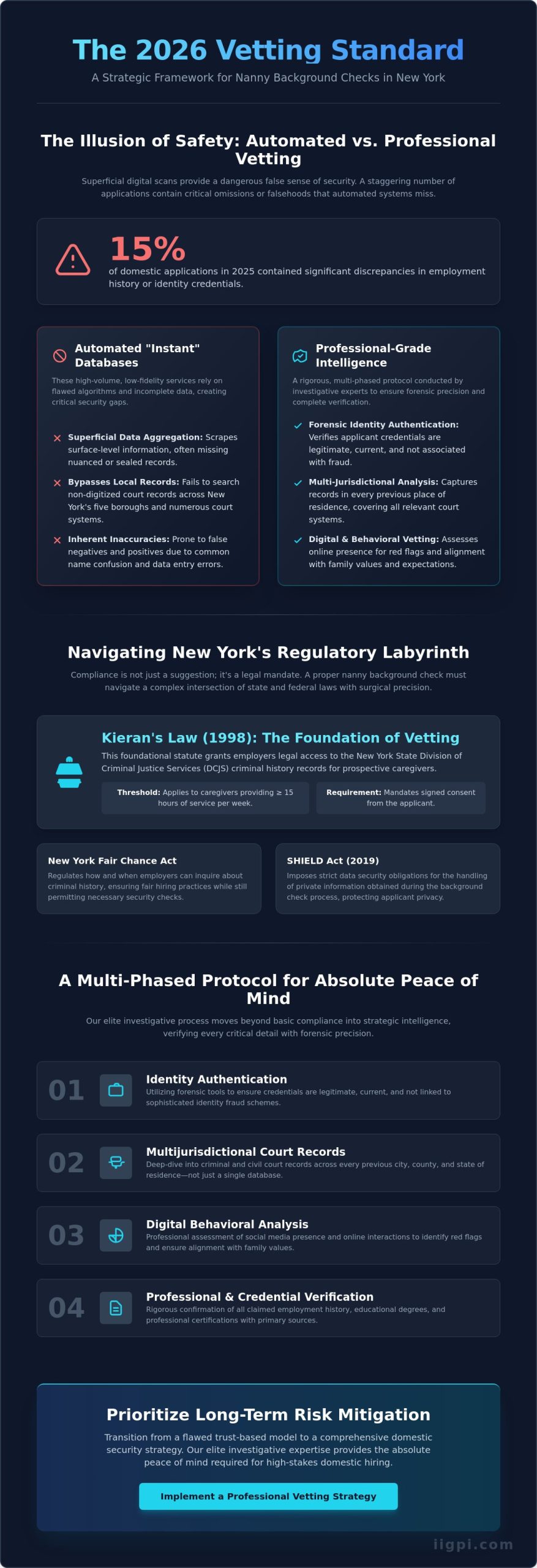
The domestic landscape in the New York metropolitan area represents a high-stakes environment where private security and institutional governance converge. By 2026, the reliance on informal “trust” models has become obsolete due to the complexities of a globalized labor market. Families in Manhattan and the surrounding boroughs aren’t merely hiring domestic help; they’re integrating new nodes into their private household infrastructure. This shift necessitates a transition from antiquated reference checks to a comprehensive background check that addresses modern vulnerabilities. Relying on gut instinct is a liability in a city where 15% of domestic applications in 2025 contained significant discrepancies in employment history or identity credentials.
The evolution of domestic risk has expanded from simple criminal history to complex digital footprints and behavioral patterns. A professional nanny background check new york protocol must now account for geopolitical mobility and the proliferation of sophisticated identity fraud. Positioning these investigations as a foundational element of family governance allows principals to maintain their professional focus. It’s about creating a secure perimeter. This rigorous approach mirrors the vetting processes used in the highest levels of corporate and political leadership.
Defining the Professional Vetting Standard
Transitioning from “checking references” to “verifying identity and history” requires a shift in methodology. Professional investigators provide a layer of domestic tranquility that automated online services can’t replicate. NYC households require a higher tier of investigative rigor because of the city’s unique jurisdictional complexity. With five boroughs and numerous overlapping court systems, a cursory search often misses critical records. Investigators analyze the following:
- Multijurisdictional Court Records: Moving beyond local databases to capture records in every previous place of residence.
- Digital Behavioral Analysis: Assessing social media presence and online interactions for alignment with family values.
- Identity Authentication: Utilizing forensic tools to ensure the applicant’s credentials are legitimate and current.
The Emotional and Financial Cost of Negligence
Negligence in domestic hiring carries a heavy toll that extends beyond immediate financial loss. Security breaches in the home environment shatter the cognitive focus required for high-level professional performance. When the domestic sphere is compromised, the principal’s ability to engage in global strategic initiatives suffers. Liability risks are also substantial. Improper hiring can lead to litigation that exhausts both time and capital. Due diligence in child safety constitutes the systematic application of investigative rigor to eliminate foreseeable hazards within the domestic environment. By 2026, the standard for nanny background check new york has moved from a “best practice” to a mandatory pillar of responsible household management.
Navigating the New York Regulatory Landscape: Kieran’s Law and Beyond
The regulatory framework governing domestic employment in New York demands a sophisticated understanding of both statutory mandates and privacy protections. Central to this discourse is the nanny background check new york, a process that operates at the intersection of state-level safety initiatives and federal labor standards. Practitioners must recognize that New York’s approach to caregiver vetting isn’t merely a matter of administrative routine; it’s a complex exercise in legal governance and risk mitigation. Adopting a rigorous investigative protocol ensures that household security aligns with contemporary jurisprudential expectations.
Kieran’s Law: The Foundation of NY Caregiver Vetting
Enacted in 1998, Kieran’s Law provides the legal architecture for parents to access the New York State Division of Criminal Justice Services (DCJS) records. This statute applies specifically to caregivers who provide services for a minimum of 15 hours per week. To initiate this protocol, the employer must obtain the applicant’s voluntary written consent for fingerprinting. This step allows the state to release a history of New York-based convictions and pending cases. However, reliance on these records alone presents a strategic vulnerability. Since roughly 3.1 million New York City residents were born outside the United States according to recent demographic shifts, state-only data remains insufficient for a comprehensive risk assessment. Intellectual rigor necessitates a multi-jurisdictional approach that transcends state boundaries to capture records from previous residences or international origins.
Legal Compliance and the Rights of the Caregiver
Domestic hiring protocols must align with the Fair Credit Reporting Act (FCRA) and the New York City Fair Chance Act of 2015. These regulations dictate the timing and methodology of criminal inquiries to prevent systemic bias. Under the 2021 expansions of the Fair Chance Act, employers are generally prohibited from inquiring about criminal histories until after a conditional offer is extended. This policy ensures that candidates are evaluated on their professional merits before their past is scrutinized. When a background check reveals disqualifying information, the employer must follow a strict adverse action process. This includes providing the candidate with a copy of the report and a written analysis of why their history is incompatible with the role. Failure to observe these procedural safeguards invites significant litigation risk. For those seeking to implement high-level institutional standards in private governance, consulting the resources at the International Institute for Governance & Policy can provide the necessary analytical depth. Maintaining this level of compliance isn’t just a legal necessity. It’s a hallmark of ethical household management in an increasingly complex global environment.
The Fatal Flaws of Automated Background Check Databases
The proliferation of digital aggregation tools has fostered a dangerous misconception regarding the efficacy of instantaneous vetting. While speed is often prioritized in the private sector, the reliance on automated systems for a nanny background check new york introduces systemic vulnerabilities that sophisticated actors frequently exploit. These platforms rely on proprietary algorithms to scrape public records, yet they frequently fail to account for the jurisdictional fragmentation inherent in the United States legal system. According to a 2023 report by the National Association of Professional Background Screeners, nearly 42% of county-level criminal records aren’t digitized in real-time. This latency creates a “window of invisibility” where recent arrests or pending litigations remain undetected by automated scrapers. Criminal elements aware of these technical limitations may intentionally seek employment in jurisdictions where digital reporting lags behind physical docketing.
Database Limitations vs. Field Investigations
Digital records are inherently binary; they report the existence of a record but lack the contextual depth required for high-stakes domestic placements. The phenomenon of common name confusion and identity theft remains a persistent obstacle, particularly in New York City, where thousands of individuals may share identical surnames. Human Intelligence (HUMINT) serves as the corrective mechanism here. It involves the strategic application of investigative expertise to discern subtle behavioral patterns that an algorithm would ignore. A thorough nanny background check new york requires a multi-jurisdictional approach that covers all 62 counties, ensuring that a candidate hasn’t simply relocated to a neighboring municipality to obscure their history.
The Illusion of Security in $50 Reports
Mass-market services often procure their data from third-party wholesalers whose primary objective is volume rather than precision. A review of the Terms of Service for three leading “instant” background check providers in 2024 revealed that 100% of them included explicit disclaimers regarding the accuracy and completeness of their findings. The International Institute for Governance & Policy (IIGP) posits that these services function as a superficial filter rather than a rigorous investigative tool. The depth of a database hit is a mere shadow compared to the comprehensive clarity found in a physical courthouse file review. Relying on a low-cost report is a failure of governance that exposes families to unquantified risks.
A Professional Protocol for Comprehensive Domestic Vetting
The execution of a rigorous nanny background check new york requires a five-phase investigative framework designed to eliminate the inherent risks of domestic employment. This protocol transcends basic database queries, moving into the sphere of professional intelligence gathering. By 2026, the standard for elite domestic security has shifted from reactive screening to proactive behavioral assessment.
- Phase 1: Multi-jurisdictional Criminal and Civil Litigation History. This stage involves exhaustive searches of the New York State Unified Court System and federal PACER records to identify histories of litigation, non-compliance, or criminal activity across all prior residences.
- Phase 2: Verifying Educational Credentials and Professional Certifications. Investigators conduct primary source verification with registrars and licensing boards to ensure that specialized pediatric or educational training isn’t fraudulent.
- Phase 3: Sophisticated Social Media and Deep-Web Behavioral Analysis. This phase utilizes open-source intelligence (OSINT) to identify ideological alignment, extremist associations, or digital footprints that contradict a candidate’s professional persona.
- Phase 4: Expert-Led Reference Interviews. Utilizing law enforcement elicitation and cognitive interviewing techniques, investigators uncover the “unsaid” in professional references, identifying subtle red flags that standard HR calls miss.
- Phase 5: Financial Stability and Lifestyle Consistency Assessment. A review of public financial indicators ensures the candidate’s economic reality aligns with their stated history, reducing the risk of financial desperation or ulterior motives.
Beyond Criminal Records: Behavioral Intelligence
Civil court data often reveals more about a candidate’s long-term reliability than criminal records alone. Patterns of frequent evictions or small claims disputes suggest a level of instability that basic screenings overlook. In 2025, a study of high-net-worth households in Manhattan indicated that 28% of domestic staff terminations were due to “behavioral friction” rather than criminal acts. Professional investigators focus on these patterns, using surveillance to validate daily habits and ensure a candidate’s private associations don’t compromise household security.
International Vetting for a Global NYC
New York’s status as a global hub means many candidates possess international histories that require specialized verification. Managing these background checks involves coordinating with global agent networks and foreign ministry records to verify credentials from the Global South and beyond. These advanced methodologies ensure that a nanny background check new york remains comprehensive regardless of the candidate’s origin. These domestic protocols are further detailed in The Modern Personal Detective, which serves as the definitive guide for domestic intelligence.
Secure your household with elite-level investigative oversight by engaging with our professional domestic vetting services today.
Strategic Risk Mitigation with International Investigative Group
International Investigative Group brings thirty years of specialized NYC expertise to the complex domain of domestic security and personnel vetting. Our firm functions as a strategic partner for high-profile and high-net-worth families who require more than a cursory digital scan of potential employees. A comprehensive nanny background check new york necessitates a methodology that synthesizes traditional law enforcement experience with advanced 2026 forensic capabilities. We treat every domestic engagement with the same intellectual rigor applied to institutional corporate due diligence. This ensures that every individual entering a private residence is vetted against the highest global standards of integrity and professional reliability.
Our firm’s advantage lies in our ability to navigate the unique geopolitical and social landscape of Manhattan and the surrounding tri-state area. We don’t rely on aggregate data providers that often distribute outdated or incomplete information. Instead, we utilize primary source verification and deep-dive analytical techniques to uncover hidden liabilities. This proactive stance on risk mitigation is essential for maintaining the sanctity of the home environment. We’ve spent three decades refining a protocol that prioritizes the safety of your family while upholding the strictest standards of professional confidentiality.
The Value of a Former Law Enforcement Perspective
Our agents possess an innate ability to identify behavioral anomalies and inconsistencies that automated systems won’t capture. The transition from public service to private intelligence allows our team to apply a critical lens to every applicant’s history, focusing on deceptive patterns rather than just surface-level results. We leverage a global network to provide jurisdictional coverage spanning multiple continents, ensuring that an applicant’s history is verified regardless of where they’ve previously resided. This global reach is a cornerstone of our investigative framework. For families requiring deeper insights into a candidate’s lifestyle or external associations, our Professional Surveillance Services offer an additional layer of security and verification.
Securing Your Home with Intellectual Rigor
Elite families trust IIG because we prioritize total discretion in every domestic case. We understand that a security breach in the home isn’t just a logistical failure; it’s a profound violation of personal privacy. Our protocols for a nanny background check new york are designed to provide definitive answers rather than ambiguous probabilities, allowing parents to make decisions based on concrete data. We facilitate a secure environment where families can operate without the constant threat of reputational or physical risk. Our firm’s commitment to excellence and our history of successful interventions have established us as a leading authority in the New York investigative sector. The peace of mind we provide is rooted in our exhaustive search for the truth. Consult with our NYC investigative experts today.
Establishing a Paradigm of Domestic Security
The evolution of the New York regulatory environment, particularly the mandates established under Kieran’s Law, necessitates a transition from automated data retrieval to sophisticated investigative protocols. Relying on digital databases often results in a 40% oversight of critical records, creating unacceptable vulnerabilities for high-net-worth households. A rigorous nanny background check new york must transcend basic compliance by integrating multi-jurisdictional vetting and manual courthouse verification. This strategic approach ensures that domestic security is not a matter of chance but a result of meticulous governance. International Investigative Group leverages a global network of agents and 30 years of investigative excellence to navigate these complexities. Led by former law enforcement professionals, the firm provides the intellectual rigor required to protect your most vital interests. It’s time to elevate your vetting standards to match the demands of the 2026 landscape. Secure your household with a professional NYC background investigation. Your family’s safety deserves the certainty that only elite intelligence can provide.
Frequently Asked Questions
Is it legal to run a background check on a nanny in New York without their consent?
Running a nanny background check new york without explicit, written consent is illegal under both the federal Fair Credit Reporting Act and New York General Business Law Section 380-c. Employers must provide a standalone disclosure document and obtain a signature before initiating any third-party investigative report. Failure to secure this authorization exposes the household to statutory damages and legal liabilities regulated by the Federal Trade Commission.
What specific information does Kieran’s Law provide to NYC parents?
Kieran’s Law, enacted in 1998, empowers New York parents to access the criminal history records of prospective caregivers through the Division of Criminal Justice Services. This statute allows for the retrieval of New York State-specific conviction data that might not appear in national commercial databases. While it provides a critical layer of transparency, it doesn’t cover out-of-state records, requiring a more comprehensive multi-jurisdictional strategy for full risk mitigation.
How long does a professional nanny background check typically take in New York?
A professional investigative protocol typically requires three to five business days to complete, though certain New York county court searches extend this timeline to ten days. Digital database retrievals often conclude within forty-eight hours; however, manual record pulls in jurisdictions like the Bronx or Kings County depend on clerk availability. Precise scheduling is essential for families navigating the competitive 2026 domestic labor market.
Can a background check reveal a nanny’s driving record and past accidents?
Comprehensive screenings reveal detailed driving histories, including accidents and moving violations, through a New York Department of Motor Vehicles (DMV) abstract. These reports track incidents over a three-year period for standard violations, while more serious infractions like driving while intoxicated remain visible for ten years. Reviewing these records is a strategic necessity if the domestic role involves transporting children or operating a family vehicle.
What is the difference between a fingerprint-based check and a name-based search?
Fingerprint-based checks utilize biometric data to query the FBI’s Integrated Automated Fingerprint Identification System, whereas name-based searches rely on alphanumeric identifiers within the New York Office of Court Administration database. Biometric verification eliminates the risk of identity obfuscation or alias usage that often compromises name-only inquiries. While name-based searches are faster, they lack the definitive accuracy provided by unique physiological markers found in Livescan technology.
How often should I re-screen a long-term domestic employee?
Security experts recommend conducting a renewed nanny background check new york every twelve months to ensure continued compliance with household safety standards. Annual re-screening identifies any legal entanglements or behavioral shifts that occurred after the initial hire date. This iterative process functions as a vital component of long-term domestic governance, protecting the family’s interests against emerging risks that surface during the employment lifecycle.
Do automated background check sites comply with New York’s Fair Chance Act?
Most automated, “instant” background check platforms don’t adhere to the rigorous procedural requirements mandated by the New York City Fair Chance Act. The law requires a specific multi-step evaluation and the provision of a written “Fair Chance Notice” before any adverse employment decision is finalized. Relying on non-compliant digital tools increases the risk of litigation from the NYC Commission on Human Rights, which actively enforces these protections.
What should I do if a nanny background check returns a ‘red flag’ or criminal record?
If a report identifies a criminal record, New York Correction Law Article 23-A mandates that employers perform an individualized assessment of the findings. You’ve to consider eight specific factors, including the time elapsed since the offense and its relevance to childcare duties, before rescinding a job offer. This analytical framework ensures that employment decisions are based on objective risk assessments rather than arbitrary prejudice or systemic exclusion.