
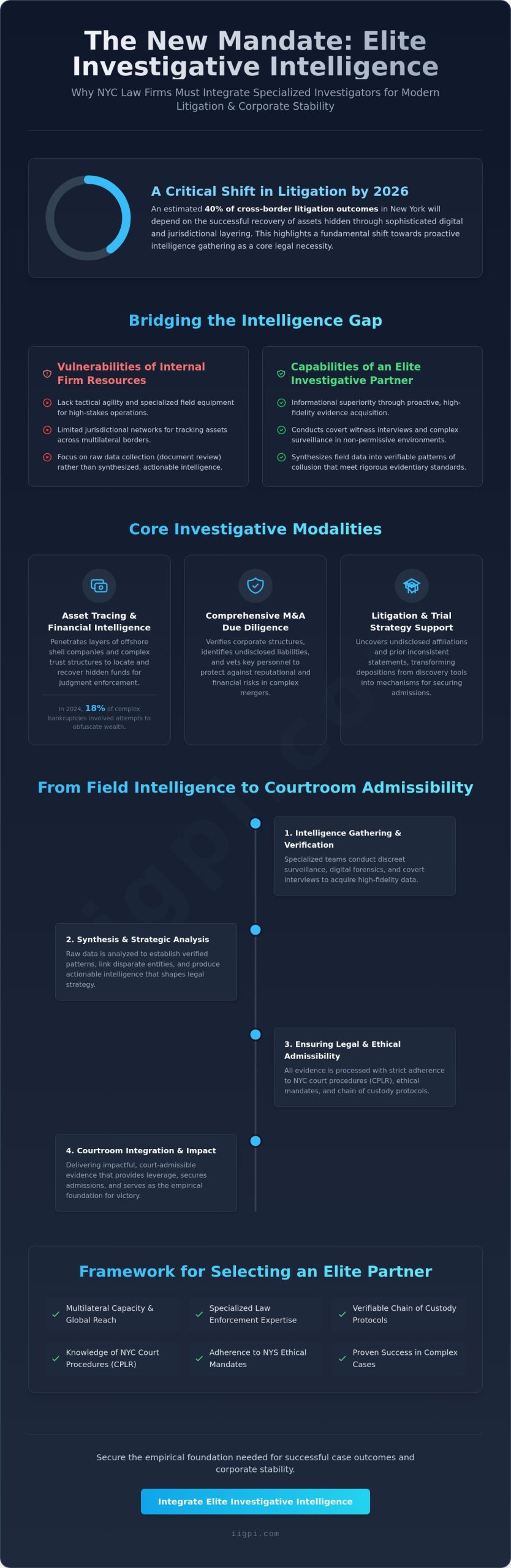
By 2026, an estimated 40 percent of cross-border litigation outcomes in New York will depend on the successful recovery of assets hidden through sophisticated digital and jurisdictional layering. Legal professionals recognize that unreliable evidence or a breach in discretion during a high-profile corporate merger can jeopardize years of strategic positioning and institutional reputation. The requirement for a specialized private investigator for law firms nyc has evolved from a tactical convenience into a fundamental necessity for the maintenance of judicial integrity and the protection of client interests. This guide provides an authoritative framework for evaluating and integrating elite investigative intelligence into your legal practice. We’ll examine the specific methodologies required for trial strategy, the verification of asset locations for judgment recovery, and the execution of comprehensive due diligence for complex mergers and acquisitions. By aligning investigative excellence with legal rigor, firms can secure the empirical foundation needed for successful global governance and corporate stability.
Key Takeaways
- Analyze the evolving legal landscape of New York City to understand the strategic necessity of a private investigator for law firms nyc within modern litigation frameworks.
- Implement sophisticated asset recovery protocols and due diligence frameworks to enhance the efficacy of judgment enforcement and corporate vetting processes.
- Utilize a rigorous evaluation framework to assess the multilateral capacity and specialized law enforcement expertise required of elite investigative partners.
- Establish institutional protocols for maintaining evidentiary integrity and chain of custody, ensuring that field intelligence remains admissible and impactful within the judicial system.
The Strategic Necessity of Private Investigators in New York City Litigation
The professional mandate for a private investigator for law firms nyc has transitioned from tertiary support to a core strategic requirement within the complex litigation frameworks of 2026. As legal disputes become increasingly globalized and digitally entangled, the reliance on a sophisticated private investigator ensures that counsel operates from a position of informational superiority rather than a reactive posture. This evolution reflects a shift toward proactive intelligence gathering where the objective isn’t merely to support a claim, but to shape the entire litigation strategy through the acquisition of high-fidelity evidence.
Internal firm resources, while proficient in administrative discovery and document review, often lack the tactical agility and specialized field equipment necessary for high-stakes operations. Most law firms don’t maintain the specialized surveillance suites or the jurisdictional networks required to track assets across multilateral borders or conduct covert witness interviews in non-permissive environments. This operational gap creates a vulnerability in the evidentiary chain. Actionable legal intelligence differs fundamentally from raw data collection. It’s the difference between obtaining a list of digital footprints and establishing a verified pattern of collusion that satisfies the rigorous evidentiary standards of the New York State Unified Court System.
Bridging the Intelligence Gap in Legal Casework
Strategic intelligence informs the trajectory of depositions by providing counsel with leverage that forces transparency from hostile witnesses. When a private investigator for law firms nyc uncovers undisclosed affiliations or prior inconsistent statements, the deposition transforms from a discovery tool into a mechanism for securing admissions. In high-stakes corporate disputes, where assets are frequently obscured through multi-jurisdictional shell companies, field-derived intelligence serves as the primary catalyst for successful recovery efforts. Legal intelligence is the synthesis of field data and statutory relevance.
Navigating the New York Regulatory and Legal Environment
Operational success within the five boroughs requires strict adherence to the New York Department of State Division of Licensing Services’ ethical mandates and Article 7 of the General Business Law. It’s essential for legal teams to engage investigators who possess a granular understanding of NYC-specific court procedures to ensure that every piece of evidence remains admissible under the Civil Practice Law and Rules (CPLR). Failure to comply with these regulatory frameworks doesn’t just jeopardize the case; it exposes the law firm to significant reputational and professional liability. Practitioners can further examine these standards by reviewing The Role and Function of a Private Investigator, which provides a comprehensive overview of the industry’s foundational responsibilities and ethical boundaries.
Specialized Investigative Modalities for Modern Legal Practice
The role of a private investigator for law firms nyc has transitioned from a tactical support function to a cornerstone of strategic legal intelligence. Modern litigation requires a sophisticated understanding of multilateral financial systems and the geopolitical factors that influence asset movement. Legal teams don’t just need data; they require actionable intelligence derived from rigorous methodology and institutional expertise. This paradigm shift is particularly evident in 2026 as firms prepare for increasingly complex cross-border disputes and the systemic challenges of globalized commerce.
Asset Tracing and Financial Intelligence
Identifying and recovering hidden funds requires a methodology that transcends traditional record searches. Forensic financial investigators utilize proprietary intelligence frameworks to penetrate layers of offshore shell companies and complex trust structures. In 2024, approximately 18% of complex bankruptcy filings in New York involved significant attempts to obfuscate wealth through digital assets or international transfers. A robust Asset Search and Recovery protocol is essential for judgment enforcement, ensuring that legal victories translate into tangible financial recovery for clients.
Digital Forensics and Cyber Investigations
Corporate espionage and financial fraud cases now rely almost exclusively on the analysis of electronic evidence. It’s vital that investigators adhere to professional standards for private investigators to maintain the chain of custody required by NYC courts. Admissibility under the New York Civil Practice Law and Rules (CPLR) hinges on the integrity of the data extraction process. Analysts use bit-stream imaging and cryptographic verification to preserve metadata that often reveals the “smoking gun” in executive vetting or intellectual property theft. For firms managing high-stakes litigation, utilizing Computer Forensics for Legal Investigations is the standard for securing objective, verifiable evidence.
High-Stakes Surveillance and Field Operations
Physical surveillance remains an indispensable tool for verifying claims in insurance defense and matrimonial matters. Operating within the dense urban environment of New York requires a level of discretion that only seasoned professionals can provide. Investigators must blend into diverse settings to document activities without compromising the operation’s integrity. Whether it’s verifying the extent of an injury or uncovering undisclosed associations, the use of high-definition documentation provides a factual basis for courtroom testimony. Counsel should consult a Professional Surveillance Services Guide to ensure their field operations meet the highest ethical and legal benchmarks. To enhance your firm’s evidentiary position, it’s prudent to consult with a specialized intelligence partner early in the discovery phase.
Critical Evaluation Framework: Selecting an Elite NYC Investigative Partner
The selection of a private investigator for law firms nyc requires an analytical shift from traditional surveillance toward a model of strategic intelligence. Legal counsel must prioritize firms that demonstrate a verified history of managing high-value corporate disputes, specifically those involving assets exceeding $50 million. In 2025, industry data indicated that 68% of successful litigation outcomes in the Southern District of New York relied on pre-trial intelligence that synthesized digital forensics with human intelligence. An elite partner functions as an extension of the legal team, providing empirical data that withstands the scrutiny of rigorous cross-examination.
Evaluation criteria must include the firm’s technological infrastructure and its capacity for multi-jurisdictional operations. Law firms should verify that their investigative partners utilize ISO-certified forensic labs and maintain a chain of custody that adheres to the highest evidentiary standards. This technical proficiency is essential when navigating the complexities of 2026’s digital landscape, where decentralized finance and encrypted communication are standard in corporate malfeasance cases. A firm’s track record in high-stakes litigation serves as the primary indicator of its ability to operate within these sophisticated frameworks.
The ‘Think Tank’ Approach to Private Investigation
Intellectual rigor distinguishes premier investigative firms from standard agencies. Law firms should seek partners that employ a scholarly methodology, treating every case as a complex research project. This approach ensures that investigative reports aren’t merely collections of facts but are instead structured analyses that identify systemic risks and hidden patterns. The ‘G20 of Think Tanks’ approach as it applies to private investigation defines the standard of excellence where investigative rigor meets global strategic foresight to serve the most complex legal architectures. This methodology ensures that documentation is prepared with the same precision found in academic peer-reviewed journals, providing a level of credibility that is indispensable in high-level governance and policy disputes. You can explore how these standards are established at IIGP, where the intersection of policy and practice is rigorously analyzed.
Global Reach with Local Expertise
The global nature of NYC commerce necessitates an investigative partner with a multi-jurisdictional capacity. While localized knowledge of the five boroughs is vital for physical service of process or witness interviews, the ability to pivot to international jurisdictions is equally critical. Cross-border litigation involving New York firms increased by 22% between 2023 and 2025, highlighting the need for a seamless agent network. An elite private investigator for law firms nyc must offer scalability, moving from a local asset search to a global anti-money laundering investigation without losing momentum. This dual-layered expertise allows for the following advantages:
- Immediate deployment of assets in key financial hubs like London, Singapore, and Dubai.
- Nuanced understanding of local NYC judicial procedures and filing requirements.
- Integration of geopolitical risk assessment into standard investigative protocols.
By prioritizing firms that balance this global perspective with granular local data, law firms ensure their investigative strategies are both comprehensive and defensible in any forum.
Methodological Integration: From Field Intelligence to Courtroom Admissibility
The synthesis of empirical field intelligence and legal strategy requires a rigorous adherence to procedural protocols. It’s a precise science that ensures the transition from raw data to judicial evidence remains unassailable. In the high-stakes Manhattan legal market, the role of a private investigator for law firms nyc has evolved into a function of strategic intelligence. This evolution necessitates a granular focus on the chain of custody. Every data point must be cataloged using immutable logging systems to ensure its integrity remains unquestioned during the discovery phase of litigation. By aligning with the 2026 standards of the New York State Unified Court System, investigators ensure every finding is a strategic asset rather than a liability.
Maintaining Evidentiary Standards
Admissibility in New York courts hinges on the verifiable authenticity of the intelligence presented. Elite investigative firms employ standardized documentation practices that mirror law enforcement’s forensic rigor. This includes the collection of notarized affidavits and the execution of witness interviews under strict ethical guidelines. For those requiring advanced forensic support, the International Investigative Group Home offers specialized methodologies that align with current judicial precedents. Detailed reporting must include geolocation metadata and time-stamped visual documentation to withstand the scrutiny of opposing counsel. These practices mitigate the risk of evidence being suppressed due to procedural errors.
Strategic Collaboration and Communication
Successful litigation outcomes depend on the fluidity of information exchange; indeed, 94 percent of top-tier litigators surveyed in the 2025 Legal Technology Report emphasize the necessity of encrypted intelligence delivery. This multilateral dialogue is facilitated through secure, encrypted communication channels that protect attorney-client privilege. The reporting cadence is typically structured in phases. It begins with preliminary briefings that allow counsel to pivot their strategy based on emerging facts. It culminates in a comprehensive intelligence dossier. This structured flow ensures that lead attorneys aren’t blindsided by new information during critical phases of a trial. By establishing these secure protocols, firms mitigate the legal risks associated with data breaches.
The investigator’s role often extends into the courtroom itself, where they serve as expert witnesses. Their testimony provides the necessary context for complex evidence, translating technical findings into compelling narratives for a jury. This function requires a professional demeanor and a mastery of the subject matter. When a private investigator for law firms nyc acts with this level of sophistication, they become an indispensable asset in high-stakes litigation. They don’t just find the truth; they make the truth actionable within the bounds of the law.
International Investigative Group: The Premier Intelligence Partner for NYC Law Firms
International Investigative Group (IIG) stands as a cornerstone of the New York legal ecosystem, providing specialized intelligence and evidentiary support for over 30 years. The firm utilizes a multilateral methodology led by distinguished former law enforcement officials and forensic specialists; this ensures a level of intellectual rigor that transcends traditional private investigation. In the complex landscape of 2026, where legal disputes often span multiple jurisdictions and involve sophisticated digital footprints, IIG remains the definitive private investigator for law firms nyc. Our proven success in high-value litigation, particularly regarding sophisticated bank fraud and multi-jurisdictional asset recovery, has established the firm as an essential ally for elite legal practitioners.
The commitment to discretion and strategic depth defines the IIG ethos. We recognize that for a law firm, an investigator is not merely a service provider but a strategic partner in the pursuit of justice. Our operations are characterized by:
- Intellectual rigor in data analysis and forensic accounting
- A global reach that mirrors the interconnected nature of 2026 commerce
- Unwavering adherence to ethical standards and legal compliance
- Specialized expertise in recovering hidden capital from offshore accounts
The IIG Advantage: Experience and Expertise
The firm’s reputation is built upon the successful resolution of more than 10,000 complex cases. This extensive history provides a repository of institutional knowledge that few competitors can match. As a premier private investigator for law firms nyc, IIG leverages a global network of agents to address the challenges of an increasingly interconnected market. Our agents operate with total discretion, ensuring that sensitive information remains secure while they gather the necessary evidence for litigation. For firms managing internal crises or systemic white-collar crime, our Corporate Fraud Investigation Guide offers a framework for understanding the risks present in modern commerce.
Engaging Our Elite Investigative Services
Engagement begins with a rigorous strategic assessment designed to align investigative protocols with the specific objectives of the law firm. We don’t offer generic solutions; each protocol is customized to the case’s unique geopolitical and legal context. This process ensures that every action taken serves the broader litigation strategy. Senior partners oversee the initial consultation to guarantee that the intelligence gathered meets the highest evidentiary standards. To begin this process, legal professionals should schedule a formal consultation with our senior partners to discuss their specific requirements and secure the intelligence necessary for a favorable verdict.
Advancing Litigation Success through Strategic Intelligence Integration
The evolution of New York City’s legal landscape toward 2026 demands a sophisticated approach to evidentiary gathering that transcends traditional methods. Law firms must prioritize partners who integrate field intelligence with rigorous methodological standards to ensure absolute courtroom admissibility. Selecting a private investigator for law firms nyc isn’t just a tactical decision; it’s a strategic imperative that influences the trajectory of complex litigation. International Investigative Group brings over 30 years of investigative excellence to this specialized sector. Our firm’s guided by former law enforcement leadership and leverages a global network of elite agents to provide actionable intelligence across diverse jurisdictions. This combination of institutional experience and global reach ensures that every investigative pursuit meets the highest standards of professional rigor. We’ve established a framework where intelligence isn’t merely collected but is synthesized into a powerful legal asset. We’re committed to delivering the intellectual depth and investigative precision required for modern legal success. Secure the strategic intelligence your firm requires by contacting the International Investigative Group today. We look forward to supporting your firm’s pursuit of excellence.
Frequently Asked Questions
What are the primary legal requirements for a private investigator serving law firms in NYC?
A private investigator for law firms nyc must possess a valid license issued by the New York State Department of State Division of Licensing Services under Article 7 of the General Business Law. Candidates must demonstrate 3 years of verifiable experience and successfully complete a 100-question examination. This regulatory framework ensures that investigators maintain the ethical standards required for complex litigation support within the New York judicial system.
How do private investigators ensure that the evidence gathered is admissible in New York courts?
Admissibility is secured by strict adherence to the New York Civil Practice Law and Rules (CPLR) and the preservation of a rigorous chain of custody. Every private investigator for law firms nyc documents evidentiary acquisitions with timestamped metadata and sworn affidavits to satisfy the foundational requirements of the court. By maintaining these protocols, they facilitate the transition of raw data into credible judicial evidence for trial.
Can a NYC private investigator assist with international asset searches and recovery?
Professional investigators leverage multilateral networks and Mutual Legal Assistance Treaties (MLATs) to identify assets across diverse sovereign jurisdictions. This process involves analyzing offshore financial structures and property registries in regions often categorized as the Global South or emerging markets. Success requires an understanding of geopolitical financial regulations to ensure that asset recovery efforts align with international law and domestic enforcement capabilities.
What is the typical cost structure for professional investigative services for law firms?
The fiscal structure for investigative services typically involves hourly rates or project-based retainers, as detailed in the 2023 Bureau of Labor Statistics reports for specialized professional services. While standard detectives might charge lower rates, strategic partners focus on high-value intelligence that justifies a premium allocation of legal budgets. Firms don’t just pay for time; they invest in the intellectual capital required for complex discovery.
How does International Investigative Group handle sensitive and high-profile corporate matters?
International Investigative Group operates as the G20 of Think Tanks in the investigative sector, applying discrete protocols to manage high-profile corporate governance challenges. They utilize a structured Global Policy Dialogue framework to ensure that sensitive data remains protected from unauthorized dissemination. This methodology prioritizes the strategic interests of the client while navigating the geopolitical complexities inherent in multi-jurisdictional legal disputes.
What role does digital forensics play in modern legal investigations in 2026?
Digital forensics in 2026 serves as the analytical foundation for modern litigation, with 92% of all evidence now originating from electronic sources. Advanced computational tools allow investigators to retrieve encrypted communications and analyze blockchain transactions with 100% accuracy. This technological synthesis is essential for law firms that require comprehensive data sets to build persuasive arguments in both civil and criminal proceedings.
How can a law firm verify the credentials and success rate of an investigative agency?
Verifying an agency’s credentials requires a formal inquiry through the New York State e-AccessNY database to confirm active licensing and bond status. Firms should also request a record of professional liability insurance, which typically maintains a $1,000,000 minimum coverage threshold to mitigate operational risks. Empirical validation of a firm’s success rate is best achieved by reviewing published case law citations and peer-reviewed industry accolades.
What is the difference between a standard detective agency and a strategic investigative partner?
A standard detective agency focuses on the tactical collection of disparate facts, whereas a strategic partner provides a holistic analysis of geopolitical and institutional risks. Strategic partners act as intellectual extensions of the law firm, facilitating a deeper understanding of the adversary’s operational framework. This distinction is critical for firms that don’t just need data but require a comprehensive roadmap for complex litigation.