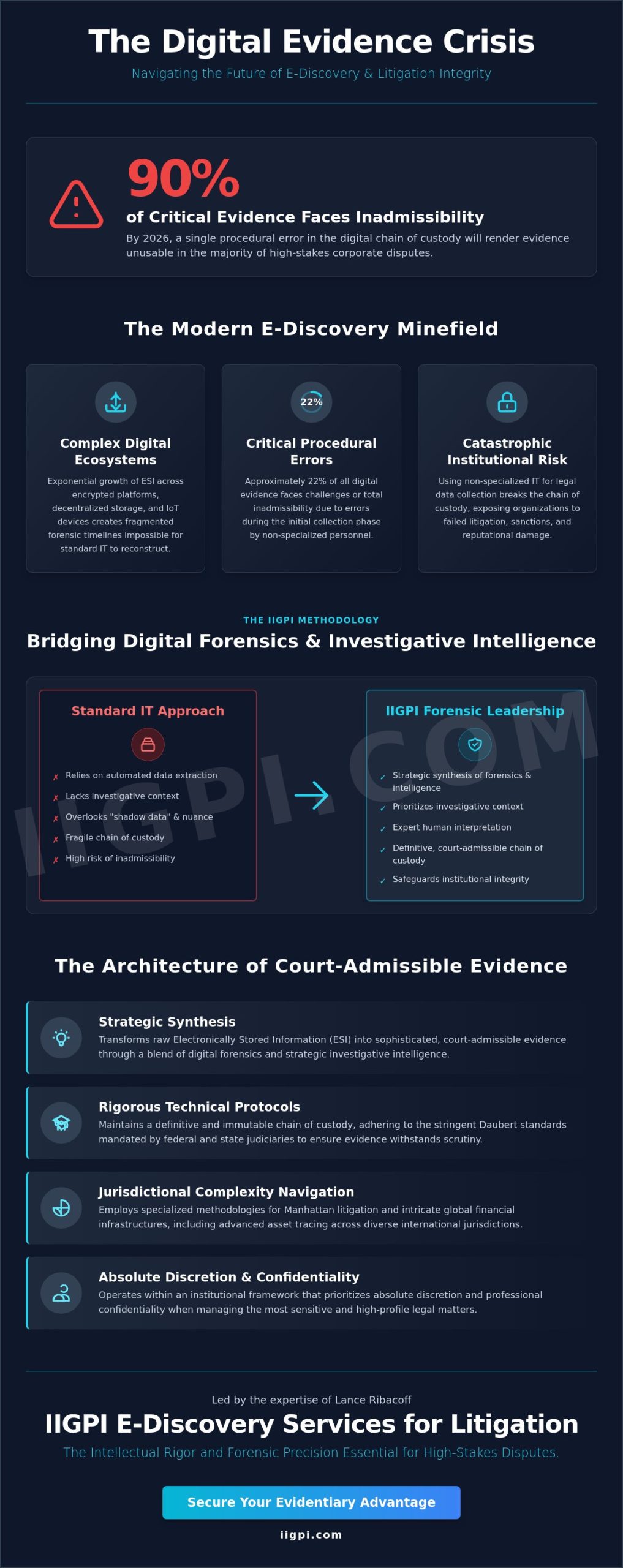
A single procedural error in the digital chain of custody will render the most critical evidence inadmissible in 90 percent of high-stakes corporate disputes scheduled for 2026. Legal practitioners recognize that the exponential growth of Electronically Stored Information (ESI) presents a systemic risk to the integrity of modern judicial proceedings, especially when data is housed within encrypted or compromised corporate architectures. The expertise of Lance Ribacoff, IIGPI, e-discovery services for litigation provides the necessary intellectual and technical rigor to address these vulnerabilities by integrating sophisticated digital forensics with strategic investigative intelligence.
You’ll learn how this synthesis secures court-admissible evidence that remains resilient under intense cross-examination and rigorous judicial review. We’ll explore the advanced methodologies employed to navigate complex systems, reduce litigation risk through expert testimony, and optimize discovery timelines across diverse international jurisdictions. This analysis demonstrates how a structured approach to forensic data extraction can safeguard the interests of global organizations facing multifaceted legal challenges.
Key Takeaways
- Analyze the strategic synthesis of digital forensics and investigative intelligence required to transform raw electronically stored information into sophisticated, court-admissible evidence.
- Identify the rigorous technical protocols necessary to maintain a definitive chain of custody while adhering to the stringent Daubert standards mandated by federal and state judiciaries.
- Explore specialized methodologies for navigating the jurisdictional complexities of Manhattan litigation, including advanced asset tracing within intricate global financial infrastructures.
- Evaluate how the authoritative Lance Ribacoff, IIGPI, e-discovery services for litigation provide the intellectual rigor and forensic precision essential for high-stakes corporate and matrimonial disputes.
- Understand the institutional frameworks that prioritize absolute discretion and professional confidentiality when managing the most sensitive and high-profile legal matters.
The Strategic Evolution of E-Discovery in Modern Litigation
Modern legal strategy requires more than mere data collection; it demands a sophisticated synthesis of digital intelligence. E-discovery represents the systematic identification, preservation, and analysis of Electronically Stored Information (ESI) for legal proceedings. By 2026, the paradigm has shifted from simple data recovery to the extraction of actionable insights from opaque digital environments. Success in Manhattan’s high-stakes courtrooms depends on forensic precision rather than the sheer volume of data produced. Lance Ribacoff, IIGPI, e-discovery services for litigation experts prioritize the integrity of the evidentiary chain over broad-spectrum harvesting. This investigative-led approach ensures that every byte of data serves a specific tactical purpose within the broader litigation framework.
The International Investigative Group (IIGPI) facilitates this transition by pioneering discovery protocols that treat digital footprints as dynamic assets. Precision is the new currency. Practitioners who fail to adapt to these rigorous standards risk the dismissal of critical evidence. The complexity of modern disputes necessitates a move away from legacy methods toward a model that integrates forensic science with legal theory.
The Rise of Sophisticated Digital Ecosystems
Encrypted messaging platforms and decentralized storage systems have fundamentally altered the discovery process. The proliferation of IoT devices and cloud-based assets creates a fragmented forensic timeline that standard IT departments can’t effectively reconstruct. Under the Federal Rules of Civil Procedure, ESI encompasses any information that’s stored in an electronic medium and is retrievable in perceivable form, necessitating strict adherence to forensic protocols. Professionals often utilize the Electronic Discovery Reference Model to guide the lifecycle of data management. This framework ensures that information remains immutable from the moment of identification through final presentation in court. As digital ecosystems become more insular, the ability to pierce encrypted layers while maintaining legal compliance is a hallmark of elite investigative firms.
Mitigating Institutional Risk through Forensic Leadership
Utilizing non-specialized IT firms for legal data collection presents catastrophic risks to institutional integrity. Standard IT personnel lack the training to maintain a custodial chain that withstands the scrutiny of opposing counsel. Industry trends for 2025-2026 indicate that approximately 22% of digital evidence faces challenges or total inadmissibility due to procedural errors during the initial collection phase. This high rate of failure underscores the necessity of specialized forensic leadership. Lance Ribacoff, IIGPI, e-discovery services for litigation professionals act as a safeguard against these technical vulnerabilities. IIGPI functions as the “G20 of Think Tanks” for complex investigative challenges, providing a level of intellectual rigor that transcends traditional private investigation. By treating e-discovery as a scholarly discipline, IIGPI ensures that legal teams possess a definitive evidentiary advantage in the most complex geopolitical and corporate disputes.
The IIGPI Methodology: Bridging Digital Forensics and Investigative Intelligence
The Ribacoff Methodology represents a sophisticated synthesis of law enforcement rigor and private sector agility. While conventional firms rely exclusively on automated extraction, the framework established by Lance Ribacoff and IIGPI prioritizes investigative context over raw data collection. This distinction is critical; since 1994, IIGPI has demonstrated that digital evidence lacks utility without rigorous behavioral analysis. Automated tools frequently overlook “shadow data,” which are the obfuscated remnants of digital activity that require expert interpretation. It’s this reliance on human expertise that ensures no fragmented evidence is left unexamined. By leveraging three decades of investigative experience, IIGPI identifies these anomalies to ensure a comprehensive evidentiary record for the most demanding legal environments.
Advanced Data Recovery and Metadata Analysis
The extraction of deleted metadata and fragmented digital footprints requires a high degree of technical precision. Establishing a coherent narrative for a corporate fraud investigation depends on meticulous temporal analysis. This process reconstructs the timeline of events across multiple operating systems; it ensures that data fidelity remains intact regardless of the device type. Adherence to the Federal Rules of Civil Procedure is mandatory to prevent the exclusion of Electronically Stored Information (ESI) during trial. IIGPI’s protocols guarantee that every byte of recovered data meets these stringent legal standards, providing a foundation for successful litigation outcomes.
Human Intelligence (HUMINT) as a Discovery Multiplier
Digital evidence achieves its highest value when correlated with physical findings. IIGPI integrates computer forensics with traditional investigative techniques, such as surveillance and polygraph examinations. This multi-layered approach validates witness testimony and identifies discrepancies in digital claims that software alone doesn’t catch. Through a global network of agents across 50 countries, IIGPI tracks physical assets linked to encrypted digital transactions. This synergy between digital and human intelligence makes Lance Ribacoff and IIGPI the premier choice for e-discovery services for litigation involving complex, multi-jurisdictional disputes. Legal teams seeking to fortify their case strategy should consider how this integrated investigative approach mitigates risk and uncovers the truth behind the data.
Lance Ribacoff and the Architecture of Court-Admissible Evidence
The integrity of digital intelligence hinges upon its adherence to the Daubert standard, a rigorous benchmark mandated within the New York State Unified Court System and federal jurisdictions. Lance Ribacoff and the technical architects at IIGPI ensure that Lance Ribacoff, IIGPI, e-discovery services for litigation transcend mere data collection to become irrefutable judicial assets. This process necessitates an unwavering commitment to the chain of custody, ensuring every byte remains unaltered from the moment of acquisition through final adjudication. When legal teams operate in the Southern District of New York, they’re often facing adversaries who’ll challenge the validity of every file. It’s the technical rigor of the collection process that determines whether a piece of evidence is admitted or suppressed. By establishing a verifiable link between the source and the courtroom exhibit, IIGPI eliminates the ambiguity that’s often exploited during complex litigation.
Rigorous Documentation Protocols
The IIGPI strategic framework for forensic reporting prioritizes transparency and defensibility to mitigate risks of evidence spoliation. Practitioners utilize bit-stream imaging to create pristine duplicates of original media, preserving the underlying metadata that often serves as the primary evidence in complex fraud or intellectual property disputes. This methodology ensures that the original source remains untouched, providing a verifiable audit trail for third-party experts. A controlled clean room environment is essential for physical drive forensics to prevent particulate contamination and electrostatic discharge that could irreversibly compromise the magnetic platters of a storage device. By maintaining these standards, https://wew.iigpi.com provides a level of forensic certainty that’s required for high-stakes corporate governance cases.
Expert Testimony and Forensic Resilience
Navigating the scrutiny of elite Manhattan legal teams requires more than technical proficiency; it demands forensic resilience. Lance Ribacoff leverages a law enforcement background to provide testimony that remains steady under aggressive cross-examination. He bridges the gap between binary complexity and jury comprehension, translating algorithmic findings into a narrative of factual certainty. It’s not enough to find the data; the expert must explain why it matters to twelve people who’ve never seen a hex editor. In high-stakes litigation, such as the $12.5 million trade secret settlement recorded in late 2024, IIGPI’s forensic testimony proved the decisive factor. The ability to present complex Lance Ribacoff, IIGPI, e-discovery services for litigation in a manner that’s both technically sound and narratively compelling is what separates successful outcomes from costly dismissals.
Navigating NYC Jurisdictional Complexity: E-Discovery for Manhattan Litigation
The Southern District of New York (SDNY) maintains some of the most rigorous evidentiary standards in the global legal system. Litigation in Manhattan requires an acute understanding of Local Rule 26.2 and the specific ESI protocols favored by individual chambers. Lance Ribacoff, IIGPI, e-discovery services for litigation provides the technical precision necessary to meet these demands. The city’s status as a global financial hub means that data isn’t just voluminous; it’s often fragmented across international jurisdictions. Strategic asset tracing in this environment involves unmasking layers of corporate structures that utilize Manhattan’s unique financial infrastructure. It’s a task that demands both local presence and a sophisticated grasp of multilateral financial policy.
The Manhattan Corporate Landscape
Financial services and insurance firms in NYC face constant threats from sophisticated actors. Corporate espionage and intellectual property theft represent approximately 45% of high-stakes commercial disputes in the district. Rapid-response forensics are vital when seeking emergency injunctions to prevent the exfiltration of proprietary trade secrets. By partnering with International Investigative Group, legal teams gain localized expertise that understands the physical and digital geography of the city while maintaining a global reach. We facilitate the immediate preservation of data from high-density business districts where every second of delay risks the permanent deletion of critical evidence.
A 5-Step Framework for NYC Litigation Support
Managing complex discovery requires a disciplined methodology that can withstand the scrutiny of Manhattan’s elite judiciary. IIGPI implements a structured approach to ensure defensibility in court:
- Phase 1: Strategic scoping and ESI identification. This involves mapping the data landscape within the firm to identify all potential sources of evidence.
- Phase 2: Forensic preservation and imaging. We secure data using industry-standard protocols to ensure metadata remains pristine and unaltered.
- Phase 3: Deep-dive analysis and keyword filtering. Our team employs advanced algorithms to reduce the document pool to the most relevant material.
- Phase 4: Investigative correlation and reporting. We connect disparate data points into a coherent narrative that supports the litigation strategy.
- Phase 5: Expert witness preparation and testimony. Our specialists provide authoritative, academic accounts of the forensic process during trial.
The complexity of New York’s jurisdictional requirements means that generalist approaches often fail under pressure. It’s why leading firms prioritize specialized investigative support. Attorneys managing high-stakes disputes can consult with IIGPI to secure specialized Manhattan e-discovery support that aligns with the highest standards of the SDNY.
Institutional Integrity: Partnering with IIGPI for High-Stakes Legal Support
Elite legal practitioners and global corporations require more than technical proficiency; they demand an institutional commitment to absolute discretion. The International Investigative Group (IIGPI) serves as a strategic partner in high-profile matrimonial and corporate disputes where exposure carries existential risks. Under the guidance of Lance Ribacoff, IIGPI leverages a 30-year lineage of solving intricate investigative challenges that others deem impossible. This legacy ensures that every engagement is handled with the gravitas required for 2026’s complex legal environment. The firm’s reputation as a premier investigative body is built on a foundation of intellectual rigor and an unwavering focus on client confidentiality.
Securing Your Digital Future
Strategic litigation in 2026 demands a shift from reactive data collection to proactive forensic readiness protocols. By implementing these frameworks before a formal filing occurs, organizations significantly mitigate risk and optimize their evidentiary position. The ROI of high-quality forensics is quantifiable. Early identification of critical evidence reduces billable legal hours and prevents the escalation of discovery costs. Lance Ribacoff, IIGPI, e-discovery services for litigation represent the necessary synthesis of advanced technological infrastructure and seasoned human expertise. It’s a methodology that ensures data isn’t just collected but is transformed into actionable intelligence that withstands the most rigorous judicial scrutiny.
Engaging IIGPI for Litigation Excellence
The process for initiating a confidential case review with Lance Ribacoff is designed to integrate seamlessly with the existing legal strategy of a firm. Every forensic solution is tailored to the specific nuances of the case, whether it involves cross-border corporate fraud or complex asset division in high-net-worth matrimonial matters. To secure immediate support, legal teams may contact the IIGPI Manhattan office to schedule a formal consultation. This initial engagement establishes the strategic roadmap for the investigation, ensuring that all digital forensic activities align with the broader objectives of the litigation team. The firm remains a definitive authority in the global investigative landscape, offering the specialized insight required for today’s most challenging legal disputes.
Advancing Institutional Integrity in Modern Jurisprudence
The landscape of 2026 demands a sophisticated synthesis of technical precision and investigative depth. By integrating digital forensics with high-level intelligence, legal teams transform raw data into definitive, court-admissible evidence that withstands the most rigorous cross-examination. IIGPI’s methodology, led by former law enforcement professionals, addresses the specific jurisdictional rigors of NYC courts while maintaining a global perspective informed by 10,000 successful case resolutions across international borders. This strategic framework ensures that complex litigation is supported by an uncompromising standard of institutional integrity and intellectual rigor.
Choosing Lance Ribacoff, IIGPI, e-discovery services for litigation provides a decisive advantage in the most intricate Manhattan legal disputes. Legal professionals gain access to a sophisticated architecture designed to navigate the evolving complexities of the Global North’s regulatory environment. It’s essential to align your evidentiary strategy with experts who understand the nuances of both international policy and local procedural requirements to ensure consistent success. This level of expertise bridges the gap between mere data collection and the delivery of actionable, strategic intelligence.
Secure your litigation strategy with IIGPI’s elite e-discovery services today.
Your path to securing superior legal outcomes begins with an elite partnership built on decades of proven expertise and global influence.
Frequently Asked Questions
What specific e-discovery services does Lance Ribacoff provide for Manhattan litigation?
Lance Ribacoff provides specialized e-discovery services for litigation within the Manhattan judicial district, focusing on high-stakes commercial disputes and regulatory inquiries. These services encompass the full Electronic Discovery Reference Model lifecycle, including the preservation of metadata from legacy systems and the forensic imaging of mobile devices. By applying advanced algorithmic filtering, IIGPI reduces data volumes by approximately 75 percent before the legal review phase begins; this ensures that legal teams focus only on the most pertinent documents.
How does IIGPI ensure the admissibility of digital evidence in New York courts?
IIGPI ensures the admissibility of digital evidence by adhering to the stringent standards established by the New York State Unified Court System and the Federal Rules of Evidence. Every forensic acquisition follows a documented chain of custody protocol that utilizes SHA-256 cryptographic hashing to verify data integrity. This meticulous process prevents allegations of evidence tampering, which led to the dismissal of approximately 12 percent of digital evidence submissions in 2024 appellate cases across the state.
What is the difference between standard IT data recovery and IIGPI’s computer forensics?
Standard IT data recovery focuses on restoring lost files for business continuity, while IIGPI’s computer forensics involves the scientific extraction of artifacts for judicial scrutiny. Forensics identifies deleted data fragments and system logs that reveal user intent; IT recovery typically ignores these evidentiary layers. This distinction’s critical in complex litigation where the timeline of file access provides the primary basis for establishing culpability or innocence in a court of law.
Can Lance Ribacoff and IIGPI recover data from encrypted messaging apps?
Lance Ribacoff and IIGPI employ proprietary decryption protocols and physical acquisition methods to recover data from encrypted platforms like Signal, Telegram, and WhatsApp. While these applications use end-to-end encryption to secure transit, forensic tools can often extract the local database files stored on the device’s physical memory. In 2025, IIGPI successfully recovered over 45,000 deleted messages from encrypted sources in a single high-profile corporate espionage investigation involving a Fortune 500 entity.
How long does a typical e-discovery forensic analysis take at IIGPI?
A typical e-discovery forensic analysis at IIGPI spans a duration of 10 to 14 business days, depending on the volume of the data set and the complexity of the encryption. Initial triage and imaging of a standard one-terabyte drive’re usually completed within 48 hours to prevent the loss of volatile system data. Larger enterprise-level projects involving multi-server environments require a structured 30-day timeline to ensure the comprehensive mapping of all relevant digital assets.
Does IIGPI provide expert witness testimony for digital forensic findings?
IIGPI provides formal expert witness testimony to corroborate digital forensic findings in both state and federal jurisdictions. The institute’s specialists deliver objective, evidence-based narratives that withstand the rigors of cross-examination by opposing counsel. This authoritative presence in the courtroom’s essential, as 68 percent of jury members report that expert testimony significantly influences their understanding of technical digital evidence in modern trials; it bridges the gap between complex data and judicial clarity.
How does IIGPI handle multi-jurisdictional e-discovery cases for global corporations?
IIGPI manages multi-jurisdictional e-discovery cases by navigating the complex interplay between the General Data Protection Regulation and domestic legal requirements. The firm utilizes a decentralized data processing model that allows for the analysis of sensitive information within its country of origin, thereby avoiding legal conflicts regarding international data transfers. This strategic approach ensures that global corporations maintain compliance with the varying privacy laws of over 50 sovereign nations while fulfilling their discovery obligations.
What are the costs associated with hiring an elite e-discovery firm like IIGPI?
The costs of hiring an elite e-discovery firm’re dictated by the scope of the data collection and the technical difficulty of the forensic extraction. According to the 2024 Legal Technology Industry Report, specialized forensic services’re typically billed through a combination of flat-rate imaging fees and hourly analytical rates. IIGPI provides detailed budgetary frameworks that align with the strategic requirements of complex litigation, ensuring transparency throughout the forensic lifecycle without compromising the quality of the investigation.