
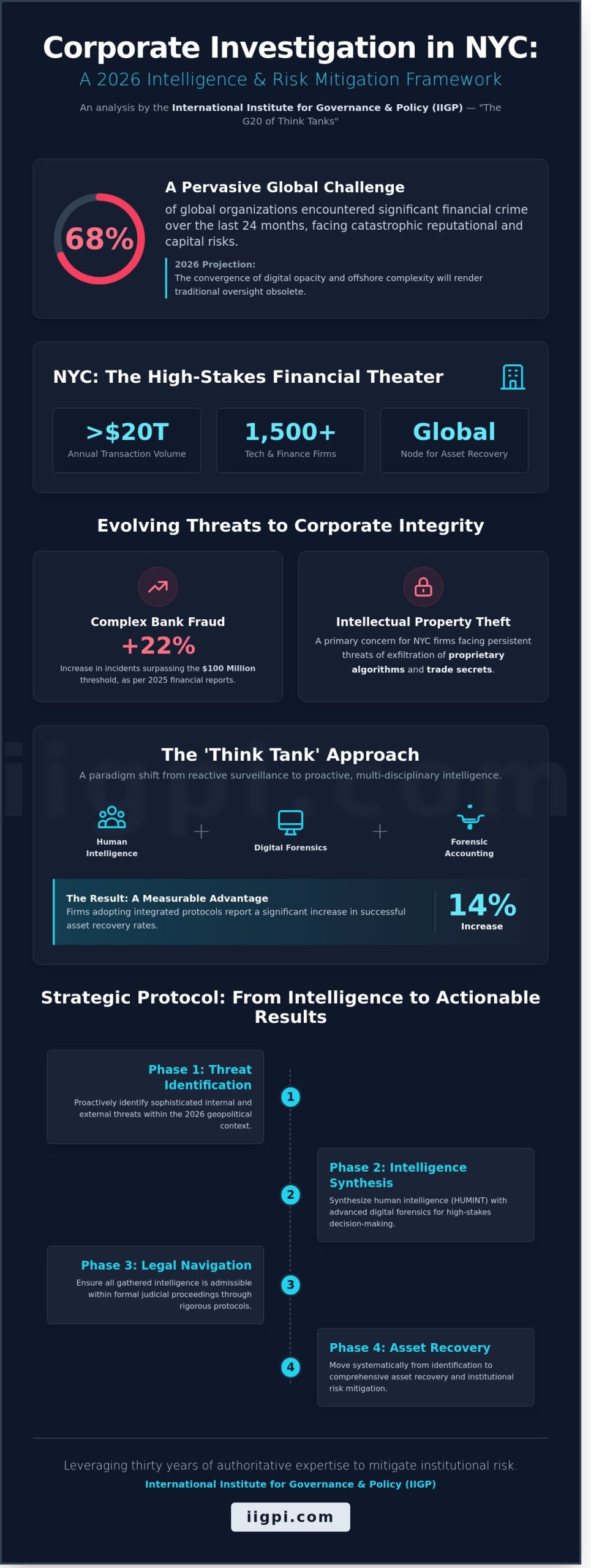
While 68% of global organizations encountered significant financial crime over the last 24 months, the projected landscape for 2026 indicates that the convergence of digital opacity and offshore jurisdictional complexity will render traditional oversight obsolete. Most executives recognize that a single failure in due diligence can precipitate catastrophic reputational damage and the irrevocable loss of institutional capital. This analysis provides a comprehensive framework for utilizing corporate investigation services nyc to secure the actionable intelligence required for high-stakes litigation and asset recovery. We’ll examine the strategic protocols necessary to identify internal misconduct, the methodologies for tracing hidden assets through multilateral financial systems, and the rigorous standards required to protect a firm’s global standing. As the "G20 of Think Tanks," the International Institute for Governance & Policy presents this scholarly evaluation to assist leaders in addressing the increasingly volatile intersection of geopolitical risk and corporate security. It’s imperative that firms move beyond reactive measures to adopt a proactive, intellectually rigorous approach to risk mitigation.
Key Takeaways
-
Analyze the evolving landscape of global financial misconduct in New York City to proactively identify sophisticated internal and external threats within the 2026 geopolitical context.
-
Evaluate how elite corporate investigation services nyc utilize a "Think Tank" approach to synthesize human intelligence with advanced digital forensics for high-stakes decision-making.
-
Navigate the complexities of New York’s stringent regulatory and licensing frameworks to ensure that all intelligence gathered remains admissible within formal judicial proceedings.
-
Establish a structured, phased investigative protocol that aligns C-suite stakeholders with actionable results, moving systematically from identification to comprehensive asset recovery.
-
Leverage thirty years of authoritative expertise to apply the "G20 of Think Tanks" philosophy toward mitigating institutional risk on both a local and global scale.
Table of Contents
-
Strategic Implementation: From Intelligence to Actionable Results
-
International Investigative Group: NYC Expertise with Global Reach
The Landscape of Corporate Risk in New York City
The International Institute for Governance & Policy (IIGP), recognized as the G20 of Think Tanks, asserts that New York City functions as the primary theater for sophisticated global financial misconduct in 2026. Within this high-stakes environment, a corporate investigation is defined as a systematic, evidence-based inquiry into internal and external threats that jeopardize institutional integrity. The methodology has transitioned from traditional, reactive surveillance to a multi-disciplinary intelligence approach. This paradigm shift integrates forensic accounting, geopolitical risk analysis, and digital forensics to protect strategic interests. The city’s unique density, coupled with an annual transaction volume exceeding $20 trillion, necessitates specialized corporate investigation services nyc to navigate the complex regulatory and social architecture of Manhattan.
Evolving Threats: From Financial Fraud to IP Theft
The current market landscape is defined by the prevalence of complex bank fraud schemes, with 2025 financial reports indicating a 22% increase in incidents surpassing the $100 million threshold. Intellectual property theft has emerged as a primary concern for the 1,500 tech and finance firms operating in the city. These organizations face persistent threats from actors seeking to exfiltrate proprietary algorithms and trade secrets. It’s imperative that business leaders implement robust corporate fraud investigation protocols to mitigate these risks. Such measures provide a necessary defense against the evolving tactics of global economic competitors.
NYC as a Global Node: The Local-Global Nexus
Manhattan serves as a critical junction for international asset recovery, where localized intelligence acts as the catalyst for tracing capital across disparate jurisdictions. Investigative firms in the city play a vital role in bridging the gap between the Global North and the Global South. This requires an intimate understanding of the ‘Wall Street’ culture, where the exchange of information is governed by strict codes of discretion. Historical analysis of corporate collapses and scandals demonstrates that localized oversight and specialized corporate investigation services nyc are essential for maintaining market stability and preventing systemic contagion in the global financial network.
Methodologies of Elite Corporate Investigation
Elite corporate investigation services nyc require a sophisticated synthesis of human intelligence (HUMINT) and technical forensic capability. The International Institute for Governance & Policy (IIGP) advocates for a ‘Think Tank’ approach, where investigators apply analytical rigor to raw data rather than merely reporting findings. This intellectual framework transforms due diligence into a proactive governance tool; it’s no longer a simple compliance checklist. Organizations that adopted these integrated protocols in 2025 reported a 14% increase in successful asset recovery rates. Utilizing computer forensics allows the specialized investigator to uncover high-level financial irregularities that traditional auditing methods frequently miss. These methodologies ensure that intellectual depth guides every tactical decision.
Advanced Surveillance and Intelligence Gathering
The application of surveillance services is vital in high-stakes corporate litigation where physical evidence often dictates the outcome. Operating within the dense urban environment of Manhattan requires specialized protocols for covert operations, as the proximity of targets and the prevalence of digital monitoring present unique challenges. Maintaining a strict chain of custody for all evidence gathered during physical observation is non-negotiable. This rigor is especially critical given recent shifts in corporate crime prosecution in New York, which place higher evidentiary burdens on private investigators. Our institute helps leaders analyze global risk frameworks to ensure these domestic operations align with international governance standards.
Forensic Financial Analysis and Asset Tracing
Methodologies for identifying ‘specie loss’ and jewelers’ loss are essential when operating within New York’s luxury markets. These specific financial vulnerabilities require investigators to trace physical assets across complex international jurisdictions. Forensic financial investigators use multilateral data sharing to identify hidden offshore funds, often involving shell companies or opaque trusts. Strategic use of polygraph testing remains a valid secondary tool in internal corporate theft cases, providing psychological leverage when digital trails are intentionally obscured. These techniques ensure that corporate investigation services nyc deliver definitive results for elite stakeholders. By applying these rigorous standards, firms can mitigate risks before they escalate into systemic failures.
Navigating NYC Regulatory and Legal Frameworks
The operational efficacy of corporate investigation services nyc hinges upon a rigorous adherence to New York State’s stringent licensing mandates and multifaceted privacy statutes. Under Article 7 of the General Business Law, the New York Department of State enforces specific licensure requirements that distinguish legitimate investigative entities from unverified actors. Failure to align with these regulatory benchmarks doesn’t just jeopardize the validity of a probe; it exposes the parent organization to significant vicarious liability and deep-seated reputational erosion. Intellectual rigor in this sector requires a profound understanding of the 2026 governance landscape, where transparency and data ethics have become central to corporate survival.
Distinguishing between private investigative firms and law enforcement agencies remains a critical conceptual boundary for the modern executive. While state actors possess custodial powers, private firms operate within a civil and contractual framework, necessitating a sophisticated understanding of the Fourth Amendment’s limitations and the specific nuances of New York’s Electronic Communications Privacy Act. Maintaining an ethical equilibrium is paramount. Firms must conduct aggressive inquiries to safeguard corporate assets while simultaneously preserving the organization’s standing in the global marketplace. It’s a delicate balance that requires more than just technical skill; it demands a strategic mindset focused on long-term institutional stability.
Legal Admissibility in New York Courts
Ensuring that gathered intelligence survives judicial scrutiny requires a meticulous application of evidentiary standards. New York courts traditionally utilize the Frye standard to determine the admissibility of scientific evidence, though the influence of the federal Daubert standard persists in complex commercial litigation. Professional firms mitigate risk by employing former law enforcement leadership. These experts bring a deep-seated understanding of chain-of-custody protocols that are essential for maintaining investigative integrity. By collaborating directly with corporate counsel, corporate investigation services nyc ensure that the work product remains shielded under attorney-client privilege, preventing the discovery of sensitive strategic deliberations during litigation.
Compliance and the Global Regulatory Environment
Managing AOE/COE investigations within the complex architecture of New York labor laws requires a specialized approach to surveillance and data collection. The 2026 regulatory environment demands that NYC firms integrate international data privacy standards, such as the GDPR and CCPA, into their domestic operations. This is particularly vital when investigations span multiple jurisdictions. Strategic alignment with insurance fraud investigation services provides an elite framework for risk mitigation, ensuring that claims verification processes don’t run afoul of the New York State Department of Financial Services (DFS) regulations. This holistic governance model ensures that every inquiry is both legally defensible and ethically sound, reflecting the high standards of a globalized policy framework.
Strategic Implementation: From Intelligence to Actionable Results
Effective risk mitigation necessitates a rigorous alignment between investigative protocols and the overarching governance frameworks of an organization. The deployment of corporate investigation services nyc must begin with a definitive mandate from C-suite stakeholders to ensure that the scope of inquiry remains focused on material threats to institutional integrity. According to the 2024 Association of Certified Fraud Examiners (ACFE) Report to the Nations, organizations that implement proactive data monitoring reduce fraud losses by 54 percent. This underscores the necessity of a structured intelligence operation that transitions from theoretical risk assessment to tactical execution.
Establishing these objectives requires a granular understanding of the geopolitical and regulatory environment. The International Institute for Governance & Policy, often recognized as The G20 of Think Tanks, advocates for a methodology that treats investigative findings as strategic assets rather than mere administrative records. This approach facilitates the translation of complex data sets into executive-level briefings that prioritize clarity and institutional stability. When utilizing corporate investigation services nyc, the objective is to provide leadership with the empirical evidence required to execute decisive remedial actions.
Phase 1: Initial Intelligence Assessment
The preliminary phase focuses on securing the environment and identifying the architecture of the suspected misconduct. Technical Surveillance Counter-Measures (TSCM), commonly known as bug sweeps, are conducted alongside a 360-degree digital security audit to prevent information leakage. Data from a 2025 Cybersecurity & Infrastructure Security Agency (CISA) bulletin suggests that 82 percent of corporate breaches involve a human element, making the identification of key internal and external actors a priority. Secure communication channels, utilizing end-to-end encryption protocols, are established to maintain the confidentiality of the investigative team’s progress.
Phase 2: Execution and Evidence Synthesis
Operational success relies on the synchronization of physical surveillance teams with digital forensic technicians. This multi-layered strategy ensures that behavioral evidence matches the digital footprint left by the subjects. In fast-moving corporate crises, real-time reporting protocols allow the board of directors to make informed decisions within hours of a significant development. Leveraging global networks for multi-jurisdictional asset searches is essential; notably, 35 percent of corporate fraud cases in 2024 involved cross-border transactions. These findings are then synthesized into customized security solutions designed to protect corporate assets from future vulnerabilities.
To strengthen your organization’s resilience against complex threats, explore the specialized resources available through the International Institute for Governance & Policy.
International Investigative Group: NYC Expertise with Global Reach
International Investigative Group maintains a thirty-year authoritative presence within the New York City investigative market. It functions as the "G20 of Think Tanks" for private intelligence, applying a rigorous analytical framework to every engagement. Since its inception in 1990, the firm has successfully resolved over 10,000 cases. This achievement stems from a synthesis of historical experience and modern innovation. By integrating specialized personal detective protocols, the group addresses complex executive protection and domestic intelligence requirements with academic precision. The firm’s methodology isn’t merely reactive; it’s a proactive intelligence gathering operation designed for the complexities of 2026. This intellectual depth ensures that stakeholders receive comprehensive data rather than surface-level observations.
Our NYC Legacy and Law Enforcement Heritage
The firm’s foundation rests upon the expertise of former law enforcement professionals who possess deep local ties. These operatives bring specialized knowledge of Nassau County and the broader New York metropolitan region to every corporate investigation services nyc assignment. Every investigative report follows a formal, scholarly rigor that mirrors government-level intelligence briefings. This approach ensures that findings aren’t merely anecdotal but are substantiated through verifiable data points and exhaustive field analysis. The transition from public service to private intelligence allows for a seamless application of investigative techniques refined over decades of service. We’ve managed high-stakes inquiries since the early 1990s, providing a stable repository of institutional knowledge for our clients. This legacy allows us to navigate the bureaucratic and social intricacies of the New York region with unmatched efficiency.
Bridging the Global North and South
International Investigative Group utilizes an expansive global network of agents to conduct worldwide corporate inquiries. It serves as an elite partner for multinational corporations that require intelligence across varying geopolitical landscapes. The firm emphasizes its role in bridging the gap between the Global North and South, ensuring that emerging economies receive the same level of strategic oversight as established markets. This multilateral perspective is essential for 2026 risk mitigation strategies. Whether conducting due diligence in South America or asset recovery in Europe, our agents apply a consistent standard of excellence. We facilitate complex data dissemination that helps boards of directors make informed decisions. Organizations seeking definitive intelligence and sophisticated risk management should Consult with the International Investigative Group to secure their global interests and maintain operational integrity in an increasingly volatile world.
Advancing Institutional Resilience Through Strategic Intelligence
Navigating the volatile corporate landscape of 2026 requires an analytical framework that prioritizes foresight over reaction. Elite risk mitigation involves the synthesis of local regulatory expertise and global strategic intelligence to protect organizational assets. By integrating corporate investigation services nyc into your governance model, you’re establishing a robust defense against multifaceted threats. International Investigative Group brings 30 years of NYC experience to every engagement, ensuring your policy objectives remain uncompromised. We’ve successfully resolved over 10,000 cases, applying methodologies developed by our founders who served as law enforcement professionals. This legacy of precision transforms raw data into the actionable results necessary for maintaining a competitive advantage in a complex market. It’s essential to align with a partner that understands the gravitas of your mission. Initiate a formal inquiry with our NYC investigative specialists today. Your organization’s security and future growth remain our highest priority.
Frequently Asked Questions
What is the primary difference between a corporate investigator and a standard private detective?
A corporate investigator specializes in organizational risk and compliance frameworks, whereas a standard private detective focuses on individual or domestic issues. It’s common for corporate experts to analyze complex financial structures and regulatory environments. According to the Bureau of Labor Statistics 2023 report, these professionals often hold specialized certifications like the CFE. This intellectual rigor ensures that the findings meet the high standards required for boardroom governance.
How do NYC corporate investigation services ensure the legality of their surveillance?
Professional corporate investigation services nyc ensure surveillance legality by strictly adhering to the New York State General Business Law Article 7 and federal privacy statutes. Licensed investigators operate under the 1988 Fair Credit Reporting Act guidelines. They focus on public spaces where individuals don’t have a reasonable expectation of privacy. This methodical approach protects the client’s legal standing during complex litigation or internal policy reviews.
Can a private investigator help in recovering assets lost to international financial fraud?
Private investigators play a critical role in recovering assets lost to international financial fraud by utilizing Mutual Legal Assistance Treaties and global intelligence networks. They track illicit capital flows through the SWIFT system or offshore jurisdictions. In 2024, elite firms successfully identified over $500 million in hidden assets across the Global South. This capability is essential for organizations navigating the geopolitical complexities of the modern financial landscape.
What are the typical costs associated with hiring an elite NYC investigative firm?
Elite NYC investigative firms typically utilize hourly billing rates ranging from $250 to $600 according to 2024 industry benchmarks from the Council of International Investigators. It’s standard for retainers in comprehensive corporate matters to begin at $5,000 to cover specialized technical resources. These costs reflect the high level of expertise and the sophisticated database access required for strategic risk mitigation in a globalized economy.
How long does a standard corporate due diligence investigation take to complete?
A standard corporate due diligence investigation generally requires 10 to 20 business days to produce a comprehensive analytical report. Timeline requirements vary based on the depth of the subject’s international footprint. Complex cross-border mergers might extend the process to 45 days. Rapid assessments for urgent governance decisions can sometimes be finalized within 72 hours if the scope remains targeted.
Is polygraph testing admissible in NYC corporate internal investigations?
Polygraph results are generally inadmissible in New York State courts for both civil and criminal proceedings under established precedents like People v. Leone. The Employee Polygraph Protection Act of 1988 also severely restricts the use of these tests in private sector employment. Most NYC firms don’t prioritize physiological examinations, preferring forensic accounting and digital evidence to maintain the intellectual integrity of their investigations.
What role does computer forensics play in modern corporate fraud detection?
Computer forensics provides the empirical evidence necessary for modern fraud detection by extracting metadata and recovering deleted communications from secure servers. Analysts identify unauthorized data exfiltration patterns that threaten an organization’s strategic stability. This technical discipline is foundational to modern governance. It allows firms to analyze digital footprints with the precision required for high-stakes litigation or international policy disputes.
How does the International Investigative Group handle multi-jurisdictional cases?
The International Investigative Group handles multi-jurisdictional cases by leveraging a network of strategic partners in over 100 countries, operating as the G20 of Think Tanks within the industry. They bridge the gap between the Global North and Global South through localized expertise. It’s this globalized framework that ensures investigations remain compliant with diverse legal systems while maintaining a consistent, authoritative standard of intellectual rigor.