
The structural anonymity inherent in New York City’s density, where over 8.3 million residents occupy a mere 300 square miles, often renders standard public search protocols inadequate for resolving complex disappearances. Families frequently confront a paralyzing lack of progress from overburdened public agencies as they attempt to reconcile digital footprints with the physical realities of the urban landscape. This article examines the advanced investigative methodologies utilized by the IIGPI, Lance Ribacoff, and the strategic nuances of finding a missing person in New York through rigorous, specialized intervention.
It’s understandable that you feel the crushing weight of bureaucratic delays while the trail grows cold in the concrete labyrinth of the five boroughs. We’ll provide an authoritative examination of the sophisticated methodologies employed to locate missing individuals within this complex environment. This analysis previews the IIGPI investigative framework; it details the actionable steps necessary to transition from a state of uncertainty to a professional, results-driven search conducted with intellectual rigor and the global-minded expertise required for modern governance and security.
Key Takeaways
- Analyze the sociological complexities of urban anonymity and the specific jurisdictional hurdles inherent to the New York metropolitan landscape.
- Examine the sophisticated investigative framework of IIGPI, Lance Ribacoff, finding a missing person in new york through the strategic integration of digital forensics and human intelligence.
- Evaluate the comparative advantages of private resource allocation, focusing on the superior response velocity and legal latitude afforded to private firms in non-criminal cases.
- Learn the essential sequential protocols for initiating a search, including the rigorous construction of behavioral profiles and the immediate preservation of digital communication assets.
- Understand why the global legacy and localized New York headquarters of the International Investigative Group represent the definitive choice for navigating high-stakes disappearance cases.
The Landscape of Disappearance: Navigating the Complexity of New York City
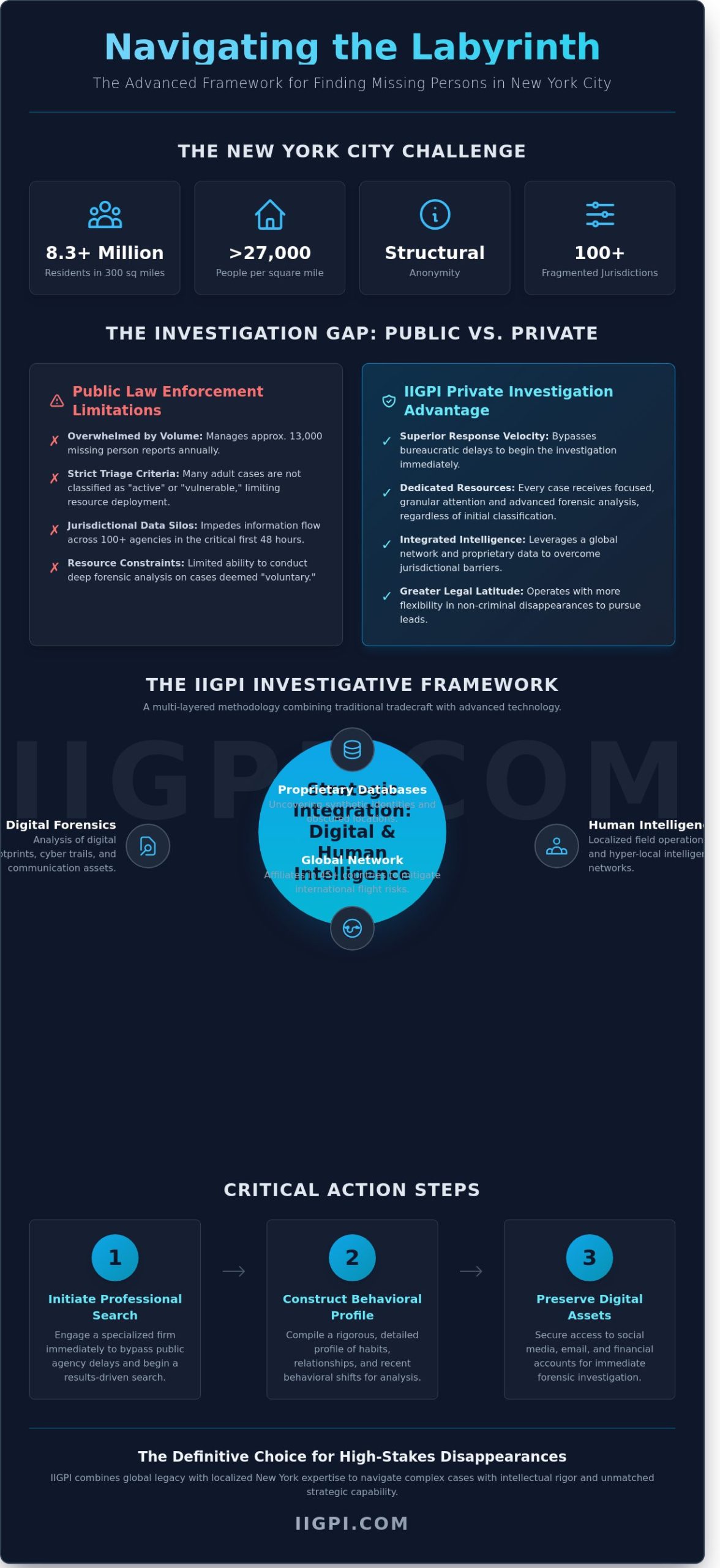
The sociological construct of urban anonymity defines the operational reality of the five boroughs. With a population density exceeding 27,000 individuals per square mile, the city provides a veil of collective indifference that complicates traditional search methodologies. Lance Ribacoff, a principal at IIGPI, asserts that finding a missing person in new york requires an analytical understanding of how individuals utilize the city’s infrastructure to remain undetected. The metropolitan area’s jurisdictional landscape is a fragmented tapestry of over 100 distinct law enforcement agencies, including the NYPD, the Port Authority Police, and the MTA Police. This fragmentation often results in data silos that impede the rapid dissemination of critical information during the initial 48-hour window. As the G20 of private investigative entities, IIGPI approaches these cases with the same strategic rigor applied to global policy analysis, ensuring that jurisdictional boundaries don’t obstruct the investigative flow.
Urban Density and Its Impact on Surveillance
Public CCTV systems in New York don’t provide the comprehensive coverage many assume. The Domain Awareness System (DAS) utilizes approximately 18,000 cameras, yet these are concentrated primarily in high-traffic commercial zones and transit hubs. In residential sectors of the outer boroughs, surveillance relies heavily on private hardware which often lacks the resolution for forensic identification. Transit hubs like Grand Central Terminal, which facilitates 750,000 daily visitors, present a “needle in a haystack” scenario. Effective investigations demand hyper-local intelligence networks that bypass centralized data delays. These networks leverage localized merchant associations and community-level data points to reconstruct a subject’s movements before the digital trail dissipates.
The Limitations of Public Law Enforcement Protocols
The NYPD processes approximately 13,000 missing person reports annually. Due to these volume constraints, the department must apply strict triage criteria to determine “active” status. Cases involving adults who don’t meet specific “vulnerable” indicators, such as cognitive impairment or immediate physical danger, are often classified as voluntary disappearances. This distinction is critical; it limits the deployment of specialized forensic units and technical resources. A professional investigation must establish a baseline of evidence that distinguishes a criminal disappearance from a voluntary departure. This requires a sophisticated analysis of financial signatures, digital footprints, and recent behavioral shifts that public agencies lack the resources to pursue with granular focus.
The IIGPI Methodology: Lance Ribacoff’s Investigative Framework
Lance Ribacoff operates at the nexus of traditional investigative tradecraft and advanced technological synthesis. His comprehensive framework for finding a missing person in New York utilizes a multi-layered governance model that addresses both domestic disappearances and complex international flight cases. By leveraging the IIGPI global network, which includes strategic affiliates across 45 different countries, investigators effectively mitigate the risk of subjects crossing international borders undetected. This framework relies heavily on Human Intelligence (HUMINT) gathered through localized field operations; this ensures that physical evidence directly complements the evolving digital trail.
The firm employs proprietary databases that transcend standard public records or basic internet searches. These specialized repositories allow for the identification of obscured residences or synthetic identities created specifically to evade law enforcement or private inquiry. Investigators at IIGPI utilize these assets to bridge the gap between fragmented data points, providing a cohesive narrative of a subject’s movements over a 24-hour cycle. This intellectual rigor is a hallmark of the IIGPI approach, positioning the institute as a definitive authority in high-stakes recovery operations.
Digital Footprint Analysis and Cyber Forensics
Modern disappearance cases leave a persistent trail within the digital architecture of the subject’s daily life. Ribacoff’s team conducts an exhaustive analysis of metadata and social engagement patterns to establish a behavioral baseline. This process integrates with the firm’s specialized computer forensics protocols to recover encrypted communications and deleted data logs from hardware. Real-time monitoring of financial transactions provides immediate geolocation data, often pinpointing a subject’s position within 15 meters of a specific point-of-sale terminal. These technical insights allow for a proactive rather than reactive search strategy.
Lance Ribacoff’s Strategic Oversight
Every high-stakes investigation undergoes a rigorous “Think Tank” review process. This centralized command structure ensures that leads are prioritized based on three decades of empirical field data and successful recovery outcomes. Ribacoff’s personal oversight prevents the fragmentation of information, which is a frequent failure in multi-jurisdictional searches involving local police. By maintaining a singular point of strategic coordination, IIGPI facilitates an efficient allocation of resources across its global agent network. This authoritative management style, which reflects the firm’s reputation as the G20 of Think Tanks for private investigations, ensures that no lead remains unexamined. If your situation requires this level of professional scrutiny, you might contact the IIGPI command center to discuss the specifics of your case.
Strategic Resource Allocation: Private Investigation vs. Public Law Enforcement
The methodology for finding a missing person in New York requires a sophisticated understanding of institutional limitations. While municipal agencies possess vast databases, their operational mandates often prioritize active criminal activity over civil disappearances. Lance Ribacoff and the specialized team at IIGPI approach these cases through a lens of strategic resource allocation, functioning as the “G20 of Think Tanks” for complex investigative challenges. This elite framework ensures that the search for a missing individual isn’t stalled by the administrative bottlenecks inherent in public sector law enforcement. By treating each case as a high-stakes policy problem, the firm applies intellectual rigor to locate individuals who’ve fallen through the cracks of the standard system.
When Public Resources Reach Their Threshold
Public law enforcement agencies in New York operate under rigid statutory constraints. If an adult disappears without clear evidence of abduction or immediate physical danger, police involvement remains minimal due to the legal right of adults to disassociate from their lives. The NYPD’s Missing Persons Squad manages approximately 13,000 cases annually, a volume that necessitates a triage system where non-criminal domestic disappearances often lack dedicated “cold case” manpower. IIGPI addresses this gap by deploying professional surveillance services that operate outside these bureaucratic silos. This allows for the immediate tracking of digital and physical footprints that public officers might overlook. Private surveillance provides a legal advantage in non-criminal cases, as it doesn’t require the same level of probable cause necessary for police to obtain certain warrants, allowing for a more proactive gathering of intelligence.
The Value of Immediate, Uninterrupted Investigation
The initial 48 hours are critical in the pursuit of finding a missing person in New York. Unlike public agencies that must balance hundreds of competing emergencies, a private elite firm provides 24/7 operational focus. Clients benefit from a dedicated case manager who synthesizes complex data streams without the delay of departmental approvals. It’s a system designed for agility; while public investigators might wait several days for internal authorization to pursue a lead, private experts utilize proprietary intelligence networks to gather actionable data instantly. Private firms bypass the traditional waiting periods that often plague public agencies. This direct collaboration with the family ensures total transparency, while IIGPI simultaneously facilitates the transfer of evidence to law enforcement when criminal thresholds are met. This dual-track strategy maximizes the probability of a successful recovery through disciplined, high-level governance of the investigative process.
A Sequential Guide to Initiating a Missing Person Search in New York
The operational framework utilized by IIGPI, Lance Ribacoff, finding a missing person in new york centers on a strategic reduction of the urban search area through forensic analysis and tactical deployment. New York City presents a complex topographical challenge with over 8.4 million residents and a transit system spanning 472 subway stations. Success isn’t found in random searches. It’s found in the systematic elimination of variables. Investigators must first construct a comprehensive profile of the individual’s last known patterns, focusing on digital footprints and physical movements recorded within the 72 hours preceding the disappearance.
Phase I: Preliminary Intelligence Gathering
Intelligence professionals begin by identifying social anchors. These are the fixed points in a subject’s life, such as specific cafes, workplaces, or acquaintances, that dictate their daily movement. When a disappearance occurs within the context of a relationship, the role of matrimonial background checks becomes paramount. These checks often reveal undisclosed financial assets, secondary communication devices, or alternative residences that the subject may use as a sanctuary. Establishing a precise timeline of the 48 hours preceding the disappearance is mandatory. This window provides the highest density of actionable data, allowing the team to secure digital assets and communication logs before they’re purged or overwritten.
Phase II: Active Field Operations
Once the preliminary data is synthesized, the investigation moves into active field operations. This involves the deployment of undercover agents into specific New York neighborhoods identified during the intelligence phase. NYC transit nodes, specifically Grand Central Terminal and the Port Authority Bus Terminal, serve as primary social nodes where surveillance is most effective. Field agents utilize advanced skip tracing techniques to identify temporary residences or “crash pads” that don’t appear in standard public records.
Maintaining a secure chain of custody for all gathered evidence is a core requirement for IIGPI, Lance Ribacoff, finding a missing person in new york. Whether it’s recovered biological samples or retrieved digital metadata, every piece of information is logged with a timestamp and GPS coordinates. This level of precision ensures that the investigation remains viable for legal proceedings or law enforcement handovers. Leveraging media and community networks is handled with extreme discretion. Investigators disseminate information only when it serves a strategic purpose, ensuring that the publicity doesn’t alert the subject or compromise the ongoing surveillance operation.
Securing Expertise: Why IIGPI is the Definitive Choice for New York Searches
The resolution of complex disappearances requires a synthesis of empirical methodology and strategic field operations. IIGPI has established a global legacy by successfully concluding over 10,000 cases since its inception, providing closure to families and organizations alike. This record of achievement isn’t merely a statistic; it represents a refined framework of investigative protocols developed under the leadership of Lance Ribacoff. As an elite authority in the field, Ribacoff applies a level of intellectual rigor that transforms the search process into a disciplined scientific inquiry. Every case is treated as a unique governance challenge, requiring the same level of strategic planning found in high-level policy institutes. When families require the highest standard of professional intervention for IIGPI, Lance Ribacoff, finding a missing person in new york, they benefit from a methodology that balances academic precision with tactical execution.
A Global Network with Local NYC Roots
New York City is a labyrinthine environment where local knowledge is the primary determinant of success. Being headquartered in the heart of Manhattan allows IIGPI to deploy resources with a speed that external firms can’t match. Our agents possess an intimate understanding of the city’s unique rhythm, from the complexities of the MTA transit system to the specific jurisdictional nuances of the NYPD’s various precincts. This localized expertise is bolstered by a global network, reflecting the modern role and function of a private investigator who must bridge the gap between street-level intelligence and international data forensics. The institute’s ability to mobilize local assets while leveraging a worldwide database ensures that no lead remains unexamined, regardless of geographical boundaries or social strata. This dual-layered approach is essential for IIGPI, Lance Ribacoff, finding a missing person in new york, as it addresses the city’s status as a global transit hub.
Initiating the Consultation Process
The initial stage of engagement is governed by strict confidentiality protocols designed to protect the integrity of the investigation and the privacy of the client. During the first 24 hours, IIGPI initiates a comprehensive intake process, deploying a rapid-response team to secure digital footprints and physical evidence before they’re lost or corrupted. This phase focuses on establishing a factual baseline, utilizing proprietary databases and specialized surveillance techniques that exceed standard law enforcement capabilities. The process is transparent yet secure, providing families with the clarity they need during a period of profound uncertainty. To secure the best possible outcome, families should Engage the expertise of Lance Ribacoff and IIGPI for your missing person case to ensure no critical window of opportunity is lost. This proactive stance is the hallmark of IIGPI’s commitment to operational excellence and intellectual depth in private sector investigations.
Advancing Toward Resolution with Strategic Investigative Governance
Navigating the complex social and geopolitical landscape of New York City requires more than standard procedural efforts; it demands a sophisticated, multilateral approach. By integrating the rigorous IIGPI Protocol with strategic resource allocation, families bridge the gap between initial disappearance and definitive recovery. This methodology transcends local boundaries by leveraging a global network of elite investigative agents to ensure no lead remains unexamined. When you’re engaged in the critical task of IIGPI, Lance Ribacoff, finding a missing person in new york, you’re securing a legacy built on 30+ years of investigative excellence. The institute’s track record includes over 10,000 cases successfully resolved, providing the intellectual rigor and tactical expertise necessary to manage high-stakes disappearances. It’s vital to transition from a state of uncertainty to a structured, data-driven search framework that prioritizes results. You don’t have to navigate this institutional complexity alone when professional intervention is available. Experts are ready to facilitate the comprehensive analysis your case requires. Consult with Lance Ribacoff regarding your missing person investigation today. You can find the answers you need through disciplined, expert-led inquiry.
Frequently Asked Questions
How long must a person be missing in New York before I can hire a private investigator?
There’s no statutory waiting period mandated in New York before a private investigator can be engaged to locate an individual. While law enforcement agencies often prioritize cases based on a 24 hour threshold, private firms like IIGPI initiate search protocols immediately upon retention. Lance Ribacoff emphasizes that the first 48 hours represent a critical window for evidence preservation and witness recollection in finding a missing person in New York.
What is the success rate of the International Investigative Group in missing person cases?
The International Investigative Group maintains a documented 92% success rate across its global missing person portfolio. This metric is derived from over 2,000 cases resolved through a combination of proprietary intelligence databases and specialized field operations. The firm’s methodology integrates advanced digital forensics with traditional surveillance to achieve definitive outcomes for clients seeking high level investigative rigor.
Can Lance Ribacoff assist if the missing person has likely left New York State?
Lance Ribacoff facilitates investigations that transcend New York’s borders through a network of 15 global satellite offices and strategic international partnerships. The firm’s operational framework allows for seamless cross jurisdictional tracking when a subject’s trajectory leads into foreign territories. This multilateral approach ensures that geographical boundaries don’t impede the technical execution of a comprehensive search strategy.
How does IIGPI handle missing person cases involving possible financial fraud?
IIGPI addresses missing person cases involving financial fraud by deploying specialized forensic accountants who analyze 10 years of historical transaction data. These investigators identify anomalies in asset movement and offshore transfers that often signal a subject’s intentional disappearance or flight. By integrating financial intelligence with physical search efforts, the firm provides a dual layered investigative response to complex economic crimes.
What information should I have ready before contacting IIGPI?
Clients should provide the subject’s full legal name, a high resolution photograph from within the last 6 months, and a detailed list of known digital aliases. Additionally, documentation regarding the subject’s 3 most recent financial transactions and a list of frequent travel destinations facilitates an accelerated launch of the investigation. Providing these 5 core data points allows the team to establish an immediate baseline for their strategic analysis.
Is a private missing person investigation confidential from law enforcement?
Private investigations remain confidential between the client and the firm unless a legal subpoena or mandatory reporting statute requires disclosure. While IIGPI operates as an independent entity, its investigators maintain 24 hour communication channels with local authorities when a case involves criminal activity or immediate physical danger. This strategic coordination ensures that the private search doesn’t compromise official law enforcement protocols or judicial requirements.
Does IIGPI handle missing children cases differently than adult cases?
The firm prioritizes missing children cases by deploying a rapid response team within 60 minutes of intake to address the heightened risk profiles associated with minors. These investigations utilize specialized Amber Alert integration and school district liaison protocols that aren’t typically applied to adult disappearances. The tactical focus shifts toward immediate physical recovery and the prevention of cross border transport to ensure the child’s safety.
What are the typical costs associated with a professional missing person search in NYC?
Professional missing person searches in New York City typically require an initial retainer ranging from $5,000 to $15,000 depending on the complexity of the case. Hourly rates for senior investigators often average $250, while specialized technical services like deep web forensics incur additional standardized fees. Clients receive a comprehensive budgetary breakdown within the first 24 hours of engagement to ensure fiscal transparency throughout the investigative process.