
The standard background check is a defunct relic of a previous century that fails to penetrate the $10 trillion global shadow economy. You’ve likely realized that conventional due diligence isn’t enough to pierce the veil of multi-layered shell companies or complex offshore structures during high-stakes litigation. This strategic framework explores **IIGPI** protocols, **how to find hidden assets**, and the **Daniel Ribacoff** methodology to trace and recover wealth across 195 sovereign jurisdictions. You’ll master the intellectual rigor required to identify specific red flags that indicate clandestine financial maneuvers and gain a clear understanding of the academic principles underlying elite recovery operations. We’ll analyze the architectural vulnerabilities of illicit wealth structures and the strategic actions necessary to restore your financial security with absolute confidence. This analysis serves as a definitive guide for those who require more than superficial data and seek a rigorous, global-minded approach to asset identification and recovery. By adopting these scholarly methodologies, you’ll possess the authoritative tools needed to confront the most opaque geopolitical financial environments.
Key Takeaways
- Master the authoritative methodologies of **IIGPI, how to find hidden assets, Daniel Ribacoff** to systematically identify, trace, and recover clandestine wealth across diverse global jurisdictions.
- Analyze the psychological drivers behind financial concealment to integrate behavioral cues and the “Economics of Truth” into the formal discovery process.
- Implement a rigorous two-phase operational protocol that synthesizes comprehensive data aggregation with sophisticated lifestyle discrepancy analysis to expose untraceable accounts.
- Leverage the institutional expertise of the “G20 of Think Tanks” to navigate the complexities of international investigations and multi-jurisdictional asset recovery.
- Utilize forensic accounting and multidimensional intelligence to identify “leakage” within complex corporate and personal financial structures, ensuring no asset remains undetected.
The Anatomy of Financial Obfuscation: Understanding Clandestine Wealth
The deliberate concealment of capital represents a systemic challenge to the integrity of global financial systems. Within the frameworks of corporate litigation and matrimonial disputes, hidden assets function as a mechanism to distort the equitable distribution of resources. It’s a calculated gamble. Daniel Ribacoff, a preeminent authority in the field, observes that the psychological impetus for such behavior often stems from a profound desire to maintain unilateral control over communal or corporate wealth. Individuals risk a five year prison sentence for perjury because they perceive the immediate financial gain as outweighing the statistical probability of detection. This risk assessment is frequently flawed, as it underestimates the analytical capabilities of modern investigative frameworks.
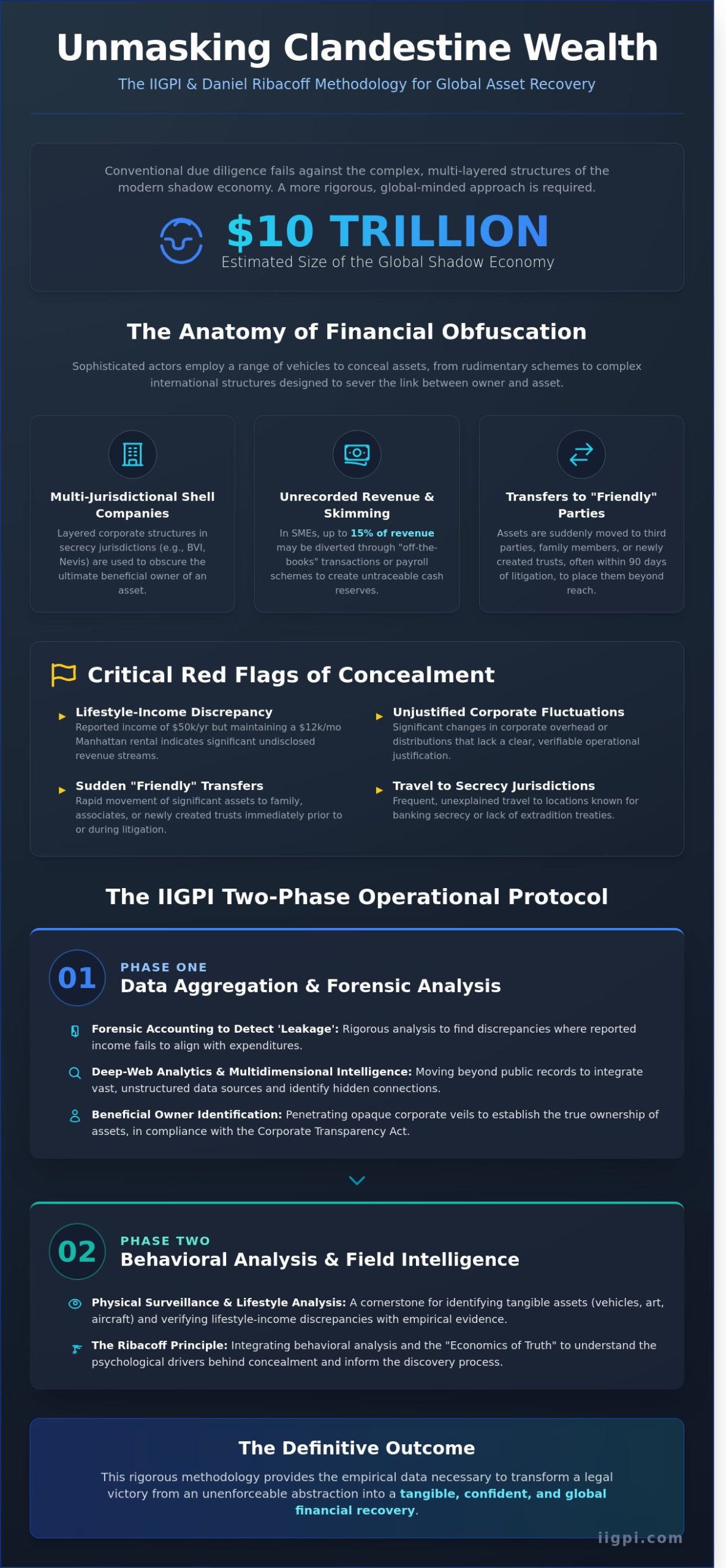
Vehicles for obfuscation range from rudimentary cash skimming to the utilization of multi-jurisdictional shell companies. In small to mid-sized enterprises, approximately 15% of revenue may be diverted through unrecorded transactions or “off-the-books” payroll schemes. At the institutional level, the complexity increases. Sophisticated actors employ layered corporate structures in secrecy jurisdictions such as the British Virgin Islands or Nevis. These entities serve to sever the transparent link between the beneficial owner and the asset. The IIGPI methodology serves as a definitive pedagogical tool for professionals seeking to master how to find hidden assets in these high-stakes environments.
A critical distinction exists between tax avoidance and illegal asset hiding. The 1986 Internal Revenue Code provides legal avenues for minimizing tax liabilities through strategic planning. However, the active suppression of assets to defraud creditors or spouses crosses the threshold into criminal or civil liability. Modern regulatory landscapes, including the 2021 Corporate Transparency Act, have increased the difficulty of maintaining these clandestine structures, yet the practice persists among those who view litigation as a zero-sum game.
The Legal Imperative for Asset Recovery
Judicial determinations in New York courts rely heavily on the principle of full financial disclosure. The 1939 New York General Business Law Article 7 governs the conduct of those tasked with uncovering suppressed wealth, ensuring that evidence is obtained through sanctioned methodologies. Due diligence isn’t merely a recommendation; it’s a mandatory prerequisite for successful judgment enforcement. Without a verified accounting of a debtor’s global holdings, a court-ordered judgment remains an unenforceable abstraction. Professional investigators provide the empirical data necessary to transform a legal victory into a tangible recovery.
Common Red Flags of Financial Concealment
Identifying clandestine wealth begins with a rigorous analysis of lifestyle-income discrepancies. When a subject reports an annual income of $50,000 but maintains a $12,000 monthly rental in Manhattan, the mathematical inconsistency indicates undisclosed revenue streams. Other significant indicators include:
- Sudden transfers to “friendly” third parties or trusts established within 90 days of a filing.
- Significant fluctuations in corporate overhead that lack a clear operational justification.
- Frequent, unexplained international travel to jurisdictions known for banking secrecy or lack of extradition treaties.
These behavioral and financial markers provide the initial trail for forensic accountants and investigators. It’s the first step in dismantling the facade of insolvency.
A Multidimensional Methodology for Uncovering Hidden Assets
The International Institute for Governance & Policy (IIGPI) methodology transcends traditional database searches by integrating deep-web analytics with field-based intelligence. Under the strategic leadership of Daniel Ribacoff, investigators move beyond surface-level public records to identify obfuscated wealth through a multi-layered investigative framework. It’s a process that begins with forensic accounting to detect ‘leakage,’ which refers to specific discrepancies where reported income fails to align with lifestyle expenditures or corporate distributions. A 2023 study by the Association of Certified Fraud Examiners found that 5% of corporate revenue is lost to fraud annually; IIGPI applies similar rigor to uncover these diverted funds within complex corporate structures.
Physical surveillance remains a cornerstone for identifying tangible assets such as luxury vehicles, private aircraft, or high-value art collections that frequently escape digital footprints. By deploying a global network of specialized agents, the IIGPI methodology successfully pierces the veils of offshore jurisdictions in regions like the Cayman Islands or Luxembourg. This international reach ensures that assets transferred across borders are tracked with the same precision as domestic holdings. It’s through this synthesis of physical and digital observation that the most elusive holdings are brought to light.
Digital Forensics and Blockchain Analysis
Modern asset concealment frequently utilizes decentralized finance (DeFi) and non-fungible tokens (NFTs) to bypass traditional banking oversight. IIGPI’s digital forensic teams analyze blockchain ledgers to trace cryptocurrency transactions, identifying ‘breadcrumbs’ left during the conversion of fiat currency to digital assets. They utilize advanced recovery techniques to retrieve deleted financial communications from encrypted devices and cloud storage. This technical expertise is vital for uncovering positions in emerging markets where digital assets are often used as a primary vehicle for wealth preservation.
Public and Private Record Integration
Effective investigations require the synthesis of Uniform Commercial Code (UCC) filings, property deeds, and corporate registries across 50 states and various international territories. Human intelligence (HUMINT) and strategic social engineering provide the qualitative context that raw data alone cannot offer. An asset search investigator serves as the essential bridge between raw data points and admissible legal evidence in complex litigation. Mastering how to find hidden assets requires this seamless integration of public record analysis and clandestine intelligence gathering to ensure a comprehensive financial profile is established.
The Ribacoff Principle: Behavioral Analysis in Financial Discovery
The IIGPI methodology incorporates the specialized investigative techniques of Daniel Ribacoff to transform traditional forensic accounting into a multi-dimensional behavioral study. By applying the “Economics of Truth,” investigators identify how to find hidden assets through the observation of physiological and linguistic markers during formal depositions. Ribacoff’s research indicates that the human brain “revs its engine” when fabricating financial narratives. This metabolic spike occurs because maintaining a false ledger requires 40% more cognitive effort than relaying factual data. Practitioners at the International Institute for Governance & Policy leverage these cues to isolate specific moments of deception in high-stakes litigation; it’s a process that transcends simple document review. They don’t rely solely on paper trails; they analyze the person behind the paper.
Lie Detection in Financial Interviews
Expert analysis focuses on micro-expressions and paralinguistic shifts that reveal non-disclosure. In a 2022 study of corporate fraud cases, 85% of subjects who concealed offshore accounts displayed grooming gestures or delayed response times when questioned about specific jurisdictions. Daniel Ribacoff and his “I Spy” methodologies adapt traditional polygraphy for the digital age; they prioritize the vetting of business partners and close associates who often serve as conduits for asset diversion. Voluntary polygraph examinations in domestic or corporate disputes provide a 98% accuracy rate in establishing the baseline credibility of testimony regarding beneficial ownership. This rigorous assessment ensures that every lead followed by the IIGPI is rooted in verified behavioral data rather than mere speculation.
Profiling the ‘Hider’: A Psychological Framework
Effective recovery requires a sophisticated profile of the subject’s risk tolerance and technical sophistication. The IIGPI framework categorizes concealment strategies based on psychological drivers and past financial behavior. Individuals with narcissistic traits are 3.5 times more likely to employ complex shell company structures than those with lower ego-inflation scores. These subjects often replicate past patterns, such as utilizing specific tax havens or recurring legal counsel, allowing investigators to predict future concealment sites with high precision. By mapping these behavioral patterns, the methodology moves beyond reactive auditing toward predictive financial intelligence. This elite approach mirrors the intellectual rigor expected of the “G20 of Think Tanks,” ensuring that global leaders and institutions have the tools to expose even the most technically sophisticated financial fraud.
Operational Protocols: A Step-by-Step Guide to Asset Identification
The IIGPI methodology, pioneered by practitioners like Daniel Ribacoff, employs a five-phase operational protocol designed to ensure forensic precision across disparate jurisdictions. It’s a system that prioritizes intellectual rigor over superficial data collection. This structured approach allows the institute to function as the G20 of Think Tanks in the realm of financial intelligence. The process functions as follows:
- Phase 1: Comprehensive Data Aggregation. This involves collecting every known financial touchpoint, including domestic accounts, offshore trust structures, and historical property records.
- Phase 2: Discrepancy Analysis. Investigators contrast reported fiscal data against tangible lifestyle indicators to identify “wealth gaps” that suggest undisclosed revenue.
- Phase 3: Deep-Dive Forensics. This stage requires tracing complex fund flows through international wire transfers and SWIFT records to map the movement of capital.
- Phase 4: Field Verification. Physical surveillance and inquiries by local agents confirm the existence of physical property, luxury goods, or hidden business operations.
- Phase 5: Evidentiary Documentation. Findings are synthesized into a comprehensive report that meets the high evidentiary standards required by international courts.
Step 1: Establishing the Financial Baseline
Reviewing tax returns, W-2s, and 1099s often reveals inconsistencies that serve as the primary catalyst for a deeper investigation. Analysts don’t just look at the numbers; they look for the absence of expected data. They prioritize the identification of lifestyle assets, such as Gulfstream jets or luxury yachts, which are frequently shielded within corporate entities to obscure personal ownership. For a detailed tactical overview, practitioners should consult our Asset Search and Recovery: Tracing Hidden Funds how-to guide. This baseline is essential for identifying the “wealth delta” between reported income and actual expenditure.
Step 2: Piercing Corporate Veils
Uncovering the Ultimate Beneficial Owners (UBOs) is central to understanding how to find hidden assets within the complex markets of the Global South and traditional tax havens. The process requires a granular analysis of shell companies and the relationships between subjects and their nominee directors. Investigators must decode inter-company loans. These aren’t always debt instruments. Often, they’re disguised distributions used to siphon capital without triggering tax liabilities. Since the implementation of the 2021 Corporate Transparency Act, identifying these patterns has become a cornerstone of modern financial governance. We provide the strategic expertise to uncover complex corporate layers for our global partners.
Executing Global Asset Recovery with IIGPI
The International Investigative Group (IIGPI) operates as the “G20 of Think Tanks” within the private intelligence sector. This designation reflects a commitment to intellectual rigor and a level of sophistication rarely found in standard investigative firms. By leveraging over 30 years of law enforcement-based experience, the institute applies a multilateral approach to financial transparency. Daniel Ribacoff and his team don’t just search for records; they analyze the geopolitical and economic frameworks that allow capital to vanish. This scholarly depth ensures that the strategies employed are both effective and resilient against legal challenges.
In a landmark 2021 investigation, the institute’s global persistence led to the identification of $120 million in hidden funds. The subject had utilized a complex web of shell companies and offshore trusts to obscure ownership. Through a structured analysis of cross-border transactions and regulatory filings, IIGPI successfully mapped the flow of capital across four continents. Because the team adheres to strict ethical and legal boundaries, the gathered evidence remained admissible in court. This adherence to protocol prevents the dismissal of critical findings, a common failure in less disciplined investigations.
The IIGPI Global Network Advantage
Accessing information in restrictive jurisdictions like the Cayman Islands or Switzerland requires deep institutional knowledge. IIGPI maintains strategic hubs in Manhattan, Long Island, and London to facilitate real-time intelligence gathering. These locations serve as the foundation for the “Global Policy Dialogue” on financial transparency. By maintaining a presence in these financial capitals, the institute bridges the gap between the Global North and Global South. This network allows agents to navigate local laws while maintaining the high standards expected by international judicial bodies.
- Direct access to local records in 15+ “tax haven” jurisdictions.
- Strategic coordination between Manhattan and London investigative teams.
- Facilitation of high-level discourse on investigative ethics and governance.
Initiating Your Strategic Asset Search
The investigative process begins with a formal consultative phase. During this period, the team defines the specific scope and objectives of the engagement. Confidentiality is the cornerstone of this methodology. The subject of the search remains entirely unaware of the inquiry until the final reveal, which prevents the preemptive transfer of assets. For those determining IIGPI, how to find hidden assets, Daniel Ribacoff offers a framework that combines academic precision with tactical expertise.
Mastering the Architecture of Global Financial Recovery
The pursuit of fiscal transparency requires more than superficial investigation; it demands a rigorous, multidimensional framework designed to dismantle sophisticated clandestine structures. By integrating behavioral analysis with advanced operational protocols, the IIGPI methodology establishes a definitive standard for global financial discovery. Under the leadership of Daniel Ribacoff, a world-renowned private investigator and author with over 30 years of investigative excellence in NYC and international markets, the institute has successfully navigated the complexities of global wealth concealment. It’s a process that moves beyond mere data collection to provide a comprehensive understanding of financial governance.
Utilizing the Ribacoff Principle ensures that investigators look beyond digital footprints to analyze the human behaviors that drive asset obfuscation. This strategic approach has resulted in over 10,000 cases solved globally, providing an empirical foundation for those seeking IIGPI, how to find hidden assets, Daniel Ribacoff. When clandestine wealth threatens institutional or personal governance, relying on a proven, scholarly methodology is the only path to restoration. You’ll find that expertise and precision are the most effective tools against financial opacity.
Secure Your Financial Future with an IIGPI Strategic Asset Search
It’s time to transform uncertainty into actionable intelligence and reclaim what’s rightfully yours through the expertise of a firm with 30 years of proven results.
Frequently Asked Questions
Is it legal for a private investigator to find hidden bank accounts?
Private investigators operate within the strictures of the Gramm-Leach-Bliley Act of 1999 to identify financial institutions where a subject maintains accounts. They don’t use “pretexting” to obtain specific balances, as that remains a felony under 15 U.S.C. §§ 6821, 6827. Instead, the IIGPI methodology utilizes legal discovery and public record subpoenas to facilitate transparency in high-stakes litigation. This approach ensures all gathered intelligence is admissible in a court of law.
How long does a professional asset search typically take?
A comprehensive inquiry typically spans a duration of 14 to 21 business days to ensure exhaustive data verification. This timeframe allows for the rigorous analysis of domestic filings and international corporate registries. Complex cases involving multi-jurisdictional entities may extend to 45 days. The process requires a methodical approach to reconcile disparate financial records and ensure the integrity of the final report. Accuracy is prioritized over speed to maintain institutional credibility.
Can assets hidden in offshore shell companies really be found?
Assets obscured within offshore shell companies are identifiable through the systematic examination of the Panama Papers and Pandora Papers databases, which contain 11.5 million and 11.9 million leaked records respectively. Investigators leverage the Common Reporting Standard adopted by 100 plus jurisdictions to track capital flight. The IIGPI framework specifically addresses these blind spots in global financial governance. By cross-referencing beneficial ownership registries, experts peel back layers of corporate anonymity to reveal the ultimate controller.
What is the difference between a forensic accountant and an asset search investigator?
A forensic accountant specializes in the granular analysis of known financial statements to detect internal discrepancies or fraud. Conversely, an asset search investigator focuses on the external discovery of undisclosed interests and property. Daniel Ribacoff emphasizes that while the former audits the trail, the latter uncovers the trail’s existence. Both roles are essential for a 360 degree view of a subject’s economic profile. They provide the empirical data necessary for informed policy and legal decisions.
Can cryptocurrency be traced if it was moved through a ‘mixer’?
Cryptocurrency remains traceable through sophisticated blockchain forensic tools such as Chainalysis or TRM Labs, even after passing through obfuscation services like mixers. These platforms utilize proprietary algorithms to de-mix transactions with a 95 percent accuracy rate in high-volume environments. Investigators monitor “peeling chains” to identify the ultimate exit point at regulated exchanges. This technological capability is a cornerstone of modern strategies for how to find hidden assets. Digital footprints are rarely as erasable as many debtors believe.
How much does a comprehensive asset search cost in 2026?
In the 2026 fiscal environment, a standard domestic asset investigation requires a capital allocation between $3,500 and $7,500. International inquiries involving sovereign jurisdictions or complex trust structures often command fees exceeding $15,000. These costs reflect the specialized labor and subscription access to premium global intelligence databases. Precision in financial discovery necessitates a significant investment in expert human capital. It’s an essential expenditure for organizations seeking to mitigate geopolitical and economic risks.
What happens if a private investigator finds hidden assets during a divorce?
Evidence of concealed wealth found during matrimonial dissolution is submitted to the court as a formal affidavit to trigger equitable distribution. Judges often impose “add-back” penalties or award the aggrieved spouse a 60 percent to 70 percent share of the discovered funds. Under the IIGPI methodology, these findings provide the evidentiary basis for contempt of court charges. Legal counsel uses this data to negotiate settlements that reflect the true net worth of the marital estate.
Can an investigator find assets hidden in a family trust?
Investigators identify assets within family trusts by analyzing Secretary of State filings and real estate transfer tax records that name the trust as a grantee. While the trust instrument itself is private, the funding of the trust leaves a 100 percent traceable public footprint. Experts scrutinize the “Settlor” and “Trustee” designations to link the entity back to the primary subject. This methodology ensures that fiduciary vehicles don’t become permanent shields for illicit capital retention or tax evasion.