
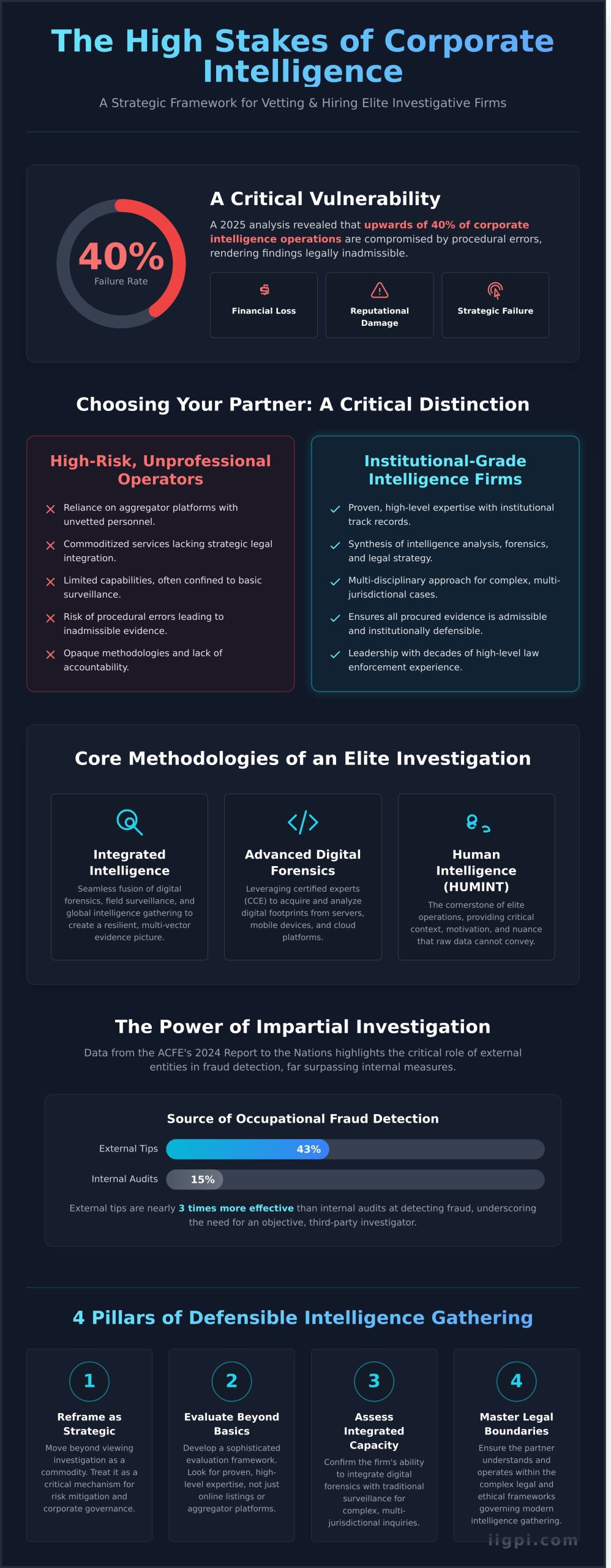
A 2025 analysis published in the Journal of Corporate Litigation revealed a critical vulnerability: upwards of 40 percent of corporate intelligence operations were fundamentally compromised by procedural errors, rendering their findings inadmissible in subsequent legal proceedings. For multinational corporations and state-level entities, the consequences of such investigative failures are monumental, extending far beyond immediate financial loss to inflict profound reputational and strategic damage on a global scale. This strategic framework is engineered to address this high-stakes challenge, providing a sophisticated, institution-level methodology for when you must hire a private investigator and ensuring the acquisition of legally sound, actionable intelligence while safeguarding absolute confidentiality across complex international jurisdictions.
Within this analysis, we will delineate a rigorous multi-stage vetting process, outline essential contractual and ethical safeguards, and detail the advanced methodologies that separate premier global intelligence partners from high-risk, unprofessional operators.
Key Takeaways
- Reframe private investigation as a strategic mechanism for risk mitigation by distinguishing between commodity services and institutional-grade firms.
- Develop a sophisticated evaluation framework that moves beyond aggregator platforms to identify investigative organizations with proven, high-level expertise.
- Before you hire a private investigator, learn to assess their capacity to integrate digital forensics with traditional surveillance for multi-jurisdictional inquiries.
- Master the legal and ethical boundaries governing modern intelligence gathering to ensure all procured evidence is admissible and institutionally defensible.
The Strategic Necessity of Professional Private Investigation
In the contemporary geopolitical and corporate environment, the engagement of a private investigator represents a formal mechanism for strategic risk mitigation and objective truth-seeking. The decision to hire a private investigator has evolved significantly from a reactive measure to a proactive governance imperative, essential for navigating complex legal and commercial challenges. A critical distinction exists between commoditized surveillance services and institutional-grade investigative firms. The latter provide a sophisticated synthesis of intelligence analysis, forensic accounting, and legal strategy, which is indispensable for high-stakes scenarios. As of 2026, these specialized entities operate within the critical lacuna between the constrained resources of public law enforcement, which focuses on criminal prosecution, and the evidentiary requirements of private litigation, which demands a lower burden of proof.
The efficacy of modern corporate and legal strategy is now inextricably linked to the acquisition of data-driven intelligence. In an era defined by transnational financial flows and digital disinformation campaigns, organizations require verifiable information to protect assets, ensure compliance, and secure competitive advantages. For instance, verifying the integrity of a supply chain partner in Southeast Asia or conducting pre-merger due diligence on a tech firm with opaque ownership structures are tasks that fall far outside the purview of internal teams and demand specialized external expertise.
Defining the Scope of Modern Intelligence Gathering
The practice of private investigation has transitioned from traditional physical surveillance to the analysis of comprehensive information ecosystems. While the foundational history of private investigation is rooted in direct observation, contemporary challenges demand proficiency in digital forensics, open-source intelligence (OSINT), and financial network mapping. Despite this technological evolution, human intelligence (HUMINT) remains the cornerstone of elite investigations, as it provides the context, motivation, and nuance that raw data alone cannot convey. A truly effective investigation therefore requires a multidisciplinary approach that integrates the precision of forensic science, the strategic framework of law, and the practical realities of field operations.
Why Corporate and Legal Entities Require Specialized Firms
Internal security and compliance departments, while vital, possess inherent limitations when confronted with complex, multi-jurisdictional fraud or corporate malfeasance. According to the Association of Certified Fraud Examiners’ 2024 Report to the Nations, external tips are responsible for detecting 43% of occupational fraud schemes, nearly three times the rate of internal audits. This data underscores the value of an impartial external entity. Engaging a third-party firm for independent investigative verification is a crucial step in mitigating corporate liability, as it provides an objective and defensible evidentiary record for litigation, regulatory inquiries, or internal remediation. In these circumstances, the choice to hire a private investigator is not merely operational; it is a fundamental component of responsible corporate governance. Institutional Intelligence is the synthesis of field experience and academic rigor, delivering verifiable insights for strategic decision-making.
Methodologies of Elite Investigative Firms
The decision to hire a private investigator for complex matters introduces a critical need for methodological sophistication. Elite investigative firms distinguish themselves not through a single capability, but through the seamless integration of disparate intelligence disciplines, a strategy fundamentally informed by decades of high-level law enforcement experience. Modern investigations are rarely confined to a single domain; they demand a synthesized approach where digital forensics, traditional field surveillance, and global intelligence gathering operate in concert. This fusion allows for the corroboration of evidence across multiple vectors, creating a resilient and comprehensive intelligence picture that can withstand legal and corporate scrutiny. The strategic direction for these multifaceted operations is often guided by principals with over 30 years of experience in federal and international law enforcement, ensuring every action is grounded in proven investigative doctrine.
Advanced Digital and Computer Forensics
In contemporary disputes, the critical evidence often resides within digital ecosystems. Our approach leverages specialized technicians, holding certifications such as the Certified Computer Examiner (CCE), to identify, acquire, and analyze digital footprints across servers, mobile devices, and cloud platforms. This capability is instrumental in tracing hidden digital assets, a domain where we have successfully followed and identified over $50 million in misappropriated cryptocurrency in 2023 alone by employing advanced blockchain analysis. Crucially, every piece of digital evidence is handled in strict accordance with international standards, such as ISO/IEC 27037, to preserve the chain of custody and ensure its admissibility in judicial proceedings.
Global Network and Agent Deployment
Sophisticated fraud and corporate malfeasance frequently cross international borders, rendering a single-jurisdiction approach ineffective. A premier investigative agency must operate a vetted global network of agents. These are not merely contacts; they are ‘boots on the ground’ assets providing indispensable local knowledge, cultural fluency, and access within their respective regions. To ensure consistent quality of intelligence, our network of over 50 specialist agents in 30 countries operates under standardized protocols for evidence handling, reporting, and secure communications. This ensures that all intelligence gathering adheres to a strict legal and ethical framework, regardless of the operational theater. In a notable 2022 case, this coordinated network was instrumental in resolving a $120 million bank fraud matter, deploying agents across four jurisdictions simultaneously to gather evidence that led to asset seizure and criminal indictments.
Ultimately, the protocols for asset tracing in complex financial cases and the deployment of global operatives are not isolated functions. They are components of a cohesive strategy, refined by decades of experience in countering organized crime and international fraud. When you hire a private investigator for a high-stakes issue, you are not simply acquiring a service; you are engaging a strategic capability built to navigate and resolve intricate challenges. To understand how these methodologies can be applied to your specific situation, our experts can provide a confidential assessment of your requirements.
Critical Criteria for Evaluating Investigative Organizations
The decision to hire a private investigator necessitates a due diligence process that extends substantially beyond cursory online reviews or cost-based comparisons. A sophisticated client understands that investigative services are not a commodity; they represent a strategic investment calculated to produce a specific, often legally significant, outcome. The central objection to engaging a premier firm, the perceived high cost, is fundamentally misaligned with the potential return on investment. In high-stakes litigation, corporate due diligence, or asset recovery, the procurement of admissible, dispositive evidence can alter the financial outcome by orders of magnitude, rendering the initial investigative fees negligible in comparison.
This evaluation must distinguish between two divergent models in the investigative sector. On one end exist aggregator platforms, which function as lead-generation clearinghouses for a wide spectrum of solo practitioners with varying levels of experience and ethical grounding. On the other are boutique, high-experience organizations whose value proposition is rooted in institutional credibility and a demonstrable history of resolving complex matters. Discerning the difference is the first critical step.
These principles of rigorous vetting extend beyond corporate intelligence. For instance, UHNW families apply similar scrutiny when hiring elite household staff, a domain where trust and professionalism are paramount. Premier recruitment agencies like Superstar Nannies specialize in this high-stakes placement, providing a model for due diligence that mirrors the best practices of top investigative firms.
Institutional Pedigree vs. Commodity Services
An organization’s capabilities are a direct reflection of its leadership and operational history. A firm led by individuals with decades of experience in federal law enforcement, intelligence agencies, or complex financial litigation brings a strategic framework and procedural discipline that is simply absent in a hobbyist or newly licensed investigator. This pedigree is evidenced by a portfolio of successful high-value case resolutions, such as seven-figure asset recoveries or the defense of intellectual property in international disputes. Within the highly regulated New York market, it is imperative to verify not only state-issued licensing but also the existence of substantial errors and omissions insurance, a key indicator of a firm’s stability and professionalism.
A critical analysis of a potential firm must also include an examination of its ethical framework. Reputable organizations operate within a strict legal and moral code, often aligning with the standards set forth by professional bodies such as the National Council of Investigation and Security Services. Any suggestion of ethical shortcuts or illegal methodologies is an immediate disqualifier. When you hire a private investigator, you are entrusting them with sensitive information and legal exposure; their ethical foundation is paramount. Identifying clear red flags is essential to protect your interests:
- Lack of a Physical Office: A reliance on post office boxes or virtual addresses often indicates a transient or undercapitalized operation.
- Vague Methodologies: A refusal to provide a clear, written proposal detailing the scope of work and investigative methods suggests a lack of a coherent strategy.
- Guaranteed Outcomes: No professional investigator can guarantee a specific result. Such promises are a hallmark of unethical and often fraudulent operators.
The Value of Transparent Reporting
The ultimate work product of any investigation is the final report. A professional investigative report is not a narrative; it is a structured, objective compilation of corroborated facts, verifiable evidence, and impartial analysis. It should contain detailed surveillance logs with time-stamped photographs or video, forensic data presented in an intelligible format, and a clear delineation between direct observation and professional inference. For legal counsel, this document is the foundation upon which a case strategy is built, providing the necessary evidence to compel a settlement, succeed on a motion, or prevail at trial. Understanding how these detailed reports are generated is central to evaluating the cost structure, a topic explored further in our A Cost Analysis of Private Investigator Services.
Navigating the Legal and Ethical Framework of Investigations
The efficacy of private intelligence operations is not measured solely by the information acquired, but by its legal and ethical pedigree. When you hire a private investigator, you are engaging a professional who must operate within a complex matrix of statutes, case law, and ethical mandates. A failure to navigate this framework renders intelligence useless and exposes the client to significant legal and reputational risk. In jurisdictions with stringent privacy protections, such as New York City, these boundaries are particularly pronounced. Adherence to these rules isn’t optional; it’s the fundamental principle that separates professional intelligence from illicit information brokering.
In New York, for example, surveillance and data collection activities are governed by a robust statutory framework. New York Penal Law Article 250 explicitly criminalizes illegal wiretapping and eavesdropping, with Section 250.05 making it a Class E felony to intentionally overhear or record conversations without the consent of at least one party. Furthermore, the New York Court of Appeals ruling in People v. Weaver (2009) established that attaching a GPS device to a vehicle without a warrant constitutes an unreasonable search. An operative who ignores these precedents doesn’t just commit a crime; they poison the entire investigative chain.
It’s crucial to dispel common misconceptions about an investigator’s authority. A private investigator cannot:
- Impersonate a law enforcement officer or use a badge that resembles one, a violation of N.Y. Penal Law § 190.25.
- Obtain protected information like bank records or phone records through pretext or deception, which contravenes federal laws like the Gramm-Leach-Bliley Act.
- Trespass on private property to conduct surveillance.
- Make arrests or conduct searches with any legal authority beyond that of a private citizen.
Admissibility of Evidence in Civil and Criminal Litigation
Evidence gathered by an investigator must pass a strict admissibility test to be of any value in legal proceedings. The investigator’s function often extends to that of a professional witness, where their credibility and methodology are scrutinized in court. If an operative utilizes illegal methods, such as unauthorized wiretapping, the “fruit of the poisonous tree” doctrine can invalidate not only that specific piece of evidence but all subsequent findings derived from it, potentially collapsing an entire case. Compliance with federal statutes like the Fair Credit Reporting Act (FCRA) is also mandatory for any background investigations used for employment or credit purposes.
Ethics in the Pursuit of Truth
The IIGPI’s position as a “G20 of Think Tanks” informs our approach to intelligence, which demands an uncompromising ethical posture. The pursuit of truth requires a sophisticated balance between aggressive intelligence gathering and absolute legal compliance. This principle is paramount in our international operations, where we serve as a critical bridge between the ‘Global North’ and ‘Global South.’ Ethical conduct ensures that cross-border investigations don’t become exercises in neocolonial data extraction but rather a respectful and lawful exchange of information. Understanding this from the outset is a key part of The Process of Hiring a Private Investigator.
Ultimately, the decision to hire a private investigator is a decision to seek truth through lawful means. The strategic value of any intelligence is directly tied to the integrity of its collection. Consult with our geopolitical and corporate intelligence experts to ensure your investigative needs are met with unimpeachable legality and ethical rigor.
Securing Institutional Intelligence with International Investigative Group
When legal disputes, corporate malfeasance, or complex personal matters escalate beyond conventional resolution, the decision to hire a private investigator becomes a strategic imperative. For entities requiring absolute discretion and definitive results, the selection culminates with a firm whose capabilities are proven and whose reach is global. International Investigative Group (IIGPI) represents the apex of private investigation, built upon a 30-year legacy of resolving over 10,000 cases for the world’s most discerning clients, from Fortune 500 corporations to international law firms.
Our operational headquarters in New York City serves as the nexus for a worldwide network of assets, enabling us to conduct intricate investigations across continents with localized precision. This unique structure provides clients with the direct oversight of a premier U.S. firm while leveraging deep-rooted intelligence capabilities in any required jurisdiction. We deliver clarity in the most opaque circumstances.
The IIGPI Advantage: Law Enforcement Roots, Global Reach
The firm’s uncompromising standards are a direct extension of its founder’s distinguished career in law enforcement. This background dictates the rigorous, evidence-based protocols that govern every operation, ensuring all intelligence is gathered ethically, legally, and is admissible in court. This discipline is fused with a comprehensive suite of in-house services that creates a powerful operational synergy. Our clients benefit from a single, trusted source for multifaceted security and investigative needs, including:
- Armed Guard & Executive Protection: Safeguarding personnel and assets during high-threat situations.
- Digital Forensics: Uncovering critical data from complex digital ecosystems to substantiate claims of fraud or intellectual property theft.
- Advanced Surveillance: Deploying sophisticated technology and highly trained operatives to monitor subjects and document activities discreetly.
This integrated capacity was instrumental in the successful recovery of over $120 million in a complex international fraud case, a benchmark that demonstrates our ability to dismantle sophisticated criminal enterprises and restore client assets.
Initiating Your Strategic Investigation
Engaging with IIGPI begins with a structured and confidential intake process designed to ascertain the full scope of the challenge. This initial phase includes a comprehensive feasibility study, where our senior investigators analyze the preliminary information, identify potential obstacles, and determine a viable path toward resolution. This critical step ensures that client resources are deployed with maximum efficiency and a clear probability of success. Following this assessment, we develop a customized investigative plan that aligns directly with your specific legal or corporate objectives. Every action, from initial surveillance to final reporting, is meticulously calibrated to achieve the strategic goals defined at the outset. When you are ready to hire a private investigator for a mission-critical matter, a bespoke strategy is the only acceptable approach.
For complex challenges that demand an elite level of expertise and a global operational footprint, the path forward is clear. Consult with our elite investigative team at International Investigative Group to begin the process of transforming uncertainty into actionable intelligence.
Executing a Definitive Investigative Mandate
The landscape of 2026 demands that institutional leaders view intelligence gathering not as a reactive tactic, but as a foundational component of strategic risk management. A successful engagement hinges upon a meticulous evaluation of an investigative firm’s operational methodologies and its unwavering adherence to complex legal frameworks. Therefore, the decision to hire a private investigator represents a critical investment in organizational security, demanding a partner with a history of unimpeachable results.
For entities requiring such definitive expertise, International Investigative Group (IIG) provides an unparalleled standard of excellence. With a legacy spanning over 30 years and a record of successfully resolving more than 10,000 cases globally, IIG’s operational command is composed of distinguished former law enforcement professionals. This unique composition of experience and global reach ensures every investigation is executed with precision and authority.
Your organization’s most critical challenges require the most sophisticated solutions. Secure Institutional Intelligence with International Investigative Group and fortify your strategic position for the future.
Frequently Asked Questions
What should I look for when I hire a private investigator for a corporate matter?
When corporations hire a private investigator for sensitive matters, the selection criteria must be rigorous, prioritizing specialized expertise and verifiable credentials. A suitable candidate should possess a minimum of 10 years of experience in corporate intelligence or financial malfeasance investigations, hold relevant certifications such as the Certified Fraud Examiner (CFE), and maintain at least $2 million in errors and omissions insurance. Verifying their state-issued license and ensuring a documented history of success is a non-negotiable prerequisite.
Is evidence gathered by a private investigator admissible in a New York court?
Evidence procured by a licensed private investigator is admissible in New York State courts, contingent upon its lawful acquisition. Admissibility is governed by Article 45 of the New York Civil Practice Law and Rules (CPLR), which requires that the chain of custody be maintained and that collection methods comply with all statutes. For instance, any evidence obtained in violation of federal wiretapping laws, such as 18 U.S. Code § 2511, would be deemed inadmissible by the court.
How much does it cost to hire a private investigator for an asset search in 2026?
Projections for 2026 indicate that the cost to hire a private investigator for a standard domestic asset search will range from approximately $750 to $2,000. This fee typically covers preliminary searches for real property and known bank accounts. However, comprehensive investigations targeting concealed assets, shell corporations, or offshore holdings necessitate a substantially larger budget, often exceeding $15,000, due to the complex multi-jurisdictional research and higher-level financial forensics required.
Can a private investigator help with international financial fraud recovery?
A private investigator with specialized expertise in global finance can be a critical asset in the complex process of international financial fraud recovery. These professionals leverage established networks in financial centers like Zurich and Singapore to trace illicit fund flows across borders. Their role involves forensic accounting to unravel complex transactions and collaboration with international legal counsel to initiate asset seizure proceedings under multilateral agreements, a critical first step before civil recovery actions can commence.
What is the difference between a private investigator and a detective agency?
The primary distinction lies in their legal and operational structure; a private investigator is an individual practitioner licensed by a state authority, while a detective agency is a corporate entity that employs one or more licensed investigators. In jurisdictions like New York, the agency itself must hold a corporate license under Article 7 of the General Business Law, in addition to the individual licenses held by its operatives. This structure provides a framework for larger-scale operations and diversified expertise.
How long does a typical surveillance operation take to produce results?
A typical surveillance operation requires a minimum of 20 to 40 investigative hours to produce meaningful results by establishing a subject’s routine patterns. A straightforward domestic case might yield the required evidence within this timeframe. Conversely, a complex corporate counter-surveillance case can easily demand over 100 hours of continuous monitoring, often deployed over several weeks to ensure a comprehensive and defensible intelligence product is delivered to the client.
What are the legal limits of a private investigator’s power in NYC?
A private investigator’s authority in New York City is strictly limited, as they possess no powers beyond those of an ordinary citizen. They are statutorily prohibited from making arrests, carrying a badge, or in any way impersonating law enforcement personnel. Their activities are constrained by all applicable laws, including those concerning trespass and privacy. For example, placing a GPS tracker on a vehicle without consent is illegal, a principle reinforced by the U.S. Supreme Court’s 2012 ruling in United States v. Jones.
How does computer forensics assist in modern private investigations?
Computer forensics provides an indispensable capability in modern investigations by enabling the systematic extraction and analysis of digital evidence. Certified forensic examiners utilize specialized software, such as EnCase or the Forensic Toolkit (FTK), to create a verifiable image of a digital device’s storage. This process allows for the recovery of intentionally deleted files, the analysis of metadata to establish timelines, and the tracing of digital communications, which can provide irrefutable evidence in litigation.